Correction, 24 September 2026. The fusion engine's trips in this post dropped the whole tank before the braking burn, so the brake ran on hydrogen held in no tank at all. With the shells that hold the braking hydrogen kept aboard, the engine as drawn still reaches Mars in 38 days at its closest, and takes 55 on an ordinary day rather than 54, 134 at its farthest rather than 133, and 307 days to Saturn rather than 304. How it turned up is in The Nearest Star, Flown.
For the last four days this blog has been pricing ways to cross between stars. The engine behind it has one rule that has never been broken: no function in it is allowed to say a drive works. It reports what is ruled out and what is still standing, and standing does not mean it works. It only means nothing has killed it yet.
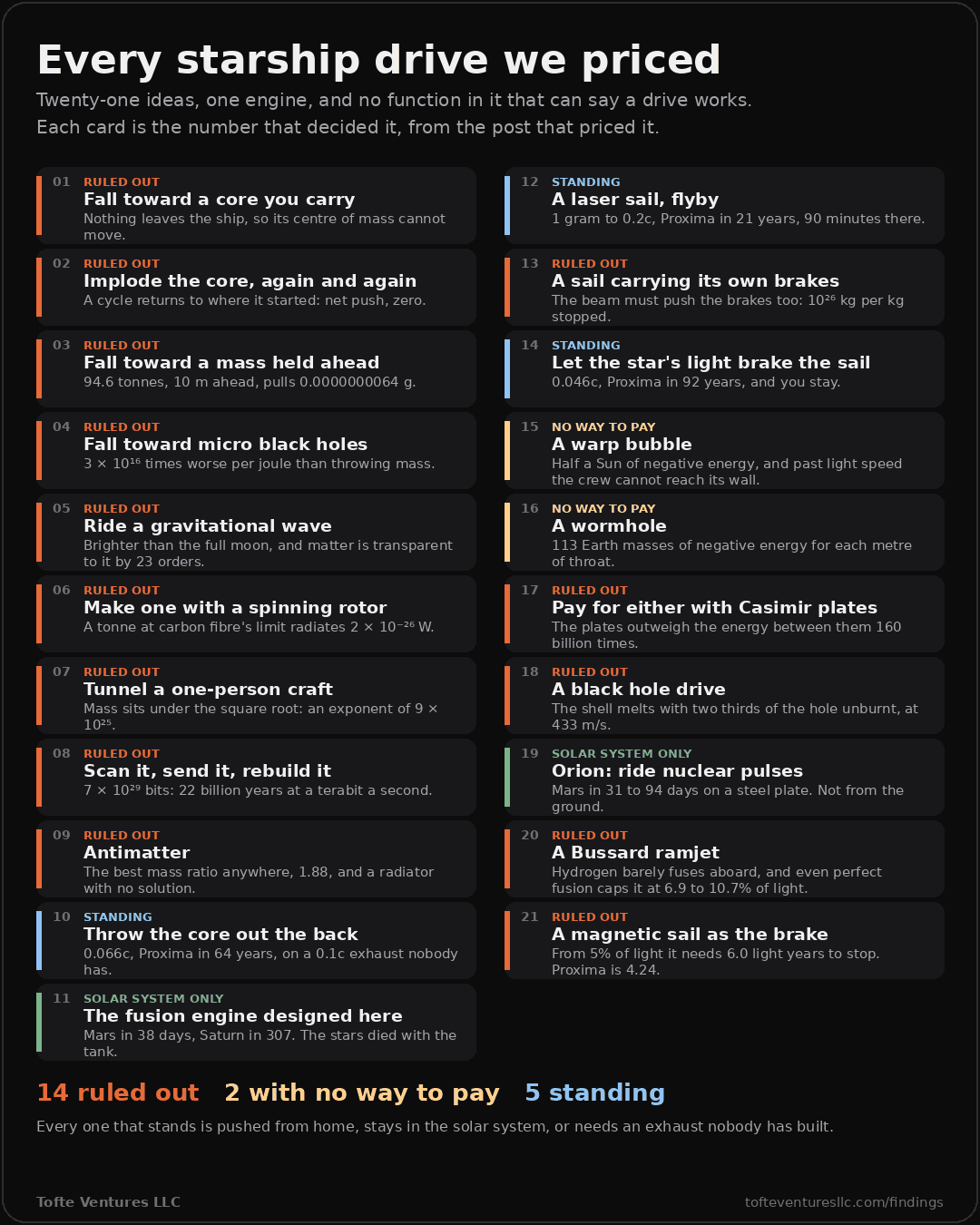
That makes twenty-one ideas across twelve posts, and nobody is going to read twelve posts to find out how it came out. So here is the whole thing on one board, with the number that decided each one and a link to the post that priced it.
Updated later the same day with a nineteenth card, Project Orion, and then with two more: Bussard's ramjet and the magnetic sail as a brake, both from The Scoop Is a Brake. The board below is the newest, and the counts in this post include all three. The fusion engine was also rebuilt with every add-on that looked like it filled a gap (Bolt Everything On). It stays one card, because none of the add-ons changed its verdict.
Nothing leaves the ship
The first idea was mine: carry something very dense, shift its gravity forward, and fall toward it forever. Falling is unfelt, so the crew would feel nothing at any acceleration. It died on the first check, before any interesting physics ran. Nothing leaves the ship, and a closed system cannot move its own centre of mass. Imploding the core over and over is a loop that returns to its start, so its net push is exactly zero. Holding the mass outside the ship works in principle and pulls with six billionths of a gravity. I Built the Check That Refused My Own Drive has all three.
Replacing the core with tiny black holes makes it worse. Measured by how much push a joule of energy buys, it is 3 x 10^16 times worse than simply throwing mass out the back (The Fuel Stays Home).
Not rockets at all
Four ideas skip the rocket entirely, and not one of them failed where I expected (Right for the Wrong Reason):
- Riding a gravitational wave. The first one ever detected was brighter than the full moon when it reached Earth. It fails because matter is transparent to it, by twenty-three orders of magnitude. The wave was plenty strong.
- Making one with a spinning rotor. A tonne spun as fast as carbon fibre survives radiates 2 x 10^-26 watts.
- Tunnelling a person across a gap, as particles do. Mass sits under the same square root as the barrier, and the exponent comes to 9 x 10^25.
- Scanning and rebuilding at the other end. Grant a perfect scanner for free. Sending the description still takes 22 billion years at a terabit a second.
Rockets
Antimatter has the best number anywhere on the board. Its mass ratio to reach a fifth of light speed is 1.88: less than half of what you launch is fuel. It dies at the 42.5 percent of its energy that nothing can aim. Shielding the crew from that and radiating the heat away makes the radiator 8,441 times the mass of the ship it cools. Every round of the calculation makes it worse, so there is no design to pay for at all (The Only One That Said Yes).
Throwing the core out the back stands, at 6.6 percent of light speed and Proxima Centauri in 64 years. It needs an exhaust at a tenth of light speed, and nobody has one. The best engine ever flown manages about a ten-thousandth.
The fusion engine designed here stands, for the solar system only. It is a compact proton-boron reactor with a valve that thickens its exhaust, and it is fast for a spacecraft (Burn Slow, Go Far). For the stars it died once its hydrogen tank was given a weight: a version a hundred times more powerful reached Proxima only with a tank that weighed nothing (A Second Opinion, and It Lied Too). Its heaviest part is a 689 tonne nozzle that nobody can draw, because its mass comes from a number nobody has measured. Rebuilt with an engine array, launchers, sails, a scoop and a magnetic brake, it still stops a fifth of a light year out in a century: the stars need 641 times its power per kilogram, and no add-on adds a watt (Bolt Everything On).
Orion stands for the solar system too. Small nuclear explosions against a steel plate get a thousand-tonne ship to Mars in 31 to 94 days on 1950s numbers. It is the one card whose limit in the solar system is law and fallout rather than physics: launching from the ground takes up to 205 Hiroshimas of fission (The Bomb Is the Nozzle).
Pushed from home
A laser sail stands, and it is the cheapest thing on the board that does. One gram to a fifth of light speed takes about $140,000 of electricity and reaches Proxima in 21 years. It gets ninety minutes there, then keeps going forever. Carrying brakes kills it, because the beam then has to push the brakes too: at an exhaust any real engine could manage, that is 10^26 kilograms launched for every kilogram stopped. Letting the destination star's light do the braking stands, at 4.6 percent of light speed and 92 years. Then you stay. All three are in The Fuel Stays Home.
A scoop and a magnet
Bussard's ramjet is ruled out on the first step of its fusion. It scoops hydrogen between the stars and burns it, but ordinary hydrogen fuses through the weak force, and in ten seconds aboard 3 x 10^-16 of it burns at best. Grant perfect fusion and the scoop's own drag still caps it at 6.9 to 10.7 percent of light (The Scoop Is a Brake).
Its magnet is more useful as a brake. A magnetic sail slows a ship on the thin gas between the stars without spending propellant, but from 5 percent of light it needs 6.0 light years to stop, at the best end of every range. Proxima is 4.24 away. It stands only on a superconductor 1.7 to 16 times better than the best figure used.
Bending spacetime
A warp bubble a hundred metres across wants half a solar mass of negative energy. Above light speed there is a second problem the bill cannot fix: the crew cannot send a signal to the front of their own bubble, so they cannot steer it, slow it or switch it off (You Cannot Steer It From Inside). A wormhole wants 113 Earth masses of negative energy for every metre of throat radius.
Neither is ruled out on arithmetic, because whether that much negative energy can exist is not something the arithmetic can settle. So the board calls them no way to pay. Then I tried to pay. Casimir plates hold the only negative energy anybody has measured, and the plates themselves always outweigh it: 160 billion times over at a nanometre (Casimir Plates and a Black Hole Engine).
A black hole
A small black hole turns all of its mass into radiation, which no other process in physics does. Nothing can reflect what comes out, so it has to be caught in a shell and re-radiated. The shell melts as the hole heats, with two thirds of the hole unburnt, and the ship has 433 metres a second. It cannot be held by charge either, so the ship has to tow it with its own gravity (The Black Hole Drive, Taken Apart).
What the board caught
Laying every drive out in one place meant checking every number against the engine again, and one of them was wrong.
Burn Slow, Go Far said the fusion engine reaches Mars in ten days at its closest. Later that same post admitted the engine needed a nozzle with real mass, and it ended with "Mars is still a fortnight away." It is not. The ten days was the bare engine, with a nozzle and a tank that weighed nothing. The engine's own test already said so, and I never reran the trips before writing that sentence. With both charged, Mars is 38 days away at its closest and 55 on an ordinary day, and Saturn is 307. That post now carries a correction. (These read 54 and 304 until a second slip turned up: the braking burn had been running on hydrogen held in no tank.)
Thirty-eight days is still several times faster than a chemical rocket. It is simply not a fortnight, and a summary board is how that turned up. It is the same shape as the rest of this archive: a number that looked finished and had not been asked again.
What the five that stand have in common
Every drive that stands is small, pushed from home, confined to the solar system, or waiting on an exhaust nobody has built. The two sails carry a gram. The fusion engine and Orion are solar system drives. Throwing the core needs a tenth of light speed out the back.
What killed the other sixteen was never mainly the energy. It was what you have to carry, what you cannot aim, and what refuses to couple: the tank, the nozzle, the shell, the radiator, the gamma rays, the wave that passes straight through. Every one of those lived in a part of the design nobody was looking at. The ones that survived are the ones where something left the ship, or never got on.