Robert Bussard proposed it in 1960, and it is the most beautiful idea on the scorecard. A ship never carries its fuel. It sweeps up the thin hydrogen between the stars with a magnetic field hundreds of kilometres wide, fuses it, and throws it out the back. The faster it goes, the more it collects. There is no tank to run dry and no mass ratio to pay.
I priced it on the same engine as every other drive here. That engine is built so it cannot say a drive works. It can only rule things out, and it only does that when both ends of every uncertain number agree. The ramjet has three questions in it, and each has its own answer.
Burning it
Ordinary hydrogen does not fuse easily. The first step turns a proton into a neutron, which goes through the weak nuclear force, and it is so slow that an average proton in the Sun's core waits billions of years for it. The Sun works because it has an enormous number of protons and all the time in the world. I took one to ten billion years as the range. That is the figure everyone quotes, from memory, and the engine marks it unverified.
A ship does not have that much time. Even if the gas stays aboard for ten generous seconds, 3 x 10^-17 to 3 x 10^-16 of it fuses. That adds 0.2 to 0.6 metres a second to the exhaust. So the ramjet as drawn is ruled out on the first step of the fusion, before the engineering starts.
Designs that burn the gas through a faster reaction have been proposed. The engine does not price them, so this post does not claim anything about them either way.
Perfect fusion hits a wall
So give the ramjet what nothing known can do: every atom it scoops fuses completely, all 0.71 percent of the mass turned into exhaust energy. That is where the second problem shows up. It is the one I did not expect to be so clean.
The gas is sitting still and the ship is moving through it. Every kilogram collected has to be brought up to the ship's speed before it can be thrown out the back, and that costs exactly the momentum it pushes with. On top of that, the field pulls on the gas it deflects. I carried that extra drag as a range, from 0.5 to 1 times the momentum flowing through the scoop, not derived.
The fusion boost is fixed, and the cost of collecting rises with speed. So there is a speed where they cancel: the exhaust leaves only (1 + k) times faster than the gas came in, with k the extra drag. That gives a closed form, v = c sqrt(2 epsilon / ((1 + k)^2 - 1)), and the engine checks it against a bisection on the thrust itself. The two agree to twelve digits.
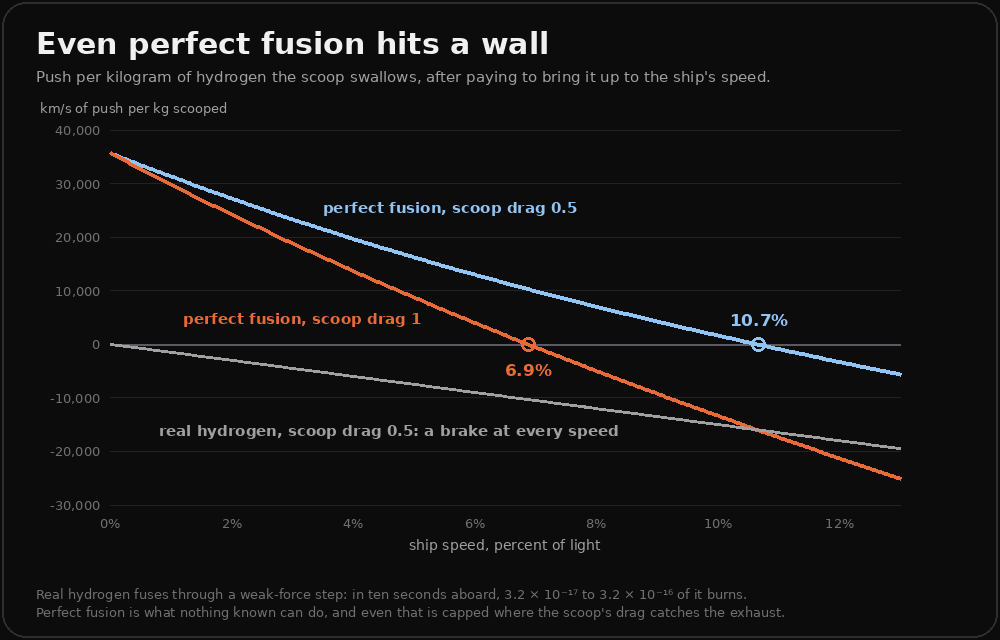
Even perfect fusion caps the ramjet at 6.9 to 10.7 percent of light. Past that the scoop is a brake. With real hydrogen it is a brake at every speed, because the burn adds under a metre a second and the drag does not wait.
Refuelling instead
Could a scoop at least top up an ordinary fusion engine's hydrogen tank? The one designed here carries 800 tonnes and burns it through a valve at 33 kilograms a second.
The interstellar gas has 0.05 to 0.3 hydrogen atoms per cubic centimetre, which is another range from memory. A scoop a thousand kilometres across at 100 kilometres a second collects 2.3 to 13.6 kilograms a day. That is 161 to 965 years to fill a tank the valve empties in 6.7 hours. The engine counts it twice, once as mass flow and once as atoms through the opening times the mass of a proton, and the two agree.
Heating the scooped gas instead of burning it, with the fusion engine's own 1.38 gigawatts, has its own break-even. Above 835 to 2,032 kilometres a second, the scoop's drag beats the push. That is under one percent of light, so it is ruled out too.
The magnet is a better brake
This is where it gets interesting. A ramjet asks its magnet to do two hard things: collect the gas, and survive the drag of collecting it. Drop the first and keep the second, and the drag is the product. A superconducting loop whose field pushes on the thin plasma it flies through slows a ship down without spending any propellant. That is a magnetic sail, and Zubrin and Andrews worked it out around 1990. It is the braking half of the ramjet.
The physics is pressure balance. The field holds the plasma off wherever its magnetic pressure beats the flow's, which sets the size of a bubble around the ship. Far from the loop the field is a dipole's, so the bubble's radius has a closed form, and the engine checks it against the actual loop's field computed from the wire. Push the flow's momentum through that bubble and two scalings fall out without being put in. The force goes as speed to the four thirds, and in the solar wind it falls with distance from the Sun as the minus four thirds, not the minus two. The tests check both.
Two more numbers fall out of that. The brake's distance and time have closed forms, which the engine checks against an integration that shares nothing with them. It also finds that the coil that stops a ship soonest weighs twice the rest of the ship, from minimising the ship's mass over the bubble's area. A scan over coil masses finds 2.00.
Then the part that decides it: the superconductor. A loop's field depends on how much current its wire carries per square metre. I carried that as a range from 5 x 10^8 amps per square metre, roughly today's high-temperature tape, to 10^10, an optimistic cold figure. Only the ionised part of the gas feels the field, 0.03 to 0.1 per cubic centimetre, and the drag coefficient is a range too.
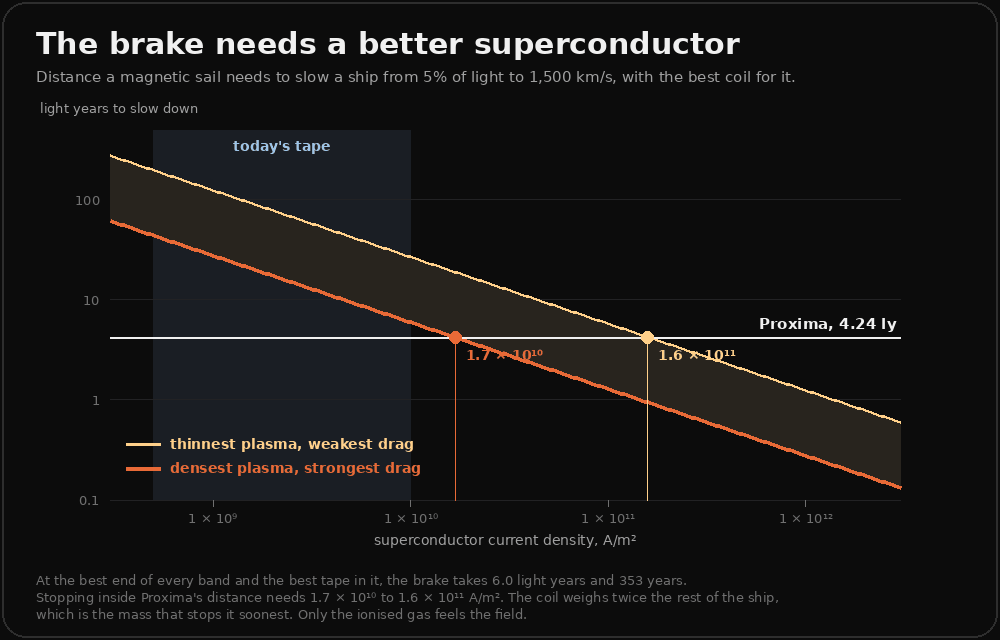
From 5 percent of light, at the best end of every range and the best tape in it, the brake needs 6.0 light years and 353 years. Proxima is 4.24 light years away. At the worst end it needs 197 light years. To stop inside Proxima's distance takes 1.7 x 10^10 to 1.6 x 10^11 amps per square metre, which is 1.7 to 16 times the optimistic end of the range. At 10^11, the figure the early magsail papers assumed, the stop takes 1.29 light years and 76 years.
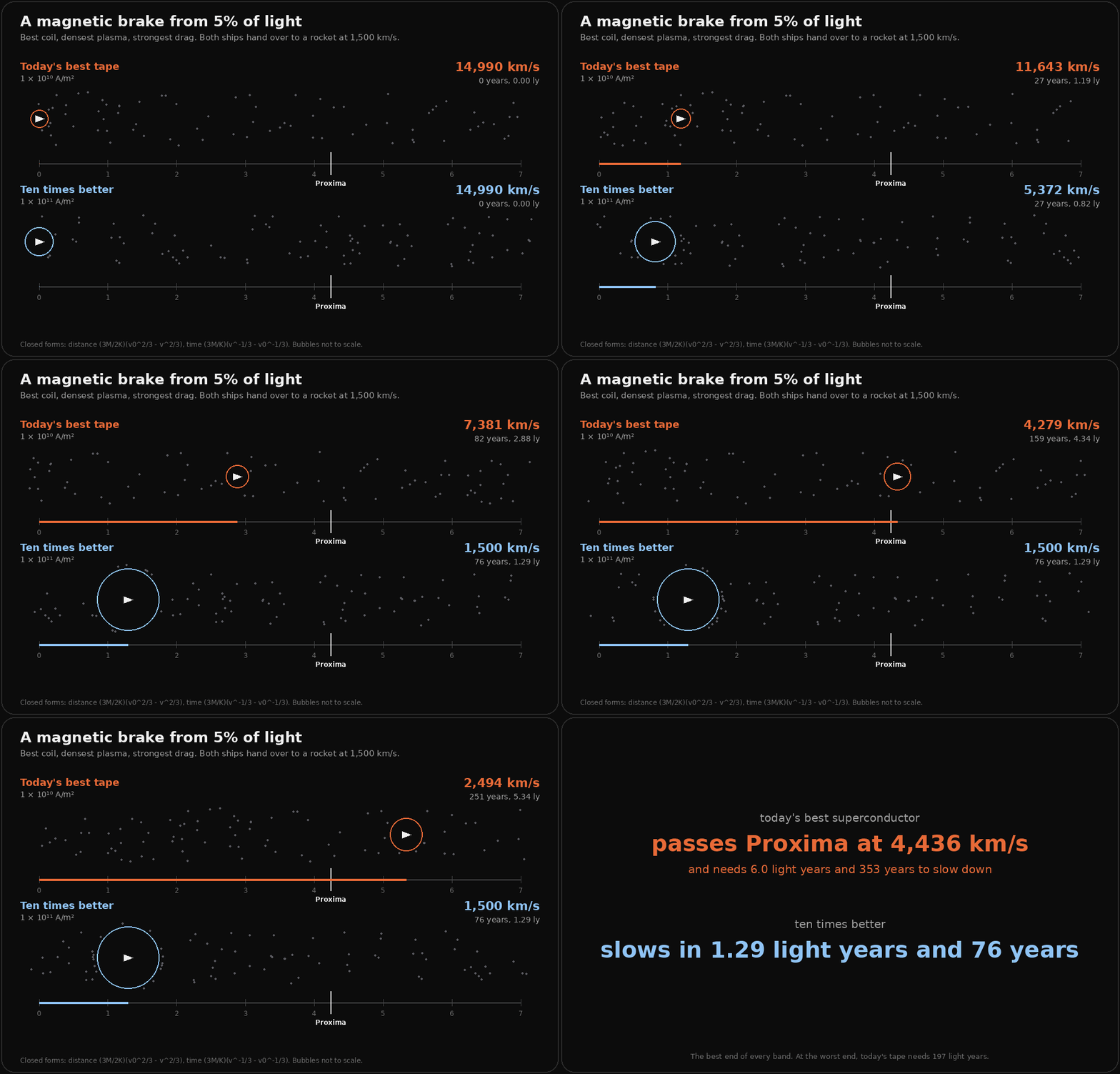
So the brake is not ruled out by physics. It is ruled out at Proxima by the wire, and it stands on a wire 1.7 to 16 times better than the best in my range. The engine also names what it does not price: the hoop stress in a loop a hundred kilometres across, keeping it cold for decades, deploying it, keeping it stable in the flow, and the neutral gas it ploughs through untouched.
In the solar wind the same kind of coil is a sail, not a brake. A thousand tonnes of it, at the top of the wire range and in an ordinary solar wind, feels about 1,100 newtons near Earth. What that is worth to a real ship is in the next post.
The verdict
- Ruled out: burning what it scoops. 3 x 10^-17 to 3 x 10^-16 of it fuses in ten seconds.
- Ruled out: refuelling a tank from the scoop. 161 to 965 years per tank.
- Ruled out: heating the scooped gas in flow. The drag wins above 835 to 2,032 km/s.
- Standing, on a fusion nobody has: perfect burning. Capped at 6.9 to 10.7 percent of light by the scoop's own drag.
- Ruled out at Proxima with today's wire: the magnetic brake. 6.0 light years at best, and it stands on a superconductor 1.7 to 16 times better.
The ramjet joins a pattern on this blog: the massless nozzle and the massless tank. The beautiful version leaves out a term. Here the missing term is the cost of the gas you collect, and putting it back turns the engine into a brake. The brake is the useful half.