Everything I had computed about a warp bubble was a price. Half a solar mass of negative energy for a hundred metre bubble, a wall that would have to be twenty three orders of magnitude thicker than the bubble to bring the bill down to the ship's own mass, a quantum bound that pushes it the other way to more than the mass of the observable universe. All of it the same shape: this costs too much. And every objection of that shape is, in principle, answerable by somebody finding a cheaper geometry.
Yesterday I built a geodesic integrator, mostly so I could check the model against itself by a second route. It let me ask a question the model had never been able to ask, and the answer is not about money.
The question
The metric carries a shape function. Call it f. It is 1 inside the bubble, 0 outside, and it falls through the wall in between. Everything the geometry does follows from that one function.
Now send a photon forward from the ship, along the direction of travel. In these coordinates it moves at v f + 1, where v is how fast the bubble is going. The bubble itself moves at v. So relative to the bubble, the photon gains ground at
v f + 1 minus v
and the interesting question is whether that is ever zero. Set it to zero and you get
f = 1 minus 1/v
Below light speed, v is less than 1, so the right hand side is negative and f is never negative. No solution. Above light speed the right hand side is between 0 and 1, and f runs across exactly that range on its way through the wall, so there is always a solution, at every speed above c, with no exceptions and no threshold.
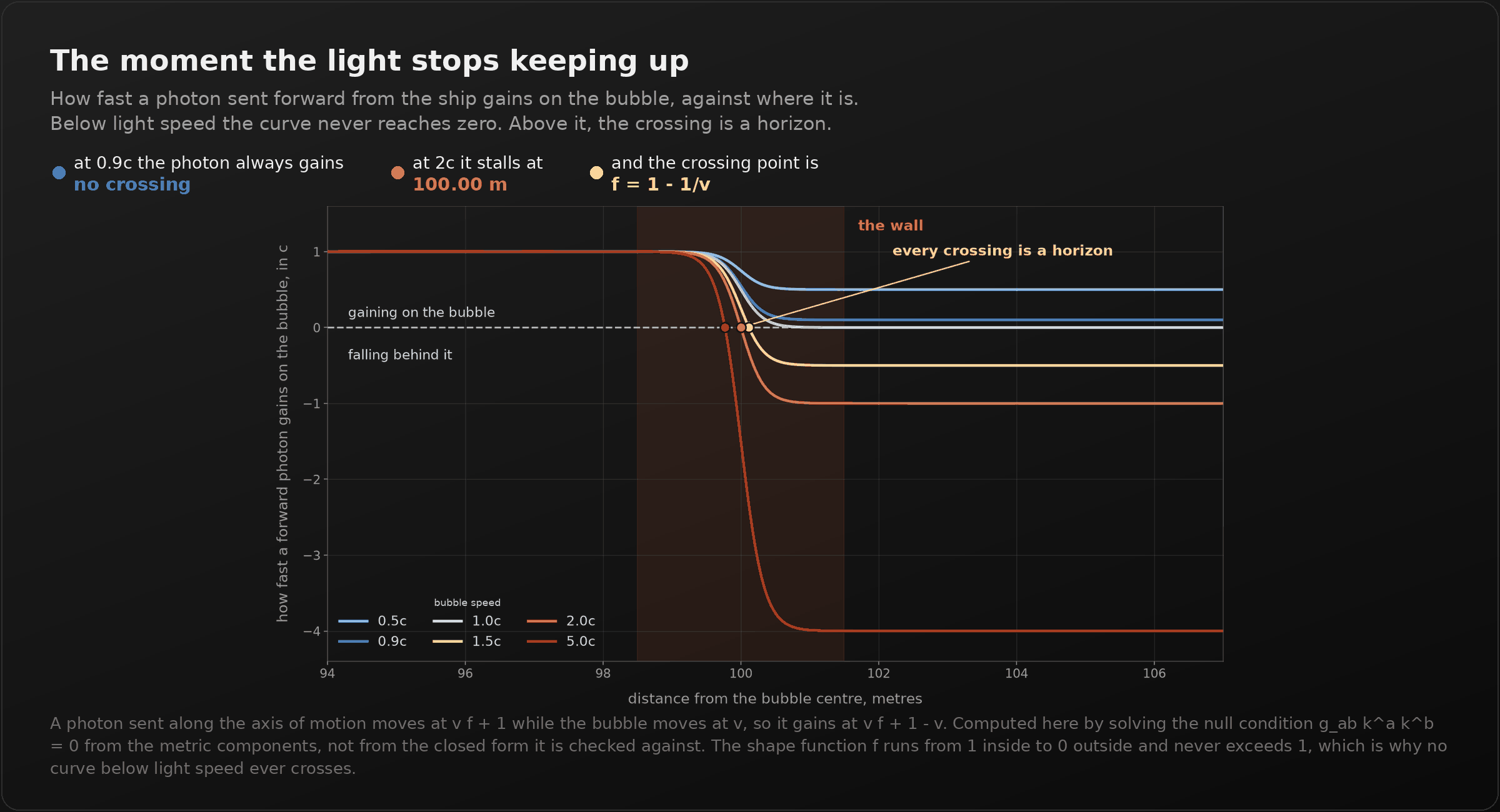
Read the curves from the left. Inside the bubble every photon gains at exactly the speed of light, because inside the bubble space is flat and nothing strange is happening. Then they reach the wall. The subluminal curves flatten out above zero and stay there. The superluminal ones cross. The crossing is a surface the photon cannot get past, which is to say it is a horizon, made by the ship's own geometry, a few metres in front of the ship.
The same thing, flown instead of solved
Solving an equation for where something stops is one route. Integrating the trajectory and watching where it goes is a different one, and I have made enough mistakes this month to want both.
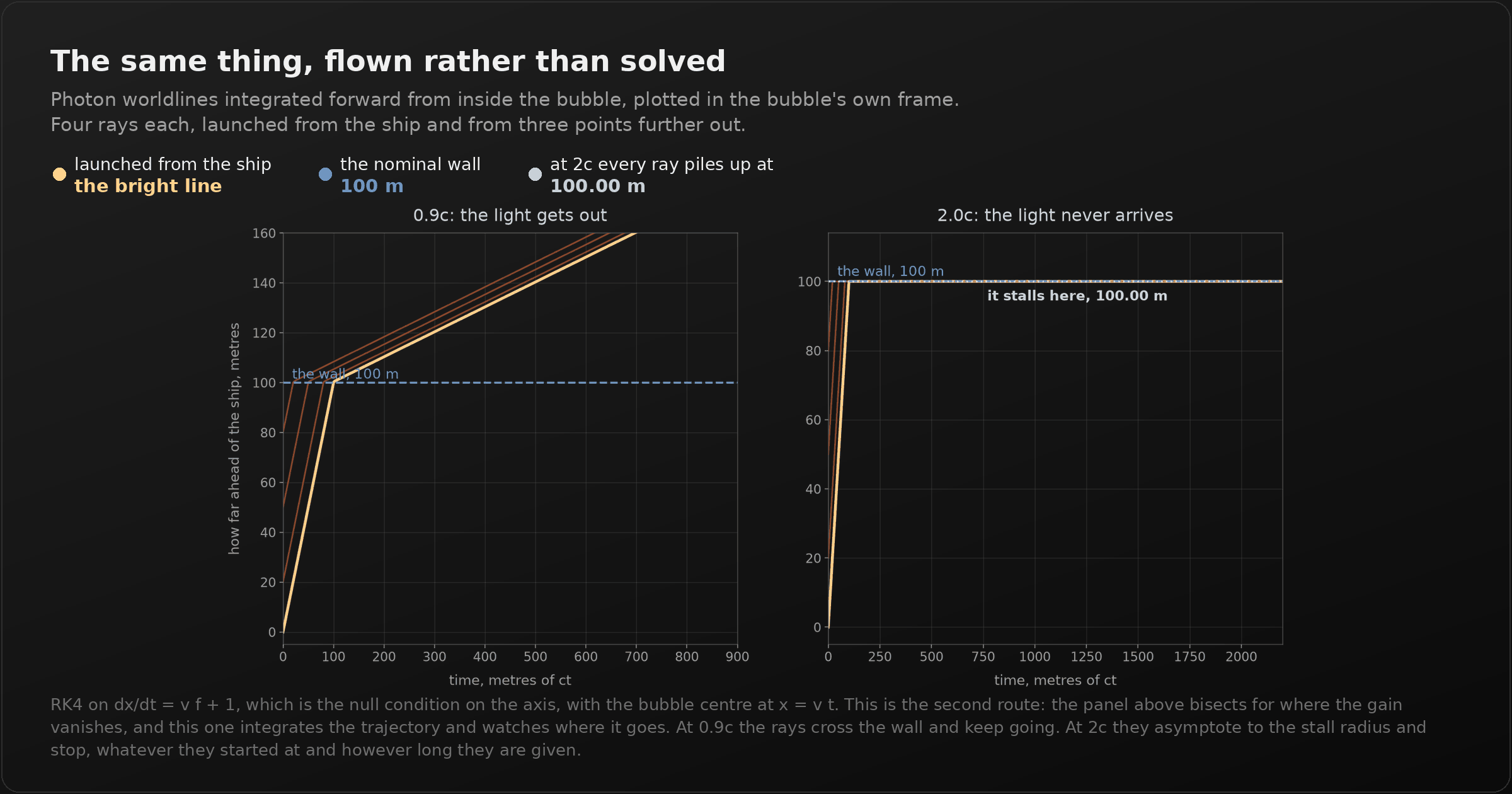
Same geometry, different operation: fourth order Runge-Kutta on the photon's own equation of motion, with the bubble sliding forward underneath it. At 0.9c the rays cross the wall and carry on. At 2c they climb, reach the stall radius, and then run flat for as long as you care to integrate. It does not matter where the ray started or how much time it is given. The two routes agree to four decimal places on where it stops.
What that costs the crew
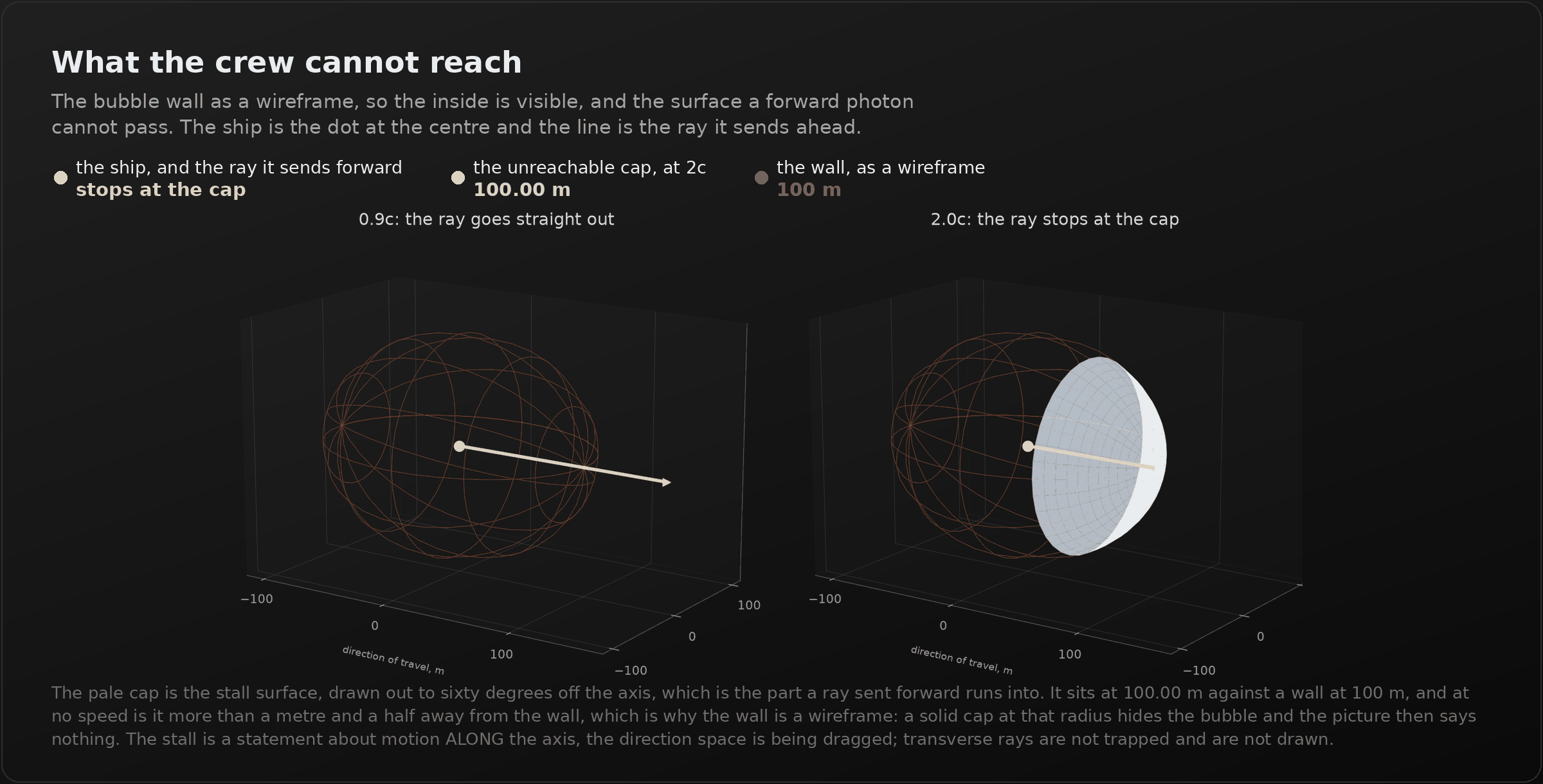
The pale cap is the part of the bubble the ship cannot signal. Not "cannot signal quickly": cannot signal, at all, ever, with anything.
Work through what that means for the machine. The wall is the part of the geometry that does the work, and it is the part that has to be built, held in shape, and taken down again at the far end. The crew is on the wrong side of a horizon from it. They cannot adjust it, because an adjustment is a signal. They cannot throttle back, because the throttle is a signal. They cannot stop, because stopping is a signal. They cannot even look at it, because looking means light coming back from it, and light cannot get there in the first place.
So the wall ahead has to be put in place by something that is not aboard, and put there in advance, along the entire route. That is not a spacecraft. That is a railway somebody else already built, and the hard part was never the train.
It arrives the instant you cross
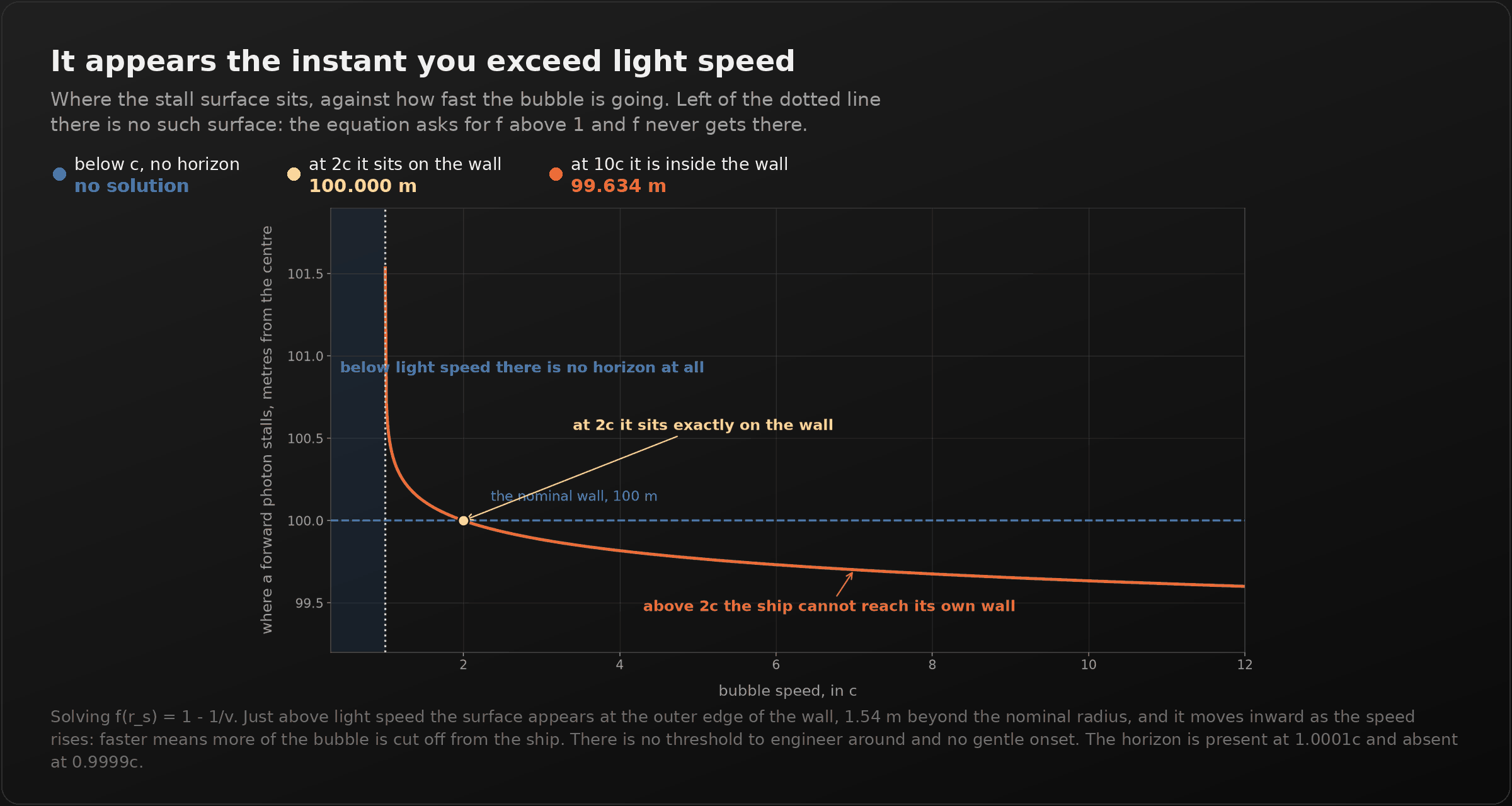
There is no gentle onset to engineer around. At 0.9999c there is no horizon and at 1.0001c there is one, sitting a metre and a half beyond the wall. And it gets worse with speed, not better. The surface moves inward as the bubble goes faster, so more of the geometry falls behind it. At exactly 2c it sits precisely on the nominal wall, which is a pleasant accident of the tanh profile: the shape function is one half there. Above 2c the ship cannot reach its own wall at all.
Why this one is different
I want to be careful about what is mine here and what is not. The result is not mine. Allen Everett published it in 1996, and Everett and Roman followed it up, and it has been in the literature ever since as one of the standing problems with superluminal warp. I did not discover anything.
What is new to me is that my own model now computes it instead of citing it. Those are different things, and the difference is the whole reason for building the model. A citation is something I can repeat. A computation is something that can surprise me, disagree with me, and be checked by somebody who does not trust me.
And it is a different kind of objection from everything else in that file. The energy bill is a quantity. Quantities can be attacked: find a cleverer wall, a smaller bubble, a different metric, and the number moves. Several published proposals do exactly that and my module lists them without scoring them. This one is not a quantity. It is a causal structure, and it does not care what the wall costs. Make the negative energy free tomorrow and the crew still cannot talk to the front of their own bubble.
One honest limit: all of this is about exceeding light speed. Below c the same arithmetic gives no horizon at all, and a subluminal warp shell is untouched by any of it. It is also specifically the Alcubierre metric, which is the one I have. A different geometry is a different calculation, not a corollary.
The part that belongs to this blog
Here is what actually happened when I first ran the search.
At 2c it reported no horizon. Cleanly, confidently, with a well formed number.
The reason is worth the price of the whole exercise. To find the photon's speed you solve a quadratic, and a quadratic has two roots. Normally one of them is going backwards in time and picks itself out, so the code took the larger root and had always been right. Inside a bubble moving faster than light, both roots go forward in time. Space is being dragged past faster than light can swim against it, so a photon aimed backwards is still carried forwards. The rule "take the larger one" quietly selected the backward photon, and then correctly reported that the backward photon never stalls, which is true and is the answer to a question nobody asked.
That is the fourth one this month, after a tank that weighed nothing and a grid that agreed with itself and a one gravity figure that needed a massless nozzle. A system returned a well formed answer that happened to be false, and the thing that caught it was not a test of the same code.
But the bigger one is the first sentence of this post. The model had been pricing this geometry for weeks, correctly, and had never once suggested there was a problem of this kind, because it could only do algebra at a point. It could tell me what the bubble cost. It had no way to tell me that nobody aboard could reach it. The question was not hard, and it was not close to being asked, and there was nothing in the output to indicate that anything was missing.
A model answers the questions you built it to answer. It will not tell you that you built the wrong ones.