I wanted a nice picture of the ship. That is the entire origin of this post, and I want to be straight about it: nothing here started as an investigation. Post after post of arithmetic has gone out with a bar chart on it, and a bar chart is not what makes somebody stop scrolling.
So I sat down to render the fusion craft the drive run has been sizing for weeks. And a render, unlike a chart, needs a shape for everything in it. You cannot draw a mass. You have to draw a thing of some size, in some place, and the moment I started asking the code for sizes it became obvious that I had been carrying one part around for a month without ever asking what it looked like.
What the code actually knows
The ship is defined by a spec: a fuel, a burn rate, an opening, a valve setting, a tank. Everything else is computed. So I went through it part by part and asked what dimension each one has and where that dimension comes from.
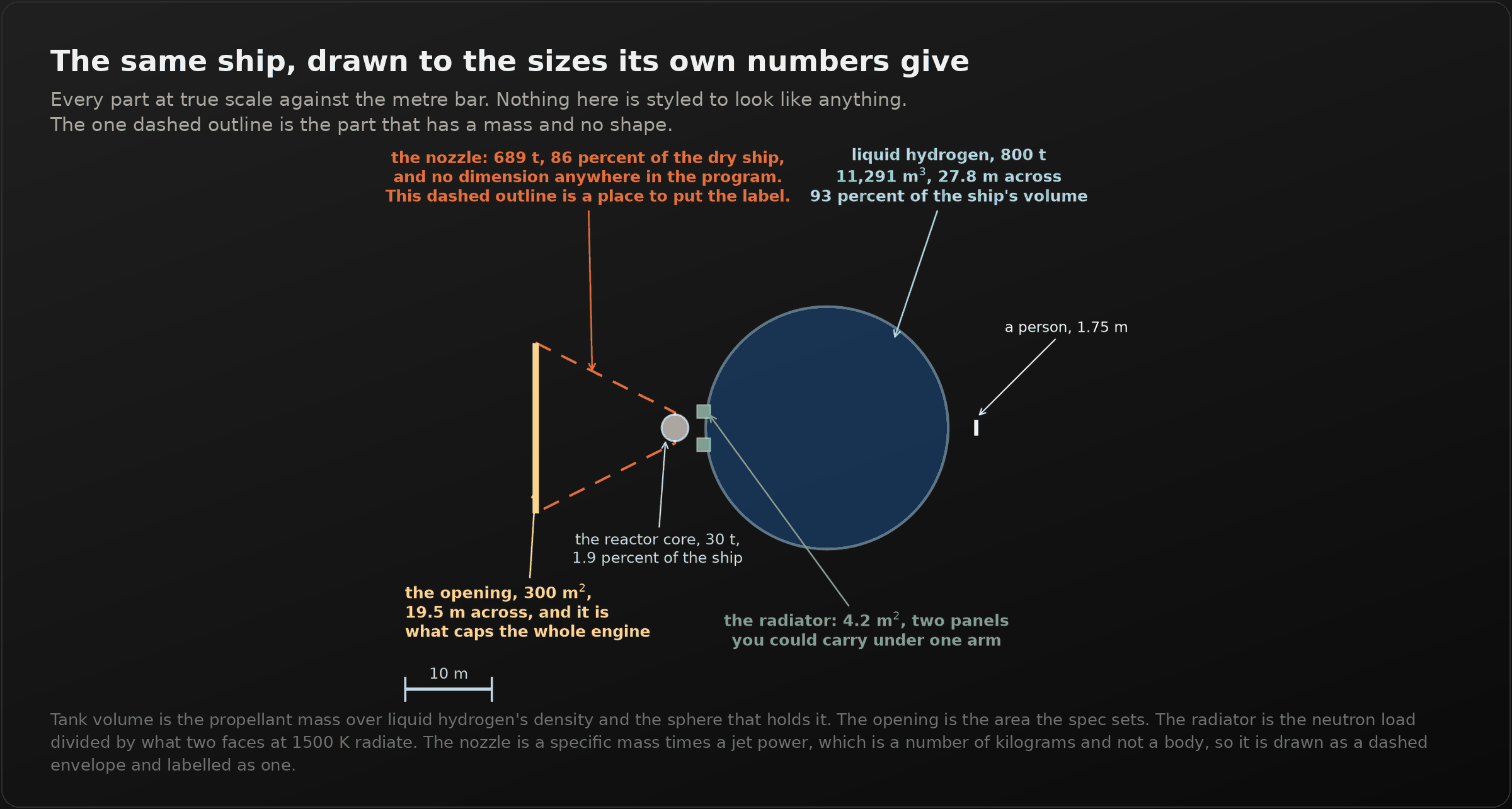
The tank is the ship. 800 tonnes of liquid hydrogen at 71 kilograms per cubic metre is 11,291 cubic metres, which is a sphere 27.8 metres across. Run the volume for every part and the propellant is 93 percent of it. Whatever else this vehicle is, it is a fuel tank with an engine bolted to the back.
The opening is 19.5 metres across, because the spec asks for 300 square metres and a circle of that area has that diameter. This is the part that binds the whole engine: the reactor makes 2,188 megawatts of steerable power and a tungsten opening at 3,000 K can only pass 1,378 of them.
The sails are exactly the opening. Twenty of them at 15 square metres each is 300 square metres, which is the opening's area to the last digit. I had not noticed that before drawing it. It also means they cannot fit inside the circle, because no set of squares tiles a disc with nothing left over, and in the render their corners hang over the rim for that reason rather than because I drew them badly.
The radiator is four and a quarter square metres. Two panels a metre and a half a side. You could carry them under one arm.
That last one stopped me. Every fusion ship anybody has ever drawn has enormous glowing radiator wings, and they are usually the most striking thing in the picture. This one has a card table, and the reason is in the spec: proton-boron is aneutronic, only a tenth of a percent of the burn leaves as neutrons, and a tenth of a percent of 2,188 megawatts is 2.2 megawatts, which two faces at 1,500 K shed in four square metres. The wings are real on a deuterium-tritium ship. On this one they are a habit.
And then there is the nozzle
689 tonnes. Eighty-six percent of the dry ship. Twenty-three times the reactor core it is attached to. It is by a long way the heaviest single thing aboard, and there is no dimension for it anywhere in the program.
It is priced the way power systems are always priced, by a specific mass: so many kilograms per kilowatt of jet power, times the jet power. That is a perfectly respectable way to size a subsystem you have not designed. It gives you kilograms. It does not give you a body, and a render needs a body.
So in all three figures the nozzle is an open dashed outline with nothing inside it, and the caption says what it is. I could have drawn a bell, or a magnetic throat with coils on it, and it would have looked more finished and been a lie: not a small one either, because the reader would then be looking at a picture in which the largest object was the one thing nobody computed.
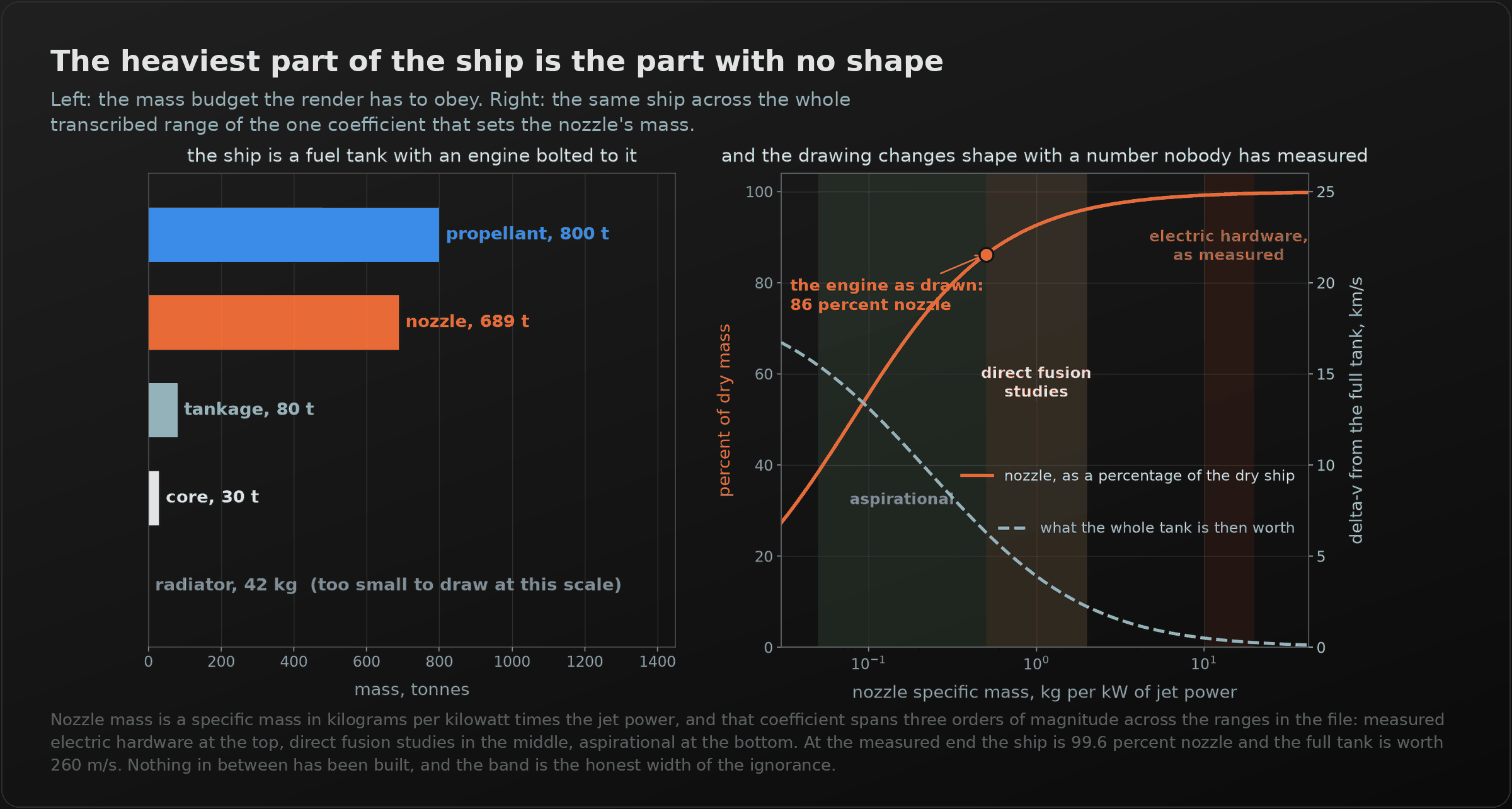
The right panel is the part that matters. That specific mass is a transcribed number, unverified, and the ranges in the file span three orders of magnitude: 10 to 20 kilograms per kilowatt for electric propulsion hardware anybody has actually flown, 0.5 to 2 from direct fusion studies, 0.05 to 0.5 for what people hope. The ship is drawn at 0.5, the friendliest end of the study range.
Slide along that axis and the vehicle stops being the same vehicle. At the aspirational end the nozzle is 69 tonnes, the dry ship is 179, and the full tank is worth 15.5 km/s. At the measured end it is 27,558 tonnes, the ship is 99.6 percent nozzle, and the same tank buys 260 metres per second, which is less than a bus does on a motorway. Nothing has been built anywhere in that range, and the band is the honest width of what nobody knows.
The correction I nearly published instead
Here is where this stopped being a drawing exercise.
There is a second module in the program that prices a magnetic nozzle: it takes the jet power and the exhaust speed, works out the pressure the plasma exerts on the throat, the magnetic pressure needed to contain it, the field that makes that pressure, and the hoop stress that field puts on the coil. For this engine those numbers are trivially comfortable. Three hundred kilonewtons spread over a ten metre throat is a hundredth of an atmosphere. A field of 0.07 tesla holds it, which is a fortieth of a hospital scanner. The coil wall that survives that field is 0.03 millimetres, thinner than a sheet of paper, and a ring of it at that radius weighs under half a gram.
Half a gram, against 689 tonnes.
I had the sentence half written. It has everything: a satisfying reversal, a second route catching the first one out, the biggest number in the file deflated by the smallest. It is also completely wrong, and it is wrong in exactly the way this blog keeps writing about.
The two numbers are not two routes to one quantity. They are two different questions that share a word. The specific mass covers a whole subsystem: the superconductor, the stabiliser, the cryoplant and its power, the current leads, the conditioning, the radiation shielding between the plasma and the magnet, and the structure that carries all of it and reacts the thrust into the ship. The hoop calculation covers one thing, the steel that keeps a coil from tearing itself apart under its own field, and it was never pretending to cover more. Putting them side by side and calling the gap a finding would have been a well formed answer to a question nobody asked.
So the module now carries a named constant saying what it computes and listing what it does not, the note travels with every answer the function returns, and there is a test asserting the scope is attached and that no sentence in the output ever turns an easy coil into a light nozzle. That is the same treatment the detachment problem already gets in the same file, and for the same reason: a limit that lives only in a comment gets quoted anyway.
The detachment problem is worth repeating here, because it sits underneath all of this. Every coil's field lines close. A plasma frozen to them gets turned around and brought back, so a nozzle that only guides the exhaust outward has not thrown anything. How a real exhaust breaks free is not settled. It is not an efficiency you can fold in as a factor either: if detachment fails the thrust is not reduced, it is absent. Every thrust figure in this run inherits that assumption, including the pretty one below.
The render, and the one decision inside it
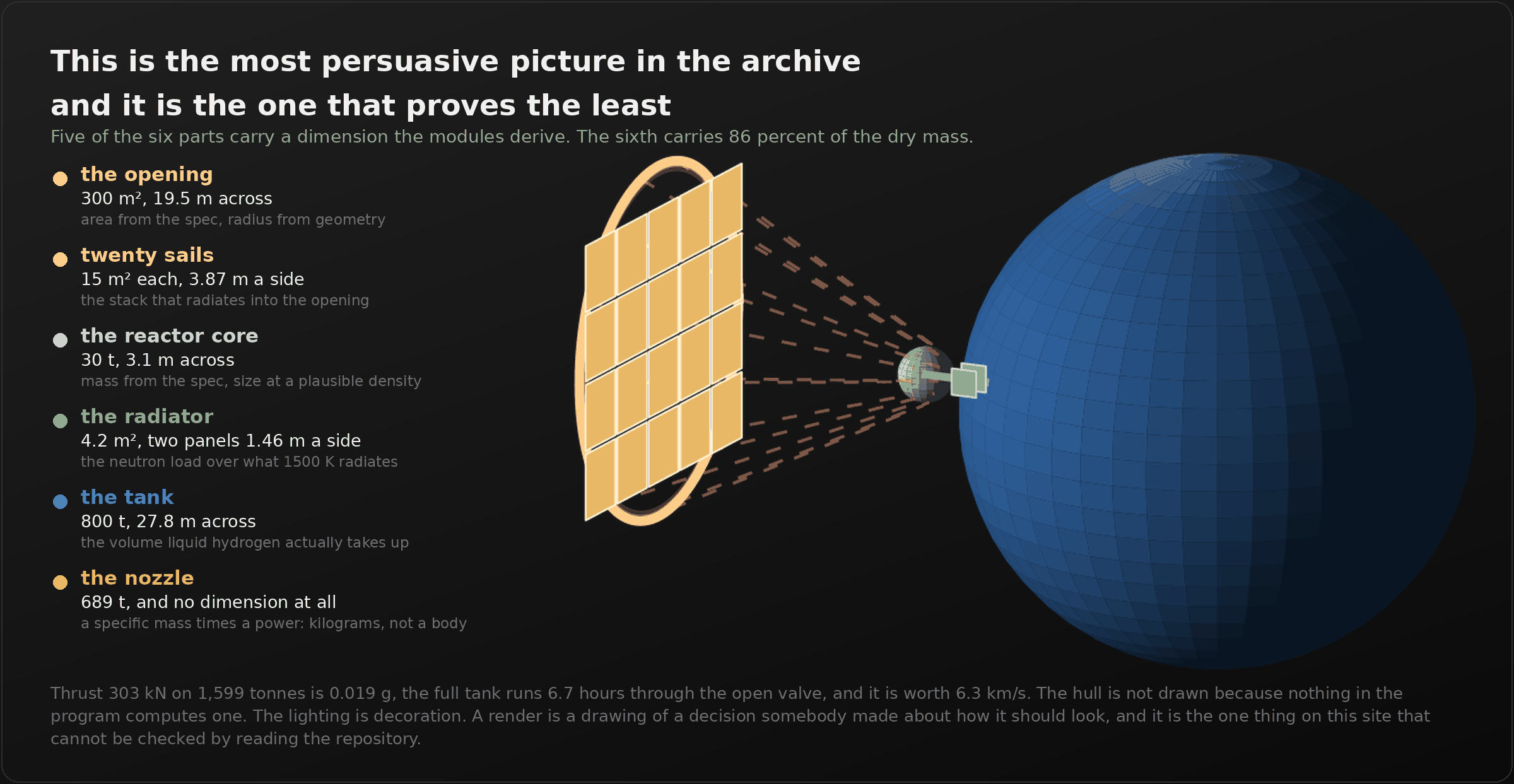
One thing in that picture is a deliberate choice and it is not the lighting.
My first version used the default perspective projection, with the opening nearest the camera. It looked better. It also drew the 19.5 metre opening larger than the 27.8 metre tank behind it, which is the reverse of the truth, in a figure whose entire argument is that these sizes are real. A picture that reverses two of its own dimensions to look more dramatic is not a picture of this ship.
So it is orthographic. No convergence, no foreshortening, nothing nearer drawn bigger. The tank is wider than the opening on screen because it is wider than the opening.
The lighting is decoration and the caption says so. It carries no information. It is there because a flat silhouette does not make anybody stop scrolling, and I would rather admit that the sheen is a choice than have somebody assume it means something.
What this ship actually does
Since the picture is flattering, the numbers should be plain. Thrust is 303 kilonewtons on 1,599 tonnes, which is 0.019 of a gravity. Opening the valve all the way empties the tank in six and three quarter hours and buys 6.3 kilometres per second. There is no crew compartment in the render because there is none in the code, no hull because nothing computes one, and no landing gear because that would be me deciding what it looks like.
It is not a spaceship from a film. It is a sphere of hydrogen with a small hot thing behind it and a very heavy question mark behind that.
Why I am publishing it anyway
Every post on this site so far has argued that a well formed answer which happens to be false is the failure mode that nothing catches by getting bigger. A render is the purest available example. It has no error bars, no units a reader can check, no line anybody can grep. It says "this exists" in a way a table of numbers never manages, and it says it just as confidently when it is wrong.
So the most persuasive thing I can publish is the one thing on this site that cannot be checked by reading the repository. That is not a reason to refuse to draw it. It is a reason to draw it from computed dimensions, to leave the part that has none as an empty outline, and to say in the caption which is which.
The picture is honest about being a picture. That is the most a picture can do.