Correction, 24 September 2026. Every stopping flight in this post dropped the whole tank before the braking burn, so the brake ran on hydrogen held in no tank at all. With the shells that hold the braking hydrogen kept aboard, the century's stop at the best valve is 0.211 light years rather than 0.214, 2.71 times the shut valve rather than 2.76, at a peak of 890 kilometres a second rather than 906; Proxima in a century needs 1,588 kilowatts per kilogram rather than 1,229; and the tank post's 3.16 light years is 3.07. The figures and numbers below are the corrected ones and every conclusion stands. How it turned up is in The Nearest Star, Flown.
The fusion engine designed here was only ever an engine. It had a reactor, a nozzle, a tank and a valve, and it left three gaps open:
- Launch. Its nozzle weighs 689 tonnes in one piece and fits no rocket, so the mission planner refuses it on the pad.
- Thrust. It pulls two hundredths of a gravity. Leaving Earth takes 29 passes and 560 of its 800 tonnes of hydrogen.
- The stars. A century of flight gets it 0.08 light years and stopped. Proxima is 4.24.
So I rebuilt it with everything that looked like it filled one of those gaps. An array of engine modules and air-breathing launchers for the first. A nuclear pulse kick, Orion's, for the second. A magnetic sail, a light sail, a hydrogen scoop to refill the tank and a magnetic brake for the third. Then I priced each one against the gap it claims to fill, because an add-on that fills a gap the ship does not have is only mass.
Before any add-on: the valve was shut
The first finding came before anything was bolted on, and it changed which gaps were real.
The engine burns proton-boron, and its valve decides how much plain hydrogen goes into the exhaust with the fusion products. Shut, the exhaust is the fusion products alone, at 11,828 kilometres a second. The mission planner flies to the stars that way, and it looks like the obvious choice, since a faster exhaust gets more out of every kilogram.
But this engine does not run short of hydrogen. It runs short of power. At 1.38 gigawatts, a shut valve passes about a gram a minute. A whole century can burn only 62 tonnes of an 800 tonne tank, so the tank never limits anything, and most of the engine's power goes into throwing a tiny amount of mass very fast. Open the valve and the same power throws more mass more slowly, which is more push.
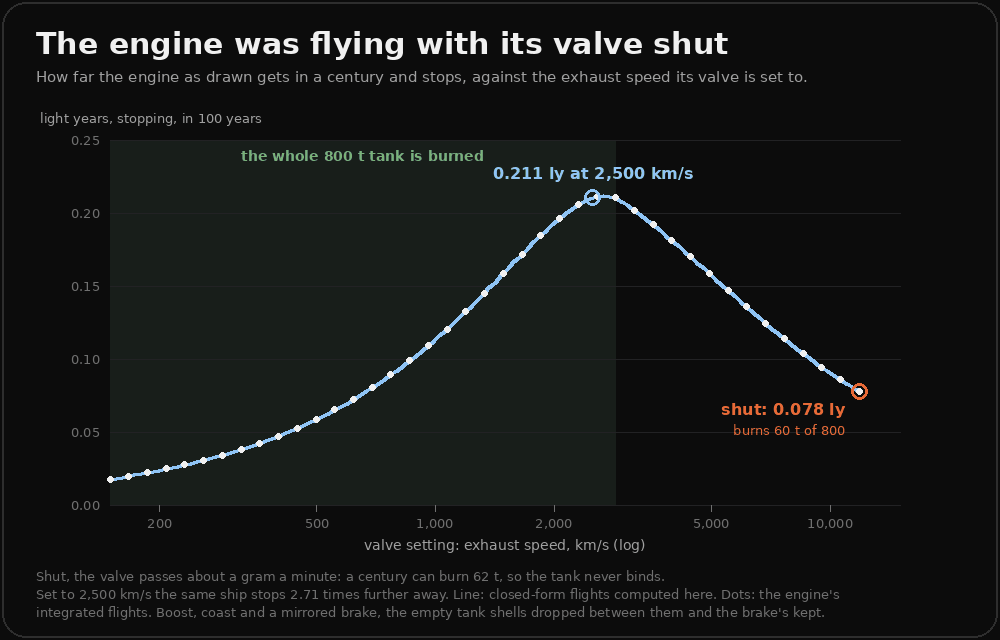
At 2,500 kilometres a second the same ship stops 0.211 light years away, 2.71 times further, and burns the whole tank. The line on that chart is worked out in the figure's own script from the rocket equation's closed forms. The dots are the engine's integrated flights, and they agree to three parts in ten thousand.
This one had to be checked against what is already published. The tank post priced an engine a hundred times more powerful, and that one has the power to use a fast exhaust: its best setting is the shut valve, so the valve does not move its figure, and the test pins that. (The brake's tank did move it, from 3.16 light years to 3.07; see the correction above.) The finding belongs to the engine as drawn. The mission planner still flies the shut valve for now, because fixing it moves the departure too, and that is its own change with its own checks.
With the valve set right, the tank binds. That is what makes the scoop a real question below instead of a romantic one.
Launch: the array and the carriers
An array fixes the launch, as long as one assumption holds. The engine charges the nozzle by the power it steers, at 0.5 kilograms per kilowatt, so 23 modules each steering a 23rd of the power carry a 23rd of the nozzle each. Under a nozzle mass that grows in a straight line with power, the array is free. That is an assumption and the engine lists it as one. I cut the tank into three shells the same way, which flatters it, since a small tank has more wall per litre and that is not priced.
That leaves every piece at 30 tonnes or less, 54 flights in all, which is the fewest the mass allows: 1,599 tonnes at 30 tonnes a flight, rounded up.
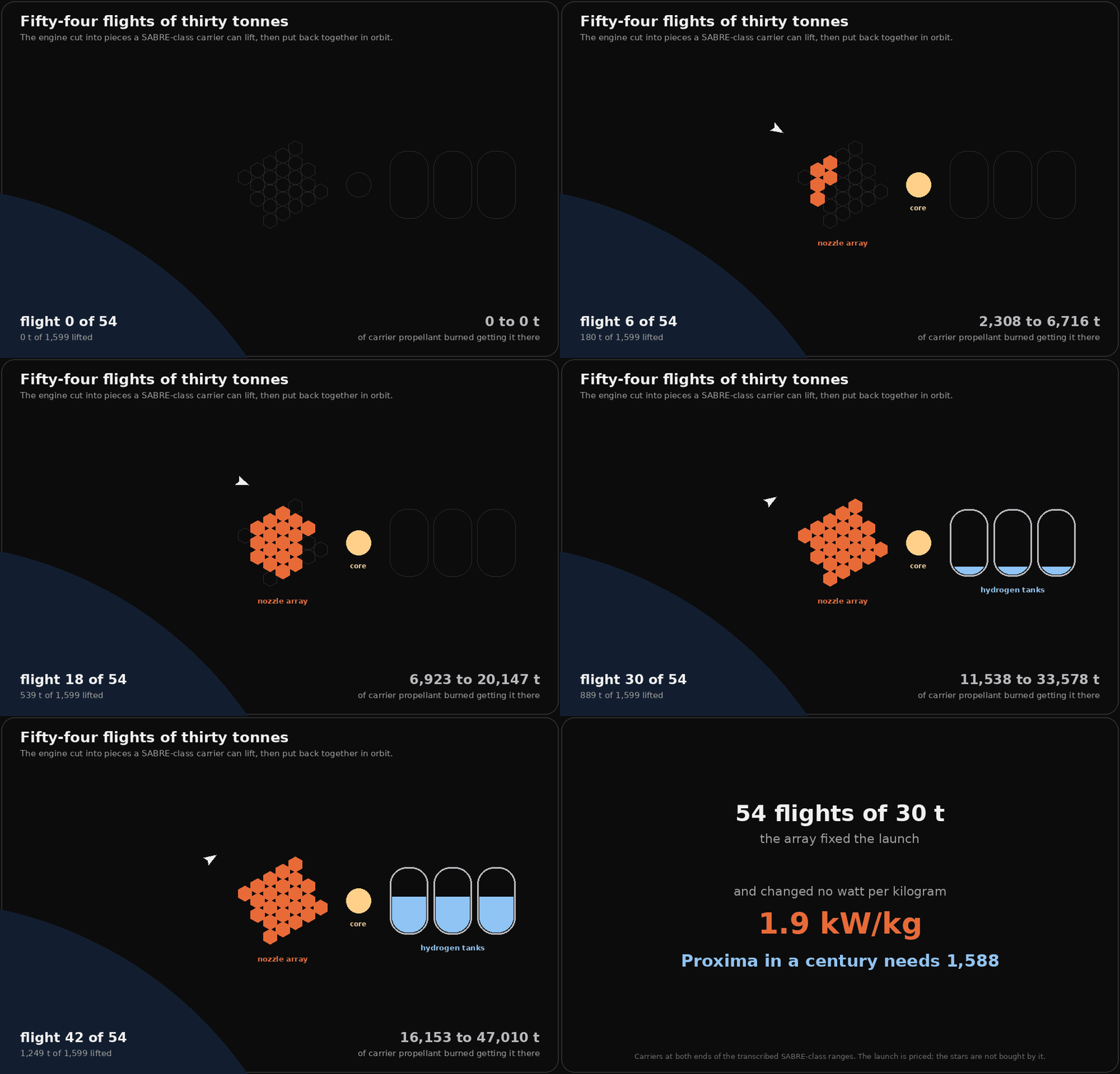
The carriers are the air-breathing kind: a single stage that breathes air to Mach 5.5 and then switches to its own oxygen, the SABRE class. In Kerbal Space Program it is the RAPIER. The real numbers are ranges from memory and marked unverified. A 30 tonne payload needs a carrier of 487 to 1,373 tonnes at takeoff, with three to seven engines, and the 54 flights burn 21 to 60 thousand tonnes of carrier propellant. A Skylon-sized bay of 15 tonnes cannot take the 30 tonne core, and a core is not two half cores.
Departure: the Orion kick
Leaving Earth with nuclear pulses instead of the tank takes 621 to 1,994 pulse units, depending on how much of each pulse ends up pushing the plate. That is 41 to 133 Hiroshimas of fission and 35 to 113 kilograms of fission products, in place of 560 tonnes of hydrogen through the open valve.
The comparison turned out not to matter. The drive's own slow spiral out of orbit, at the valve setting the stars want, leaves Earth on 5.0 tonnes in 131 days, or 41 tonnes in 15 days with the valve opened further. So the gap Orion fills is small. And it is ruled out anyway, by law rather than physics: the Partial Test Ban Treaty of 1963 bans nuclear explosions in outer space as well as in the air.
The sails
A hundred tonnes of superconducting loop in the solar wind gives the ship 24 kilometres a second at best, against a cruise that peaks at 890. At the bottom of today's range of superconductor the loop's field is too weak to make a sail at all near Earth, and the engine refuses it. A hundred tonnes of light sail gives 5.5 to 17 kilometres a second, depending on how thin the film is.
Both figures leave out the Sun's gravity on purpose, so each one is a ceiling. The engine also reports how hard each sail pushes against that gravity: 14 percent of the Sun's pull for the magnetic sail, 2 to 17 percent for the light sail. A sail pushing straight outward has to beat half the Sun's pull to lift a ship out of a circular orbit, and neither does.
The scoop: the one with a real gap
This is the add-on the valve finding made worth taking seriously. The tank limits the stars now, and the interstellar gas is hydrogen.
The ramjet post found that a scoop is a brake: every kilogram it collects has to be brought up to the ship's speed, and the field drags on the gas as well. So the engine does not price the scoop as a collection rate. It flies it: boost, coast and brake, with the scoop's drag and its gas both in the flight. With no scoop, that flight reproduces the rocket equation to a part in a million.
The scoop loses on the way out, where its drag costs more than its gas is worth. On the way in it wins twice: its drag helps the brake, and the gas it collects refills the tank the brake is burning. A thousand-kilometre scoop, switched on only for the brake, takes the century's stop from 0.211 light years to 0.222 to 0.274, depending on how dense the ionised gas is and how hard the field drags. At the dense end it collects 278 tonnes.
That gain is worth 47 to 239 tonnes of scoop. Beyond that, the scoop's own mass costs more reach than it buys. And its mass is the one thing not priced. A field that merely holds the gas off at a thousand kilometres would weigh about 2,900 tonnes at the best superconductor in the range. A funnel that gathers the gas into the ship is a different field, and nobody here has sized one. So the scoop stands, on a field nobody has drawn.
Using the scoop to refill the reactor has no gap to fill. The reactor burns proton-boron, 54 tonnes of it over the cruise, and 92 percent of that is boron, which is not out there to scoop.
The magnetic brake
The magnetic brake from the ramjet post was supposed to be the big one. At this ship's speeds it is the worst. The force falls as speed to the four thirds, so a slow ship barely feels it. From 890 kilometres a second down to the gas's own speed, the best coil takes 1,580 to 51,942 years. Doing it in fifty would take 1.8 x 10^12 amps per square metre, over a hundred times the best wire in the range. It is ruled out.
The gap that decides the stars
Every add-on above was priced against a gap, and the gap that decides the stars was never on the list. It is power per kilogram.
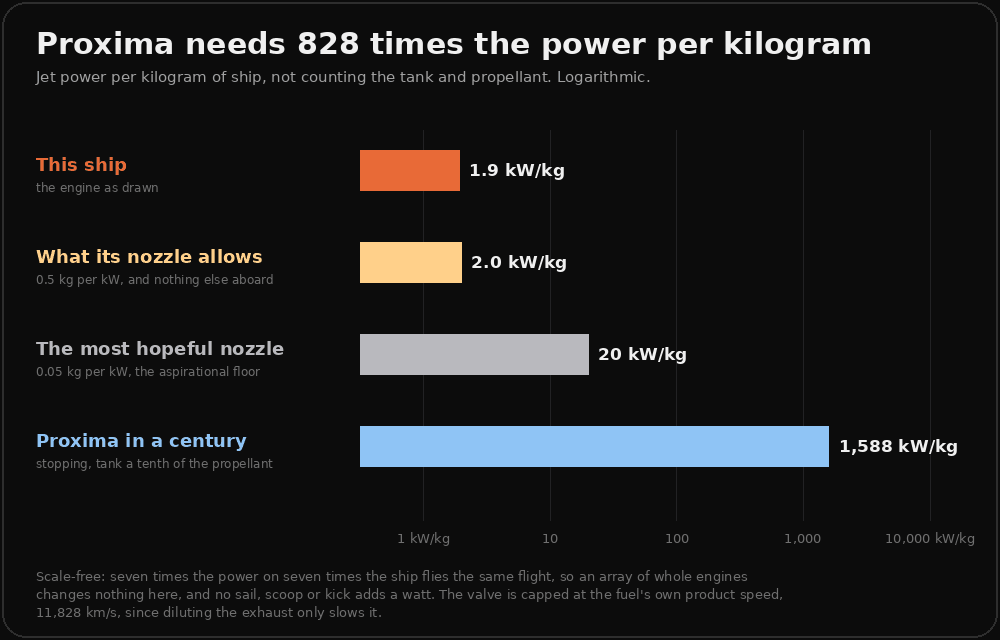
The engine checks why this is the only lever. Multiply the power, the mass, the tank and what is dropped by seven, and the flight comes out identical, so watts per kilogram is the only thing that matters. It follows that an array of whole engines changes nothing: it multiplies power and mass together. No sail, scoop or kick adds a watt.
Stopping at Proxima in a century needs 1,588 kilowatts of jet power per kilogram of ship. That is with the tank sized by the same search and the valve capped at the fuel's own exhaust speed, since watering the exhaust down only slows it. This ship has 1.9. The nozzle alone caps it at 2.0, and the most hopeful nozzle figure in the range caps it at 20. The nozzle is the part nobody has drawn, and it is still the part that decides the trip.
One number the engine did not find on the first try. The first version sized the tank after the fact, as a tenth of whatever the best flight burned. The search never saw that more propellant costs more tank, so a ship whose tank weighed nothing came out needing more power than one with a real tank. That is backwards, and a test now pins the right direction.
The verdict
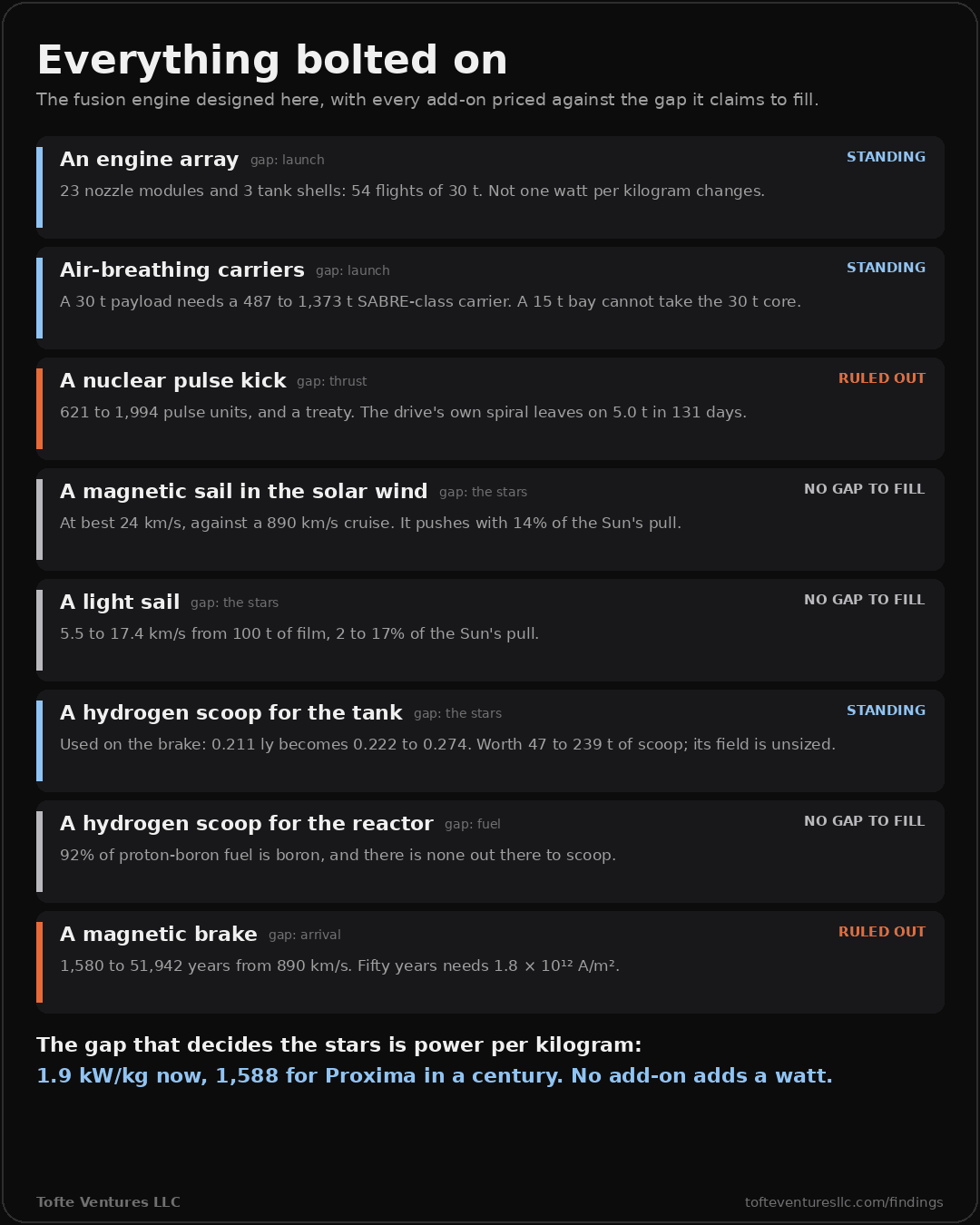
- Standing: the engine array, for launch. 54 flights of 30 tonnes, on a straight-line nozzle mass.
- Standing: air-breathing carriers, for launch. 487 to 1,373 tonnes each, at 30 tonnes a flight.
- Standing: a hydrogen scoop for the tank, for the stars. 3.5 to 28 percent more reach, on a field nobody has sized.
- Ruled out: the Orion kick. By treaty, and the spiral already does the job on 5 tonnes.
- Ruled out: the magnetic brake at these speeds. Over a thousand years.
- No gap to fill: both sails, and a scoop for the reactor.
The engine was giving a well-formed answer for the stars, and it was flying the setting it had rather than the one it needed. That is the same shape as every correction on this blog, and this time it was caught before anything was published on it. The rebuilt ship still stops a fifth of a light year out. What it needs is not on any list of add-ons. It is a nozzle eight hundred times lighter per kilowatt.