Over the last few days I built four modules that refuse things. One prices anything that throws mass, one works out what gives way as you pile matter on a core, one screens the mechanisms that are not rockets at all, and one does antimatter. They share a rule: no function in any of them is allowed to return "this works", and none may ever be added. They report what is ruled out and what is still standing, and standing rules out nothing.
Across all of it, exactly one proposal has ever come back standing on the number that decides everything.
The number
The relativistic rocket equation takes a mass ratio and an exhaust speed and gives you a change in velocity. Run antimatter through it and the mass ratio to reach a fifth of light speed is 1.88.
For comparison, the thrown osmium core from the drive post would need 7.59 to reach the same speed. A mass ratio of 1.88 means that less than half of what you launch is propellant, to cross a fifth of light speed. Osmium at the same target is 87 percent propellant: 659 tonnes of it behind a 100 tonne ship, against 88 tonnes of antimatter mixture. It is the only genuinely good figure anywhere in this whole run, and the module says so plainly, in standing, without hedging.
That paragraph said 194.6 and a factor of 103 when this post first went up, and both were wrong. The correction is at the end, because it turned out to be the most instructive mistake in the series.
I want to be careful about where that number comes from, because the easy version of this post quotes it and stops.
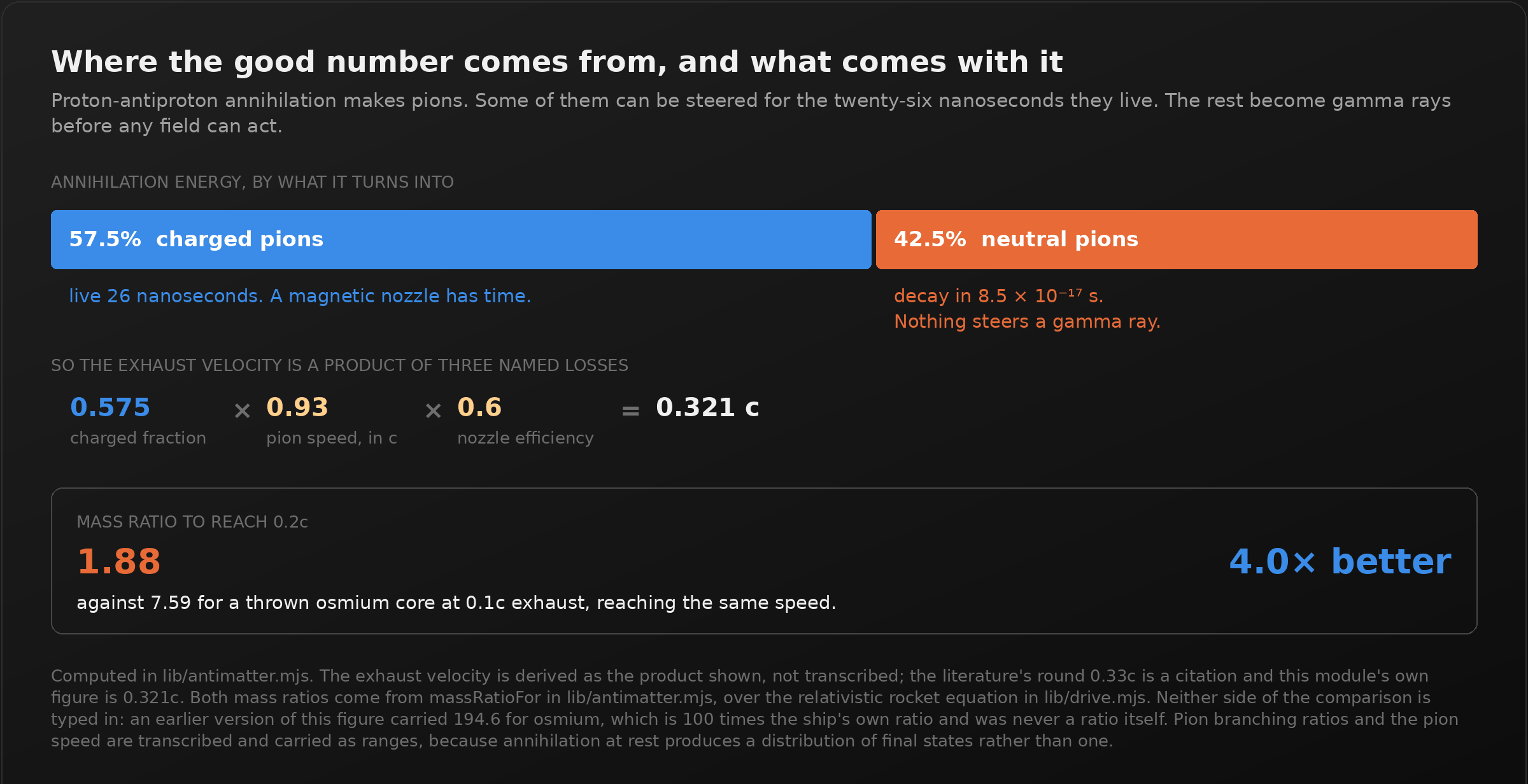
The exhaust velocity is derived, not looked up. Proton-antiproton annihilation makes pions. The charged ones can be bent by a magnetic nozzle during the twenty-six nanoseconds they live. They come out at about 0.93 of light speed. A real nozzle turns maybe six tenths of their momentum into thrust rather than spray.
Multiply the three and you get 0.321c.
The propulsion literature quotes 0.33c for a pion rocket, and landing within three percent of it from three independent losses is a reassuring place to be. But 0.33 is a citation and 0.321 is this module's own answer, and I had three test assertions pinned to 0.33 before I noticed I was checking my code against somebody else's rounding rather than against physics. Those are now pinned to 0.321.
There is a second correction sitting inside that paragraph. I had originally written that the split was about sixty percent neutral and forty percent charged. It is the other way round. Roughly three charged pions to two neutral ones, so 57.5 percent charged. That correction makes antimatter better than I had claimed, which is not the direction these usually go, and I only caught it by having to write the branching ratios into a table with a range attached.
And a third, which flatters it the other way. The famous specific energy of 1.8 times ten to the seventeenth joules per kilogram is per kilogram of antimatter. You cannot burn antimatter on its own. It needs an equal mass of ordinary matter and in space you are carrying that too, so per kilogram of what is actually in your tanks the figure is nine times ten to the sixteenth. Exactly half. It also moves the comparison against fusion from 529-fold down to 264-fold. The function returns both numbers with both names now, because the larger one is the one everybody quotes, me included.
So: the rocket equation says yes, and it says yes for real reasons that survive being checked.
The 42.5 percent
Here is the part that does not survive.
Neutral pions decay to gamma rays in 8.5 times ten to the minus seventeen seconds. There is no field that acts in that time. There is no nozzle geometry, no material, no configuration. That 42.5 percent of your annihilation energy leaves in every direction at once, contributes exactly zero net thrust, and a fair share of it goes straight through your crew.
A few hundred MeV of photon is not stopped by a sheet of anything. Cutting the flux by a factor of a thousand takes about three and a half metres of water. Wrapped around a five metre compartment that is 2,007 tonnes.
Your ship was 100 tonnes. It is now 2,107.
And 1.88 is a ratio, so it applies to whatever the dry mass turns out to be. The antimatter requirement goes from 44 tonnes to 928.
That is where I left it when I wrote about this yesterday. I reported the waste heat, I reported that it needed 1,780 square kilometres of radiator, and I moved on.
I had left out a term.
The loop that does not close
A radiator has mass.
That sounds too obvious to be worth a sentence, and it is exactly the kind of obvious thing that gets left out of an arithmetic chain because it lives in a different part of the design from the number you are chasing. I computed an area. An area is not a cost. Reporting an area and stopping quietly assumes the radiator weighs nothing.
Put its mass back in and the chain closes on itself.
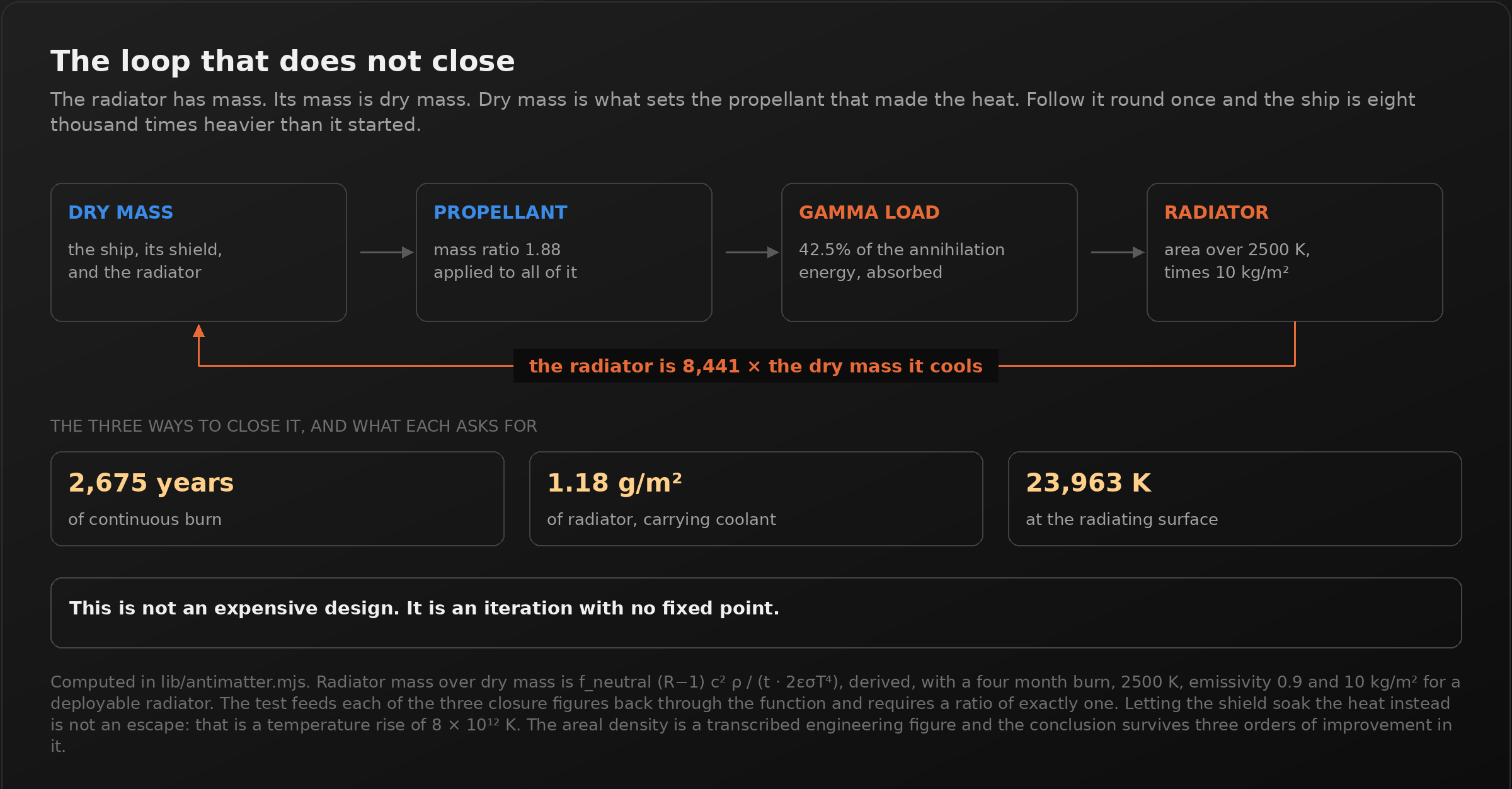
Dry mass sets the propellant, through the mass ratio. The propellant sets the gamma load, through that 42.5 percent. The gamma load sets the radiator area, through Stefan-Boltzmann. The radiator area times its areal density is radiator mass, which is dry mass, which is where we started.
Go round once with a deployable radiator at ten kilograms per square metre, running at 2,500 kelvin, over a four month burn.
The radiator comes out at 8,441 times the dry mass it is cooling.
So the ship is now 8,441 times heavier, which means 8,441 times the propellant, which means 8,441 times the gamma load, which needs a radiator 8,441 times larger than the one we just added. There is no second iteration that is better than the first. It diverges.
This is a different kind of answer from everything else in this series, and the distinction is the reason I went back and rewrote the module rather than just fixing a number in a post. Every other refusal here has been an expense. Too much propellant, too much energy, too many years of the world's electricity. Those are bad answers but they are answers. This one is not an expense. The crewed antimatter rocket does not have a mass problem. It has no fixed point. You cannot pay more and get it. There is nothing to pay for.
The function now returns the three things that would close it, because each one is a number rather than an opinion, and each one is worse than it sounds:
A burn lasting 2,675 years. Spread the same total heat over long enough and the instantaneous power drops until the radiator is manageable. You will need to start early.
A radiator massing 1.18 grams per square metre. That is lighter than the thinnest solar sail foil anybody has ever proposed, and unlike a sail it has to contain circulating coolant and survive at 2,500 kelvin.
A radiating surface at 23,963 kelvin. Temperature enters as the fourth power, which makes it look like the promising lever right up until you do the division: a factor of 8,441 in area is only a factor of 9.6 in temperature, and 9.6 times 2,500 is 24,000. The surface of the sun is 5,800. There is no material.
The obvious dodge is to not radiate it at all and let the shield soak the heat instead. The shield is two thousand tonnes of water, after all. That is a temperature rise of eight times ten to the twelfth kelvin.
I have three tests that take each closure figure, feed it back through the function, and require the ratio to come out at exactly one. That is the only way I trust an inverse.
Where it stops being absurd
Everything above assumes a crew.
Take the crew out and something interesting happens: you do not need the shield, because there is nobody to protect, and if you do not absorb the gammas you do not have to radiate them either. They just leave. The loop never forms. You are back to a design that is merely, catastrophically expensive rather than unsolvable, and expensive is a thing you can put on a chart.
So I turned the question round. Every figure up to this point starts from a target speed and ends in a tonnage nobody can picture. Start instead from an energy budget somebody might plausibly one day have, and ask what it buys.
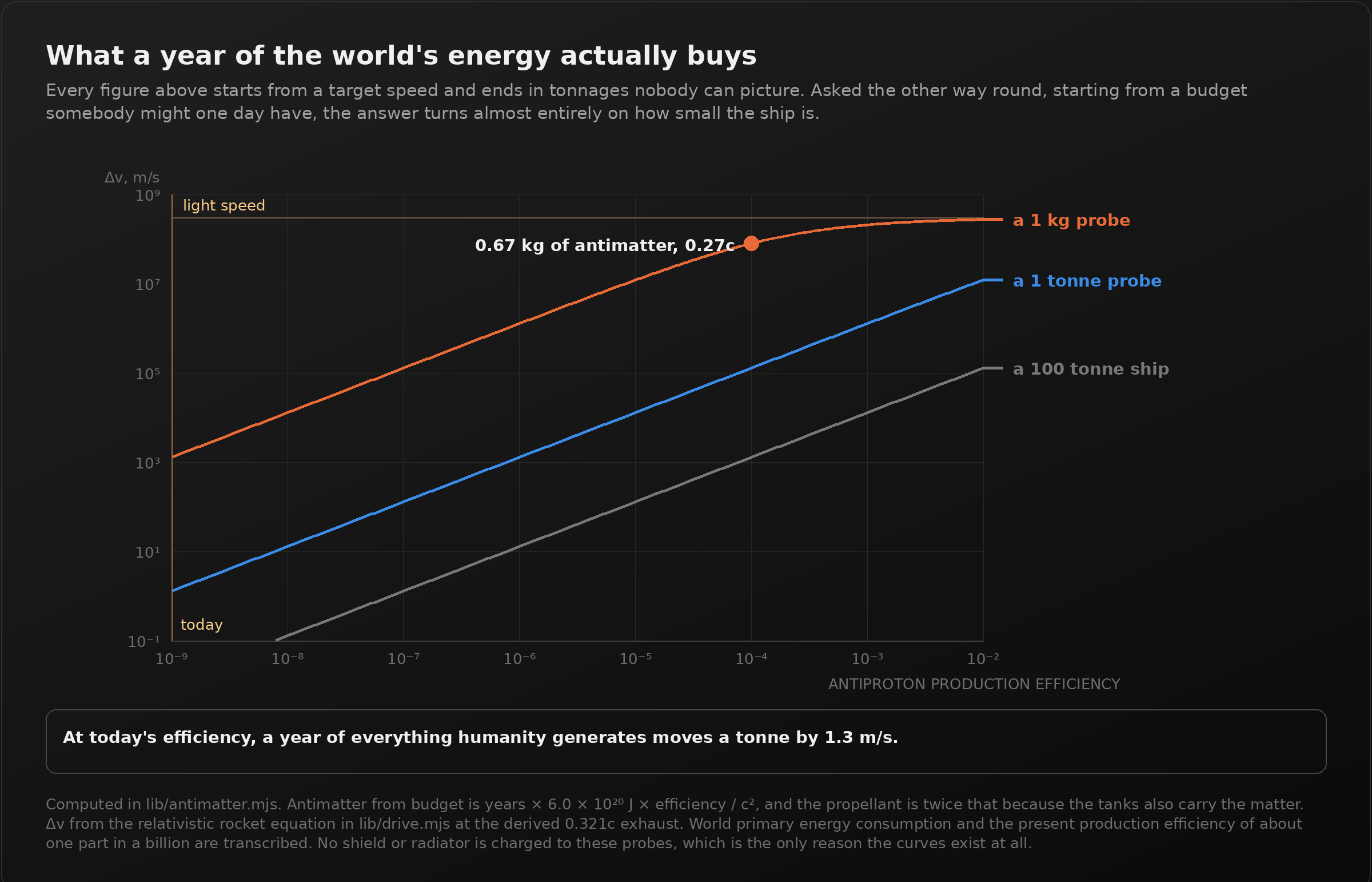
One year of total world primary energy consumption, at the production efficiency we actually have, makes 6.7 micrograms of antimatter. On a one tonne probe that is a change in velocity of 1.3 metres per second. A person can walk faster than everything humanity generates in a year can push a tonne.
Now grant five orders of magnitude of improvement in antiproton production, to one part in ten thousand. That is an enormous concession and I have no idea whether it is reachable. The same year of world energy now makes 0.67 kilograms.
On a hundred tonne ship, that is 128 metres per second. Still nothing.
On a one kilogram probe, it is 0.27 of light speed.
That is the only configuration in this entire post where the numbers stop being silly, and it is the same shape as the answer the beamed sail post arrived at from a completely different direction: the thing that works is very small and it does not carry people. The honest caveat is that a one kilogram antimatter rocket is not a thing anybody knows how to build, because the magnetic nozzle and the storage trap alone are structures, not payload, and the trap that currently holds a million antiprotons is furniture-sized. I am not claiming a gram-scale antimatter probe. I am saying that the arithmetic only ever stops being absurd at the small end, and it does that consistently, whichever propulsion scheme you come at it from.
The version where it is a spark plug rather than a fuel
There is one more configuration worth pricing, because it is the one that actual proposals use.
Do not carry antimatter as propellant. Carry uranium or fusion fuel as propellant, and use a handful of antiprotons to start the reaction. The antimatter becomes an igniter. The quantities drop from tonnes to micrograms, which is a regime where the storage problem at least has the right number of zeroes.
The question is whether that trade is actually favourable, and it has a clean answer that falls out of two rest masses.
Each antiproton you spend costs its own annihilation, which counting the proton it takes with it is 1.88 GeV. Each fission it triggers returns about 180 MeV. So catalysis only beats simply annihilating the same antimatter above 10.4 fissions per antiproton. Below that you would have been better off burning it directly.
Whether a real subcritical assembly multiplies far past ten is a genuine engineering argument that I am not in a position to settle. So fissionsPerAntiproton is a parameter in the module rather than a constant, and the test asserts that changing it changes the verdict: at a pessimistic four fissions, catalysis loses; at a hundred, it wins by tenfold. That is the honest shape of the answer. The break-even is physics and it is 10.4. Which side of it you land on is somebody's reactor design, and this program does not assert other people's reactor designs.
The correction: a number that was already known to be wrong
When this post first went up, the comparison at the top read "194.6 for the osmium core" and "103 times better". Gunnar noticed the osmium figures did not line up across the posts, and he was right.
194.6 is not a mass ratio of anything. It is 100 times 1.946, which is the osmium ship's own mass ratio: 100 tonnes dry, 94.6 tonnes of core thrown at a tenth of light speed. And 1.946 is not the number that belonged in that comparison either, because that design only reaches 0.0665c. To get to the same 0.2c that antimatter was being measured against, osmium needs a ratio of 7.59.
So antimatter beats it by about four, not by a hundred. Four is a good result. It did not need to be a hundred, and I should not have been comfortable with a hundred.
The part that bothers me is where 194.6 came from. Days earlier I had made a chart that marked a point at a hundredfold mass ratio when it meant a hundredfold propellant. I found that, fixed the chart, and wrote about it. But the wrong number did not die there. It stayed loose in my head as "the osmium figure", and then I typed it into a module comment, a test assertion, two figures and two posts as though it were real.
Every other number in these modules is computed. That one was typed, and it was typed from memory, and the memory was of something I had already established was false.
The fix is structural rather than a find-and-replace. There is now one function, massRatioFor, that inverts the rocket equation, and both sides of any comparison come out of it. There is no literal left. The test round-trips the osmium figure through the drive module and separately pins 194.6 as exactly a hundred times the ship's ratio, so if it ever reappears it fails a check rather than a reader.
A comparison figure that is typed rather than computed is the same class of error as a constant that is transcribed rather than derived, and I had a whole doctrine about the second one while doing the first.
The whole run, on two panels
Five posts is a lot to hold at once, so I drew the campaign as a single board.
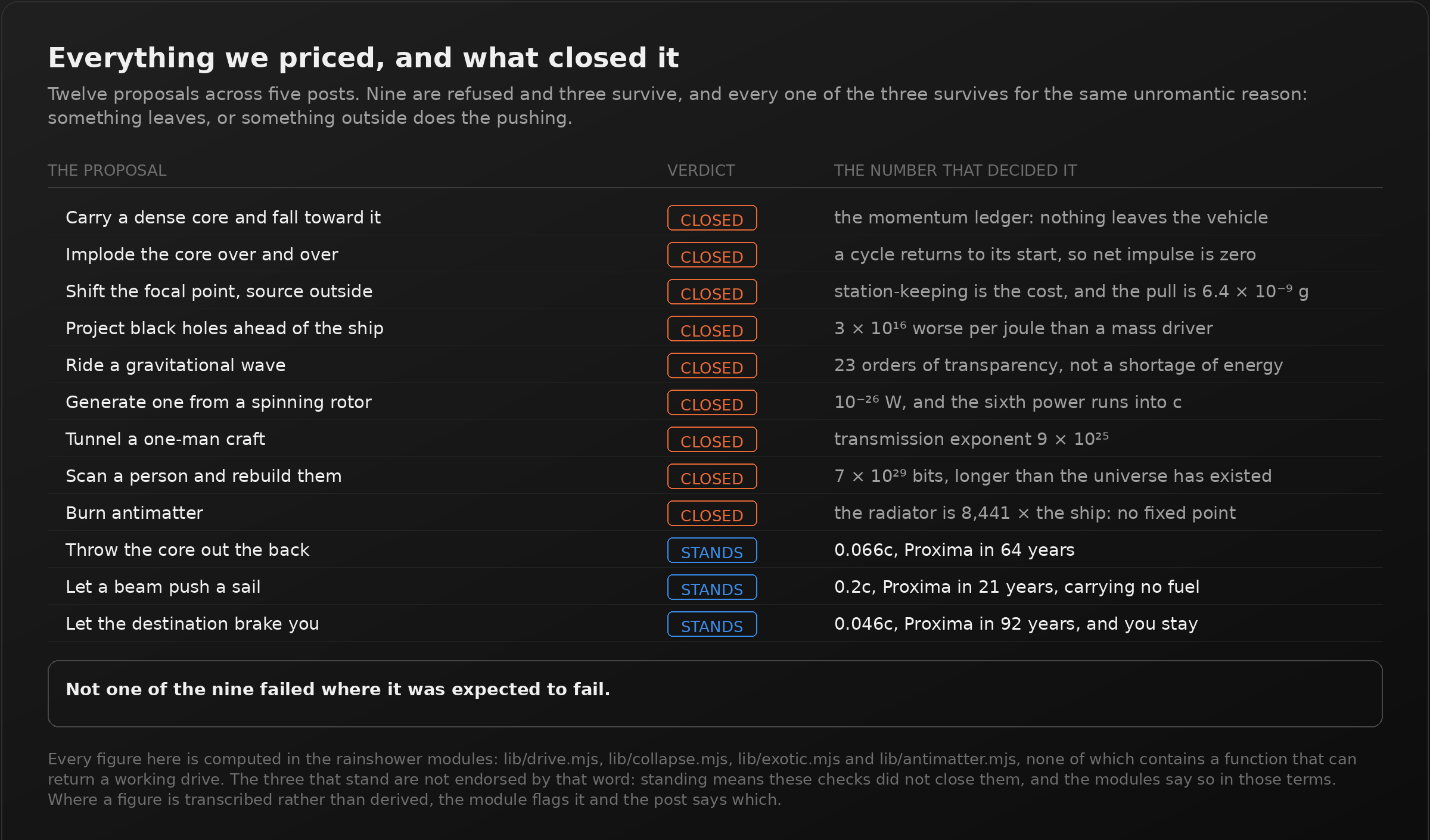
Nine closed, three standing, and the three that stand all survive for the same unromantic reason. Something leaves the ship, or something outside does the pushing.
Then I drew the comparison the run never actually made, which is what a kilogram costs to put at a fifth of light speed, by every route we priced.
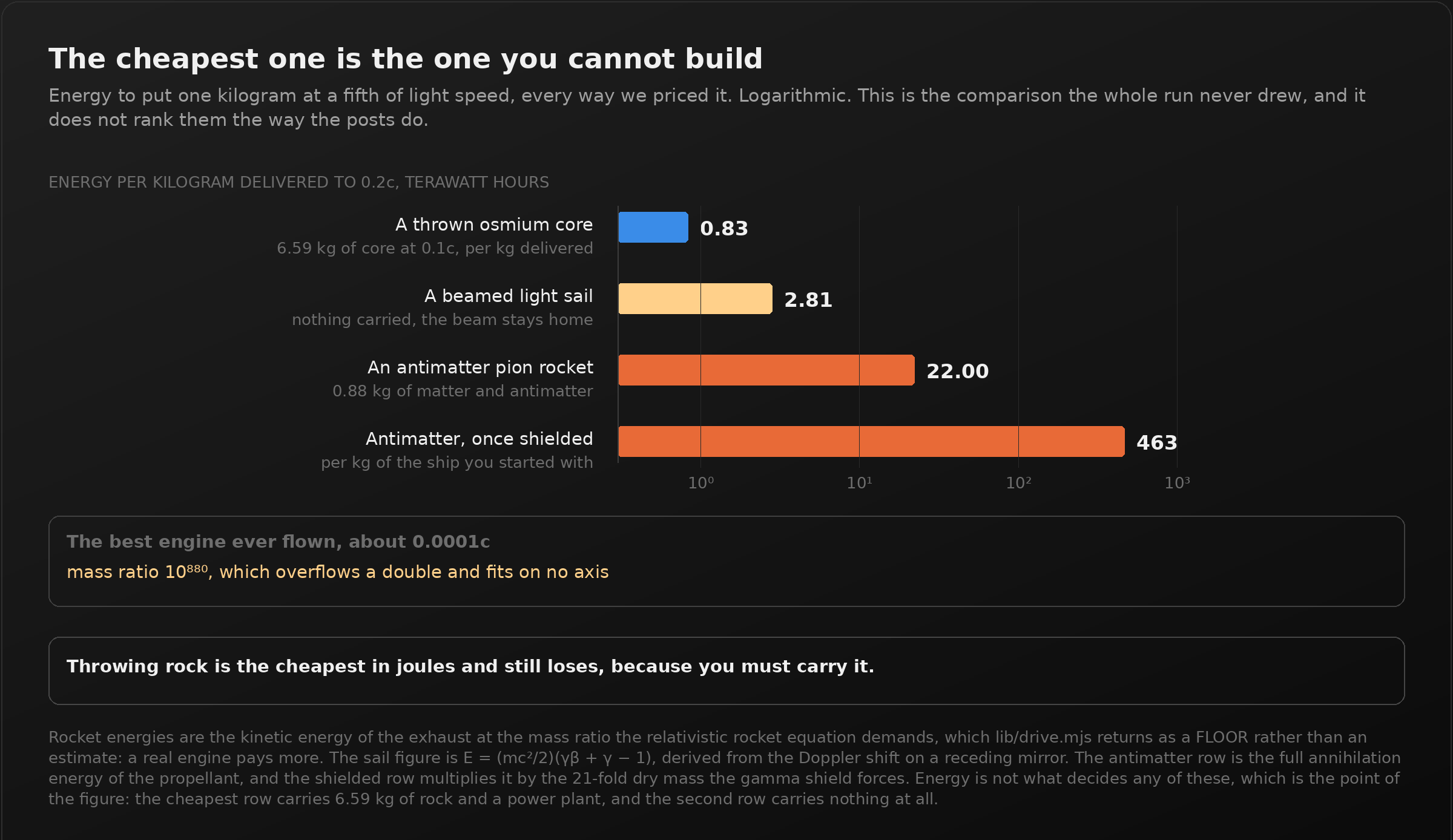
The ranking is not the one the posts arrive at, and that is the useful part. Throwing rock is the cheapest thing on the board, three and a half times cheaper than the sail and twenty-six times cheaper than antimatter. It still loses, because those 6.59 kilograms have to be aboard, along with whatever produces the energy to throw them. The sail costs more joules and wins anyway, because it carries neither.
Which is worth saying plainly after all this arithmetic: energy was never the deciding axis. Not once, in any of the twelve. What decided every single one was what you have to carry, what you cannot aim, or what refuses to couple.
What I actually take from this
Antimatter is the only drive we priced that the rocket equation approves of, and that approval is real. 1.88 is not a rounding artefact or a best case, it comes out of three named losses that each have a physical meaning, and the module reports it as standing rather than burying it under the refusal.
And it does not matter, because the design is not decided by the thing it is good at.
The pattern has held for every one of these. The gravitational wave was brighter than the full moon and failed at the coupling. Tunnelling fails at the mass rather than the barrier. Reconstruction fails at the wire rather than the scanner. Antimatter has an excellent mass ratio and fails at the 42.5 percent of the exhaust that nothing can aim.
In every case the decisive quantity lived in a part of the design nobody was looking at, and in every case I only found it because the number had to come out of a file that a test could open. The radiator term in this post is the cleanest example I have produced so far. I did not get it wrong. I left it out, which is much harder to notice, because nothing you can read is incorrect. The area was right. The power was right. The sentence describing them was true. There was simply a term missing, and with it the answer changed from a very large bill to no solution at all.
And then the osmium comparison, which is the other half of the same lesson. The radiator was a term I never computed. The osmium ratio was a number I computed, found wrong, corrected in one place, and then carried forward by hand into five others. Deriving a number once does not protect it. It has to stay derived, at every place it is printed.
That is the same finding as a code checker that scanned nothing and reported zero issues in green and a ledger that stopped at five thousand rows. The output was well formed. The output was confident. The output was incomplete in a way that looked exactly like completeness.
The only thing that has ever caught one of these is a second route to the same number.