Every drive on the scorecard so far was an idea somebody sketched. Orion is the one that was studied as engineering. General Atomics worked on it from 1958 to 1965, with Ted Taylor and Freeman Dyson among the people on it. The proposal is simple enough to say in one sentence: drop a small nuclear device out of the back of the ship, let it go off a short distance behind a thick plate, and let the plate push the ship through shock absorbers. Then do it again, about once a second.
It has a reputation as the drive that would actually have worked. So I put it through the same engine as the others, which is built so that it cannot say a drive works, and checked where the reputation holds up.
One note on scope, because the subject calls for it. What the engine models is momentum geometry, and nothing about the devices. A pulse here is a yield, a mass, the share of the yield that ends up as fast-moving debris, and how that debris spreads over directions. How a real device would produce those numbers is not in the engine and is not going to be.
The bomb is the nozzle
The fusion engine designed here has a nozzle problem: its nozzle weighs 689 tonnes and nobody can draw it. Orion's nozzle is a steel plate, which is a thing you can weigh. The part that does a nozzle's job, steering the exhaust, has moved into the explosion itself.
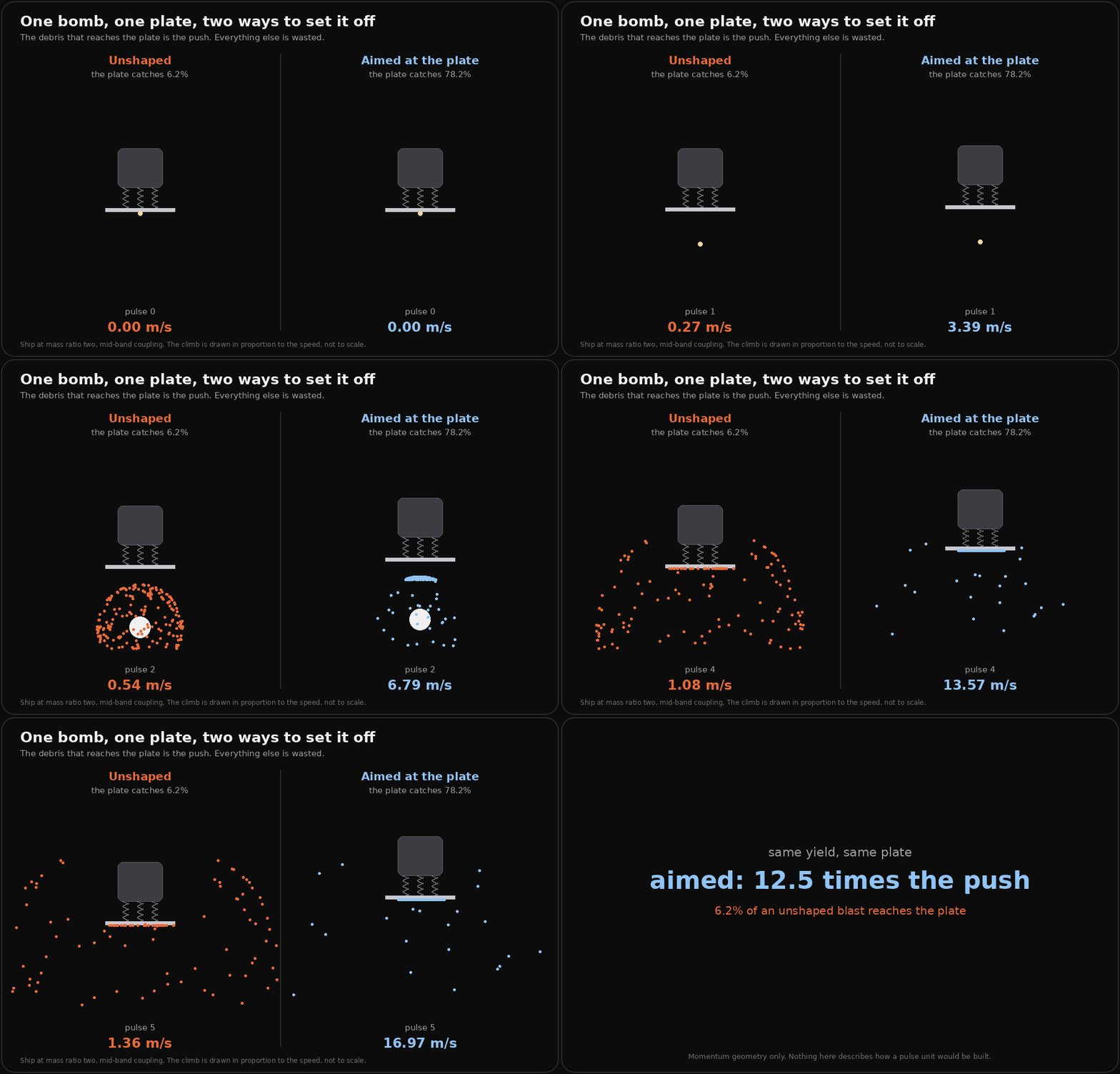
An explosion that throws its debris equally in every direction wastes almost all of it. A plate that covers thirty degrees either side of the detonation point, as seen from the blast, catches 6.2 percent of the debris's push. That is exact, sin² of the angle over four, and the engine checks it against a sum over every direction to ten decimal places. Throw most of the debris into a cone aimed at the plate instead, and the plate catches 78 percent.
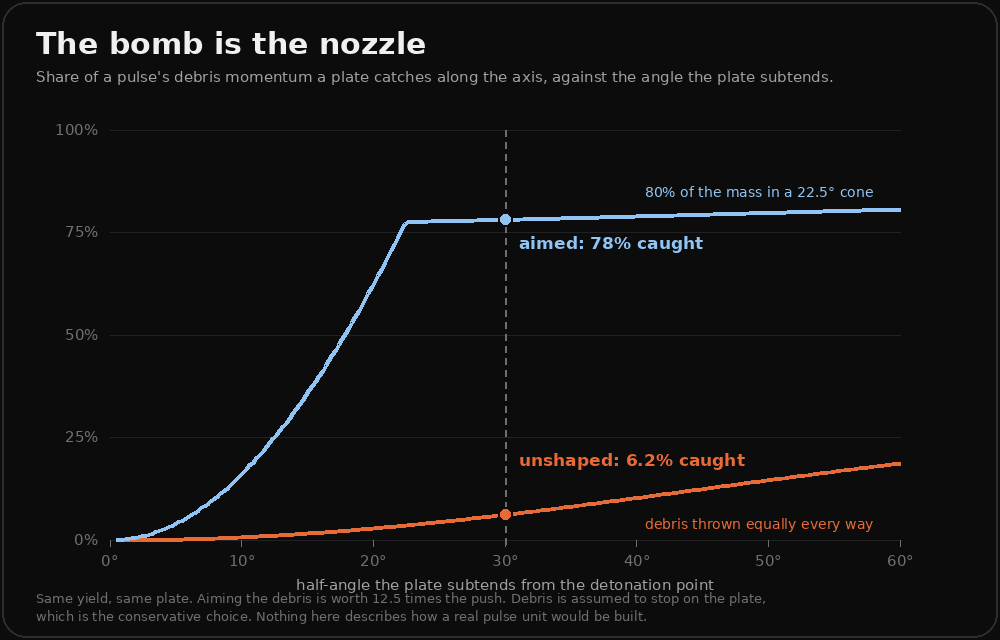
Same yield, same plate, 12.5 times the push. That is the whole engineering idea of Orion, and it is the reason the design lives or dies on the pulse unit rather than on the ship.
The ship
The engine needs a ship to price, and none of the numbers below comes from a historical design. They are round numbers I chose, stated so anybody can change them:
- A ship of 1,000 tonnes, including a 200 tonne plate.
- Pulse units of 200 kilograms each, one kiloton each, all of it expended.
- The same mass again in pulse units, so a mass ratio of two: 5,000 pulses at one a second, a burn of 1.4 hours.
The one number the engine cannot work out is how much of each pulse's energy ends up as debris speed. So it carries that as a range, chosen so the result brackets the 2,000 to 6,000 seconds of specific impulse that Orion studies are usually quoted at. I am quoting that range from memory and the engine marks it unverified. It rules something out only when both ends of the range agree.
At those two ends, the ship reaches Mars at its closest in 94 to 31 days. The plate takes 4 to 35 g on each stroke of the absorbers. The crew, averaged over the pulses, feels 0.2 to 0.6 of a gravity. That is comparable to the fusion engine designed here, which takes 38 days now that its nozzle and tank are charged, and Orion does it on 1950s specific impulse with a nozzle made of steel.
From the ground
This is where Orion stopped, and the engine is careful to say this is not a physics refusal.
To reach orbit the ship needs about 9.4 kilometres a second, and at the ends of the range that takes 868 to 3,079 pulses. That is 0.87 to 3.1 megatons of fission, or 58 to 205 times the Hiroshima bomb, going off in the atmosphere. It leaves 49 to 174 kilograms of fission products in the air. The engine derives 56.6 grams per kiloton from the energy of a fission, and checks it against the familiar rule of thumb of 57.
The Partial Test Ban Treaty of 1963 banned nuclear explosions in the atmosphere, underwater and in outer space. Space is in that list, so the wall is not only on the ground. Orion was closed down two years later. Its limit in the solar system was law and fallout, and physics never got the chance to refuse it.
The stars
Here physics does get a say, and the answer comes in two parts.
The first is a ceiling. No pulse can throw its debris faster than its fuel's own energy allows. If every joule went into the fuel's debris and all of it went straight at the plate, fission tops out at 4.05 percent of light speed and deuterium-tritium fusion at 8.64 percent. The engine gets those both classically and from the exact relativistic formula.
The second is how far Orion as studied sits below that ceiling.
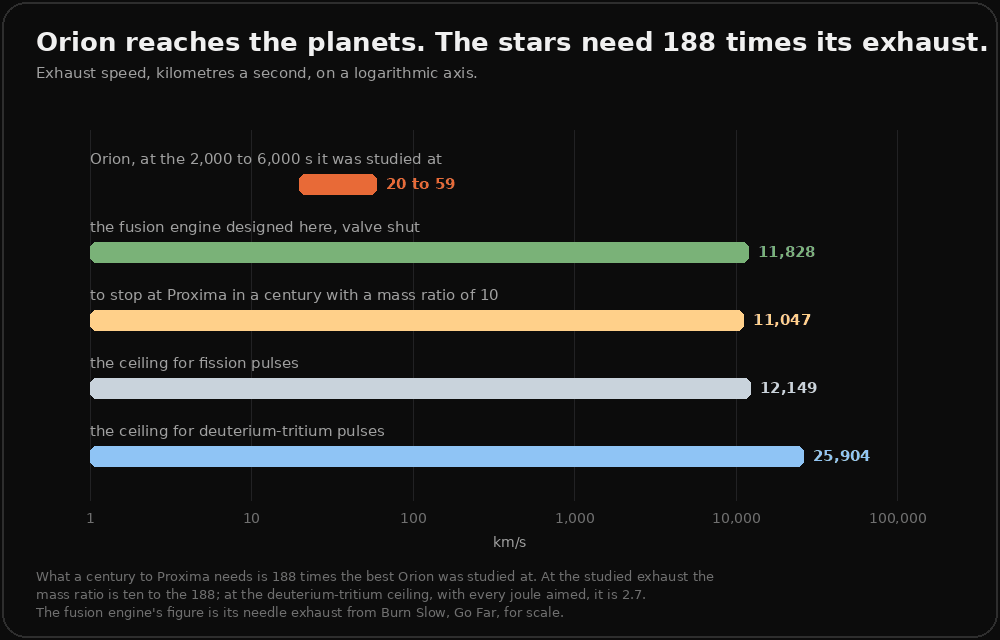
Stopping at Proxima Centauri within a century needs 188 times the best exhaust Orion was studied at. At the studied exhaust the mass ratio for that trip is ten to the 188 at best. That number overflows a double, and the engine returns it as a logarithm rather than printing Infinity as a mass ratio. At the fusion ceiling, with every joule aimed at the plate, the same trip needs a mass ratio of 2.7.
So interstellar Orion is not ruled out, and it is not standing on anything Orion ever demonstrated either. It lives entirely in the gap between the chart's first bar and its last, and that gap is made of the two things this engine cannot price: how much of a pulse's energy becomes debris speed, and how well the debris is aimed.
What the engine does not price
It says so in a named list rather than leaving it out. It does not price the plate's face wearing away a little with every pulse, over thousands of pulses. It does not price the absorbers taking thousands of strokes. And it does not price how a real pulse unit would reach the coupling and cone this post assumes. None of the three is modelled, so nothing here says the plate survives.
The verdict
- Ruled out: an unshaped explosion. The plate catches 6.2 percent.
- Ruled out: launching from the ground. It is not ruled out by physics: 58 to 205 Hiroshimas of fission to reach orbit, and a treaty.
- Ruled out: the stars at the exhaust Orion was studied at. A mass ratio of ten to the 188.
- Standing: the solar system, in space. Mars in 31 to 94 days.
- Standing: the stars at the fusion ceiling. A mass ratio of 2.7, if every loss the engine cannot price were somehow zero.
That makes Orion the nineteenth card on the scorecard, and it stands for the solar system. It is also the only drive there whose solar system version was stopped by something other than physics. Most of the other cards were refused by a term somebody left out: a tank, a nozzle, a radiator, a shell sized for the wrong moment. Orion's missing terms are on the list above, in plain sight, and it still has a card that says standing.