The last post ended at 650 AU, a hundredth of a light year, and asked what this engine does against the distance to the nearest star. This is that answer, flown. It is not a lifetime. It is the first time the ship this blog has built has a date at Proxima at all.
It leaves the solar system in four years
The solar wind blows out to about 120 AU before the gas between the stars stops it, and the boundary is the only line anybody draws for where the solar system ends. Voyager 1 crossed it about 35 years after launch. The ship flying down the Sun's focal line in the last post passes 120 AU in year 3.96, read off the engine's own flight.
Five centuries to fly past Proxima, seven to stop
Proxima Centauri is 4.25 light years away, from its parallax: 268,550 times the distance from the Earth to the Sun. The engine flies it as a straight line from the Sun, one boost, a coast, and for stopping a brake, with the valve and the hydrogen load free to go wherever they get there soonest. It checks the relativistic flight against the Newtonian one; at these speeds they agree to a few parts in a hundred thousand.
Flying past, the best version reaches Proxima after 482 years, at 3,962 kilometres a second, 1.32 percent of the speed of light. Stopping, it arrives after 703. Voyager 1, at its own speed, would take about 75,000 years, so this is about 155 times sooner than anything that has flown.
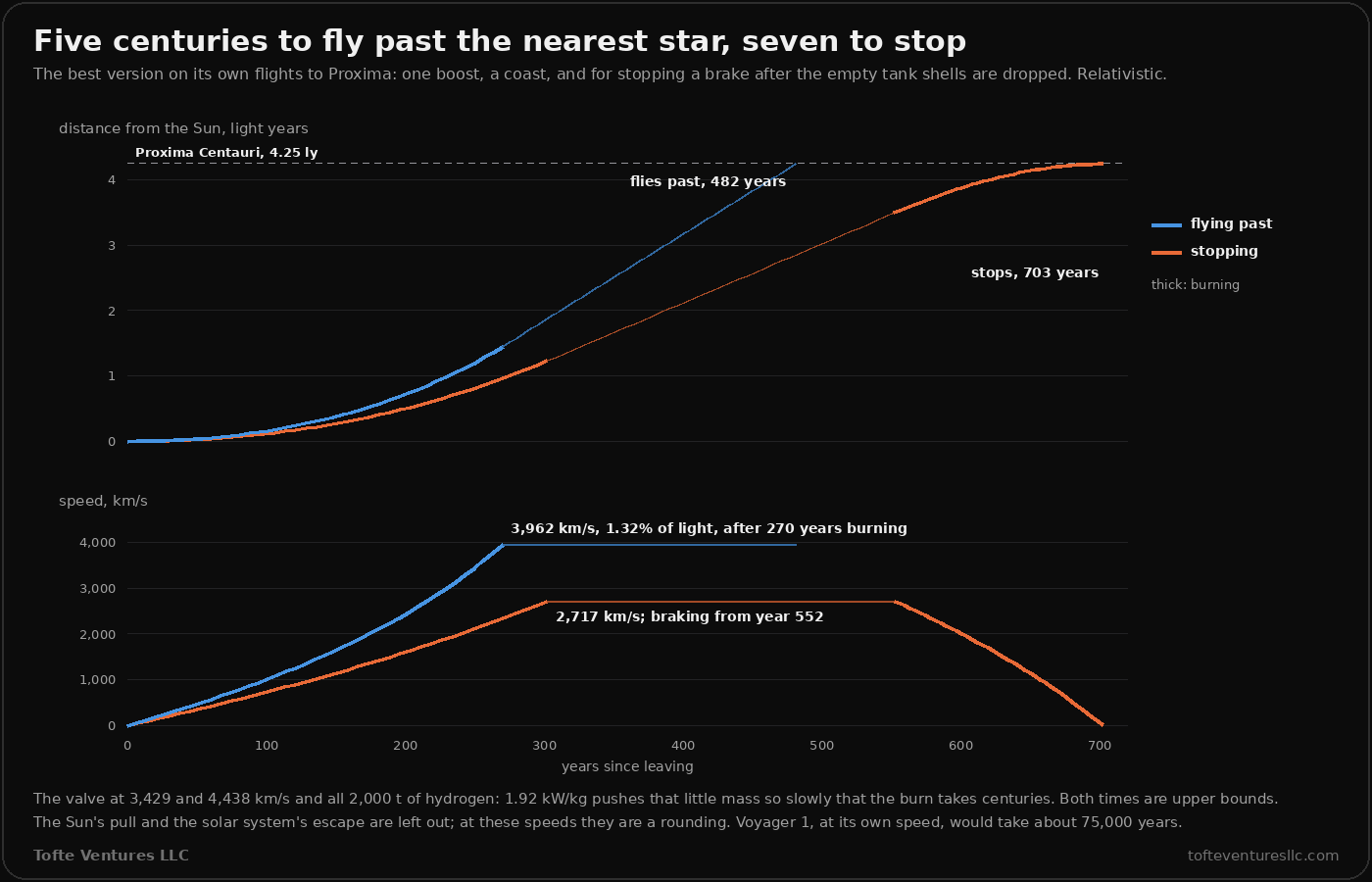
Why so long is the same thing every post here has found. The engine is short of power, not hydrogen. At the valve that suits Proxima it pushes out 7.4 tonnes of hydrogen a year, so emptying the 2,000-tonne tank takes 270 years, and the ship is still accelerating two and a half centuries after it leaves. The ship's own clock runs slow by nine days over the five centuries, which is what 1.32 percent of light is worth.
What would make it a lifetime
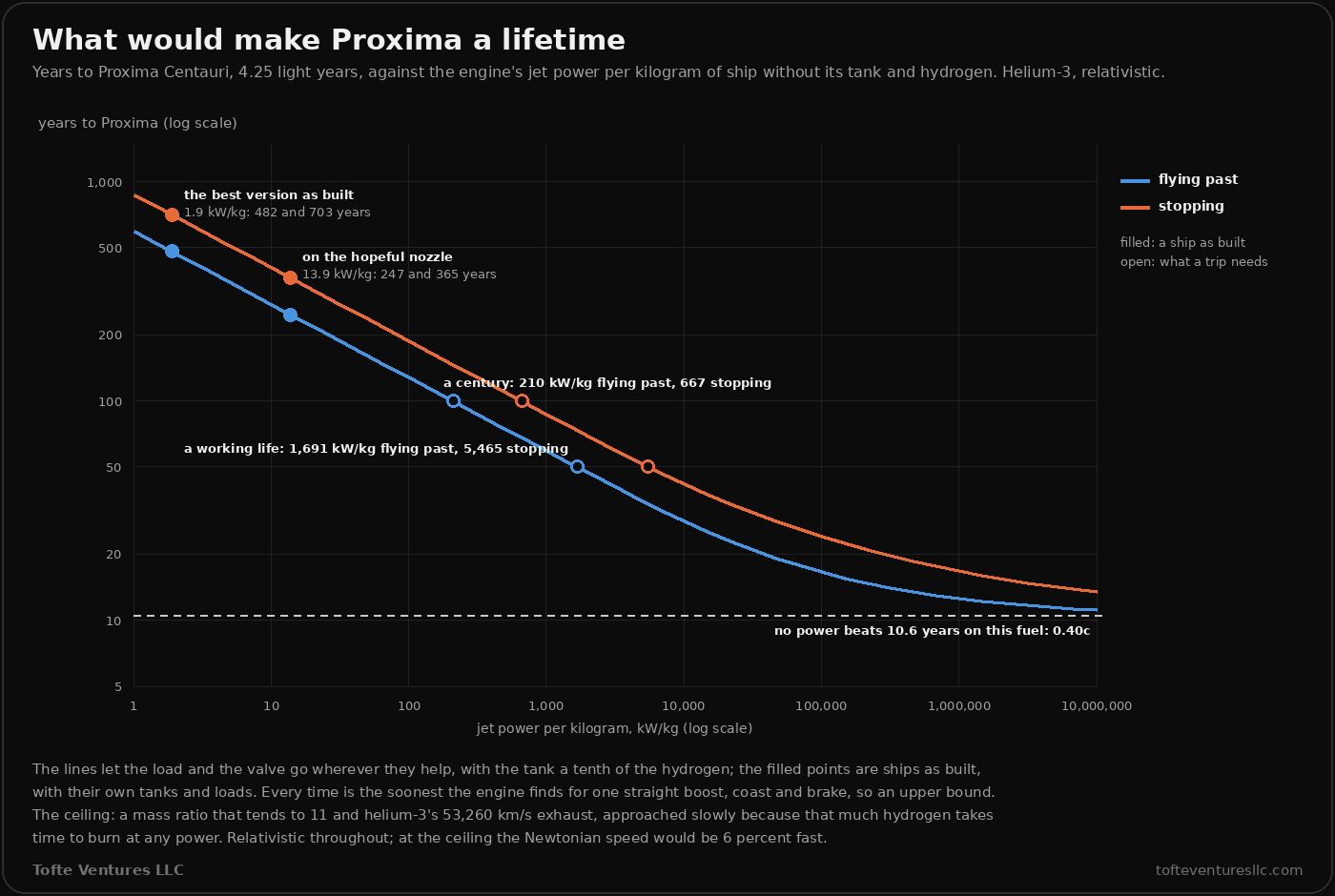
The answer turns on one number: the jet power per kilogram of ship, not counting its tank and hydrogen. This ship has 1.92 kilowatts per kilogram. The same ship on the most hopeful nozzle figure in the range, from the best version post, has 13.9, and gets there in 247 years flying past and 365 stopping.
To fly past Proxima in a century takes 210 kilowatts per kilogram, about 110 times what this ship has. To stop there in a century takes 667, about 350 times. In fifty years, a working life, it takes 1,691 flying past and 5,465 stopping.
What no power can buy
Power is not the whole story, because the fuel sets a ceiling of its own. Helium-3's fastest exhaust is its 14.7 MeV proton, 53,260 kilometres a second. The tank weighs a tenth of the hydrogen it holds, so however much hydrogen is loaded, the ship is never more than eleven times heavier full than empty. With unlimited power the burns are instant, and the ship reaches 40 percent of the speed of light and Proxima in 10.6 years. Nothing beats that on this fuel.
It is the first trip for this ship where relativity changes the answer. Worked out with Newton, the top speed would be 6 percent higher than the rocket actually gets, and the ship's own clock reads 9.7 years to the Earth's 10.6. The ceiling is approached slowly, too. That much hydrogen takes time to burn at any finite power: a million times this ship's power per kilogram still takes 12 years, and coming within a few percent of 10.6 takes tens of millions of times.
The sky from the ship
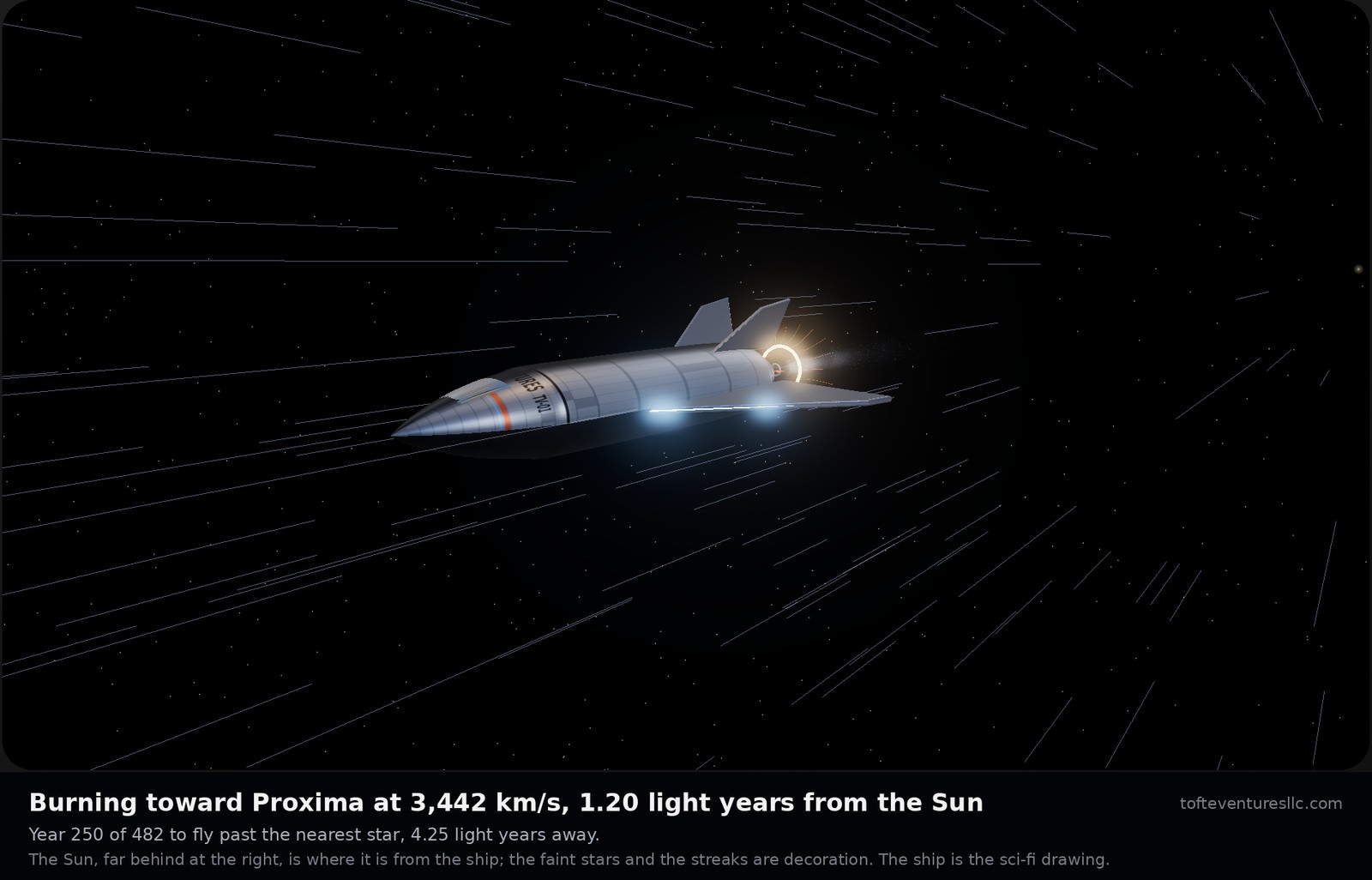
From the ship, the stars sit where they would really be seen from wherever the ship is. The Sun fades behind it. Seen from Alpha Centauri it is a star of magnitude 0.45, one of the brighter stars in that sky. Alpha Centauri brightens ahead. Every star is also moved by aberration, which crowds the sky toward the direction of travel. At the best version's speed, a star directly to the side appears 0.76 degrees further forward, which nobody would notice. At the 12.7 percent of light a fifty-year trip peaks at it is 7.3 degrees. At the fuel's ceiling it is 23.7, and the sky ahead turns bluer and the sky behind redder.
Speed has a cost the engine does not price yet. A gram of dust met at the best version's speed carries the energy of 1.9 tonnes of TNT; at a working life's 12.7 percent of light, 175 tonnes.
Two numbers I had published were wrong
This blog keeps finding answers that were well formed and false, and this post found two of its own.
The first was a search that skipped the answer. The best version post said stopping at Proxima in a century on helium-3 needs 730 kilowatts per kilogram. The search behind that number tried valve settings in steps from 1,000 to 10,000 kilometres a second, then jumped straight to the fuel's top speed, 53,260. The best setting for that trip is about 28,600, between the two. At 626 kilowatts per kilogram and that valve, the old integrator itself stops at Proxima in a century. The 730 was the grid's answer, not the engine's.
The second was in every stopping trip on this blog. When a ship stops, it drops its empty tank shells between the boost and the brake. Every flight here dropped the whole tank, and so braked on hydrogen held in no tank at all. The shells that hold the braking hydrogen have to stay aboard. On the straight-line model, keeping them costs every trip that burns the whole tank 1.95 percent, the same at Mars, at the giant planets and at the Sun's focus. The best version's Mars trip goes from 31.2 days to 31.8, and its century's stop from 0.231 light years to 0.224. The proton-boron figure for Proxima in Bolt Everything On moves from 1,229 kilowatts per kilogram to 1,588.
Every one of those times was described as an upper bound, and this slip went the other way. Every post that carried a stopping time has since been re-flown with the shells kept and corrected in place, each with a dated note at the top saying what moved. The 667 above has both corrections in it, plus Proxima's measured distance. Like the answer that was off by 5,600 kilometres and the one that only worked in water, both were caught by working the same question out a second, independent way.
What is not priced
The engine names what it has not worked out:
- the dust and gas between the stars: at thousands of kilometres a second every grain arrives with the energy of explosives, and the shielding is not priced;
- the Sun's pull and Proxima's, left out, since at these speeds they are a rounding;
- the exhaust's own relativity: its power is taken as the Newtonian one, about two percent low at the top valve;
- the steering: one straight boost, coast and brake, so every time is an upper bound for that ship;
- anything that has to keep working for centuries, crew or machine: nothing here prices reliability;
- talking home: every message takes 4.2 years each way;
- the helium-3: a round trip to Mars already needs 0.4 to 8.7 million tonnes of lunar soil for its 8 kilograms, and a star trip burns far more.
An age, not a lifetime
Five centuries is an age. It is also about 155 times sooner than anything we have flown, from a ship this blog has priced part by part. What stands between it and a lifetime is not a new principle. It is at least a hundredfold gain in power per kilogram, and the chart above says exactly how far that number has to move.
In the meantime, the same ship can be at the Sun's focus in nine years, looking at Proxima's planet through the Sun.