The previous post ended on a line I liked: the rocket keeps winning, and it wins for the least romantic reason available, which is that something left. That was true. It was also not the end of the argument, because there is a better answer and it took another few hours to find.
First, the detours, because they were instructive
If gravity is the mechanism, the obvious escalation is to make the mass denser, and the densest possible thing is a black hole. So: project micro black holes ahead of the ship and fall toward them.
They do something genuinely spectacular. A micro black hole is a one hundred percent mass-to-energy converter, which is better than anything except antimatter and has no storage problem. A thousand-tonne one evaporates in eighty-four seconds and radiates 3.6 × 10²⁰ watts while doing it.
And it is completely useless for this, for two reasons. The radiation is isotropic, so it delivers no net thrust at all. And gravitationally, a thousand-tonne black hole pulls exactly like a thousand tonnes of gravel, because outside a spherical body the field depends only on the enclosed mass. The black hole part contributes nothing.
Here is the general version, which I think is the most useful single chart in either post.
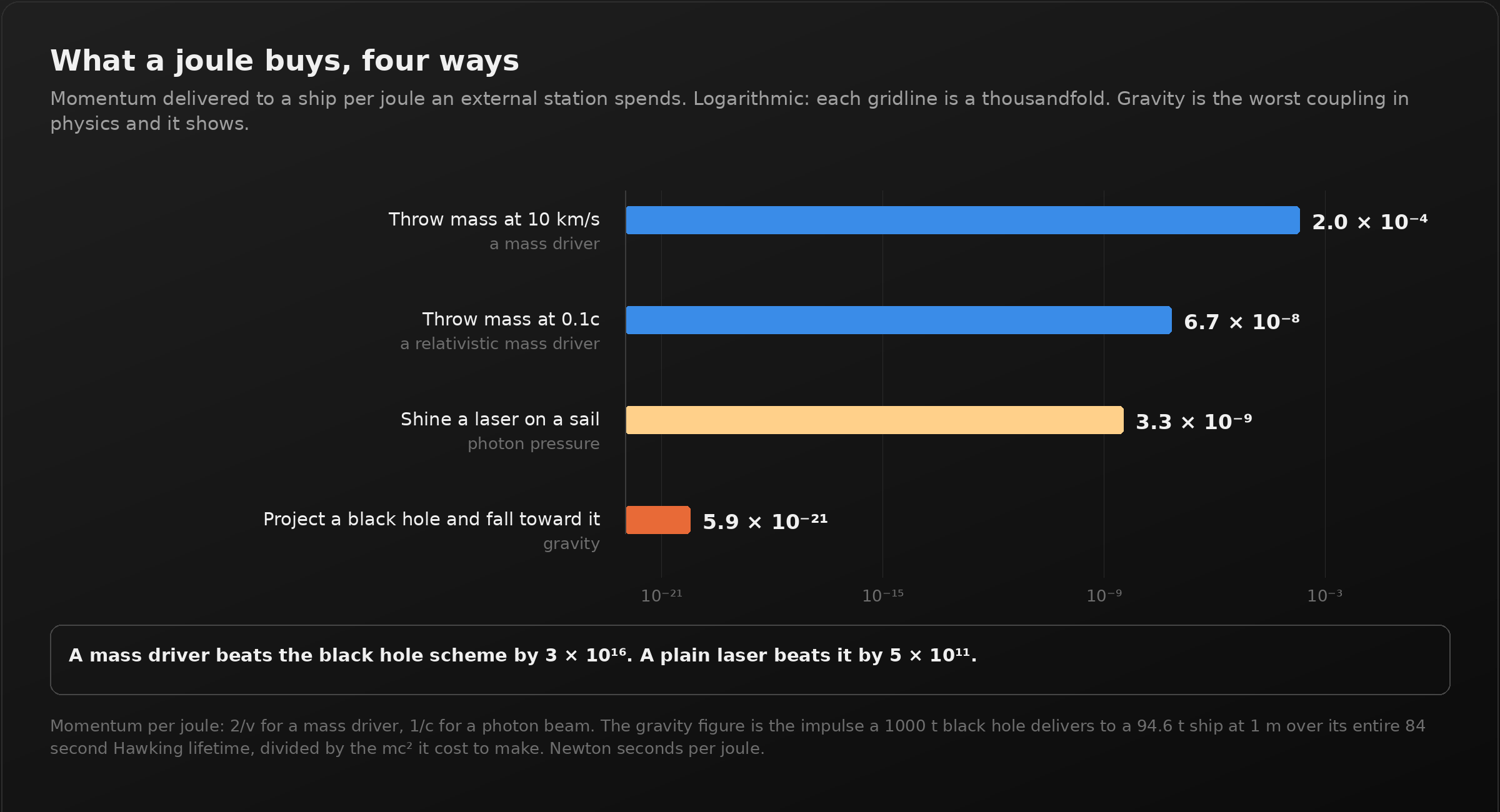
If an external station is going to spend energy pushing you, that table is the whole decision. Gravity is the worst coupling in physics by an enormous margin, and no cleverness about the shape of the source changes it.
And I produced another beautiful piece of nonsense along the way. My script also reported that a billion-kilogram black hole held a metre ahead would give the ship 5.6 × 10⁹ metres per second, which is nineteen times light speed. That number is garbage. It assumed the hole sits politely one metre away for its entire 2,700 year lifetime, when in reality the two fall together and collide in about four seconds. Correct arithmetic on an assumption nobody examined. That is six now, all mine, in two days spent specifically on being careful.
One more thing that kept coming back and never worked: density. A thousand kilograms of water, a thousand kilograms of osmium and a thousand kilograms of neutron star matter all pull with 6.674000 × 10⁻¹⁰ metres per second squared at ten metres. Identical to every digit. The intuition underneath it is buoyancy, where a density difference genuinely does drive motion, but buoyancy needs a pressure gradient in a medium. Space is not a medium. There is no gravitational buoyancy and a density difference creates no gravitational difference at all.
Then the thing that actually works
Look at that chart again and notice the third bar. A laser on a sail beats gravity by five hundred billion, and it has a property none of the others have: the energy source never leaves the ground.
I derived the cost rather than looking it up, because that is the only way to trust it. A perfect mirror receding at β reflects incident energy as (1−β)/(1+β), so integrating the momentum it takes from the beam gives a clean closed form: E = (mc²/2)(γβ + γ − 1).
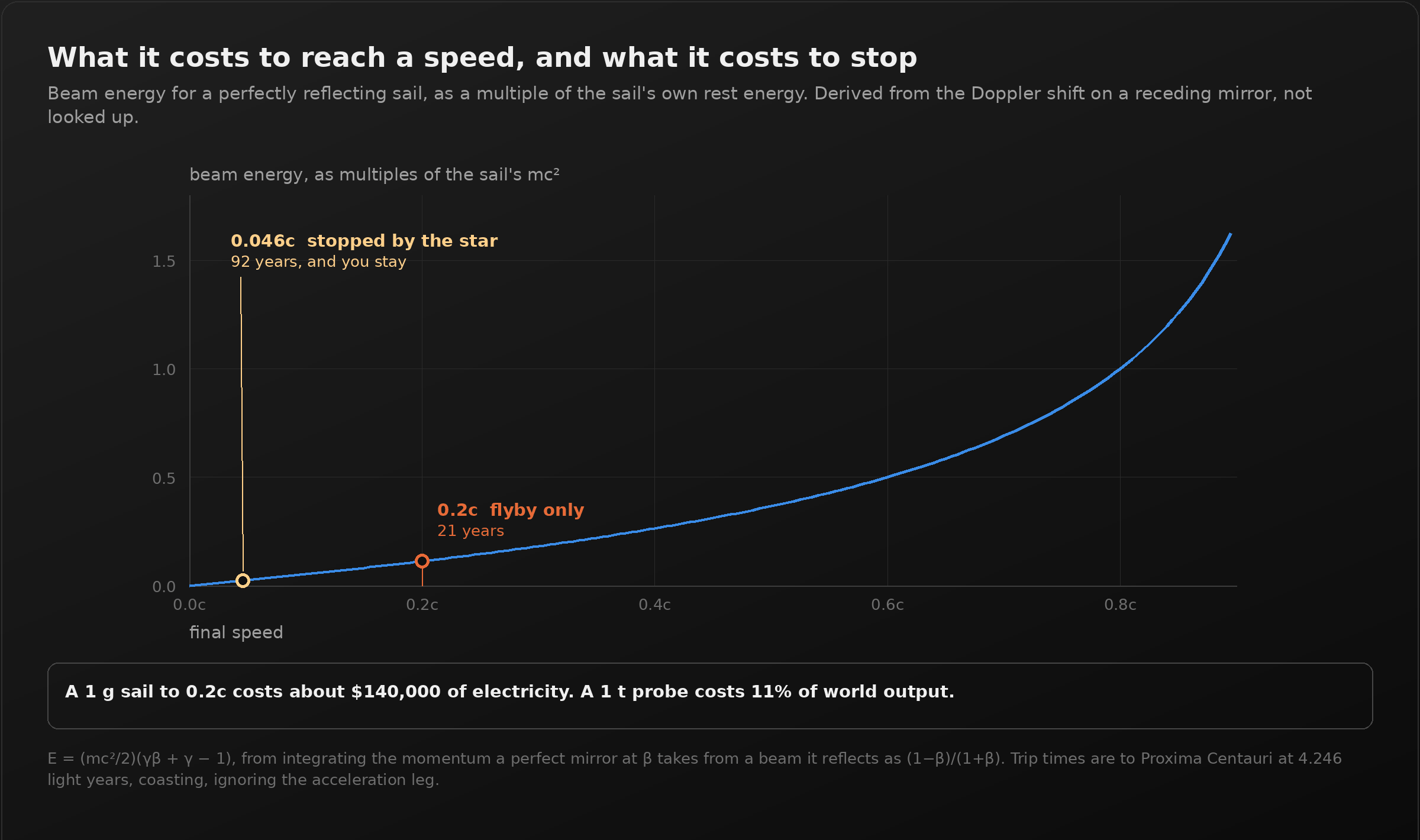
The gram-scale probe is astonishingly cheap. One gram to 0.2c needs 1.0 × 10¹³ joules. At a hundred gigawatts that is a hundred and one seconds of beam, pulling sixty-eight thousand g, and at five cents a kilowatt hour the electricity costs about a hundred and forty thousand dollars. That is a used sports car, for an interstellar probe.
And that is exactly why nobody proposes sending anything larger. The energy scales with mass and nothing else. One kilogram to 0.2c is 2.8 terawatt hours. One tonne is 2,805 terawatt hours, and the world produces about twenty-five thousand a year, so a single tonne is eleven percent of global electricity delivered as a coherent beam.
Against the rocket from the last post, the comparison is not close. The osmium rocket reached 0.0665c carrying 94.6 tonnes of propellant and took sixty-four years. The sail reaches 0.2c carrying nothing and takes twenty-one. Three times faster, and the entire power plant stays on Earth where somebody can maintain it.
The catch, which is that it cannot stop
There is no beam at the far end. Starshot is a flyby: the whole encounter with Proxima lasts about ninety minutes at 0.2c, and then it is past, forever, still going.
The obvious fix is to carry brakes. Attach the sail to a drive core, ride the beam out, then burn the core to decelerate. It is a real hybrid architecture and the instinct behind it is sound.
The trap is that the beam has to accelerate your brakes too.
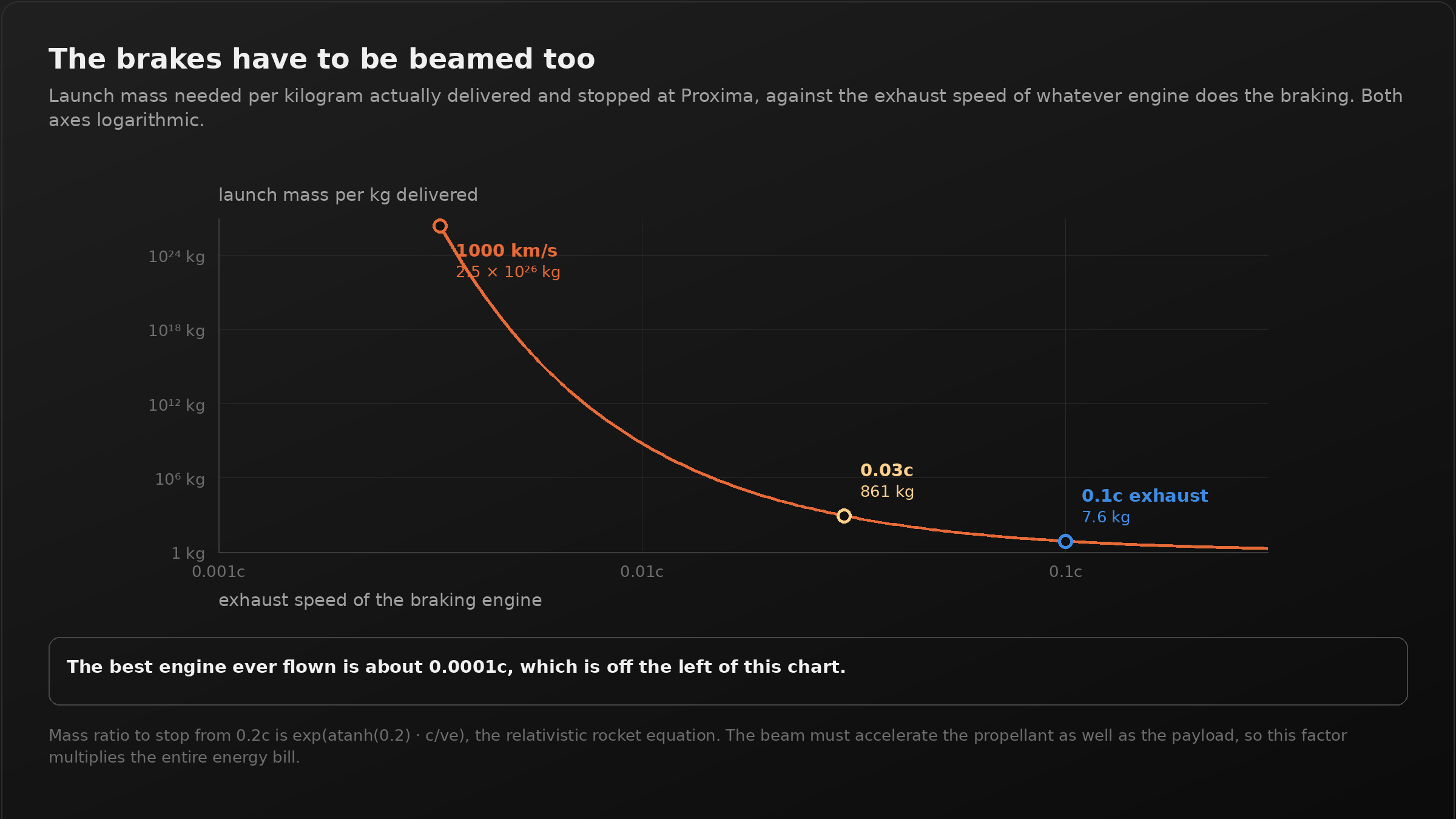
With a 0.1c exhaust the whole thing works: 7.6 kilograms launched per kilogram delivered and stopped, a 7.6 times premium on the energy, which is a perfectly reasonable price. The problem is that nobody has a 0.1c engine. The best thing ever flown is around 0.0001c, and at a generous thousand kilometres a second the mass ratio is 10²⁶, which is not an engineering gap, it is the end of the sentence.
And attaching a heavy core costs you the exact thing the sail was for. Beaming 94.6 tonnes to 0.2c takes 265,000 terawatt hours, about eleven times annual world electricity production. The sail's entire advantage was that the mass stays home, and a core hands it straight back.
How you actually stop: let the destination do it
Heller and Hippke worked this out in 2017, and it is the most elegant thing in the whole subject. A sail arriving at Alpha Centauri can be braked by the stars' own radiation pressure and gravity, using no propellant whatsoever. You turn the place you are going into the brake.
It works, and it has exactly one price: you have to arrive slowly enough to be caught.
| Speed | Proxima in | What you get | |
|---|---|---|---|
| Starshot flyby | 0.200c | 21 years | ninety minutes, then gone |
| Photogravitational capture | 0.046c | 92 years | you stay |
So the real menu is twenty-one years and a glimpse, or ninety-two years and a residency. Both of them beat the sixty-four year rocket in the only way that matters, which is that the fuel never left Earth.
What two days of this actually taught me
Every single idea got priced, and the answer was always the same shape. The universe quotes an exchange rate and does not negotiate. Density bought nothing. Compactness bought nothing. A black hole bought nothing, at a cost of 10²⁷ to one against simply throwing the same mass. Every attempt to make gravity carry momentum lost to a flashlight by eleven orders of magnitude.
And the winner, when it finally turned up, won by removing something rather than adding it. No core. No propellant. No engine. A gram of foil, a power station that stays where you built it, and the patience to wait twenty-one years for ninety minutes of data.
The last post said the rocket wins because something left the ship. The better version is that the best ship is the one that never carried it in the first place.
I still like the core. It was a good instinct and it is a superb thing to throw. It is just that the thing you actually want to throw is light, and you want to throw it from home.