Correction, 23 September 2026. The black hole numbers below assume the hole gives off light and nothing else, and the line about "every kind of particle the theory allows" came from a transcribed range that turned out to be ten times too narrow. I have since computed what a hot hole really gives off. A hundred-year hole weighs 1.85 million tonnes, not 335,000, and gives off 17.5 petawatts, mostly as quarks and gluons rather than light. Its shell needs a metre of tungsten rather than nine centimetres, is 23.7 kilometres in radius, and weighs 73,000 times the hole. The shell also melts as the hole heats, with two thirds of the hole unburnt, so the ship gets 433 metres a second, not 14 kilometres a second. Making the hole is 280,000 years of the world's energy, not 50,000. Every conclusion below stands, and every one got worse. The whole account is in The Black Hole Drive, Taken Apart. The Casimir half of this post is unchanged.
I spent the last two days reading quantum mechanics. I went in with a question from this archive: every exotic drive on this blog stops at a bill for negative energy. A warp bubble a hundred metres across wants half a solar mass of it. A wormhole throat a metre in radius wants a hundred Earths' worth. The engine behind these posts can price those bills, but until now it had never tried to pay one.
When people say "quantum" about a starship, they almost always mean one of two real effects. One is the Casimir effect, which has been measured on a lab bench. The other is Hawking radiation, which theory predicts and nobody has ever seen from a black hole. I built a module for each and priced a drive on each, and the line between measured and predicted turned out to be the most useful thing in either of them.
The one negative energy anybody has measured
Put two mirrors very close together in a vacuum. Empty space is never quite empty: it is full of electromagnetic fluctuations at every wavelength. Between the mirrors, only the wavelengths that fit can exist, so there are fewer of them than outside. The energy between the plates ends up lower than the energy of empty space, which means it is negative, and the plates are pushed together.
It is a small effect until the gap gets tiny: 1.3 millipascals of pull at a micrometre, and about one atmosphere at ten nanometres. It was first measured precisely in 1997, and to about a percent the following year. This is real, and it is the only negative energy density anybody has ever measured.
The engine computes it two ways that share no formula. One is Casimir's closed form. The other literally counts every standing wave that fits between the plates, subtracts the same count with no plates, and removes the cutoff at the end. They agree to six digits.
So I tried to pay a bill with it.
- The density. A one metre wormhole throat needs its negative energy packed densely at the throat. Two plates get that dense only when they are 3 x 10^-18 metres apart, under half a percent of the radius of a proton.
- The total. At a gap matter can actually hold, one nanometre, the total a one metre throat needs fills a hundred million Suns' worth of plates. A hundred metre warp bubble at light speed would need a hundred and seventy billion.
Then the part that settles it. The plates are not free. This is the same lesson as the fuel tank that weighed nothing and the nozzle before it, in a third place. The negative energy only exists because the plates do, so their own mass belongs on the same ledger. I priced them as generously as physics allows: perfect mirrors, which real metals are not at small gaps, and only one atom thick.
Even so, a stack of plates is net positive at every gap matter can make. A nanometre apart, the plates outweigh the vacuum energy between them 160 billion times. They would only break even at 0.19 picometres, which is eighteen hundred times closer than the layers in graphite and well inside the atoms themselves.
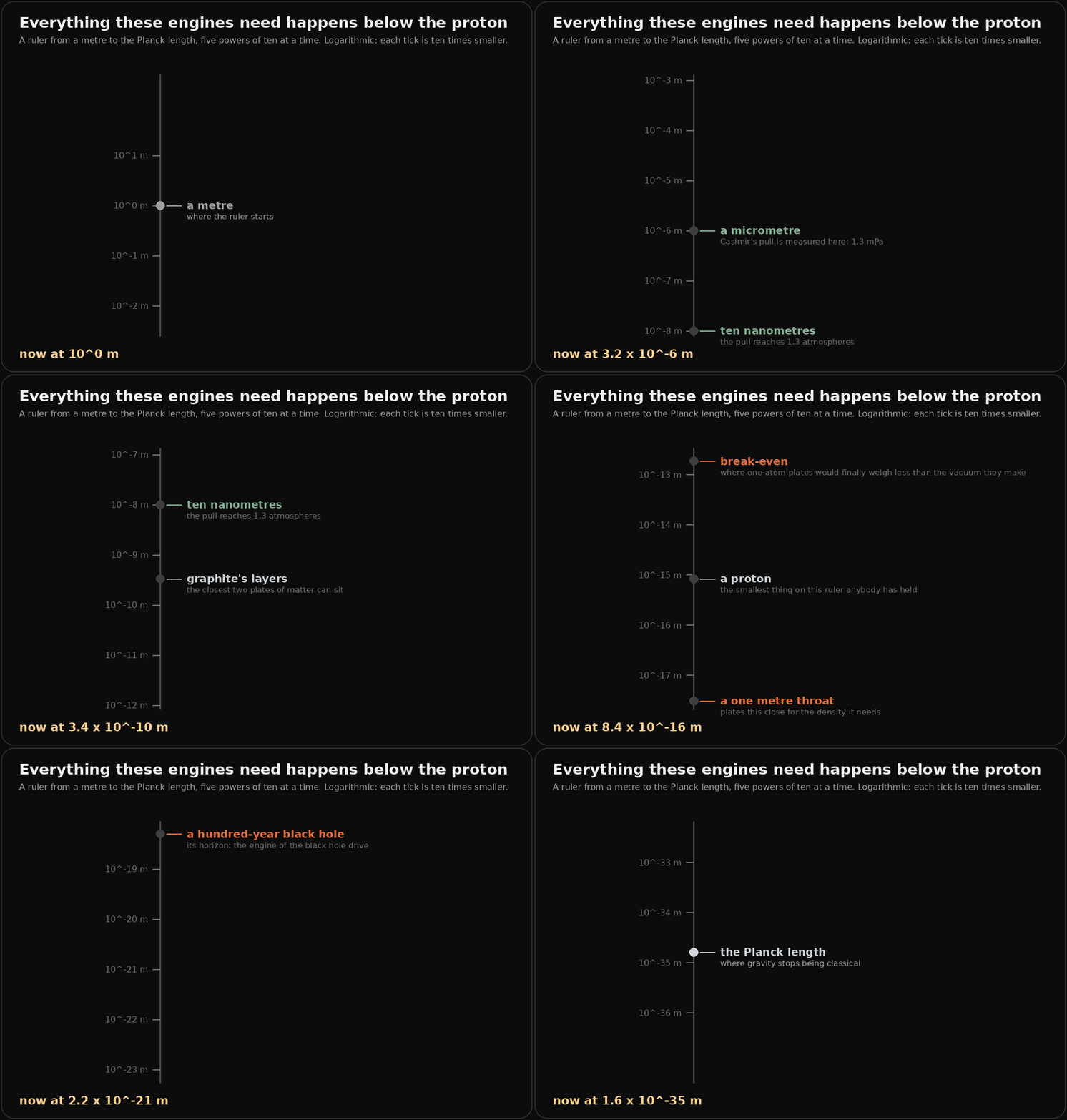
What about negative energy without plates? Quantum theory allows it briefly in empty space, but only briefly: the more negative, the shorter. At the density a one metre throat needs, that limit (the Ford and Roman quantum inequality, which I am quoting rather than deriving) allows about 10^-26 seconds.
The vacuum between mirrors is real and measured. It is not a fuel tank.
A black hole as an engine
The second idea is stranger, and it has been argued seriously in the literature, by Crane and Westmoreland in 2009. A black hole is not completely black. Quantum effects at its edge make it glow, and the smaller it is the hotter it glows. A small enough hole turns all of its mass into radiation. Nothing else in physics does that. Antimatter needs an equal mass of ordinary matter to burn with and loses a large share of its output in directions nobody can aim, which is what finally sank it on this blog.
The catch is the word "predicted". Hawking radiation follows from well tested theory, but nobody has ever observed it from a real black hole. Experiments with artificial horizons in fluids have shown its signature, which supports the mathematics, not the black holes. So every number in this section carries that status, and the module refuses to drop it.
Here is the engine. A hole that burns for exactly a hundred years weighs about 335,000 tonnes, about as much as a large loaded oil tanker. It is half an attometre in radius, a billionth of a billionth of a metre. It gives off 3 petawatts, about 170 times everything humanity uses, as particles of about 90 GeV each. If it emits every kind of particle the theory allows, rather than just light, it runs to 900,000 tonnes and nearly 9 petawatts. The engine carries both ends of that range and only rules something out if it fails at both.
Every figure is again computed two ways: the power from the textbook formula and again as a glowing surface at the hole's temperature, the lifetime in closed form and again by stepping the hole down as it evaporates, the rocket by its equation and again one emission at a time.
The problem is aiming it. The output is gamma rays and heavier particles at tens of GeV, and nothing reflects a photon above about one MeV. It goes into the mirror and turns into an electron and a positron. The only way to point the energy is to catch all of it in a shell around the hole and let the hot shell glow out of its back half.
To shed 3 petawatts at 3000 K, safely below the melting point of tungsten, the shell is 10.5 kilometres in radius. It needs 8.8 centimetres of tungsten to stop the particles, and it weighs 7,000 times as much as the hole it surrounds. Burn the entire hole and the whole thing gains 14 kilometres a second, about half the speed of the Earth round the Sun.
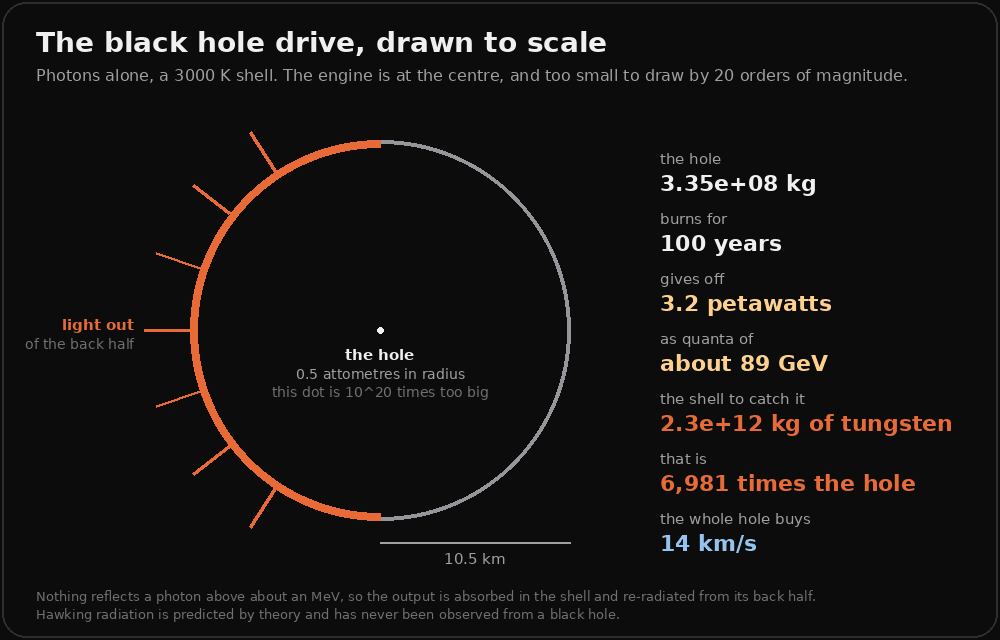
And then making it. The hole's rest energy is fifty thousand years of the world's entire energy use. All of it has to arrive at once inside a radius six ten-thousandths of a proton's, an energy density 10^40 times what the Large Hadron Collider reaches. Once made it cannot be fed to keep it going: it is 1,700 times smaller than a proton, so feeding it means hitting a target far smaller than any atomic nucleus, continuously.
What is still standing is the converter itself. A hole turning mass entirely into energy is the best engine physics describes. It is standing on an effect that has never been seen.
What the two days bought
Both quantum effects are real physics, and both fail as drives in a specific, numbered place:
- Casimir energy is measured and negative, and the plates that make it always outweigh it, by a factor of a hundred billion at a nanometre and at every gap matter can hold.
- A black hole is the perfect converter, on paper, and its output cannot be aimed. The shell that aims it weighs thousands of times more than the hole, and making the hole in the first place is beyond anything we could build or power.
"Pay the warp bill with Casimir plates" is a well formed sentence. It even names a real, measured effect. The ledger is what makes it false, which is the recurring subject of this archive, and why the engine carries the plates on the bill.