In Casimir Plates and a Black Hole Engine, Priced I costed a starship driven by a small black hole. The idea is serious. A hole that small glows, turns all of its mass into radiation, and burns out faster the smaller it gets, so there is a size that lasts exactly as long as a trip.
Those numbers rested on an assumption: that the hole gives off light and nothing else. The post's upper end, for every kind of particle, came from a transcribed range, one to twenty times more than light alone, which I had not checked. So I built the part that computes it. The range was ten times too narrow, and every number in that section of the post moved. Every refusal held, and all of them got worse. Asking what happens over the whole burn, not just at the start, turned up one new refusal. One thing I expected to be a refusal is not one.
What a black hole lets out
Hawking's result says a black hole glows like a hot object, but not quite like one. Everything it makes has to climb out through the curved space around it, and some of it falls back in. How much gets out depends on what the particle is: its spin and its energy. That fraction is called the greybody factor, and getting it means solving the wave equation for each kind of particle around the hole.
I did that for all four spins that matter: 0, 1/2 (neutrinos, electrons, quarks), 1 (light and gluons) and 2 (gravitons). Three checks need no fitted number at all:
- Nothing is created or lost in the solution. What goes in equals what comes out plus what gets through, to a few parts in a hundred thousand.
- At long wavelengths the hole swallows a scalar wave over exactly the area of its horizon. It lands within 0.4 percent.
- At short wavelengths every kind of wave is swallowed over the same area as light: 27 pi M^2, set by the orbit where light can circle the hole. They land within 2 percent.
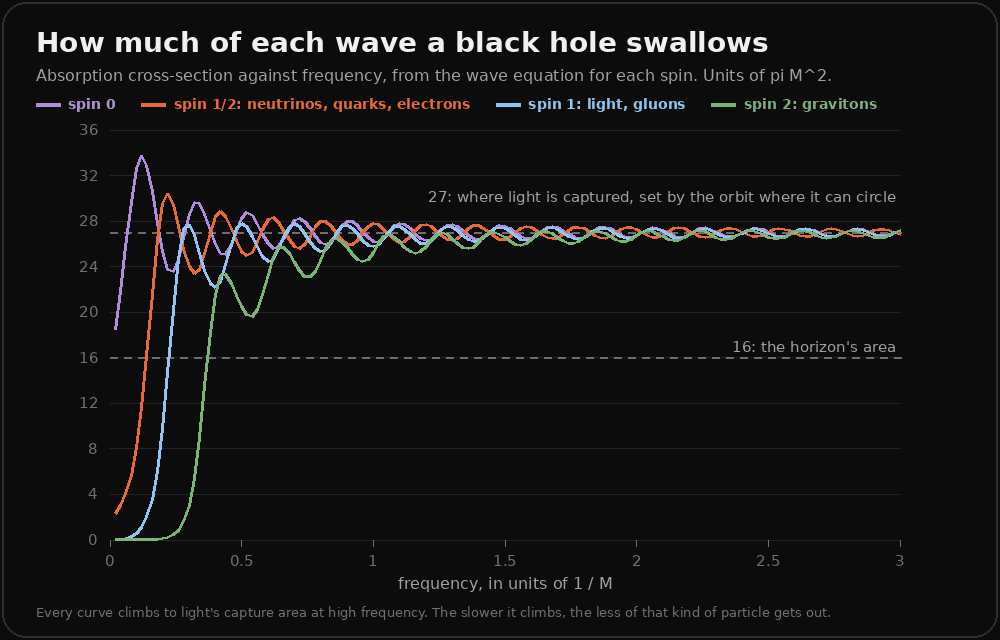
Then the real test. Don Page computed exactly this in 1976, for the particles known then to be massless: neutrinos, light and gravitons. His total power came out at 2.011 x 10^-4 in the natural units of the problem, split 81 percent neutrinos, 17 percent light, 2 percent gravitons. Mine comes out at 2.0114 x 10^-4, split 81.4, 16.7 and 1.9. Nothing was tuned to land there. Add every particle in the Standard Model and the total is 15.5 times what those three give on their own, against a published 15.35 from MacGibbon and Webber's work on hot holes, which I am quoting from memory rather than from the paper.
What a hot hole gives off
A hole that burns for a hundred years runs at 5.7 GeV. That is hot enough to make every particle lighter than a few GeV, and it makes them in proportion to how many ways each can exist. Quarks come in three colours and six flavours, and gluons in eight colours, so they win by numbers.
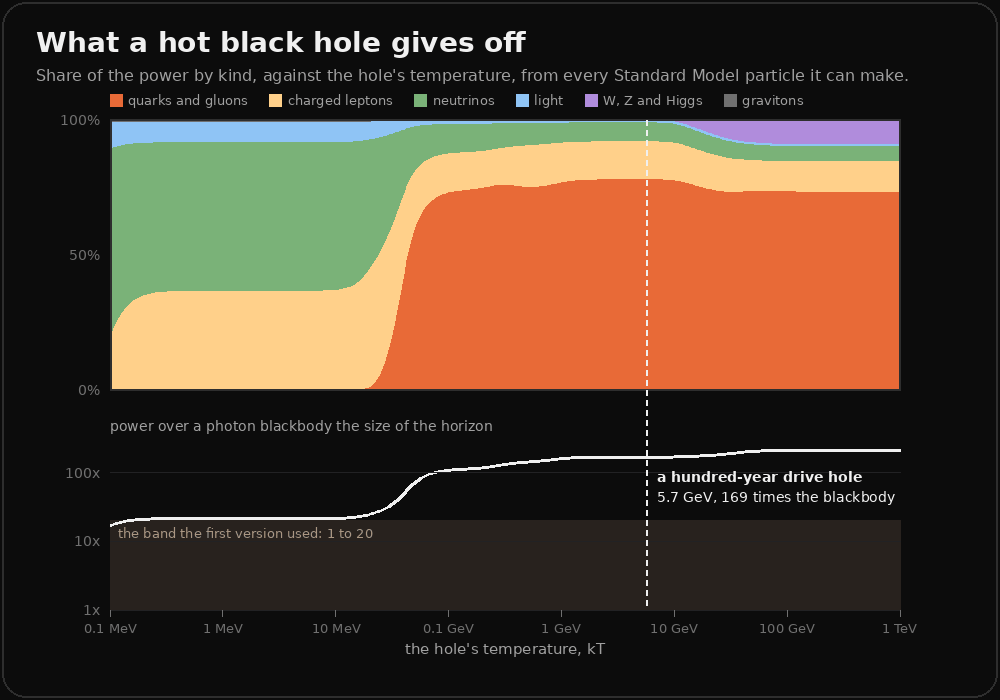
At the drive hole's temperature:
- 78 percent quarks and gluons, which leave as jets of hadrons.
- 14 percent electrons, muons and taus.
- 7 percent neutrinos.
- 1 percent light.
- A tenth of a percent gravitons.
All together it is 169 times what a glowing surface the size of the horizon would give off, which is what the first version assumed. The transcribed range said up to 20. It also claimed drive holes run above a few hundred GeV, when they run near five.
This is the pattern this archive keeps finding. The range was marked unverified. The engine ran every refusal at both ends of it. It still could not notice that both ends were wrong, because a range only protects you from what is inside it.
The engine, recomputed
A hole that radiates 169 times faster has to be heavier to last the same hundred years.
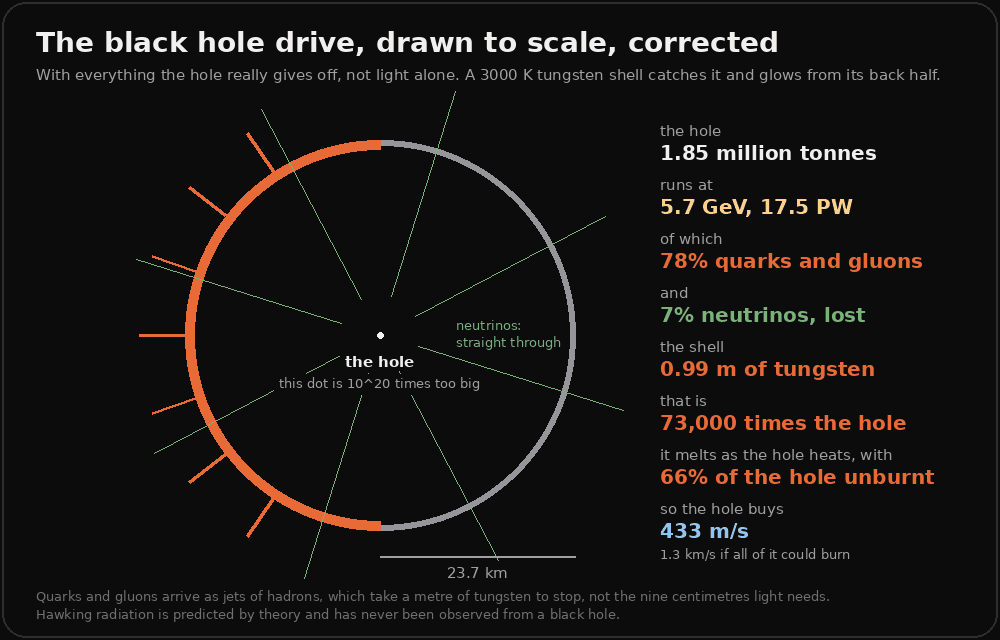
- It weighs 1.85 million tonnes, five and a half times the 335,000 of the light-only version.
- It gives off 17.5 petawatts, about 920 times everything humanity uses.
- Its horizon is 2.8 attometres in radius, 305 times smaller than a proton.
Nothing reflects any of this. The only way to point it is still to catch everything in a shell and let the hot shell glow out of its back half. The output is mostly hadrons, not light, and a hadronic shower takes about ten nuclear interaction lengths to stop. That is a metre of tungsten, not the nine centimetres light needs. To shed the heat at 3000 K, safely under tungsten's melting point, the shell is 23.7 kilometres in radius. It weighs 73,000 times as much as the hole it surrounds.
The 7 percent that is neutrinos goes straight through the shell and the ship and away, and more follows once the jets' pions decay. That share is simply lost.
The shell melts first
This is the new refusal, and it was hiding in my own arithmetic from the start.
Every version of this engine, and the last post, sized the shell for the power the hole gives off when the trip begins, then spent the whole hole into it. But a black hole gets brighter as it shrinks. Its power goes up as one over its mass squared, and faster still as it gets hot enough to make heavier particles. So a shell of fixed size runs hotter every year of the trip.
Designed at 3000 K, the shell reaches tungsten's melting point of 3,695 K when the power has risen 2.3 times. That is 71.6 years into a hundred-year burn, with 66 percent of the hole still unburnt. Spending the whole hole would have bought 1.3 kilometres a second. By the time the shell melts, the ship has 433 metres a second. The first post said 14 kilometres a second.
A bigger shell does not rescue it. Run the shell cooler and it survives longer, but it has to be larger and heavier. Run it hotter and it is lighter but melts sooner. The engine scanned every way of sizing it for a later point in the burn. The best is within a part in two thousand of what a 3000 K shell already does, stopping with about two thirds of the hole left. No temperature beats it.
Then there is what is left: 1.2 million tonnes of black hole, still burning for another 28 years, with 26 billion megatons still to come out and nothing left to catch it.
The engine finds the melting point two ways. One solves for the mass where the shell's heat load reaches the limit. The other steps the hole down through time, watching the shell's temperature, and adds up the speed as it goes. They agree to a part in a million.
Holding it
This is the one I expected to be a refusal, and it is not.
The shell is pushed by the heat it radiates. The hole is not, because it glows the same in every direction. And by Newton's shell theorem, a uniform spherical shell exerts no gravity at all on anything inside it, anywhere inside it. So a uniform ship accelerates away from its own engine. Its back wall reaches the hole in about seven days, and the ship flies off without it.
What can tow the hole is the ship's own gravity, made lopsided on purpose. Put extra mass on the front half of the shell and it pulls the hole forward. 1.7 percent of the shell's mass, about 2.3 billion tonnes, pulls it at exactly the ship's acceleration. The hole's own mass cancels out of that calculation, which surprised me. The engine checks the formula against a sum over thousands of rings of shell.
It does not come free. Earnshaw's theorem says no arrangement of masses holds anything stably in empty space, so the balance has to be steered the whole way. And it has to be re-tuned as it goes, because the extra mass has to grow 2.3 times before the shell melts. That is engineering, not physics, so it stays on the list as standing.
The first number I computed here was a time: how long before the hole drifts out of balance. It said 83 years. That was the rounding error of a zero. For a shell shaped like this, the pull does not change at all near the centre, to first order, so the calculation was dividing by zero. No time is quoted.
Added later the same day: why not give it a charge? The other way to hold a black hole is electric: charge it and pull it with a field. At a billion volts per metre, about what a vacuum gap between metal plates holds before it sparks, the tow needs the charge of 1.5 trillion electrons on the hole. That is a millionth of the most a black hole can carry, so relativity has no objection. The heat does. At 5.7 GeV the hole gives off 450 billion billion electrons, muons and taus every second, counting nothing else, and a charge on it tips that emission toward its own sign. The whole charge is gone in 3.5 trillionths of a second, and a single electron's worth in 5 x 10^-23 seconds. A field a thousand times stronger than any electrode can hold changes nothing. Gravity is the only handle, which is why the lopsided ship is the one way left to hold it.
Buying speed with time
The one thing that does improve is time. A longer burn buys speed in almost exact proportion, because the shell's weight relative to the hole falls as the burn gets longer. Nothing else about the drive gets better. Try it:
To reach 1 percent of light speed, the hole has to burn for about 780,000 years. It weighs 34 million tonnes, and making it takes 5 million years of the world's entire energy use. The widget thuds when you get there, on a phone that can vibrate.
Making it, and the end of the trip
Making the hundred-year hole means putting 280,000 years of the world's energy inside a radius three thousandths of a proton's. That is an energy density nearly 10^39 times what the Large Hadron Collider reaches. It is five and a half times the bill in the last post, because the hole is five and a half times heavier.
It cannot be fed to keep it going: its horizon is 305 times smaller than a proton. It cannot be switched off. And it brightens as it shrinks, all the way down.
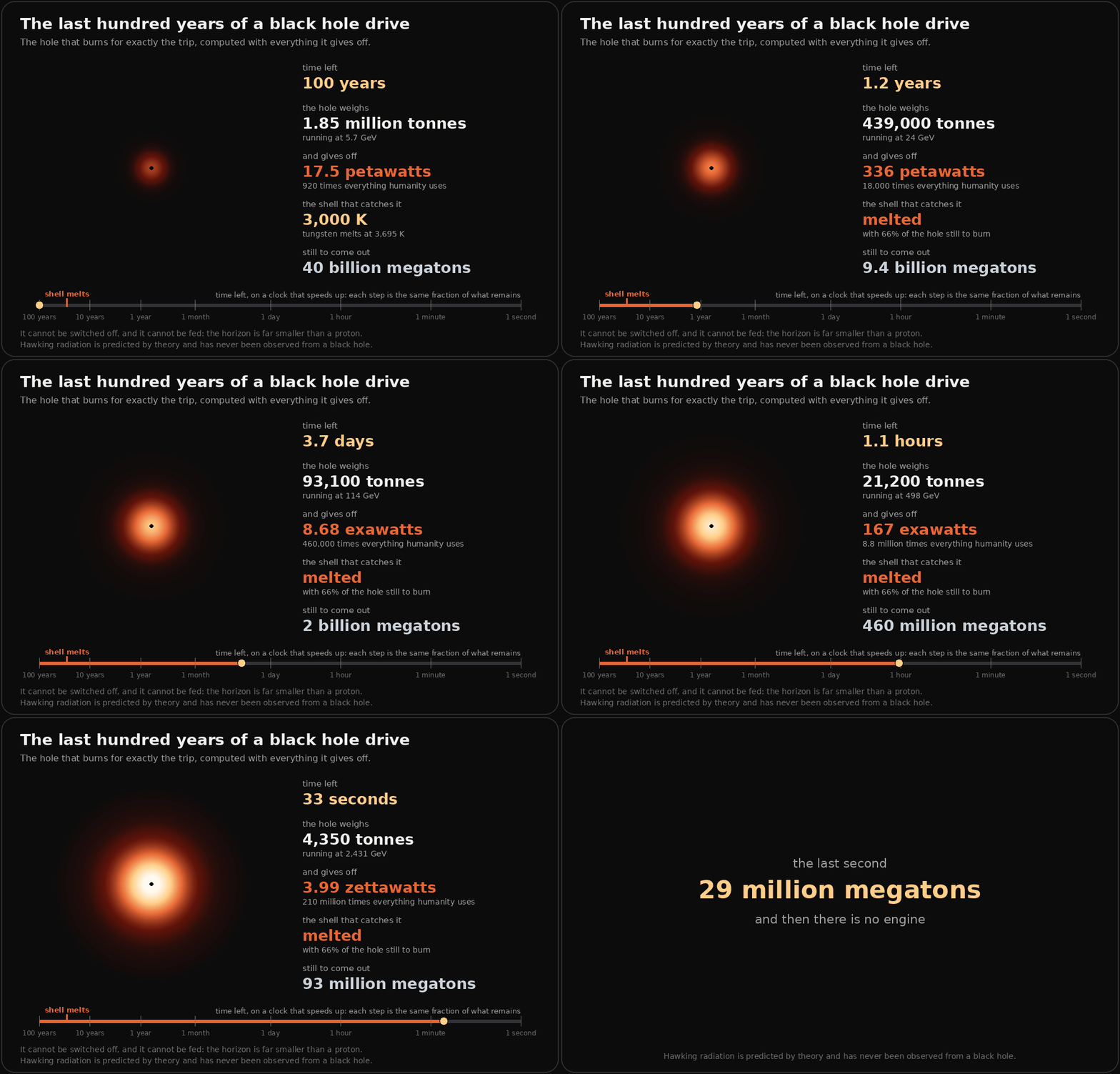
Its last second releases 29 million megatons. Its last day releases 1.3 billion, and its last year 9 billion. That last second does not depend on how big the hole started. Every black hole ends the same way.
What is still standing
All of this rests on Hawking radiation, which is predicted by well tested theory and has never been observed from a black hole. With that said:
- Ruled out: reflecting the exhaust. Nothing reflects a gamma ray, and most of the output is not light.
- Ruled out: aiming it. The shell weighs 73,000 times the hole and melts with two thirds of the hole unburnt, at 433 metres a second.
- Ruled out: making it. 280,000 years of the world's energy, in a space far smaller than a proton.
- Ruled out: ending the trip. It cannot be switched off, and it ends in 29 million megatons.
- Ruled out: holding it by charge. It sheds the charge in 3.5 trillionths of a second.
- Standing: holding it by gravity, with a lopsided ship steered the whole way.
- Standing: the converter. Nothing else in physics turns all of a mass into radiation.
The last post read "burn the entire hole" and gave a speed. That was a well formed answer, in the right units, from a calculation that only ever looked at the first second of the burn. The shell was sized for a moment the engine never stays in. Every number I checked this time at the end of the burn, not just the start, got worse. That is the recurring subject of this archive, and this time it was in the design, not just the data.