Correction, 23 September 2026. The trip times in this post are for the bare engine, with a nozzle and a fuel tank that weigh nothing, and the last line claims Mars is "still a fortnight away" once the nozzle is charged. It is not. The engine's own check says so, and I had not rerun the trips when I wrote that line. With the 689 tonne nozzle and the tank both charged, the engine as drawn arrives and stops at Mars in 38 days at its closest, 55 on an ordinary day and 134 at its farthest, Jupiter in 205 and Saturn in 307, counting the departure from low orbit. (Corrected again on 24 September: these read 54, 133, 203 and 304 until the braking burn was given a tank for its hydrogen; see The Nearest Star, Flown.) That is still several times faster than chemical rockets, and it is a solar system drive rather than a fortnight to Mars. The figure below shows the bare engine and is kept as it was published. How this turned up is in Every Starship Drive We Priced.
Correction, 24 September 2026. The corrected trips above dropped the whole tank before the braking burn, so the brake ran on hydrogen held in no tank at all. With the shells that hold the braking hydrogen kept aboard, the engine as drawn still reaches Mars in 38 days at its closest, and takes 55 on an ordinary day rather than 54, 134 at its farthest rather than 133, and 307 days to Saturn rather than 304. How it turned up is in The Nearest Star, Flown.
The last post ended on the sail winning because it never carried anything. That was right. It was also a flyby, and it left me with the rocket still sitting on the desk, so I spent a day sizing one properly: a fusion core, a hull that runs white hot at 3,000 kelvin, and a module that prices every part of it and refuses what it cannot justify.
Four things came out that are easy to picture. I will keep the arithmetic in the figure captions and the module, and keep the words plain.
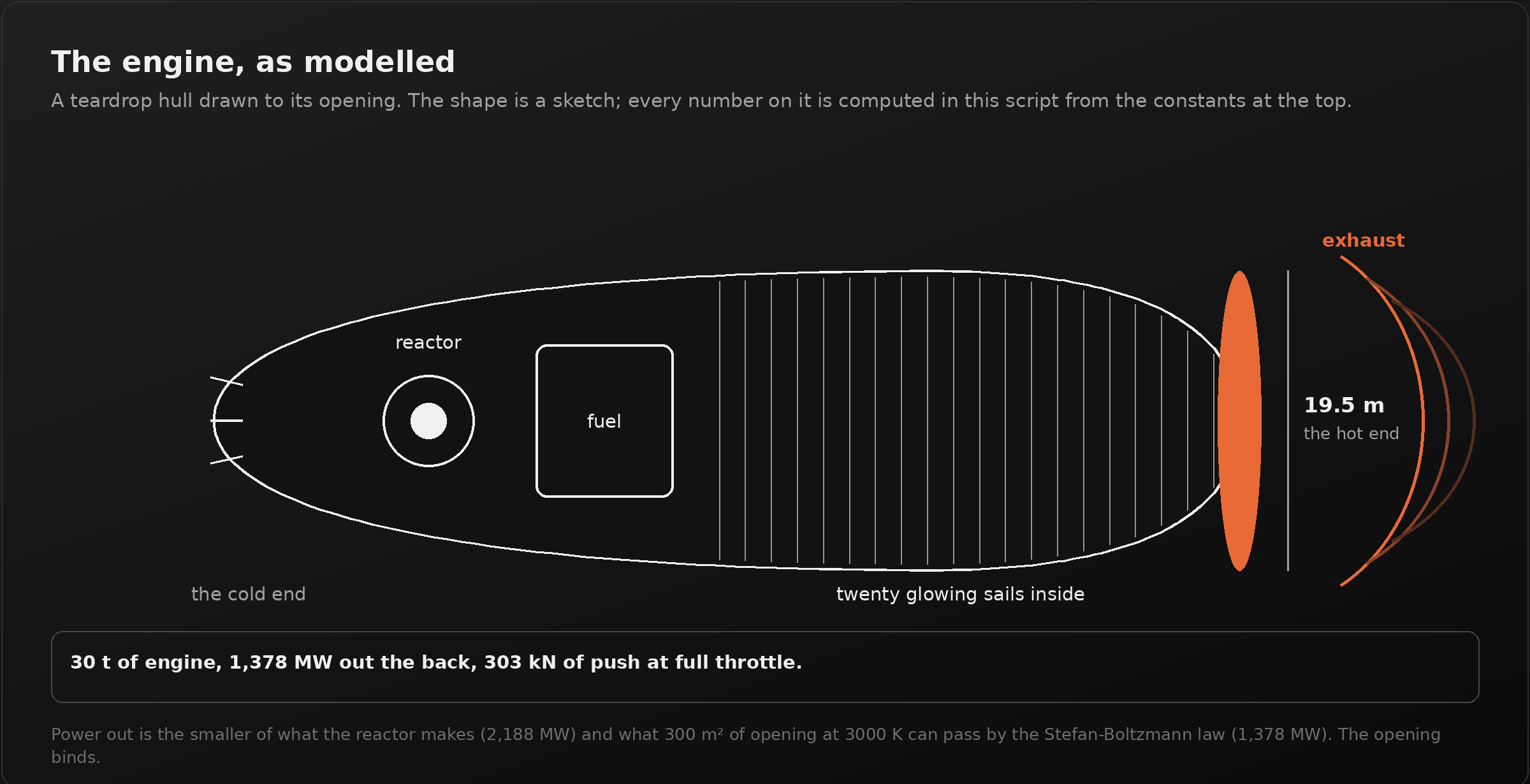
Thirty tonnes. About a power station's worth of output coming out of the back. Roughly one jumbo jet engine's worth of push. The shape is a sketch; every number on it is computed by the script that draws it.
One dial, and the dial is a thumb over a hose
Inside the reactor, atoms fuse and the bits fly out at about 11,800 kilometres a second. That is stupendously fast and almost useless for pushing. A thin stream, however quick, does not shove a ship. It is a needle.
So the engine has a valve. Open it and cold hydrogen pours into that stream, mixes in, and slows the whole thing down. The stream gets fat and slow, and fat and slow is what pushes. Thumb off the hose for a long thin jet; thumb on for a wide spray.
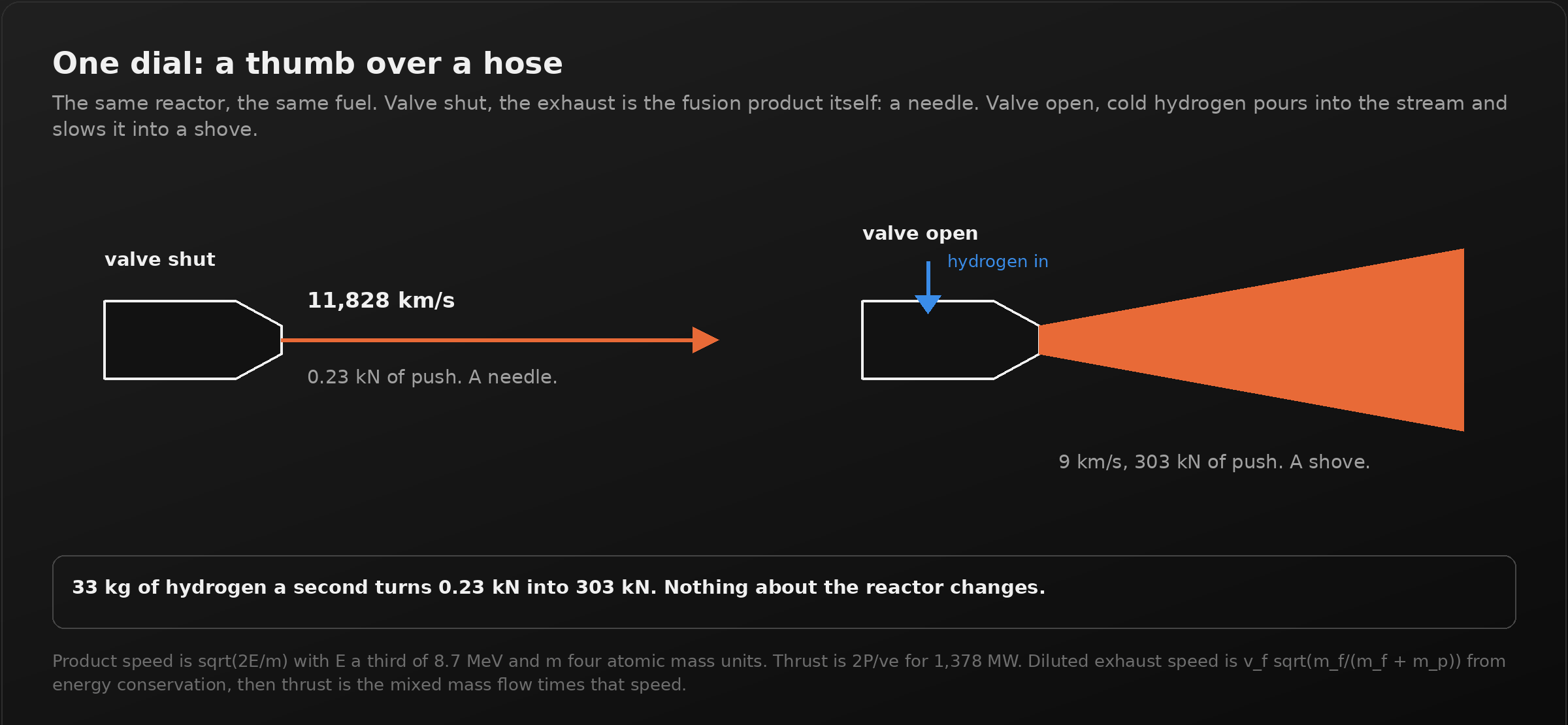
Same reactor, same fuel, one dial. That replaced a much worse idea I had first, which was two different nozzles for the two jobs. A fusion engine does not swap nozzles between a sprint and a cruise. It opens a valve.
Stacking more heaters inside does not help, and the reason is a window
The engine makes its power by glowing. Twenty sails inside the hull run at 3,000 kelvin and radiate like the inside of a kiln. The tempting move, and I made it, is to cram in more sails for more power.
It does not work, and the reason is lovely. Picture a room full of heaters with one small window. However many heaters you add, the window can only let out as much light as a window that size, at that temperature, ever can. If it could do more, you could point it at a second room at the same temperature and warm it for free, and the second law of thermodynamics does not run that way. The extra heaters just warm the walls.
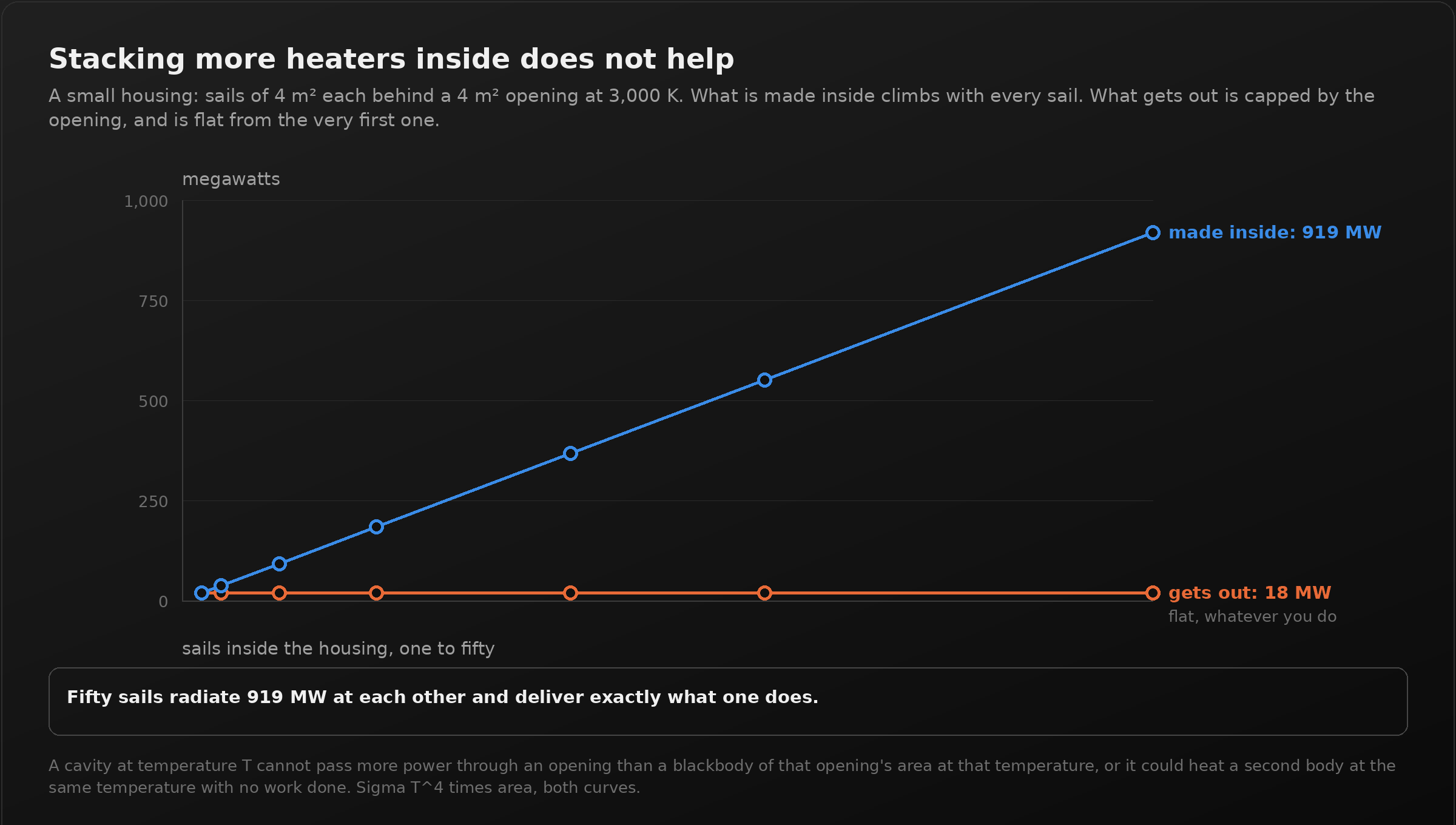
The opening is the engine. The sails set how much power you can make. The opening sets how much can leave. Physics offers exactly two ways to get more out: a bigger window or a hotter room. I had been trying a third.
Burn the same tank slowly and you go forty-five times faster
This is the one that surprised me most. Take one tank of hydrogen. Burn it in five minutes and the exhaust comes out slow, the ship gets a hard brief shove, and it picks up 2.6 kilometres a second. Burn the exact same tank over a week and the exhaust has to come out much faster, the shove is gentle, and the ship picks up 117 kilometres a second.
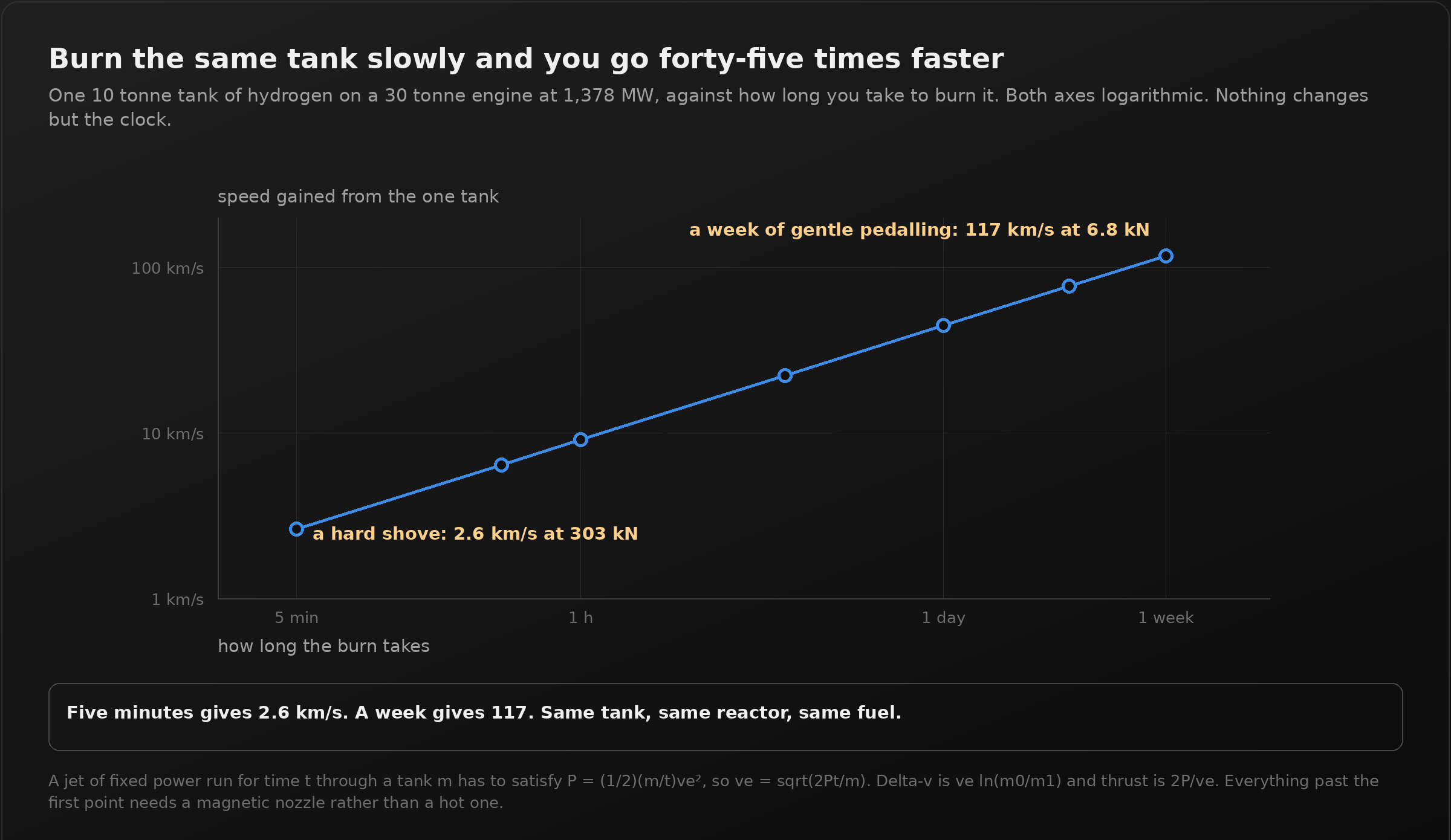
Same tank. Same reactor. Same fuel. The only thing that changed was the clock. For a jet of fixed power, thrust is two times the power divided by the exhaust speed, so a slow burn is a fast exhaust and a fast exhaust is what buys distance. It is the difference between a sprinter and a cyclist who never stops pedalling, and it means a manoeuvring engine and a travel engine are the same hardware with a different schedule.
What that buys, which is the solar system
I had been measuring this engine against the stars, and it kept coming up short. That was the wrong yardstick.
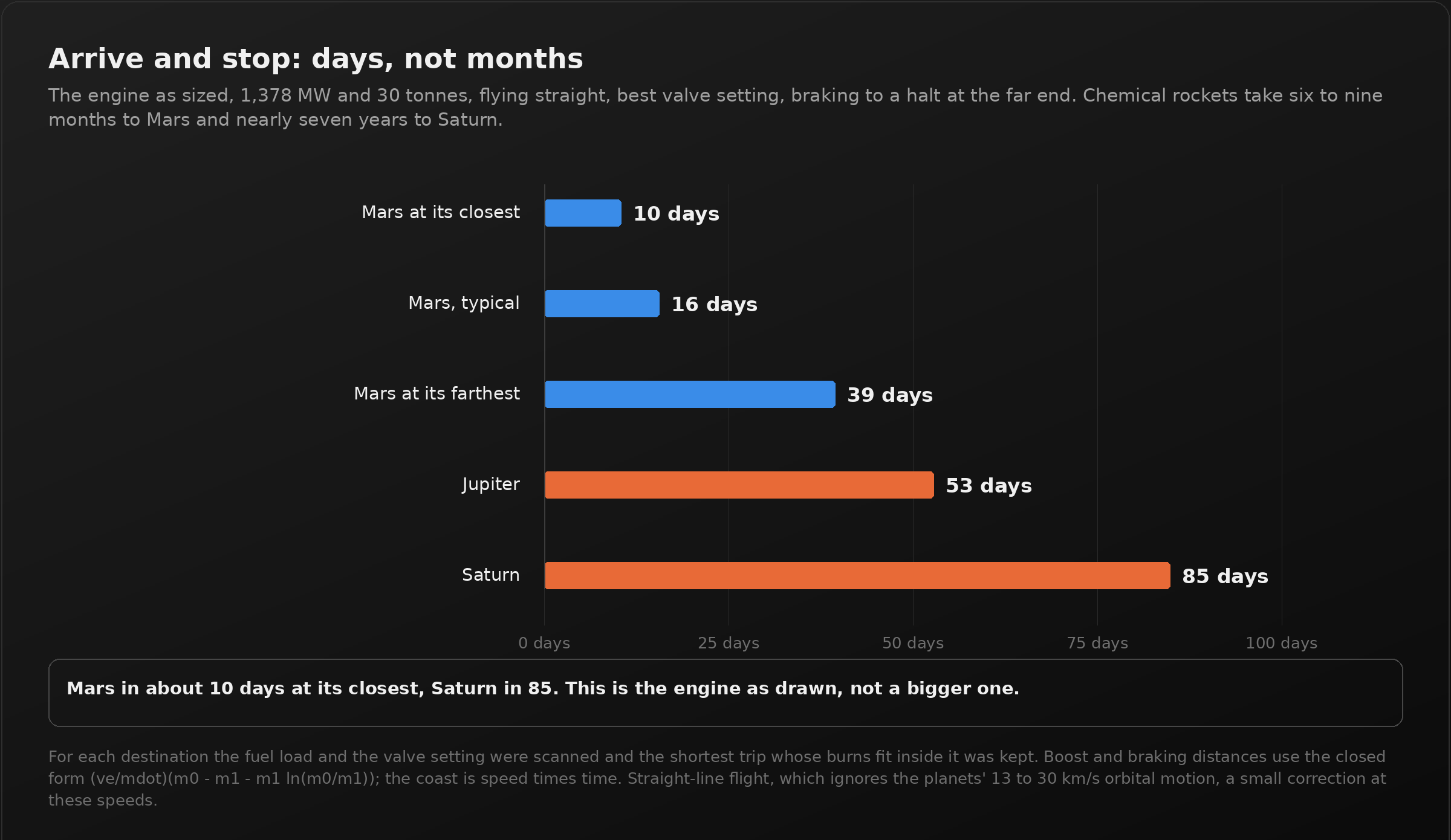
Those are trips that arrive and stop, with the engine exactly as sized, not a bigger one. Ten days to Mars when it is close, sixteen on an ordinary day, and Saturn in under three months. Chemical rockets take six to nine months to Mars and nearly seven years to Saturn. The inner solar system collapses to days and the outer to a season.
What it does not buy, which is the stars
Give the same engine eighty years and point it at the nearest star, four and a quarter light years away. It covers one and a half. It does not arrive. The best flight spends sixty of the eighty years under thrust and coasts the last twenty, and the lever that would change that is not fuel and not speed. It is how much power you can get from each tonne of reactor.
| Power per tonne | Flyby, in 80 years | Arriving and stopping |
|---|---|---|
| The engine as drawn | 1.5 light years | 0.8 |
| Ten times as much | 4.7, past the nearest star | 2.6 |
| A hundred times as much | 9.6, past Sirius | 5.1, stopped at the nearest star |
So it was never an interstellar drive that underperforms. It is a solar system drive that makes Saturn a summer trip, and I had been grading it on the wrong exam.
Two honest footnotes
The engine type is not new. A fusion core whose exhaust you thin or thicken with propellant has been on the drawing board for decades, and proton-boron is the fuel those studies want as well. What is new here is only the way of looking at it: the opening as the thing that matters most, and the valve as a schedule rather than a setting.
Everything above assumes a compact fusion reactor that nobody has built. The arithmetic was checked two ways at every step, and the figures on this page are drawn by a script that recomputes every number from the constants rather than copying them from the text. The reactor was assumed. That is the whole gap between this post and a spaceship.
And the one that belongs to this blog's running theme
Early on, the module told me the engine would pull one gravity. A clean number, well formed, and I liked it enough to write it down. Then I made the nozzle weigh something. Steering a gigawatt of exhaust takes a machine, and the lightest such machine anyone has studied is about half a kilogram per kilowatt. For this engine that is 689 tonnes of nozzle on a 30 tonne engine, and the acceleration falls to four hundredths of a gravity. To keep the one gravity, the nozzle has to weigh about a tonne. My one-gravity figure required a massless nozzle, and it had sat in the results looking exactly like every number around it that was fine.
That is the same shape as the check that refused my own drive and the sail that could not stop: a well formed answer that happens to be false, caught only because something was made to pay for what it had been getting free. The module now charges the nozzle. The figure is gone. Mars is still a fortnight away.