The last two posts made black holes. This one uses the other famous object in general relativity, the wormhole, and asks what happens when you build a lot of them. The idea is a network of stations: one at every nearby star, each a wormhole back to Earth, so that once they are built, reaching any of those stars is a step.
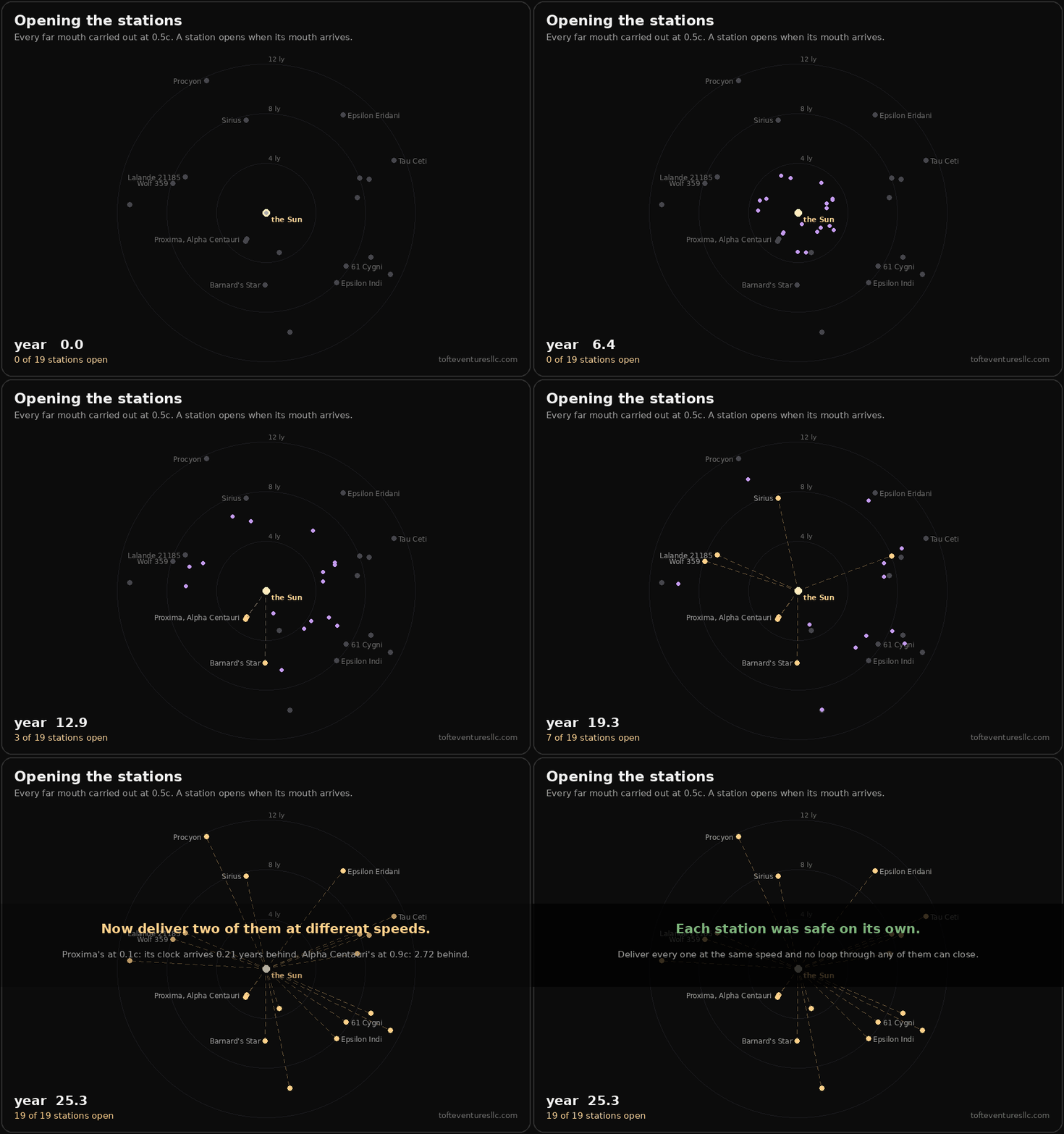
The engine behind this blog already priced a single wormhole, and it settled two facts that decide everything here. The far mouth has to be carried to the far end, at the speed ships actually go. A wormhole joins two mouths, and a mouth at Proxima has to be taken to Proxima, so a wormhole is a shortcut on a route somebody has already flown. The second fact is that the mouth arrives with its clock behind. For one station that is harmless. For a network, it is how you build a time machine without meaning to.
What a station is, and what is granted
A station is a wormhole with one mouth left at home and the other carried out to a star and left there. The delivery is paid once; after that every crossing is free. Four things have to be granted, and I am saying so up front, because none of them is settled:
- Negative energy, a lot of it. A throat needs 113 Earth masses of negative energy for every metre of its radius, which the scorecard listed under "no way to pay". Nineteen stations with one-metre throats need 2,142 Earth masses of it, about seven Jupiters. Shrink the throats to a millimetre and it is still two Earths. The only negative energy anyone has measured is the Casimir effect, and the plates that make it outweigh it by a factor of billions.
- A mouth that can be carried at all. The throat's energy is negative, and the mass a push acts on depends on details of its shape; in the simplest case it is zero. The engine records that as not computable rather than guessing.
- A throat short enough that crossing takes no time.
- Stars that keep still. Their own motions are ignored.
Everything below is kinematics on top of those four.
The delivery has to stop
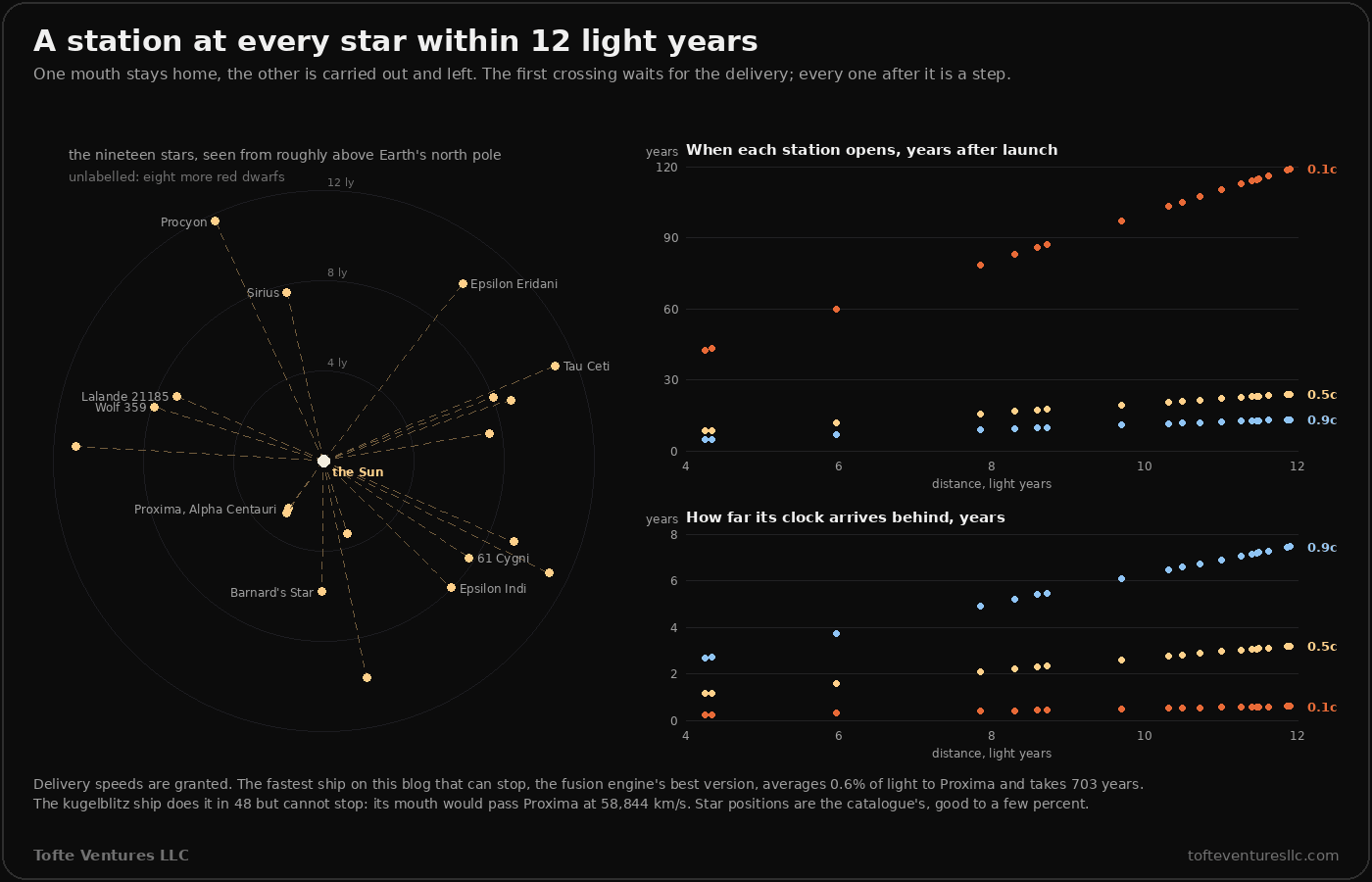
A delivery speed of half the speed of light is a grant too. The fastest ship on this blog that can stop at Proxima is the fusion engine's best version, and it takes 703 years, averaging 0.6 percent of light. The kugelblitz ship passes Proxima in 48 years at a fifth of light speed, but a black hole cannot be switched off, so it cannot stop. Its mouth would go past Proxima at 58,844 kilometres a second. Stepping out of it at the star would carry the kinetic energy of 426,000 tonnes of TNT for every kilogram of you. That is a doorway you cannot use.
So the speeds in this post, 0.1, 0.5 and 0.9 of light, are granted the way the negative energy is. What follows is what the network does if you have them.
One station can never loop
A mouth carried at speed ages less than the one left at home, which is the twin paradox with a wormhole as the twin. Carried to Proxima at 0.9c, the mouth arrives 4.72 years after it left, having aged 2.06 years. Its clock is 2.66 years behind the home mouth's, and the throat joins the two clocks. Step in at Proxima when its clock reads some date and you step out at home on that same date by the home clock, which is 2.66 years earlier than it is at Proxima in Earth's frame.
That sounds like a time machine, and on its own it is not one. To use it you first have to get to Proxima the ordinary way, which takes at least 4.25 years at light speed. Coming back 2.66 years early after a journey of 4.25 still gets you home a year and a half after you left. For a loop, the lag would have to be longer than the distance in light years, which means more than a year of lag per light year carried.
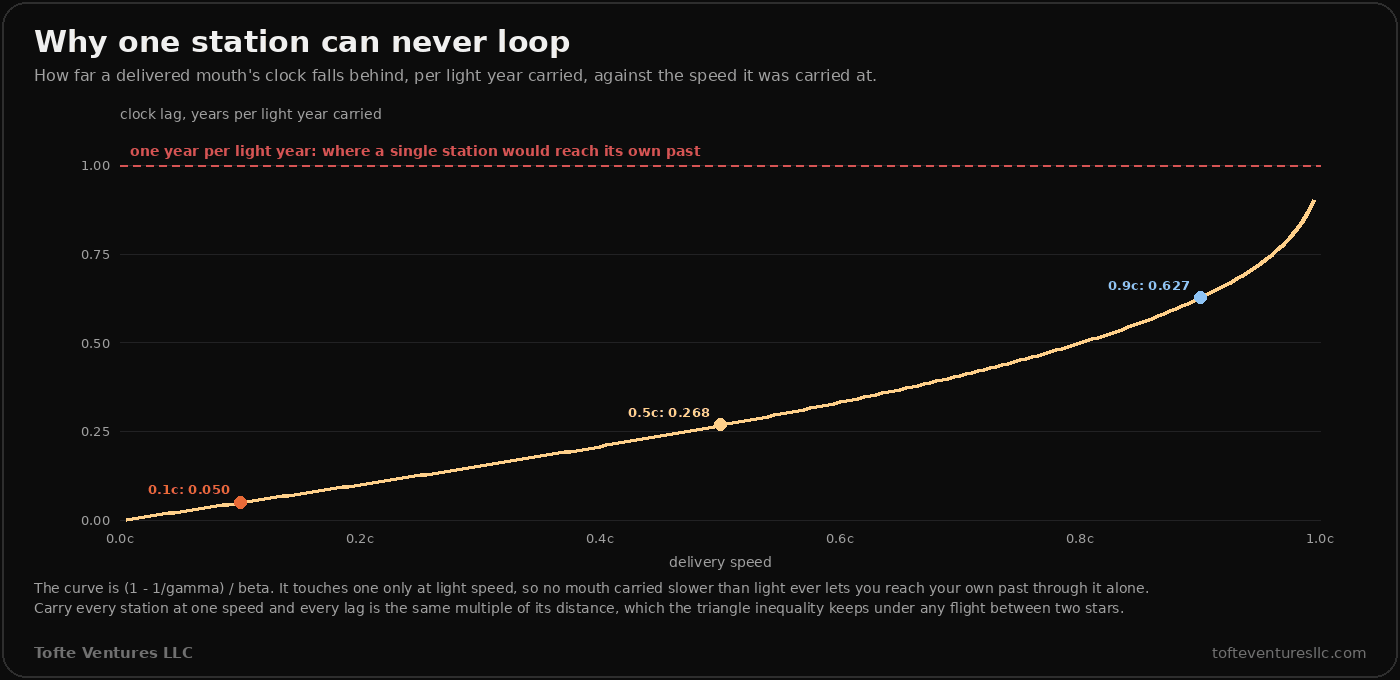
The lag per light year is (1 − 1/γ)/β, and it reaches one only at light speed. At 0.99c it is 0.87. So no station delivered slower than light can take you into your own past through it alone, at any distance. The engine checks it by scanning a thousand speeds, and against the same scan in the wormhole module it was built on.
What does make a time machine is bringing the mouth back. The mouths are then close together, the flight between them takes no time, and any lag at all closes a loop. That is how Morris, Thorne and Yurtsever turned a wormhole into a time machine in 1988. The answer for stations is to leave each mouth where it lands.
Two stations can
Now build two. Proxima's far mouth was carried at 0.1c, so its clock is 0.21 years behind. Alpha Centauri's was carried at 0.9c, so its clock is 2.72 years behind. The two stars are 0.19 light years apart.
- Leave home at year 0 and step through Proxima's station. You come out at Proxima at year +0.21.
- Fly the 0.19 light years to Alpha Centauri at light speed, the best case. It is now year +0.40.
- Step back through Alpha Centauri's station. You arrive home at year -2.32, before you left.
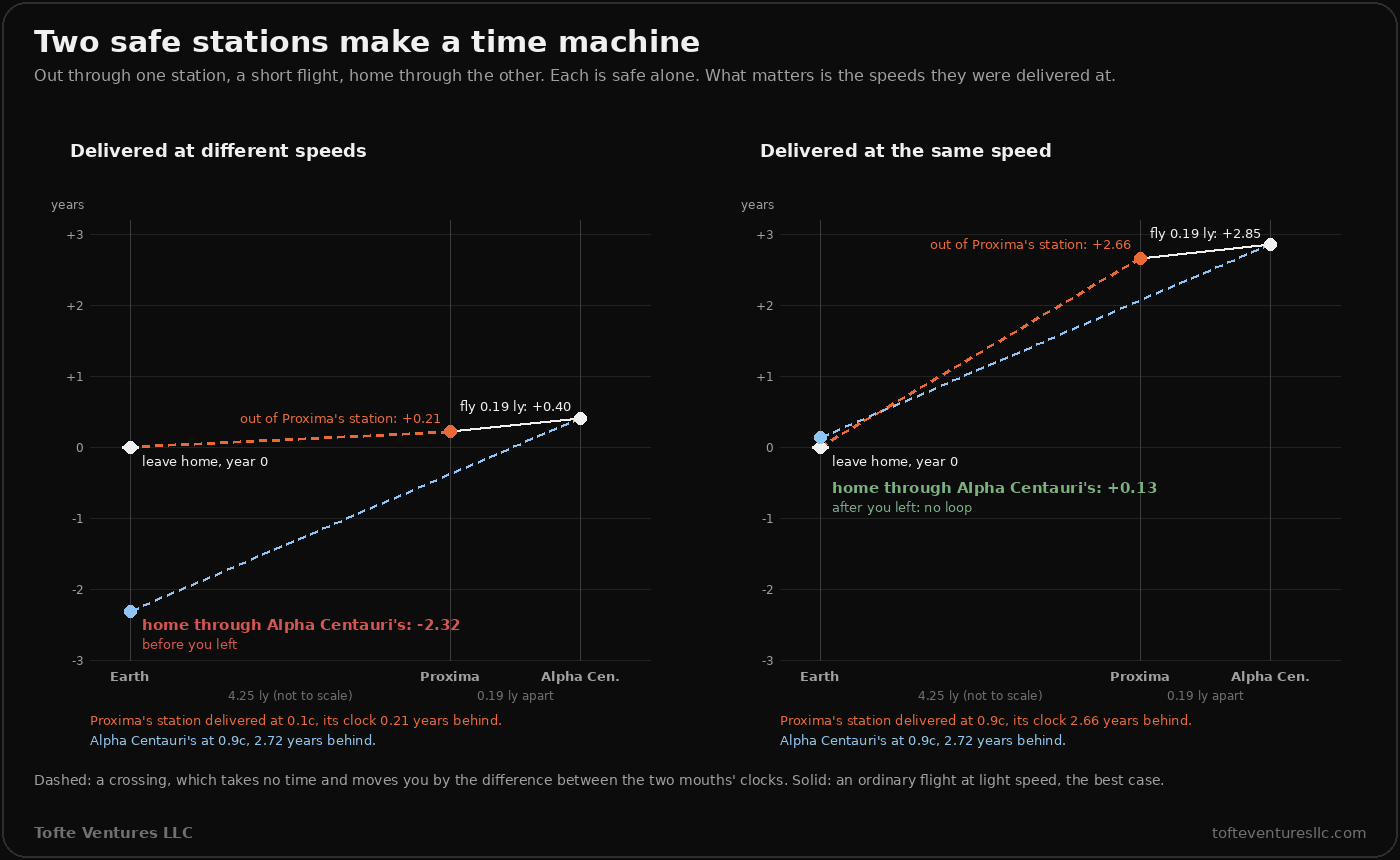
Neither station does anything strange on its own. Each passes the one-station check with room to spare. The trouble is between them. The round trip lands the first station's lag, plus the flight, minus the second station's lag after it began, and when two stations are close together and were delivered at different speeds, that goes negative. Two stations at the same star, delivered at 0.1c and 0.5c, loop by the whole difference in their lags, 0.92 years, with no flight at all.
Build the whole neighbourhood with alternating speeds, 0.9c and 0.1c, and 6 of the 171 pairs loop, the worst by 2.25 years. The engine checks every pair and then, separately, searches every possible loop through home and any number of stations for one that arrives before it left. On 400 random networks at mixed speeds the two checks agreed every time, and 38 of those networks were time machines.
This turned out to be known. Matt Visser described it in 1997 as a "Roman ring", after Tom Roman: wormholes arranged so that no subset of them is close to making a time machine while the whole set is. I found it by pricing stations. Visser had published it nearly thirty years earlier.
What the trip would look like
I rendered the trip, and every sky in it is worked out for where the camera is and how fast it is moving. Stepping out of Proxima's station, it is year +0.21 by Earth's calendar. The station is parked 0.05 astronomical units from Proxima, near the orbit of its one known planet (a choice, not a requirement). From there Proxima is a red disc 1.6 degrees across, three full Moons wide. The brightest point in the sky is Alpha Centauri A and B together at magnitude −7.1, brighter than Venus ever gets from Earth. The Sun is magnitude 0.4, about as bright as Procyon looks from here: one more star.
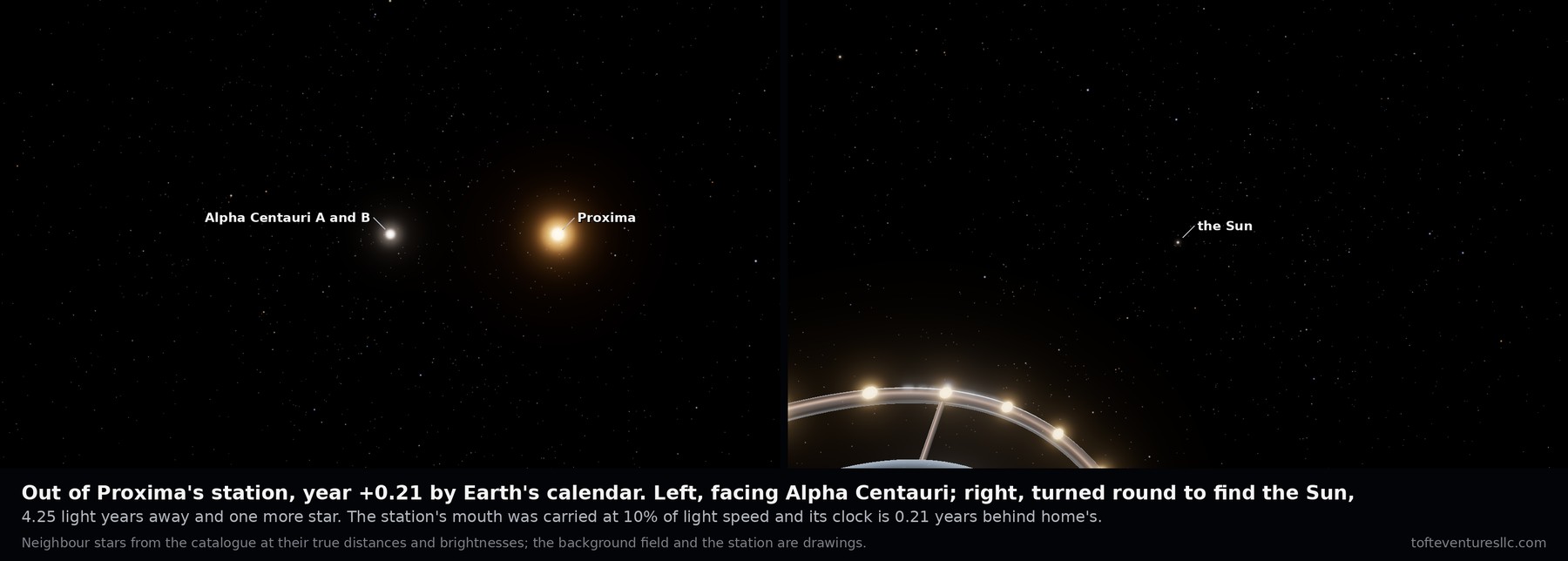
The flight from Proxima to Alpha Centauri, at 99 percent of light speed, takes 0.19 years by Earth's calendar and ten days on board. Ahead, the stars crowd into a small blue cluster, the same effect the kugelblitz cinematic shows at much higher speed. Alpha Centauri's station is parked where A shines exactly as brightly as our Sun does from Earth. Step through it, and you are home at year −2.317. It is not quite −2.319, because the flight took a little longer than light would.
One rule stops it
Carry every mouth at the same speed. Then every lag is the same multiple of its station's distance, a fixed fraction of a year per light year and always under one. The difference between two stations' lags is that fraction times the difference in their distances from Earth. That difference can never exceed the distance between the two stars, by the triangle inequality, so the flight between them always takes longer than the lags can give back. No loop through any number of stations can close.
All nineteen stars at 0.5c: the closest any round trip comes is 0.16 years after it left, out through Proxima and back through Alpha Centauri. At 0.1c it is 0.19; at 0.9c it is 0.13. In 400 random networks where each network used a single speed, none was a time machine.
The rule is a policy, not a law of physics, and it is the opposite of what would happen by default. Ships get faster. A network built over centuries would have its first stations delivered by slow ships and later ones by fast ones, and that is exactly the mixture that loops. Mixed speeds do not always make a time machine. They make one when two stations are close together and their lags differ by more than the distance between them, and Proxima and Alpha Centauri are the closest pair there is.
Does physics allow it?
In 1992 Stephen Hawking proposed the chronology protection conjecture: that the laws of physics prevent time machines from forming, perhaps because quantum fluctuations circulating through the loop build up without limit as it is about to close. It is a conjecture, and it is still argued about. Visser's point about the ring was that each wormhole stays far from the danger, so the fluctuations in any one of them stay small, which makes protection harder to invoke.
None of that is arithmetic, and the engine does not pretend to settle it. What it does settle is that the question only comes up if you mix speeds. A network built to the one-speed rule never gets near it.
Build your own network
Tap a star to change the speed its mouth was carried at, or pick a preset. The widget runs the same module as the figures on the same star positions. It checks every pair, then searches every loop the second way, and draws the worst round trip on the map. Slide the throat radius to see the negative energy bill. It thuds on a phone when a change turns the network into a time machine.
What the network teaches
Every station in the time machine passes every check you can run on it alone. Its lag is under a year per light year, and it could never take anyone into their own past. That verdict is correct and well formed. The network is still a time machine, and nothing about any single station says so. The check has to be run on the network, because that is where the failure is.
The rest stays granted. That includes 2,142 Earth masses of negative energy for nineteen person-sized throats, mouths that can somehow be carried, and ships that can stop at a fraction of light speed when the best one here averages 0.6 percent. Nobody has made a wormhole. The clocks are the part that is ordinary relativity, and it is the part that shows up first.