The black hole drive on this blog has an awkward shape. The hole is the engine and the fuel at once, it weighs 1.85 million tonnes, and the ship has to drag it the whole way (The Black Hole Drive, Taken Apart). The obvious question is why carry it at all. Why not make the hole when you need it, or keep it stored as something lighter until then?
The idea is real, and it has a name. A black hole made from light is called a kugelblitz, German for ball lightning. Light carries energy, energy has weight, and enough of it in a small enough space collapses into a horizon, whatever it started as. Crane and Westmoreland's 2009 black hole starship proposal assumed the hole would be made this way, with an enormous gamma-ray laser.
So I added the part of the engine that prices it, and then did something this blog does not usually do. I granted every step that fails and flew the ship, to see what it would look like if it worked.
Storing it saves nothing
Start with the cheapest-sounding version: keep the hole as energy in some compact store and make it later. The store weighs exactly what the hole does. Energy has mass, E = mc², and that holds for energy in a battery or a flywheel as much as for anything else. A store holding 1.67 × 10^26 joules weighs 1.85 billion kilograms. The engine calculates that directly (the store's mass is its energy over c²) and the test suite requires it to equal the hole's.
Storing it as information does not get round this. A description of a hole is not a hole. The mass has to be turned into energy at some point, and that energy weighs the same.
So making it on board does not save any mass. The only version that helps is making it somewhere that is not the ship, from energy the ship never carries: sunlight, at home. That is the one priced here.
The power does not depend on the hole
Making a horizon has one hard condition: all the energy has to be inside the horizon's radius at once. Light arriving as a shell closing in on a point is only all inside a radius r if the shell is thinner than r, so the whole pulse has to arrive within one light-crossing time of the hole it is making. For the drive hole that radius is 2.75 × 10^-18 metres, a three-hundredth of a proton's, and the pulse has to be 9.2 × 10^-27 seconds long. The shortest pulse of light anyone has made lasted about 43 attoseconds. This one is five billion times shorter.
Divide the energy by that time and something odd happens. The energy is Mc². The time is the radius over c, which is 2GM/c³. The mass cancels, and the power is c⁵/2G, 1.8 × 10^52 watts, for a hole of any size. A bigger hole takes more light but is allowed a longer pulse, in exact proportion. A one-kilogram hole and one the mass of the Earth need the same wattage.
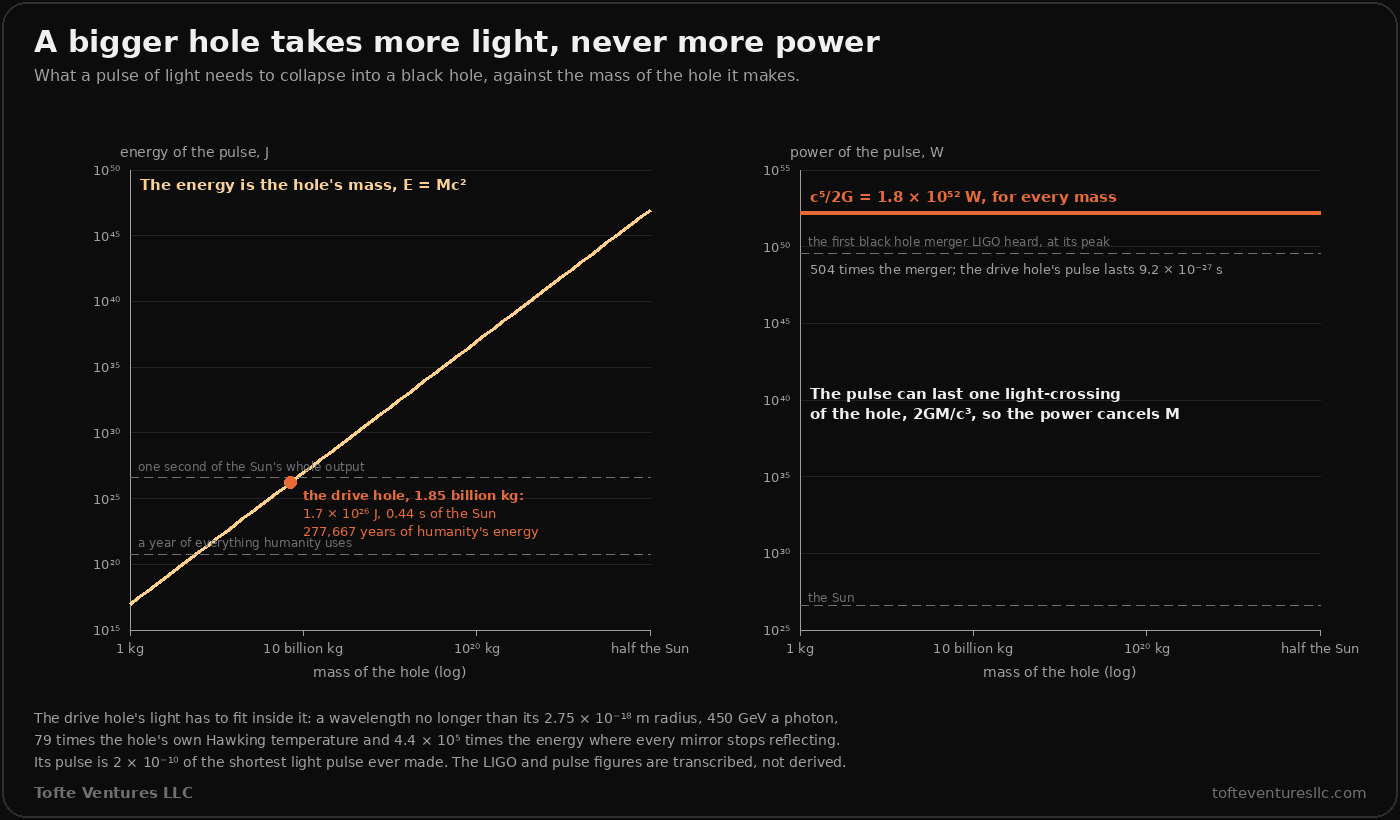
For scale: 1.8 × 10^52 watts is 47 trillion trillion times the Sun's output, and about 500 times the peak of GW150914, the first black hole merger LIGO detected, an event usually described as briefly outshining every star in the observable universe put together. It is also exactly half of c⁵/G, the Planck power, the scale at which gravity is thought to cap how bright anything can be, give or take a small factor. The engine builds the Planck power a second way, from the Planck energy and Planck time, and requires the two to agree. That fits: the pulse's whole job is to be concentrated enough to make a horizon, so it lands right at the scale where gravity starts to limit brightness itself.
The LIGO peak and the attosecond record are the only two numbers here the engine did not calculate. They are typed in and marked unverified in the code.
The light it has to be made of
The light has to fit inside the hole it is making, so its wavelength can be no longer than the horizon's radius. That fixes a minimum energy per photon: at least 450 GeV a photon, gamma rays harder than anything a laser has made.
The engine checks that number a second way, and the second way turned up a ratio I did not expect. The hole will give off Hawking radiation at a temperature of 5.7 GeV. The light that makes it is 8π², about 79, times hotter per photon than the light it gives off. That ratio contains no mass, so it is the same for every hole ever made this way.
That light also cannot be focused by anything. A mirror works up to about an MeV. Above that, a photon hitting the mirror turns into an electron and a positron instead of bouncing off. These photons carry 440,000 times that. And even ignoring mirrors, diffraction rules out aiming from a distance. Focusing light of wavelength λ into a spot the size of λ needs an aperture wider than the distance to the target: 1.22 times it. The emitters cannot be to one side. They have to surround the target on every side, firing inward, with their timing matched to 10^-26 seconds.
The energy is not the hard part
This surprised me. The energy is reachable, on paper. The whole Sun puts out the drive hole's worth in 0.44 seconds. A swarm of collectors catching a thousandth of the Sun's output gathers it in 7 minutes. All the sunlight that lands on Earth gathers it in 30.4 years.
What is out of reach is the release. Seven minutes of collecting has to be let out in 9.2 × 10^-27 seconds, a compression of 5 × 10^28. Every one of the problems above is really this one.
Try it. Pick a mass and watch the three bars. They share a single scale, so the energy and the pulse length slide together by the same distance and the power does not move.
At about 8 × 10^14 kilograms, the photons drop below the pair threshold, so in principle a mirror could reflect them. The widget thuds there on a phone that can vibrate. By then the hole weighs 440,000 times the drive hole, and is far too cold and too long-lived to be an engine.
There is also a published argument that none of this can be done at any size that matters. In 2024 Álvarez-Domínguez, Garay, Martín-Martínez and Polo-Gómez argued in Physical Review Letters ("No Black Holes from Light") that light this concentrated turns into electron-positron pairs first. The pairs carry the energy away before a horizon can form, for any hole between 10^-29 and 10^8 metres in radius. The drive hole is well inside that range. A published comment disputes the result and the authors have replied. I have not reproduced that calculation, and the engine does not include it, so its bill above is the cheapest possible one: it assumes the pulse does not lose energy on the way in.
Granted all of it
Now suppose it all works. Here is the list the engine attaches to the result:
- Granted: the hole is made, and the kugelblitz bill is waived.
- Granted: it is towed without being lost, which in the real design needs steering all the way.
- Granted: a mirror of no mass reflects every particle straight back. Nothing known can do this above an MeV.
- Not granted: what the hole gives off is the engine's computed emission, with no simplifications. Neutrinos pass through any mirror, so 7 percent of the output is lost.
- Status: Hawking radiation is predicted, not observed. Nothing in this section has been built or seen.
With those grants the ship is a photon rocket. Each quantum reflected pushes it forward, and the hole slowly converts itself into the push. The engine flies a 1,000 tonne ship on the drive hole, stepping the burn and the relativity together, and checks it against the textbook photon rocket formula to within a millionth.
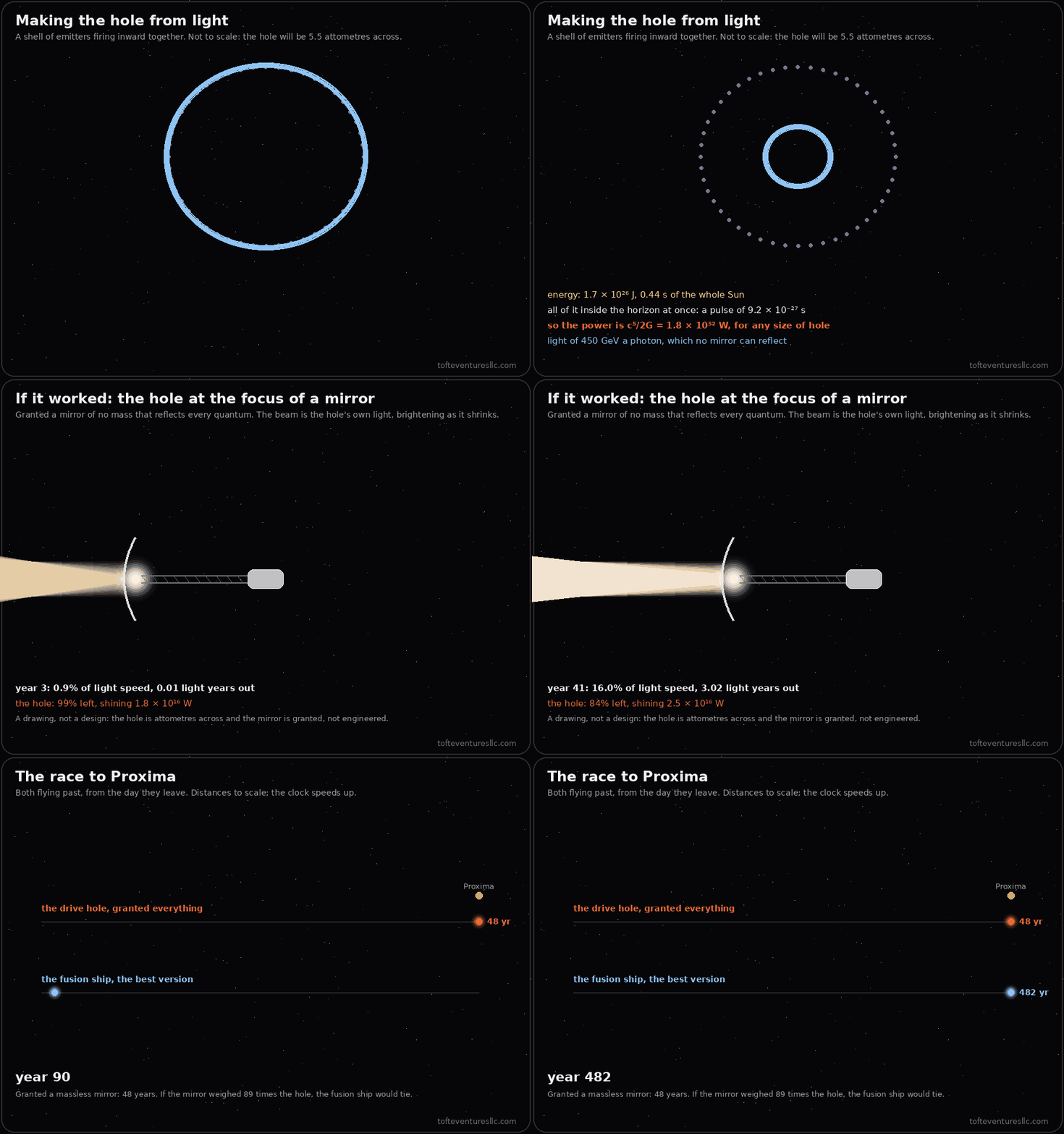
It passes Proxima Centauri 48 years after the hole is lit, at 19.6 percent of the speed of light, with 81 percent of the hole still unburnt. The payload barely matters. Anything from 100 tonnes to 100,000 tonnes gets there in 47.9 to 49.1 years, because the ship's mass is almost entirely the 1.85 billion kilogram hole.
It cannot stop there. A hole cannot be switched off, and it gets hotter as it shrinks. This one keeps pushing, faster and brighter, and burns out 110 years after launch, 33.6 light years out, at 99.9999 percent of the speed of light. Stopping at Proxima needs something this design does not have.
What the crew would see
There is one more thing about this flight that can be worked out exactly, because it needs only special relativity and no engineering: what the sky looks like from the ship.
Two effects move the stars. Aberration tilts every star's light toward the direction of travel, the way rain seems to fall at a slant on a moving car. The Doppler shift makes light from ahead bluer and light from behind redder. At burnout the ship is moving at 99.99986 percent of the speed of light, and time on board runs 595 times slower than at home. By then 110.2 years have passed on Earth and 100.0 on the ship.
A star exactly beside the ship appears a tenth of a degree from straight ahead. Every star within 115 degrees of the heading, seven in every ten stars in the sky, appears inside a circle 0.3 degrees across. Light from ahead is shifted up by a factor of 1,190, so a star like the Sun there becomes an X-ray source and loses 4.4 magnitudes of visible light. Everything behind the ship is shifted down into the infrared and radio, and that part of the sky goes dark.
Something else appears in its place. The cosmic microwave background is the 2.7 kelvin afterglow of the Big Bang, and it fills every direction. Dead ahead it is shifted up by the same factor of 1,190, to 3,242 kelvin, the colour of a glowing coal. Above 1,000 kelvin it makes a disc about half the width of the full Moon, with the crowded sky inside it.
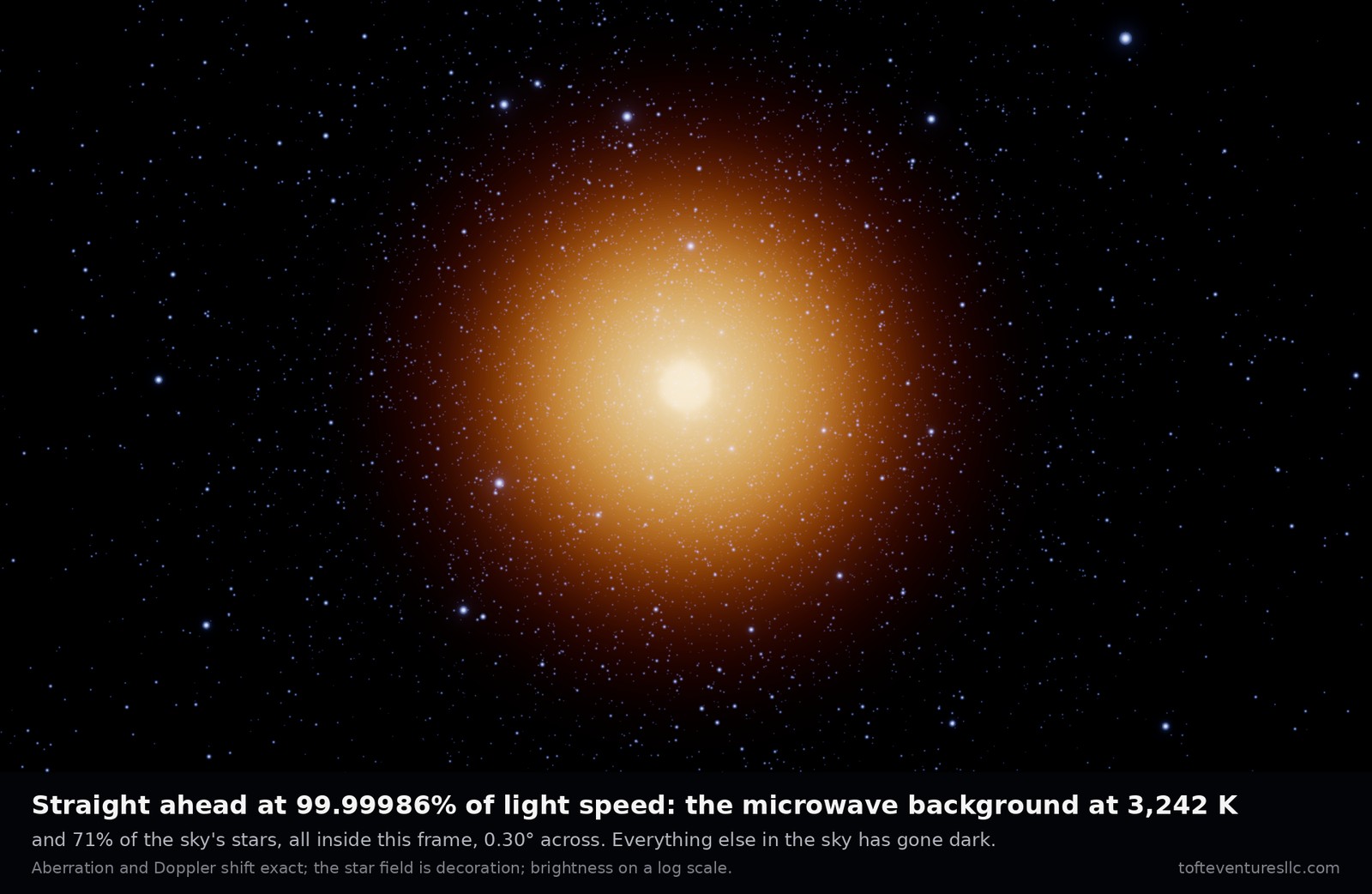
The shift and the aberration in that picture are exact. They are worked out from Planck's law for every star and for the background, using the flight's own speed. The stars themselves are decoration: random stars with a realistic count by brightness and a spread of temperatures. Brightness is on a log scale, because the disc outshines every star in it by far too much to show otherwise.
One thing the flight does not model would matter a great deal here. At this speed, every hydrogen atom in the ship's path hits it with 557 GeV, more than the photons that made the hole.
What the mirror is allowed to weigh
The weakest grant is the mirror of no mass, so I gave it mass.
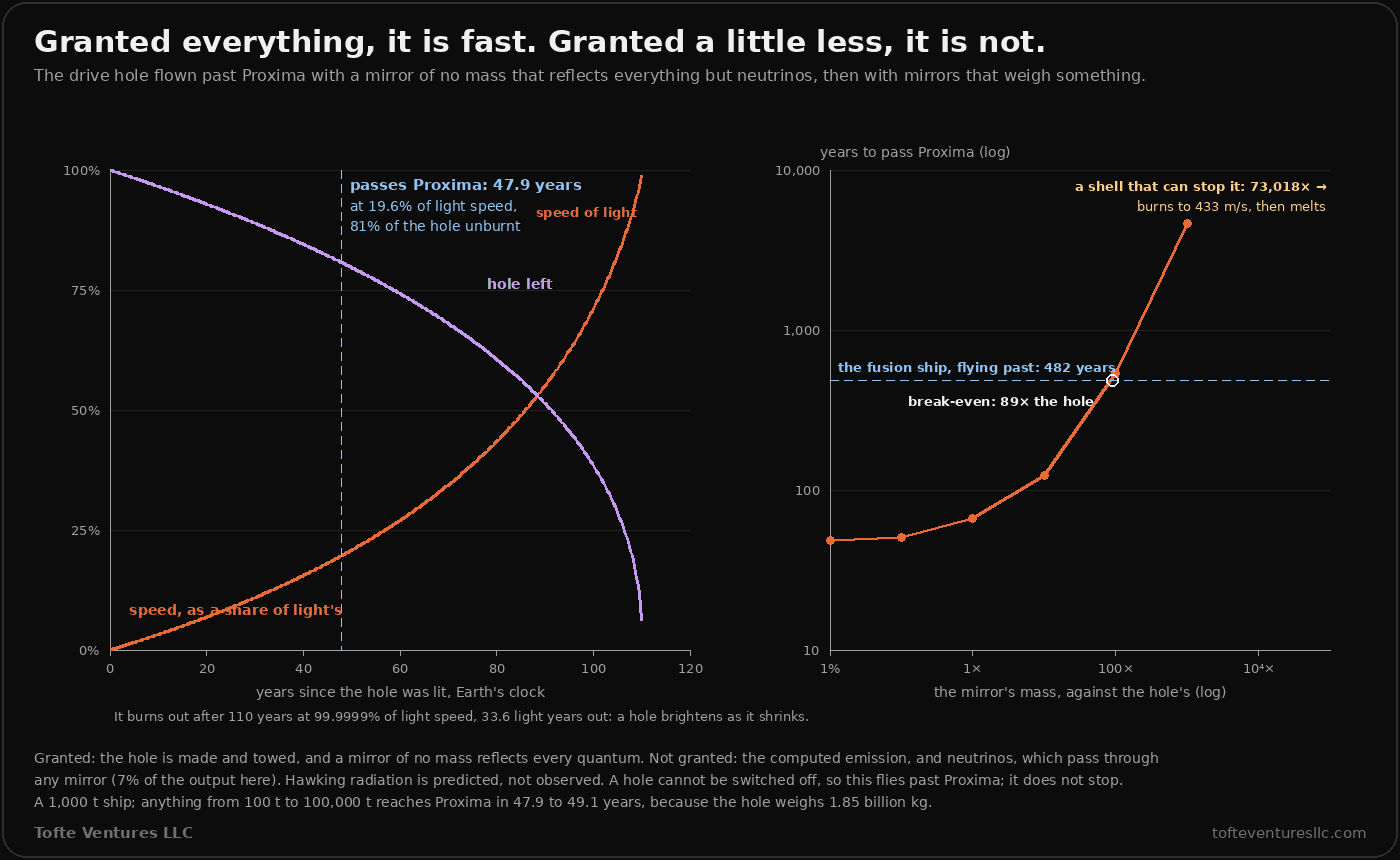
A mirror weighing a hundredth of the hole costs almost nothing: 48 years becomes 48.1. A mirror as heavy as the hole makes it 66 years. At ten times the hole it is 124. At 89 times the hole, the trip takes as long as the fusion engine's 482 years (The Nearest Star, Flown), and the black hole's advantage is gone.
The only structure the engine knows how to build around this hole is the tungsten shell from the earlier post, and it weighs 73,000 times the hole. That is 800 times the break-even mass. The shell also cannot reflect anything: it absorbs the output and radiates it back out as heat, only a third of it aimed backward, and it melts after a third of the hole has burned, at 433 metres a second.
What this adds up to
Why not make the hole instead? Because making it is harder than hauling it. Storing the energy weighs the same as the hole. Releasing it takes 1.8 × 10^52 watts, at any size, as light that nothing can reflect, from emitters that surround the target, and there is a published argument that the light turns into matter before it can collapse.
Why it is tempting anyway: if all of that were granted, together with a mirror that weighs almost nothing and reflects everything a 5.7 GeV hole gives off, this is the fastest trip to another star this blog has priced for anything heavier than a one-gram sail. The distance between that result and the real one is all in the grants. The mirror is the grant that costs the most, and the real version of it is 800 times too heavy.
That is why the engine keeps "if it worked" behind an explicit list. The first drive I designed here was given a well-formed, encouraging number before anything had checked whether it could work at all, and that number turned out to be forty-two percent too good (I Built the Check That Refused My Own Drive). This time the list is part of the result, printed with the 48 years.
Next I want to take the other half of the original question seriously: the hole, or anything else, does not have to fly with the ship if what the ship needs is already waiting along the way.