The kugelblitz post flew a black hole drive, granted everything, and found one thing it could not do: stop. A hole cannot be switched off. It gets brighter as it shrinks, so the ship passes Proxima at a fifth of light speed and keeps accelerating until the hole is gone. The Whole Voyage drew the best version of the fusion ship twice, once as the engine would build it and once as a film would. This post puts the two together. The fusion ship docks to the hole's mirror, rides it as fast as it goes, and never stops. Because it never stops, it carries a door home.
The engine behind this blog now flies that ship, and checks each answer a second way. It turns up one thing I did not expect: the door is safe on its own and breaks the station network from the wormhole post.
Catching a black hole that will not wait
The hole starts pushing the moment it is lit, so the ship has to catch a mirror that is already pulling away. The drive hole is 1.85 million tonnes and gives its mirror 0.029 metres per second squared, about three thousandths of a gravity. The fusion ship's hardest setting is its lowest exhaust speed, 30 kilometres a second, where its 1,378 megawatts push 92 kilonewtons. With its tanks full, 2,919 tonnes, that is 0.031 metres per second squared: it catches the tug by 7 percent. The heaviest ship that could catch it is 3,138 tonnes.
Docked, the ship rides in front of the mirror, in its shadow. The mirror throws the hole's light backward and is granted a mass of zero, as in the kugelblitz post. The engine does not size it, so the drawing makes it big enough for its shadow to cover the ship.
As fast as it goes
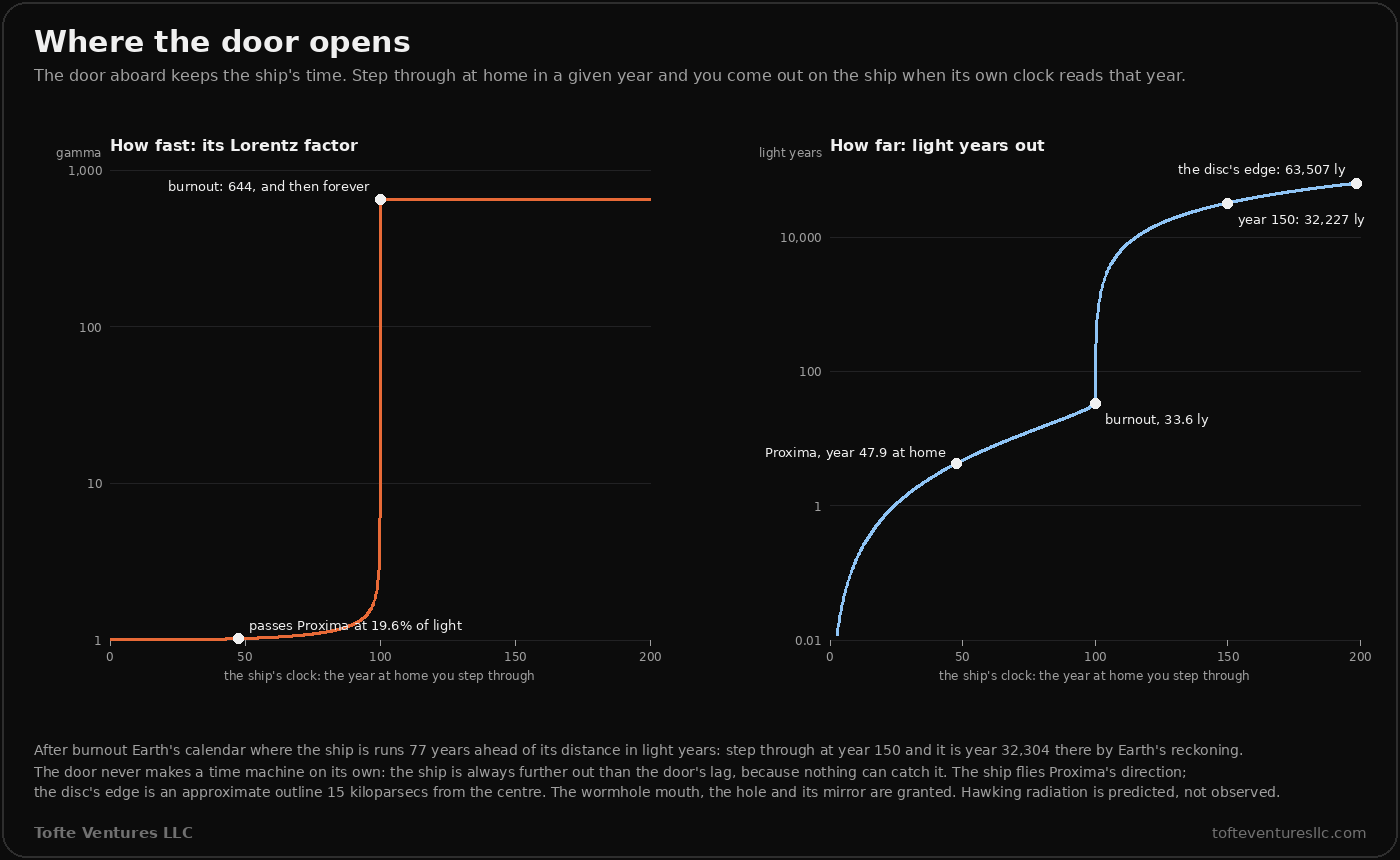
The ship's dry mass is 919 tonnes against 1,854,000 tonnes of hole, so almost everything that moves is the hole. It passes Proxima 47.9 years after the hole is lit, at 19.6 percent of light speed, and burns out after 110.2 years by Earth's calendar and 100.0 by its own, 33.6 light years out, at 99.99988 percent of light speed. That is a Lorentz factor of 644: after burnout a year aboard is 644 years at home. The spent mirror is let go and the ship coasts on, forever.
It flies Proxima's direction, which in the galaxy is longitude 314 degrees, nearly in the plane of the disc. That line passes 19,200 light years from the galactic centre at its nearest and reaches the approximate edge of the disc 63,500 light years out, 198.6 years by the ship's clock and 63,584 by Earth's.
Two checks. With the share of the light the mirror can aim held fixed, the integrated speed must match the photon rocket's closed form, and it does to a part in ten thousand. And the ship's own clock, rebuilt from the Earth-frame path it was flown along, must match the clock the flight recorded, which it does to a part in a thousand.
A door, because it never stops
A ship that cannot stop cannot let anybody off. At the speeds it reaches, stepping off at Proxima would be like hitting it at 58,800 kilometres a second. So the explorer carries a wormhole mouth aboard, with the other mouth at home, and the mouth is the door.
The door keeps the ship's time. Step through at home in a given year, counted from when the hole is lit, and you come out on the ship when its own clock reads that year. Step through in year 150 and the ship is 32,227 light years out. By Earth's reckoning it is year 32,304 there. After burnout, Earth's calendar where the ship is always runs 77 years ahead of the distance in light years.
The door alone never makes a time machine. Using it to get home early would need someone to reach the ship before its clock read the year they left home, and the ship is always further out than its lag, because nothing can catch it. The engine checks this at every moment of the flight. It also checks that no two moments on the same flight close a loop against each other.
The door breaks the network's rule
The wormhole post put a station at every nearby star, each a mouth carried out at some speed and left there, and found one rule that keeps the network safe: carry every mouth at the same speed. A station's clock arrives behind home's by a lag set by its delivery. Two stations whose lags differ by more than the distance between them make a loop: out through one, across, home through the other, and home before you left.
The door is a mouth carried at a speed nothing else was. By the time the explorer passes Proxima its lag is 0.266 years. Proxima's station, carried at a tenth of light speed as in that post's film, lags 0.213. Flown straight past the station, the two make a time machine: out through the station at home, across to the ship as it goes by, home through the door, 18 days before you left. Neither the explorer nor the network does anything wrong on its own. This is the shape this blog keeps finding: two systems that each pass every check they are given, and fail together.
The engine checks every moment of the flight against every station within 20 light years, both ways round. It checks once in closed form and again with a search of every loop through home, the stations and 240 moments of the flight, which assumes nothing about the loop's shape. Both find the loop. Both also find the fix, which is distance. A loop needs the ship close enough to the station that crossing the gap takes less time than the two lags differ by. The explorer has to pass Proxima at least 3,344 AU wide, about 0.05 light years. The film flies it 3,511 AU off, and there no station in the neighbourhood closes a loop.
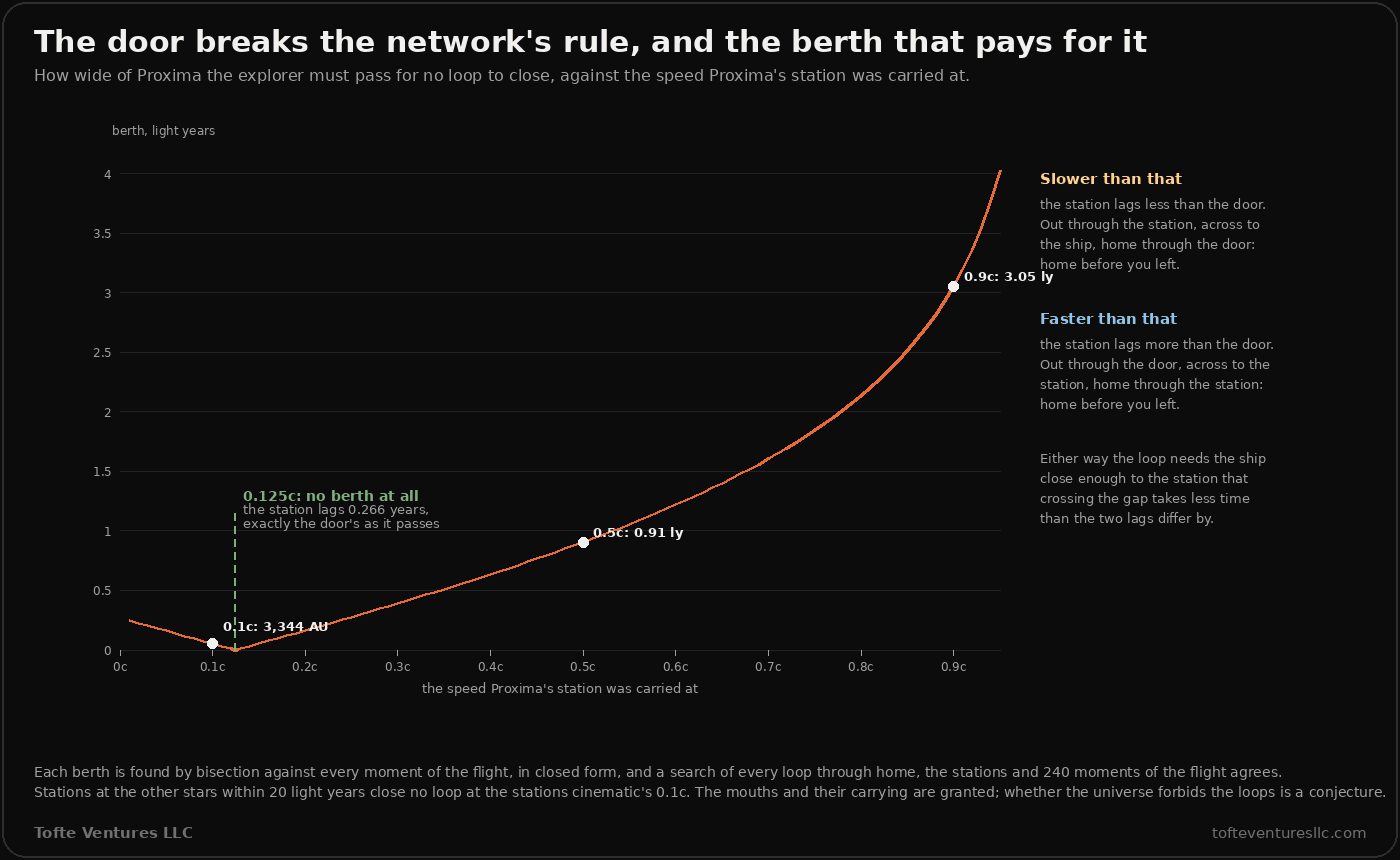
There is one speed at which Proxima's station needs no berth at all: 0.125 of light speed. There the station's lag is exactly the door's as the ship goes by, which is the network's rule met by accident at one star. Slower stations need a berth because they lag less than the door. Faster ones need a berth because they lag more, and a network carried at 0.9c needs the explorer to stay 3 light years clear of Proxima. Whether the universe forbids these loops, which is Hawking's chronology protection conjecture, is not arithmetic, and nothing here settles it.
What the front meets
Space is not empty. At a Lorentz factor of 644 the thin hydrogen between the stars arrives at the ship's nose at 603 GeV an atom, squeezed 644 times denser by the ship's own motion. Across the density range for the gas near the Sun, that is 0.9 to 5.6 gigawatts on every square metre, 15 to 89 times what the surface of the Sun gives off. On the ship's 26 metre front it is 0.5 to 3 terawatts. The engine checks it against the flow of energy in a cold stream of gas, which shares no step with counting atoms.
The first draft of that number left out the squeeze and came out 644 times too low. It looked entirely reasonable, which is the problem with a number that is wrong by a factor that is also a plausible quantity. The drag, for what it is worth, is negligible: under a part in a thousand of the ship's momentum over 60,000 years. Nothing in the engine says a shield can take the heat, and the film shows the nose glowing, because it would.
Through the door, and past a star
Here is the most science-fiction thing the engine will price. In year 150 somebody at home steps through the door and comes out on the ship, 32,227 light years away, as it dives past a star. Nothing out there is in the catalogue, so the star is placed by hand: a star like the Sun, passed at 1.85 of its radii, the closest the Sun dive let the fusion ship's hull go.
At a Lorentz factor of 644 the star's light arrives ahead 1,288 times bluer, a Sun-like surface seen at 7.4 million degrees. The brightest part of the pass lasts about 7 milliseconds by the ship's clock, and the nose takes 240 gigajoules on every square metre, about 57 tonnes of TNT's worth. The engine computes that in closed form and again by stepping through the pass, and the two agree to a part in a million. The peak comes thirty degrees before closest approach, at 200,000 times the heat of the Sun's surface.
It is also only what the interstellar gas delivers every four minutes, so in a sense the dive is the easy part of the trip. The star bends the ship's path by under an arcsecond, because it is gone before its gravity can do anything. Aiming the pass at all takes about 41 metres a second of sideways nudge per year of the ship's clock ahead of it, since a sideways speed aboard is 644 times slower at home but lasts 644 times longer.
What the trip would look like
I rendered the flight. The ship catches the tug and docks. The pair burns out past Proxima, which slides by as a small red star. Over the last few years of the burn every star in the sky crowds into one blue point ahead. At burnout the hole goes in a final flash, and the ship lets the mirror go. Then comes the door, with home in its window; at home, the other end hangs by Earth with one blue point in it; through it, the star dive, slowed down; and the ship goes on toward the edge of the disc.
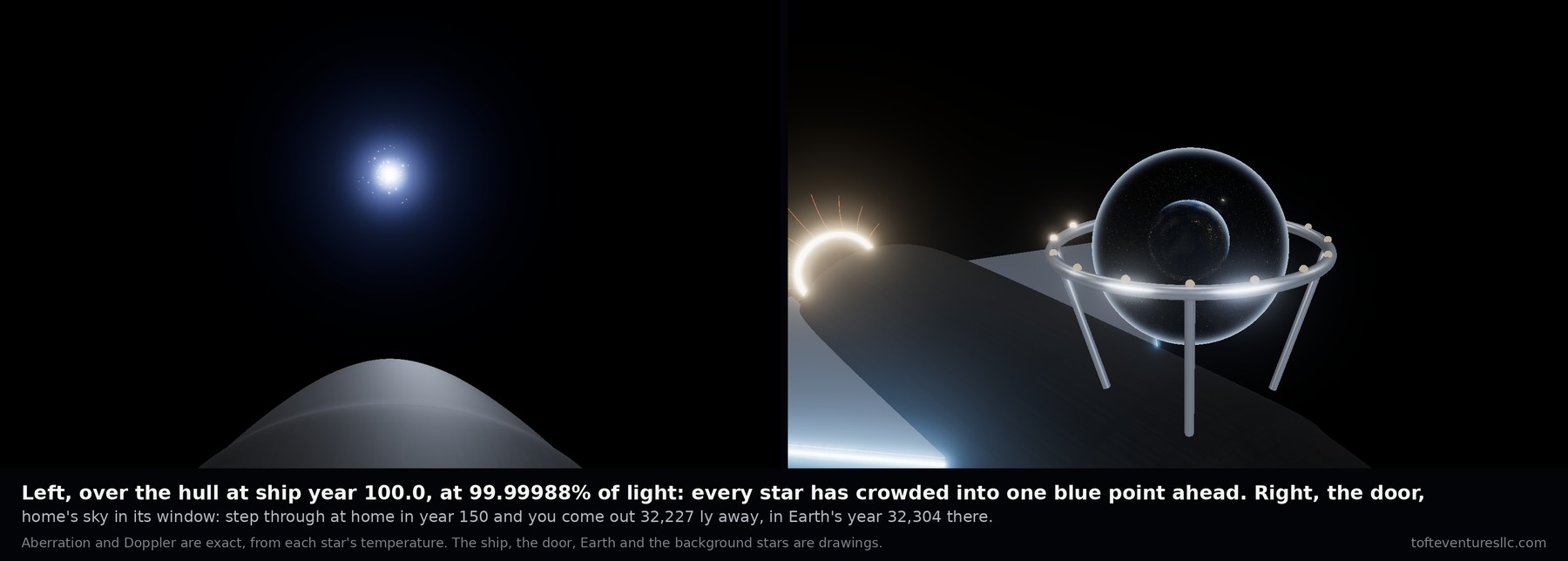
The sky is the physics. Every star is moved and recoloured exactly for the ship's speed from its temperature, and the neighbour stars are the catalogue's, at the brightness their distance gives. The ship, the mirror, the door, Earth and the background field are drawings.
Try the door
Pick the year at home you step through and see where the ship is when its clock reads it. Then pick the speed the station network was carried at and see how wide of Proxima the explorer has to pass. The widget reads the engine's flight and berth curve directly.
Or it comes home
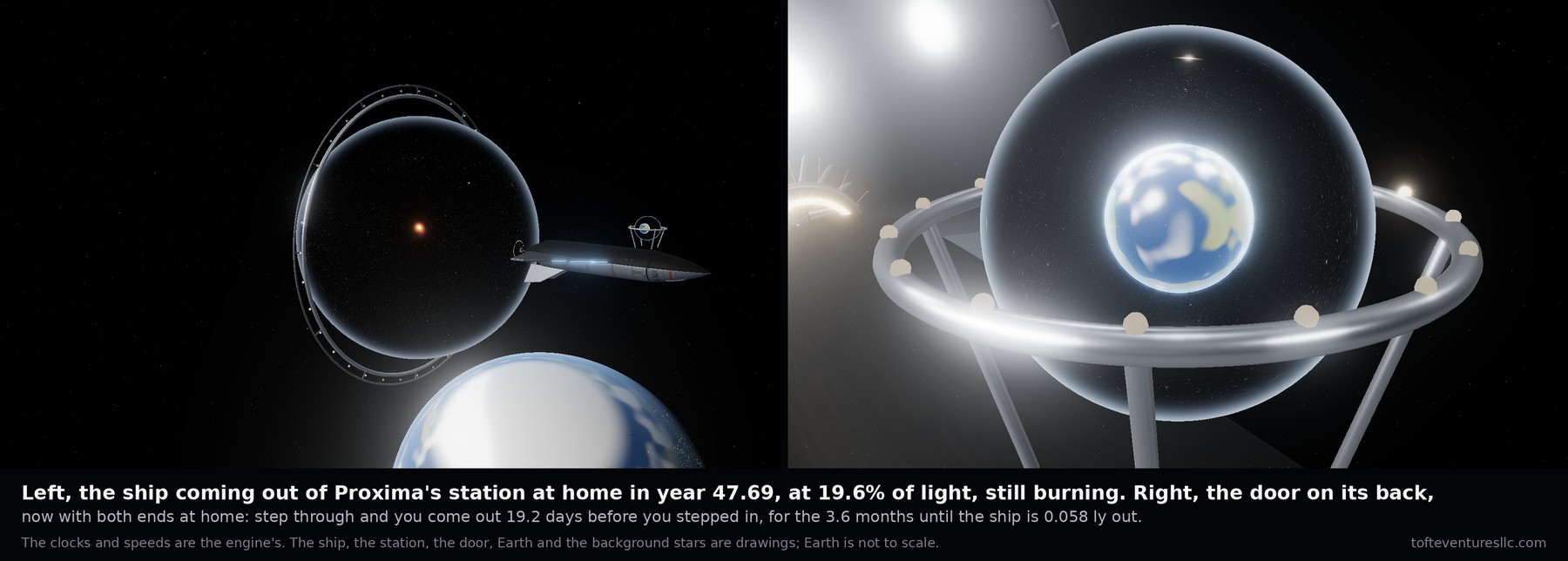
The explorer does not have to keep its berth. Fly it into Proxima's station instead of past it, and it comes out of the station's other mouth at home. A crossing takes no time and moves you by the difference between the two mouths' clocks, and the station's clock is 0.213 years behind. So the ship goes in at Proxima in year 47.91 and comes out at home in year 47.69, still at a fifth of light speed and still burning 27 petawatts, because a hole cannot be switched off. Its own clock reads 47.64.
And it has brought its door. Both ends of the door are now at home, and they disagree by 19.2 days: step through the door aboard and you come out at home 19.2 days before you stepped in. That is the arrangement the wormhole stations post said makes a time machine, the one Morris, Thorne and Yurtsever described in 1988: carry a mouth away, let its clock fall behind, and bring it back. Here it happens by accident, because the door kept the ship's time and the station kept the network's.
It does not last. To use it, something at home has to reach the ship, and the ship is leaving. Send anything after it at light speed and it catches up, goes through the door and arrives home before it was sent, by less each day. The engine walks the ship's clock until that margin reaches zero: ship year 47.93, 0.058 light years out, 3.6 months after it came out by home's calendar. After that the door is only a door again. A Bellman-Ford search over home and the ship's new path finds the same loop.
Two more things are granted for this ending. The throat has to be wide enough to fly the ship through, and the mirror is drawn 280 metres across, so the station is priced at 150 metres in radius: about 16,900 Earth masses of negative energy. And whether the universe lets the loop form at all is not arithmetic. Hawking's chronology protection conjecture says quantum fluctuations build up round a loop like this as it forms, and stop it. Nobody knows whether they do.
What is granted
The hole is made and towed; its mirror has no mass and reflects everything but neutrinos, which pass through any mirror and make up 7 percent of the output. The wormhole mouth exists, can be carried, and is short enough to cross in no time; its negative energy is 113 Earth masses per metre of throat, and nothing here supplies it. The ship's front survives the gas. The stars keep still. The docking, the flight, the clocks, the door's lag, the loops, the berth and the heat on the front are the engine's arithmetic on top of those grants.
Hawking radiation is predicted, not observed, and nobody has made a black hole or a wormhole out of anything. But if both existed, this is the ship: it cannot stop, so it keeps a door open behind it, and that door is only safe if it stays clear of every other door. Bring it home through one, and for 3.6 months home has a door into its own past.