Correction, 24 September 2026. Every trip in this post dropped the whole tank before the braking burn, so the brake ran on hydrogen held in no tank at all. With the shells that hold the braking hydrogen kept aboard, every trip is about 2 percent longer: the best window is 32.3 days rather than 31.6, January 2027 is 48.5 rather than 47.7, a bad day to leave is up to 150 rather than 148, and the straight line they are compared with is 31.8 rather than 31.2. The dose moves with the days, and the winged ship is still slower than the dish. The figures and numbers below are the corrected ones, and every conclusion stands. How it turned up is in The Nearest Star, Flown.
This one puts everything together. The last few posts built the best version of the fusion engine, raced it, and let the air brake it. All of that flew a straight line to Mars with no Sun in the way. This post flies the whole voyage: when to leave, whether to dive past the Sun on the way to the stars, whether wings or light sails would help, what gravity the crew can have, and what dose they take.
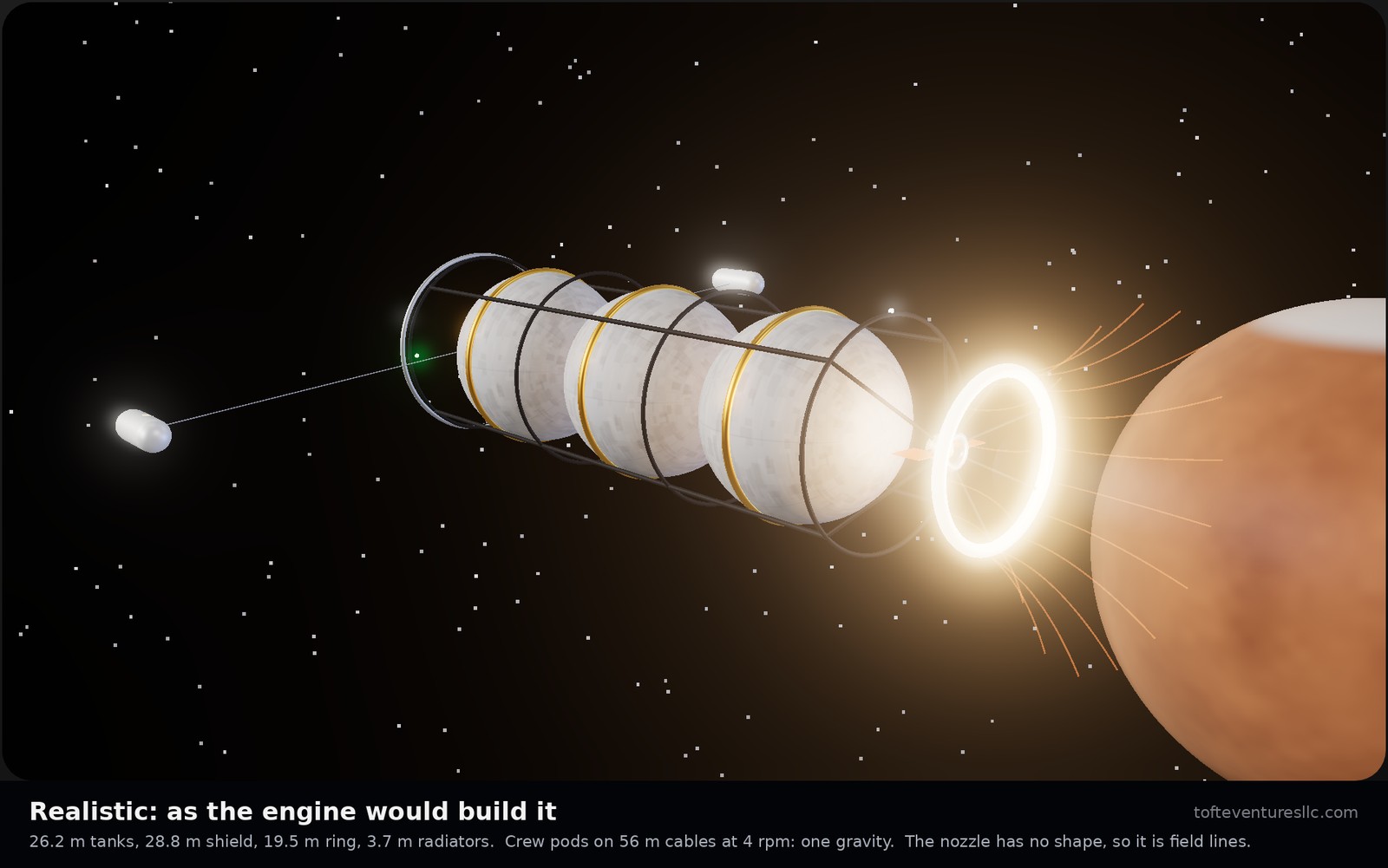
And it draws the ship two ways. First as the engine would build it:
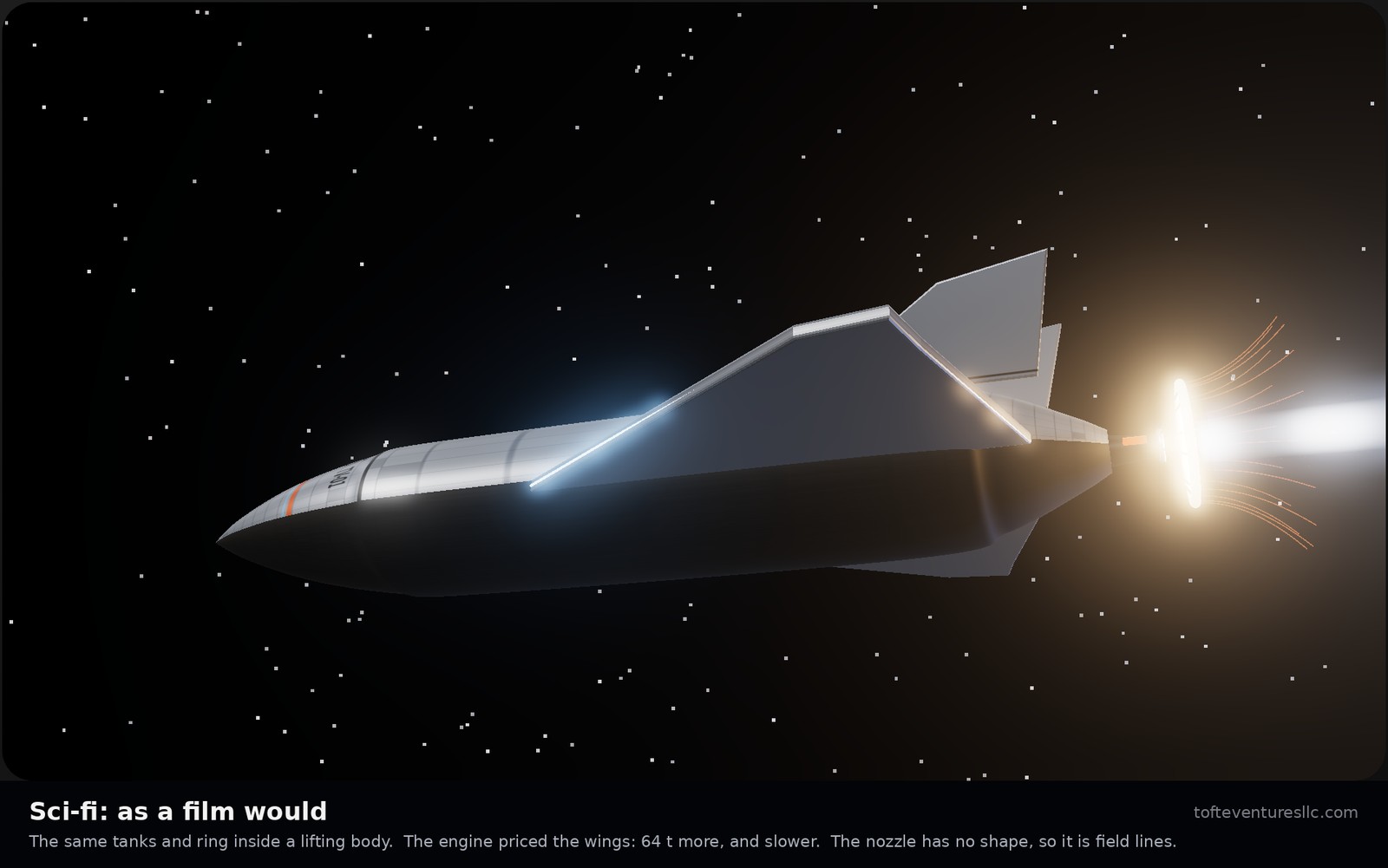
And then as a film would:
Two drawings, one engine
Turn either one. The engine burns, the crew pods turn at their real rate, and the sizes button shows which parts are the engine's.
The realistic one adds nothing the engine does not size or a real ship of this kind would not carry. The three hydrogen tanks are the 26.2 metres the engine sizes for 2,000 tonnes, wrapped in white insulation with gold foil at the frames, which is how cryogenic tanks are dressed. The nose is the 28.8 metre aerocapture shield. The ring at the stern is the 19.5 metre opening, glowing at the 3,000 K it runs at. The two radiator panels are their computed 3.7 metres, and they glow a dull orange because a 1,500 K surface does. The exhaust is faint, because hot hydrogen at 50 kilometres a second is nearly invisible. The crew rides two pods on 56 metre cables turning at 4 revolutions a minute, which is one gravity, and they reel in behind the shield for the pass through Mars's air.
The sci-fi one is the same tanks, ring and radiators inside a lifting body: a long nose, a tiled belly, swept wings and fins. It is drawn for fun, and further down is why.
In both, the nozzle is field lines with no surface, because the engine gives it a mass of 689 tonnes and no shape at all. That is also why neither drawing gives an overall length.
When you leave decides how long it takes
Every Mars figure on this blog so far has been the same idealisation: Mars at its closest, 0.37 AU, in a straight line, with no Sun, from a standing start to a standing stop. That gave the best version 31.8 days.
The real trip leaves Earth where Earth actually is on a given date, moving at Earth's 30 kilometres a second, and has to arrive where Mars will be, moving at Mars's speed, with the Sun pulling on the ship the whole way. The engine now flies that. It takes the planets from an ephemeris, integrates the ship through the Sun's field with its thrust, and solves for the steering that lands it on Mars at Mars's velocity. Then it walks the trip time down until the tank runs out. It did that for a departure every ten days from October 2026 to the end of 2045: 704 of them.
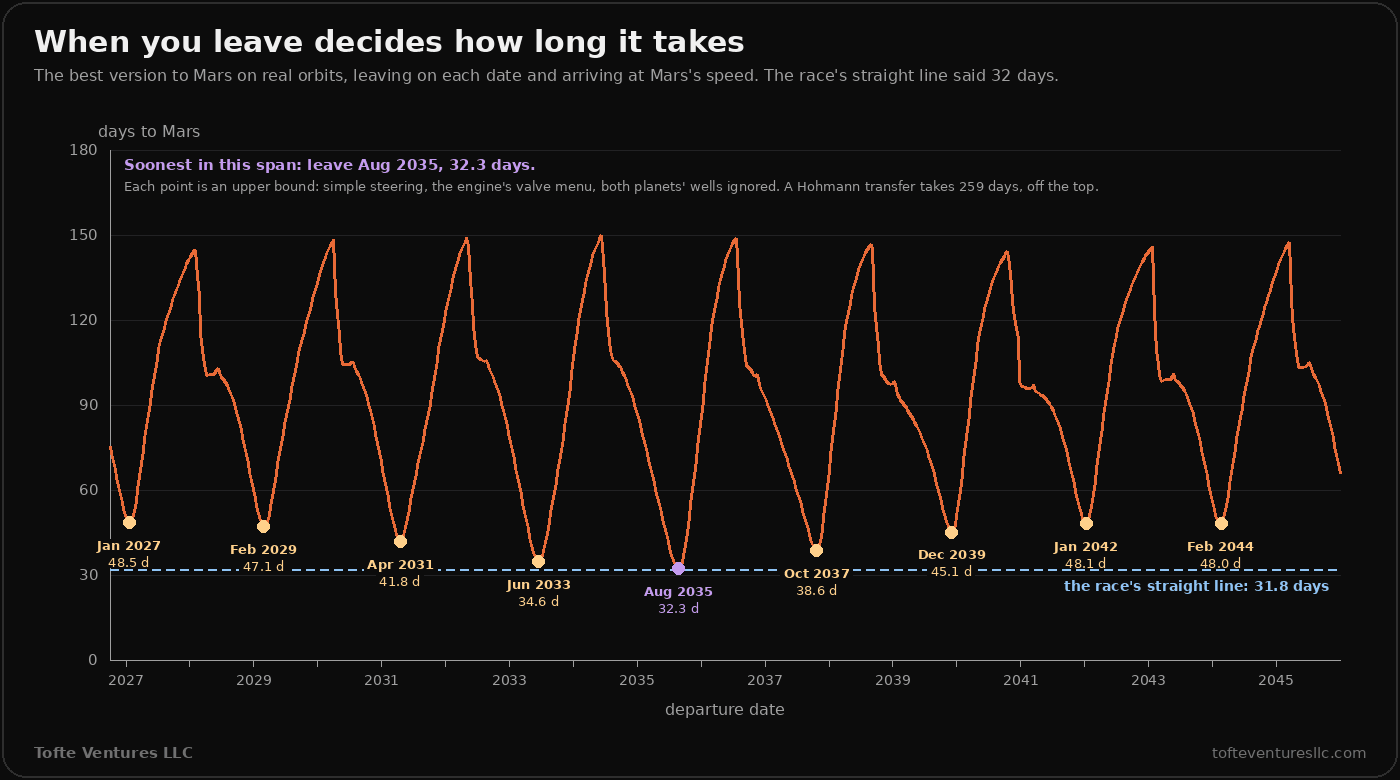
The best window before 2045 is August 2035: 32.3 days, within 2 percent of the straight line. That is the year Mars comes closest. The next window is January 2027, at 48.5 days, and the windows between run 35 to 48 days. So the straight line was the best case, not a typical one: in a typical window the real trip is 30 to 50 percent longer.
Away from the windows it gets much worse. Leave on a bad day and the trip is up to 150 days, nearly five times the best. A window comes round every 26 months, which is why real missions wait for one.
Here is the 2035 trip, flown on the orbits.
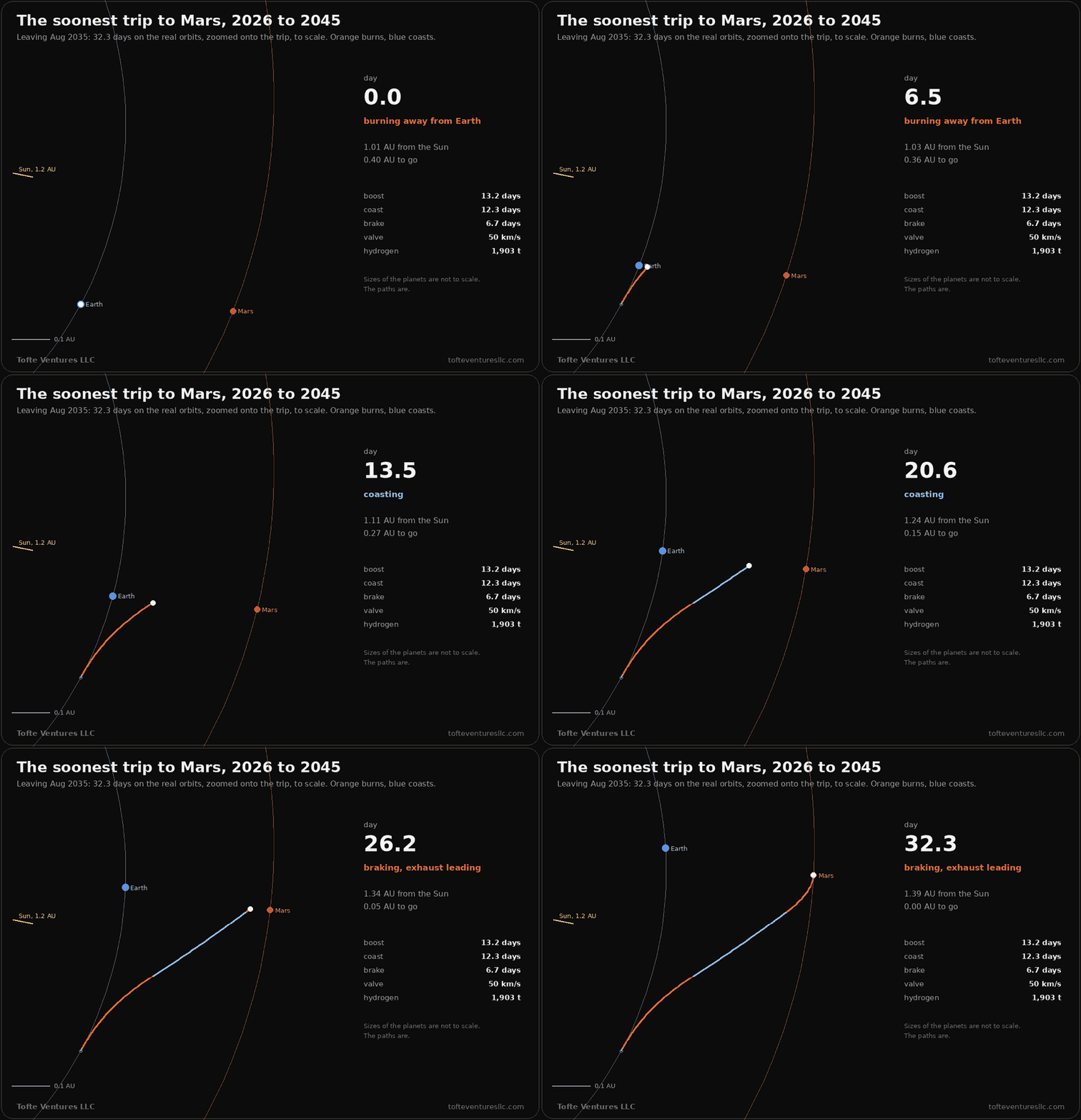
Two honest limits. The steering is simple: one fixed direction for the boost and one for the brake. That cannot be the best a ship can do, so every number here is an upper bound. Letting each burn turn once, with the fuel minimised, saved nothing measurable on the windows tested, which says the simple steering is not what sets these numbers. And the valve is the engine's menu of exhaust settings, as in the race: a setting between two on the menu could be a little faster.
The engine flies each trip twice, too. A separate script re-flies the exported steering with its own integrator and lands within 5 metres of Mars.
Diving past the Sun
There is a famous trick for leaving the solar system fast. Fall toward the Sun, and burn at the bottom of the fall. A rocket gains more speed from a burn where it is already moving fast, because the propellant it throws out was carrying energy that it gives up to the ship. That is the Oberth effect, and at a close pass of the Sun it is enormous.
For a kick, it pays. The same 2,000 tonnes of hydrogen at 50 km/s, burned as one instantaneous kick at the closest pass the ring survives (1.85 solar radii), leaves the Sun at more than twice the speed of the same kick burned at Earth's orbit.
For this ship, it mostly does not. This ship's burns are not kicks. At the setting it uses for Mars, the whole tank takes three weeks to burn, and at the setting it uses for the stars it takes about fifty years, while the pass at the bottom of the fall lasts hours. And falling in costs 13 to 26 km/s before any of it starts, up to most of Earth's orbital speed, paid out of the same tank.
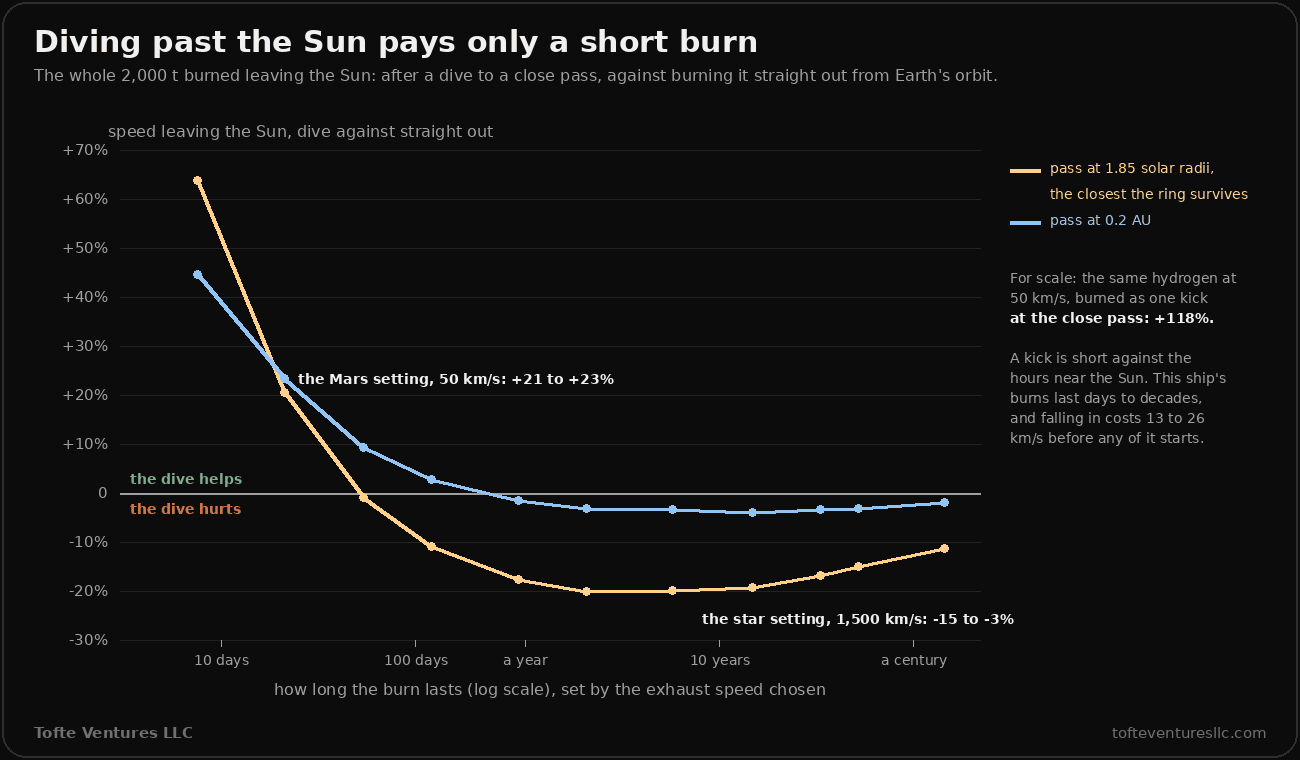
A dive helps a burn of days and hurts a burn of years, and the trip to the stars is a burn of decades. At the star setting the dive costs 3 to 15 percent of the ship's speed, after one to six years spent spiralling in. The engine's original mission planner found the same for the ship as first drawn, and priced the dive without taking it. This is the same answer for the best version, and it is the pattern this blog keeps finding: a well formed answer, true of the rocket it was worked out for, and false of this one.
Wings look fast and fly slow
Two good questions came up while drawing the sci-fi version. Would wings help the pass through Mars's air, with the whole belly shielded like a shuttle's? And would photon sails help as wings?
Wings help the air and cost the ship more than they give. A lifting body flies the pass with more lift for its drag than a dish does, and more lift lets the ship come in faster. But the limit on the pass was never the wing. It was the crew's 6 g. Lift can only turn more of that 6 g into holding the curve round the planet, so even perfect lift raises the entry speed from 12.6 to 14.8 km/s, 17 percent, however good the wing. Against that, a shielded belly and wings of 3,200 square metres at 20 kg per square metre is 64 tonnes carried the whole way.
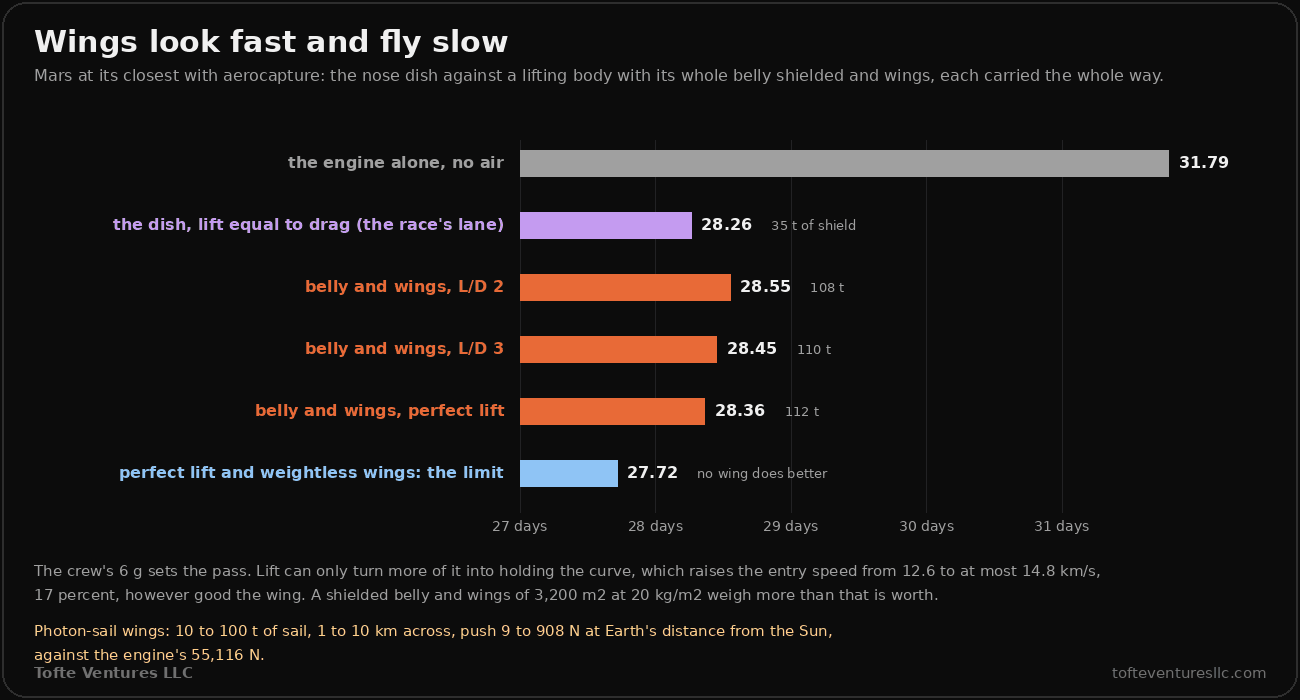
So the winged ship is slower: 28.4 to 28.6 days against the dish's 28.3. Even perfect lift from wings that weigh nothing would save half a day. The dish wins because it is light.
Photon sails are worse. Sunlight pushes about 9 micronewtons on a square metre of mirror at Earth's distance. A sail of 10 to 100 tonnes, at the thinnest films anyone has proposed, is 1 to 10 kilometres across and pushes 9 to 908 newtons. The engine pushes 55,000. At best that is under 2 percent of the engine, from a sail the size of a town, and it fades with the square of the distance from the Sun. Sails are brilliant for a probe of a few grams. On a 2,900 tonne ship they are decoration.
That is why the sci-fi drawing is labelled as fun. It looks faster, and it flies slower.
Gravity for the crew
Spin gives gravity: a room turning at a rate w at a distance r feels w squared times r. The limit is the crew, not the engineering. People adapt to about 2 revolutions a minute with no trouble, and to 4 to 6 with some.
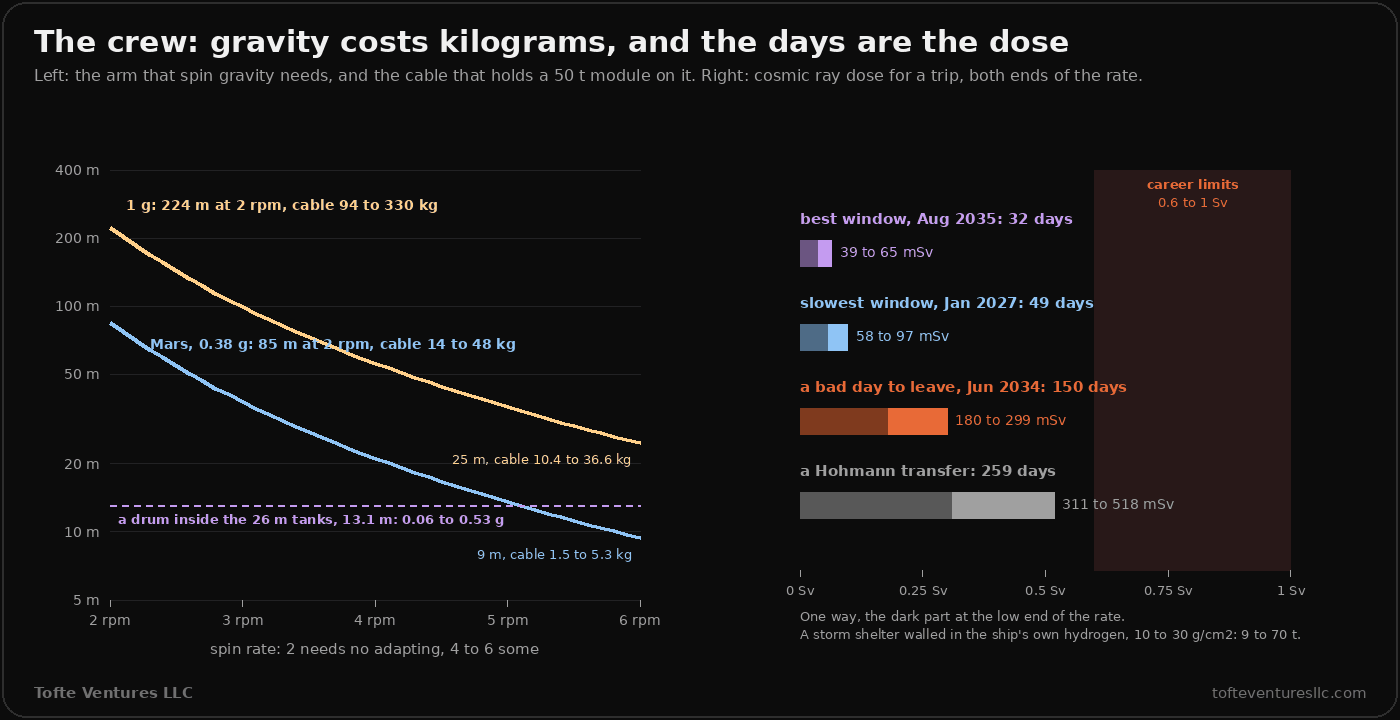
Spin gravity costs kilograms. One g at 2 rpm needs a 224 metre arm, and the cable that holds a 50 tonne crew module out there weighs 94 to 330 kilograms, depending on the fibre. At 4 rpm, the realistic drawing's setting, the arm is 56 metres. At 6 rpm it is 25 metres and the cable is tens of kilograms. The engine checks the cable twice, by its closed form and by summing it piece by piece, each piece holding everything outboard of it.
Inside the ship there is less room. A drum inside the 26 metre tanks has 13.1 metres of radius, which gives only 0.06 to 0.53 g at those rates. That is why the realistic drawing puts the crew on cables.
The days are the dose
Cosmic rays cannot be stopped by anything a ship carries, so the dose is set by the days spent in deep space: about 1.2 to 2 millisieverts a day. A fast ship's best radiation shield is its speed. The 2035 trip takes 39 to 65 millisieverts, and even the slowest window stays under 100. Leave on a bad day and it is 180 to 299. A Hohmann transfer takes 311 to 518, most of a career's limit, on the way out alone.
Solar storms are different: a large one can be walled out. Ten to 30 grams per square centimetre of shielding cuts its dose several fold, and the ship carries the best shielding there is by mass, hydrogen. A storm shelter for a few people walled in the ship's own hydrogen takes 9 to 70 tonnes of it, a few percent of the load, as long as that much is left when the storm comes.
What is not priced
The engine names what it has not worked out:
- the steering: one fixed direction per burn is not the best a ship can do, so every window is an upper bound;
- the valve: the engine's menu of exhaust settings, as in the race;
- leaving Earth and arriving at Mars: both planets' own gravity is ignored, as in the race, and the aerocapture saving is not added;
- sunlight on the tanks: trips passing inside 0.3 AU are refused rather than priced;
- the dive's sunshield, whose mass would only make the dive worse;
- how much the hydrogen cuts cosmic rays, which thick shielding can raise at some depths through the particles it knocks loose;
- the spin's bearings and seals, and reeling the pods in and out for each pass.
So what does the voyage look like
Leave in a window, and the best version gets a crew to Mars in 32 to 49 days, spinning at a full gravity on cables, for a fifth of a Hohmann transfer's dose or less. Leave in the wrong month and it can take nearly five times as long. Do not dive past the Sun on the way to the stars, and do not bother with wings. If it is ever built it will look like the first drawing, not the second: three tanks, a truss, a ring, and a nozzle nobody has drawn yet.