The Whole Voyage priced the famous trick of diving past the Sun and found it helps this ship's short burns and hurts its long ones. That was a chart. This is the dive itself, flown by the engine at the setting where it pays most, and drawn.
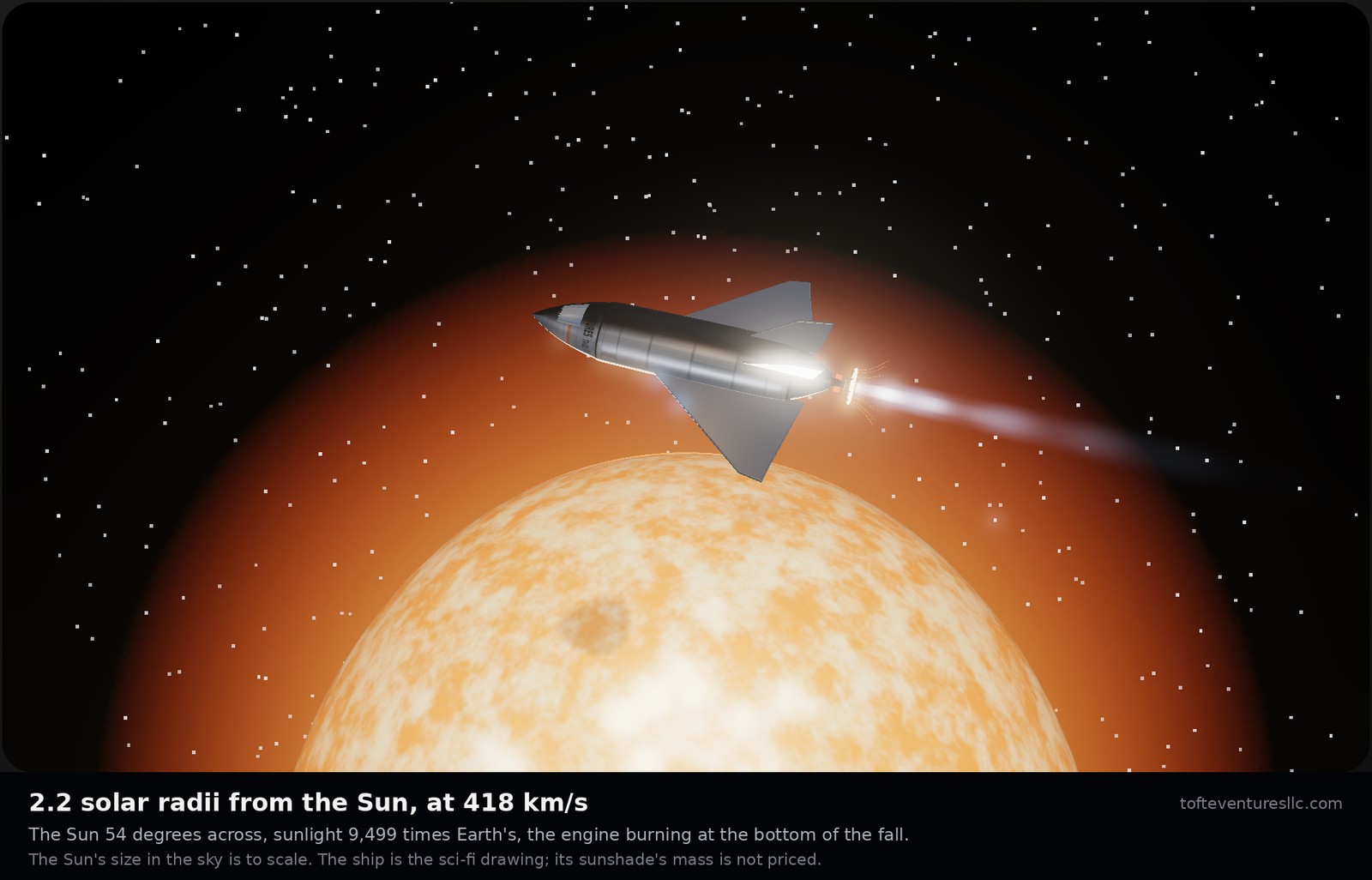
The Sun in that picture is its true size in the sky for where the ship is: 54 degrees across, about a hundred times the width of the Sun seen from Earth. The ship is the sci-fi drawing from last time, drawn for fun. The flight is the engine's.
The dive, flown
Play it, pause it, drag through it, and switch between the map and the view from the ship. The map is to scale; the Sun is the small disc in the middle, and the ship really does pass that close to it.
The trick is the Oberth effect: a rocket gains more from a burn made where it is already moving fast, and nowhere near here is a ship moving faster than at the bottom of a fall into the Sun. The dive has three parts.
Falling in. The ship starts in Earth's orbit, moving at Earth's 30 kilometres a second, and has to lose most of that to fall. It burns against its orbit for 37 days, spending 615 tonnes of its 2,000 tonnes of hydrogen, until the low point of its orbit reaches the closest pass the fusion ring survives.
The fall. Then it coasts, for about seven weeks, speeding up the whole way.
The burn at the bottom. Three days before the low point it lights the engine with everything it has left and burns for 5.2 days. Because the burn starts early, it lifts the pass a little: the ship goes by at 2.2 solar radii from the Sun's centre, about 840,000 kilometres above the surface, at 418 kilometres a second. The sunlight there is 9,500 times what reaches Earth. It spends 18 hours inside a twentieth of an AU, and then it is gone.
Three months lost, and the race won
The comparison is the same ship burning the same hydrogen straight out from Earth's orbit, starting the same day.
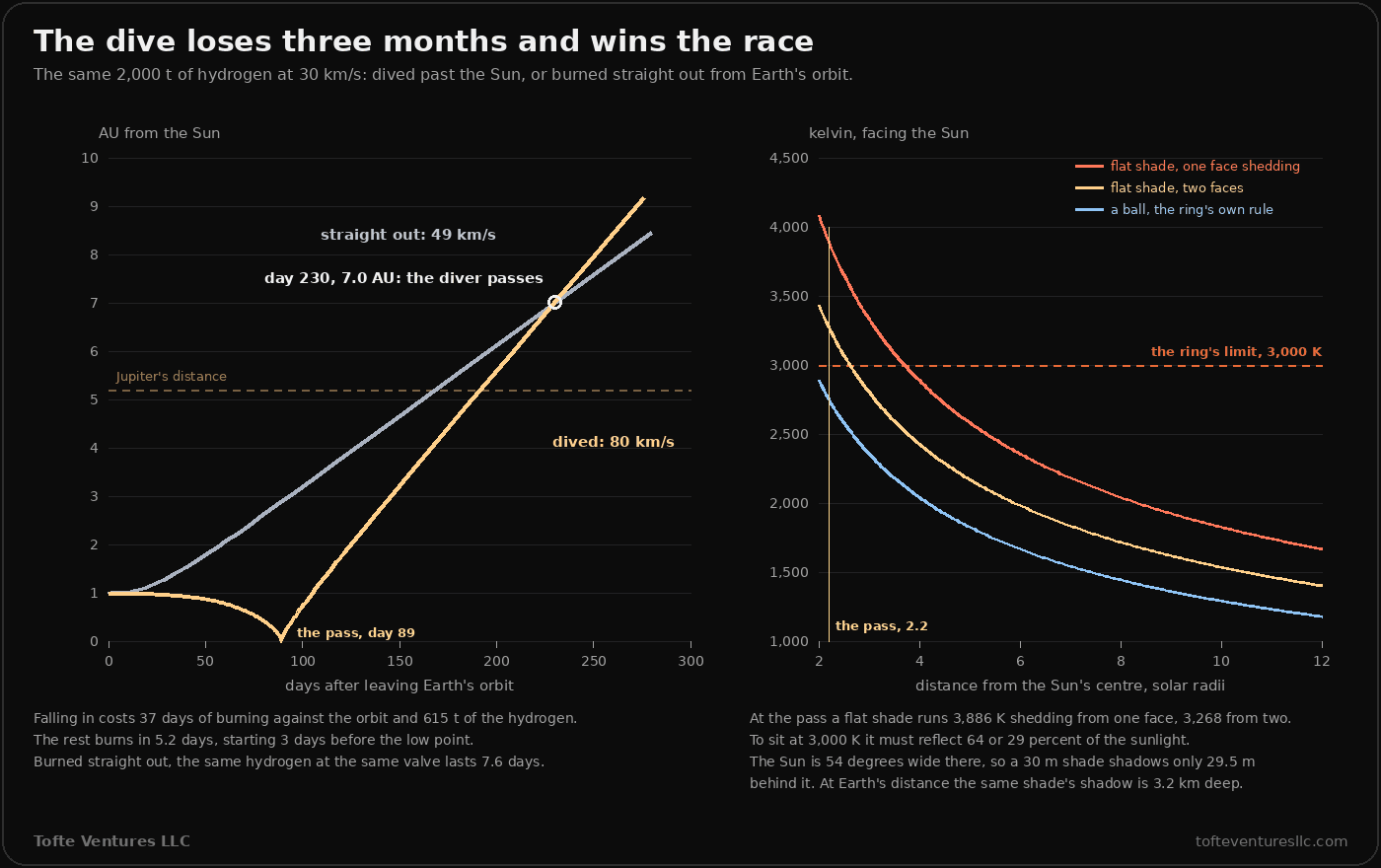
The straight-out ship leaves the Sun at 49 kilometres a second, the speed it keeps once it is far away. The diver leaves at 80: 64 percent faster. (The readout in the widget shows the speed at each moment, which is higher while either ship is still climbing out.) The diver spends three months falling in while the other ship is already on its way, so it starts far behind, and it catches up on day 230, 7 AU from the Sun, past Jupiter's distance. After that it is ahead for good.
The engine flies both, and a separate script flies the dive again with its own integrator, from the same settings, and gets 79.9 kilometres a second against the engine's 79.9.
Why this setting and not the others
The dive only pays when the burn at the bottom is short against the time the ship spends deep in the well, which is hours to days. At the engine's lowest exhaust setting, 30 kilometres a second, the whole tank burns in about a week, and that is as close to a kick as this ship gets. At slower-burning settings the gain goes away fast:
- 30 km/s: the dive leaves 64 percent faster;
- 50 km/s, the Mars setting: 20 percent faster;
- 80 km/s: 1 percent slower;
- 120 km/s: 11 percent slower;
- 200 km/s: 18 percent slower.
That is the same finding as last time, now flown: a dive helps a burn of days and hurts a burn of weeks. The trip to the stars is a burn of decades, so the ship doesn't dive for the stars. For a fast getaway on the short-burn setting, it does.
The sunshade was the wrong shape
The closest pass the engine allows, 1.85 solar radii, is where the ring reaches its 3,000 kelvin. I built the cinematic with the ship's tiled belly turned to the Sun as a sunshade, and asked the engine how hot that belly gets. It had never been asked, and the answer is: hotter than the limit.
The 3,000 K rule is for a ball. A ball catches sunlight on its cross-section and sheds heat from its whole surface, four times that area. A flat shade turned to the Sun catches sunlight on its whole face and sheds it from one face, or two if its back can see space. So at the same distance it runs hotter. At this dive's pass, a flat shade runs 3,886 kelvin shedding from one face and 3,268 from two. To sit at 3,000 it has to reflect 64 or 29 percent of the sunlight. At the ring's own limit, 1.85 solar radii, the one-faced shade would reach 4,243.
And it casts less shadow than you would think. From 2.2 solar radii the Sun is 54 degrees wide, so light comes round the edges of anything held up against it. A shade 30 metres wide throws a full shadow only 29.5 metres deep, where at Earth's distance the same shade's shadow runs 3.2 kilometres. A sunshade here is not a parasol held out on a boom. It has to be almost as big as what it hides, and right up against it.
That is the pattern this blog keeps finding. "The closest pass the hull survives" was a true answer about a ball, sitting in a planner for a ship that is not a ball. The engine now prices the shade's temperature and its shadow. It still does not price the shade's mass, which could only make the dive worse.
What is not priced
- the sunshade's mass, and the heat that gets past it into 2,000 tonnes of liquid hydrogen;
- Earth's own gravity: the dive starts in Earth's orbit, not at Earth, and in the plane, not on a real date;
- the steering: the burn points along the ship's path the whole time, which is simple, not the best;
- solar particles and the dose from a pass this close, which the engine does not model;
- the ring's limit itself: 3,000 kelvin is a chosen figure, and the pass moves with it.
So should it dive?
On its shortest burn, yes: nothing in the arithmetic stops it, and the dive buys 64 percent more speed leaving the Sun for three months spent falling in. The price is a shade that has to run hotter than the ring, reflect most of the light and sit almost on the hull. On the long burns it was built around, no. The ship was made to go fast by burning for a long time, and a long burn is exactly the kind the Sun cannot help.