Correction, 24 September 2026. Every stopping flight in this post dropped the whole tank before the braking burn, so the brake ran on hydrogen held in no tank at all, and the search for Proxima's power skipped the best exhaust setting. Corrected: the best version reaches Mars in 31.8 days rather than 31.2 and stops 0.224 light years out in a century rather than 0.231; Proxima in a century needs 666 kilowatts per kilogram on helium-3 rather than 730, and 1,588 on proton-boron rather than 1,229; and on the hopeful nozzle the best load halves, from 400 tonnes to 200, reaching Mars in 16.6 days rather than 16.2 and 0.606 light years rather than 0.625. The numbers and animations below are the corrected ones, and every conclusion stands. How it turned up is in The Nearest Star, Flown.
The last post bolted every add-on I could think of onto the fusion engine designed here, and priced each one against the gap it claimed to fill. This one goes the other way. It takes everything that survived and builds the best version of the ship the engine can draw. Then it answers the three questions that came up straight away: what about more fusion rings, what about bigger ones, and what about a different fuel?
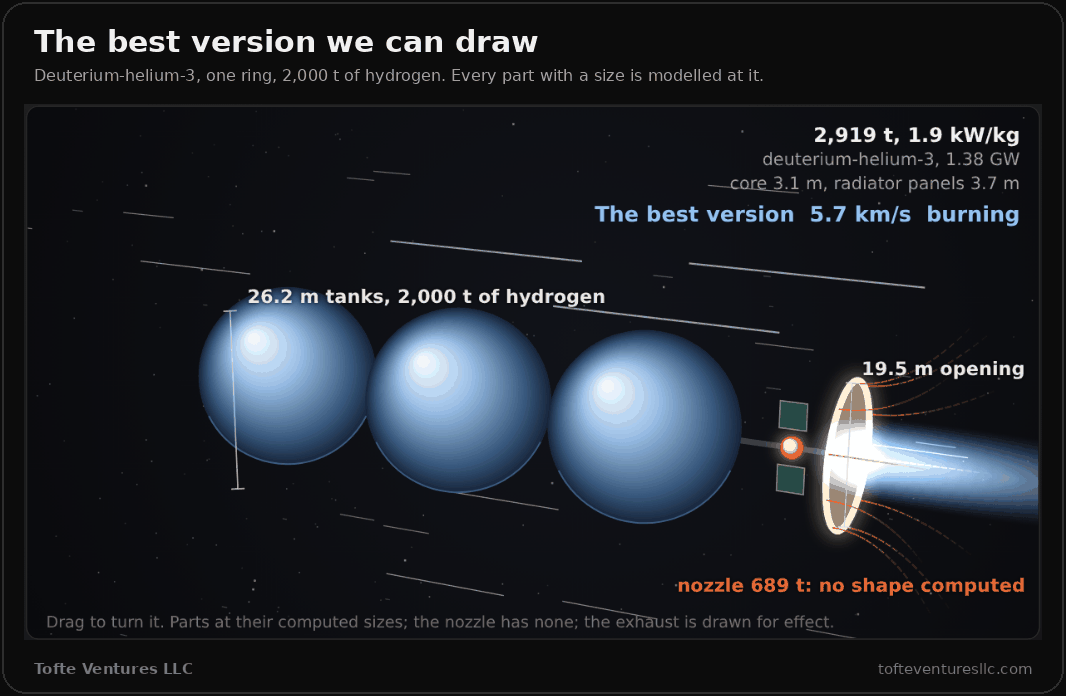
Here it is, burning.
Now race it. The ship is a 3D model: every part that has a size is built at that size, and you can drag it to turn it. Pick a trip, pick a ship to draw, and press launch. The last lane is yours.
Watch the ship halfway through. A rocket that wants to stop has to point its engine the way it is going, so each ship turns end for end while it coasts, and it brakes with its exhaust leading. The turn is drawn in the middle of the coast, and with almost no coast it happens at the switch.
The race runs on the engine's own numbers. The browser flies each ship with the rocket equation's closed forms, and a check script holds those to the engine's integrated flights on every lane and on 36 other builds. They agree to a hundredth of a percent. Each trip is a straight line from a standing start that arrives at rest. That is why the published engine shows 33.4 days to Mars here and 38 in its own post: the 38 includes climbing out of Earth's gravity first.
More rings, or bigger ones
A fusion ring here is a whole engine: its own 19.5 metre opening, its own 30 tonne core and its own share of the nozzle. Two rings give twice the power, and they also carry twice the mass.
Three rings on three times the hydrogen fly exactly the same flight as one ring, to nine decimal places: 31.8 days to Mars and 0.224 light years in a century, stopped. That is the result the last post predicted, that watts per kilogram are the only thing that matters, checked this time on the built ship rather than on the flight alone. Three rings sharing one ring's tank do worse: 34.6 days and 0.205 light years, because the tank is now small for the engine.
A bigger ring is the same thing under another name. One opening three times the area carries exactly the nozzle mass of three rings. Rings buy redundancy and size. They do not buy speed. You can see it in the race: slide your rings up and your hydrogen with them, and your lane does not move.
A different fuel
This is where the answer surprised me, because the fuel matters in two places I did not expect and does nothing in the place I did.
On the trips it does nothing. Proton-boron and deuterium-helium-3 give the same Mars time and the same century to four decimal places. The nozzle sets the power per kilogram, and the fuel does not touch the nozzle.
It matters first for whether the fire burns at all. A fusing plasma radiates X-rays as its electrons swerve past the ions, and that loss rises with the square of each ion's charge. Boron's charge is 5. The engine's check on this finds proton-boron's balance against that radiation unresolved: on the transcribed numbers, fusion beats radiation by 0.07 to 1.5 times, depending on which end of the ranges you take. Deuterium-helium-3 clears it across the whole range, by 1.14 to 5.5. It is the only fuel here that clears its own radiation at both ends and keeps its neutrons to a trace. Deuterium-tritium clears the radiation easily too, but it puts four fifths of its energy into neutrons, which no magnet can steer. Its radiator comes out about 350 times helium-3's, and once the nozzle is light that radiator is what slows the ship.
It matters second for the stars. At the power a star needs, the engine wants an exhaust faster than proton-boron's products can give. Proton-boron's alpha particles leave at 11,800 kilometres a second. Helium-3's protons leave at 53,000. So Proxima in a century needs 666 kilowatts per kilogram on helium-3, against 1,588 on proton-boron. That is still 350 times this ship. It is also the first lever in this series that lowered the star requirement without touching the nozzle.
What the engine does not price is where the helium-3 comes from. It is rare on Earth, it cannot be scooped between the stars, and mining it is outside anything modelled here. The engine lists that as an open question rather than leaving it out.
The best version
After rings and fuel, the one thing left to choose is how much hydrogen to carry. Too little and the tank runs dry. Too much and the ship spends its power pushing its own tank. The engine searched loads from 100 to 20,000 tonnes and took the one that falls short of each trip's own best by the least.
The best version: deuterium-helium-3, one ring, 2,000 tonnes of hydrogen. At the studied nozzle it reaches Mars at its closest in 31.8 days and stops 0.224 light years out in a century, against 33.4 days and 0.211 for the ship as drawn on the same model.
- The hydrogen fills three spherical tanks 26.2 metres across, 28,229 cubic metres in all.
- The opening is 19.5 metres across and the core 3.1 metres.
- The radiator is 27 square metres, two panels 3.7 metres on a side. Helium-3's small neutron share needs ten times proton-boron's radiator, and it still weighs 269 kilograms.
- The nozzle weighs 689 tonnes and has no dimension, because nothing in the engine gives it a shape. That is why the model draws it as field lines with no surface, and why this post gives no overall length.
- The whole ship is 2,919 tonnes at launch, about 98 flights of 30 tonnes.
The scoop from the last two posts is not in it. With 2,000 tonnes aboard, the tank no longer limits the trip the way it did, and the scoop's 0.221 to 0.249 light years does not beat the ship without it at both ends of the ranges.
Honestly, the best version is barely better than the original. It wins by a day and a half to Mars and seven percent on the century. That is the finding. Every choice left to make was a small one, because the one number that decides this ship is not a choice.
If the nozzle comes good
That number is the nozzle's mass per kilowatt. The ship above uses 0.5 kilograms per kilowatt, the lightest figure the direct fusion studies reach. The last lane in the race uses 0.05, the floor of the hopeful range, and nothing here claims anybody can build it.
With that nozzle the best load drops to 200 tonnes and the ship changes character. Mars in 16.6 days, and 0.606 light years in a century. The scoop comes back into play too, because the tank is small again: switched on for the brake, it takes the century to 0.91 to 0.93 light years. That is still a fifth of the way to Proxima.
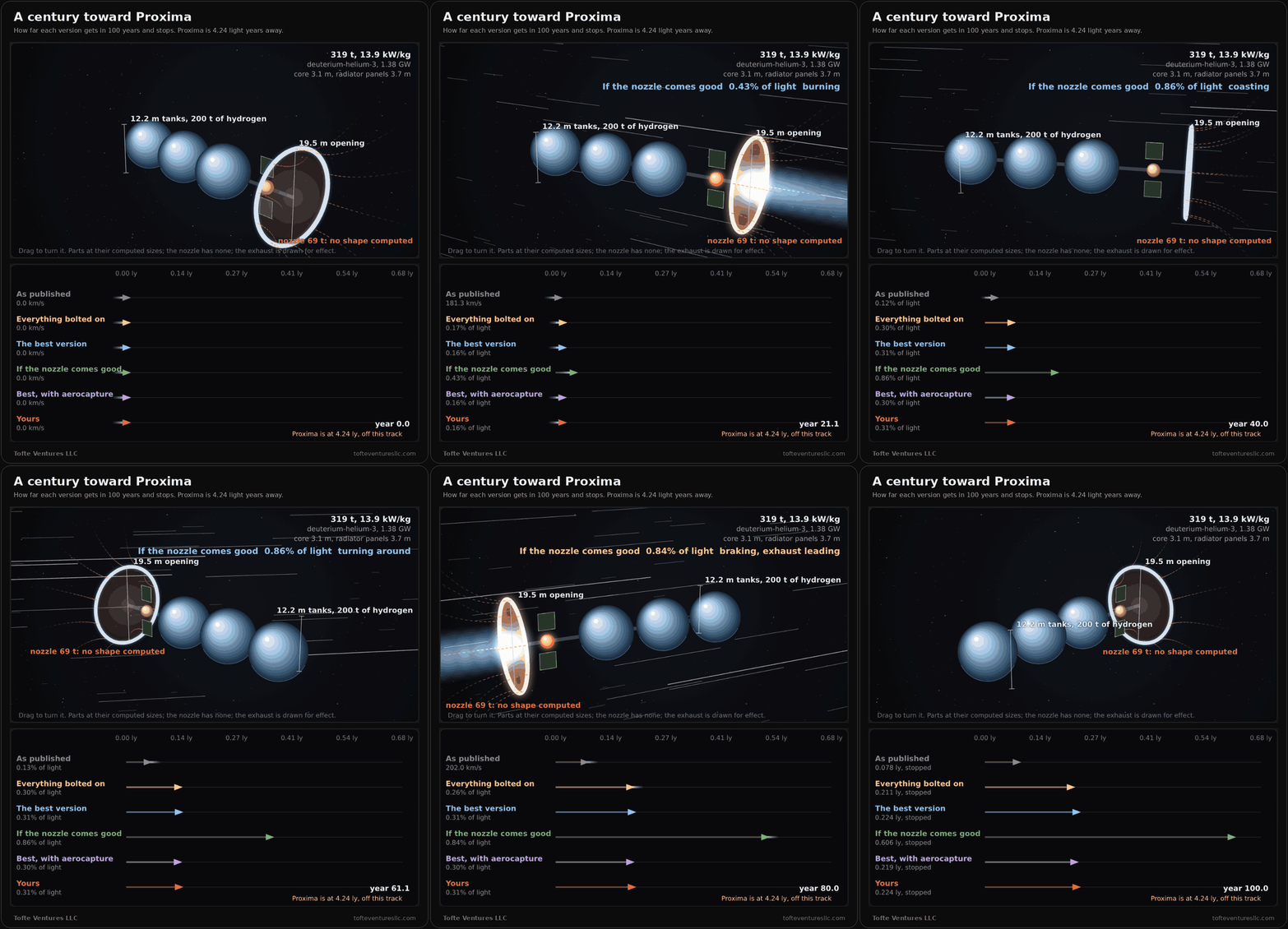 Even the hopeful nozzle leaves the ship about fifty times short of the power per kilogram a star needs.
The verdict
- More or bigger rings: the same ship at a larger size. Redundancy, not speed.
- Deuterium-helium-3: the only fuel that clears its own radiation at both ends with its neutrons kept to a trace, and the first lever that cut the star requirement, from 1,588 to 666 kilowatts per kilogram. Where the helium-3 comes from is not priced.
- The best version: one ring and 2,000 tonnes. Mars in 31.8 days, 0.224 light years in a century.
- The same ship on a nozzle ten times lighter: 200 tonnes of hydrogen, Mars in 16.6 days and 0.606 light years, and it still does not reach a star.
Every version of this engine runs into the same wall, and it is the part with no shape. Build your own in the race above and try to get past it: the nozzle slider is the one that moves your lane, and the band it sits in tells you how much hope that setting needs.