Correction, 24 September 2026. Every stopping flight in this post dropped the whole tank before the braking burn, so the brake ran on hydrogen held in no tank at all. With the shells that hold the braking hydrogen kept aboard, the engine alone takes 31.8 days rather than 31.2, and the shield saves a little more: 1.4 to 4.6 days with a crew rather than 1.2 to 4.2, and the race's lane 28.3 days rather than 28.1. Never braking at all is still 22.3 days, now a 30 percent saving. The numbers and figures below are the corrected ones, and every conclusion stands. How it turned up is in The Nearest Star, Flown.
Slowing down looks like half the trip. The ship spends its hydrogen getting up to speed, then spends more getting back down, and at Mars there is a whole atmosphere sitting there that would do the second job for free. So I put a heat shield on the best version of the fusion engine and let the air do the braking.
It helps a little. With a crew aboard, held to 4 to 8 g, the shield saves 1.4 to 4.6 days of a 32 day trip to Mars. And the most any atmosphere could ever save, if the ship did no braking at all, is 30 percent. Half the trip was never available. Here is why, and here is the ship.
Race it
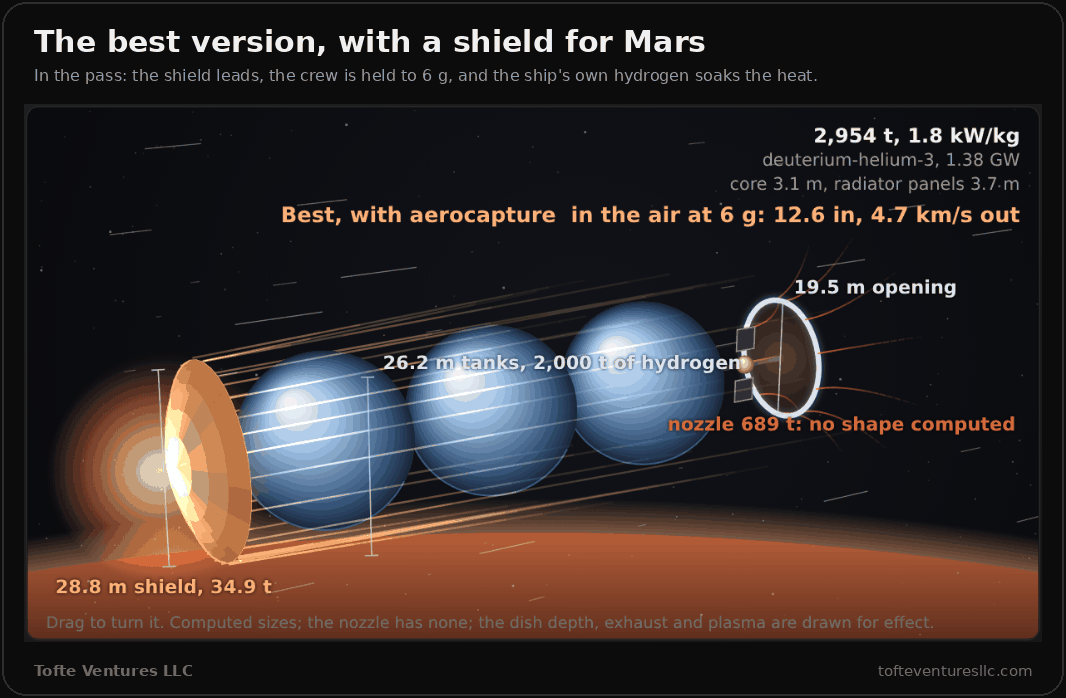
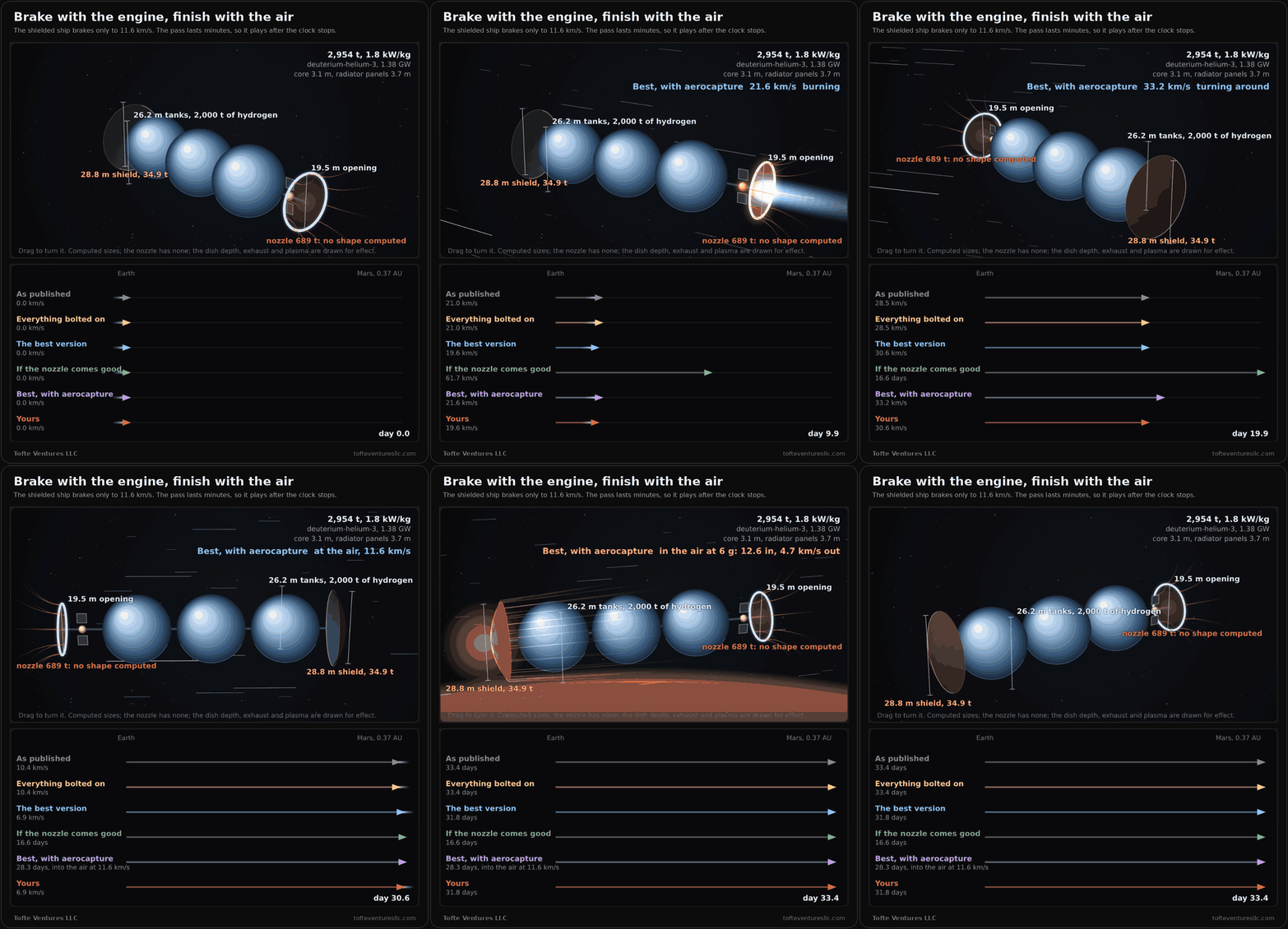
This is the same race as before, opened on a new lane: the best version with a shield at the bow. It brakes with its engine only down to 11.6 kilometres a second, turns shield first, and lets the air take it the rest of the way into orbit. The pass lasts about two and a half minutes, which would not show on a clock counting days, so it plays after the clock stops.
You can put a shield on your own ship too. The readout shows your trip with the air and with the engine alone, side by side.
The shielded lane is checked the same way as the others. The browser flies it with the rocket's closed forms, and a check script holds its arrival speed, its shield and its days to the engine's own export, where they agree to a hundredth of a percent. A figure script flies it a third time on its own and gets the same numbers.
Here is one run of it, captured from the widget frame by frame.
The brake is the cheap half
Here is the trip with the engine alone: 14.0 days burning, 10.8 days coasting, 7.0 days braking. The brake takes half the speed change and only a fifth of the time. By the time the ship brakes it has burned most of its hydrogen and dropped its empty tank shells, so it is light, and a light ship changes speed quickly on the same power. It is also still flying at full speed the whole time it brakes, so those days are not lost. They cover ground.
So the right question is not what the brake costs. It is what the ship would do if it never had to brake at all. Then it could spend all its hydrogen going faster, and never turn around. The engine flies that too. Never braking at all gets the ship to Mars in 22.3 days instead of 31.8, a saving of 30 percent. That is the ceiling on the whole idea, for any atmosphere, any shield and any crew. A ship at constant thrust hits the same wall in nearly the same place: skip the brake entirely and its trip gets shorter by 1 minus 1 over the square root of 2, which is 29 percent.
This is the pattern this blog keeps finding: an answer that is well formed, sounds obviously right, and is false. "Half the trip is slowing down" is true of the speed and false of the time, and only the time matters.
The crew sets the speed, not the heat
The ship cannot hit the air as fast as it likes. At 12 kilometres a second it is going far faster than orbital speed, and on its own it would cut straight through the top of the atmosphere and out the other side. To stay in the air it has to curve around the planet, and the only thing that can bend its path is lift from the shield, pulling it down. That pull lands on the crew exactly as braking does. Early in the pass at the race's setting, 4.2 of the crew's 6 g go into just holding the curve, which leaves 4.2 g of braking (the two add as sides of a right angle, not end to end).
So there is a fastest arrival, and the crew's limit sets it. How fast depends on how much lift the shield makes for its drag and how much deceleration the crew may take:
- a blunt capsule at 4 g, the harsh end, may arrive at no more than 5.3 kilometres a second;
- a slender lifting body at 8 g, the friendly end, may arrive at 14.8;
- the race's setting, lift equal to drag at 6 g, arrives at 11.6.
Both routes to that ceiling agree: the closed form, and a pass integrated along the curve that holds just under it and is refused just over it. Here is the pass at the race's setting, with Mars and the paths drawn to scale.
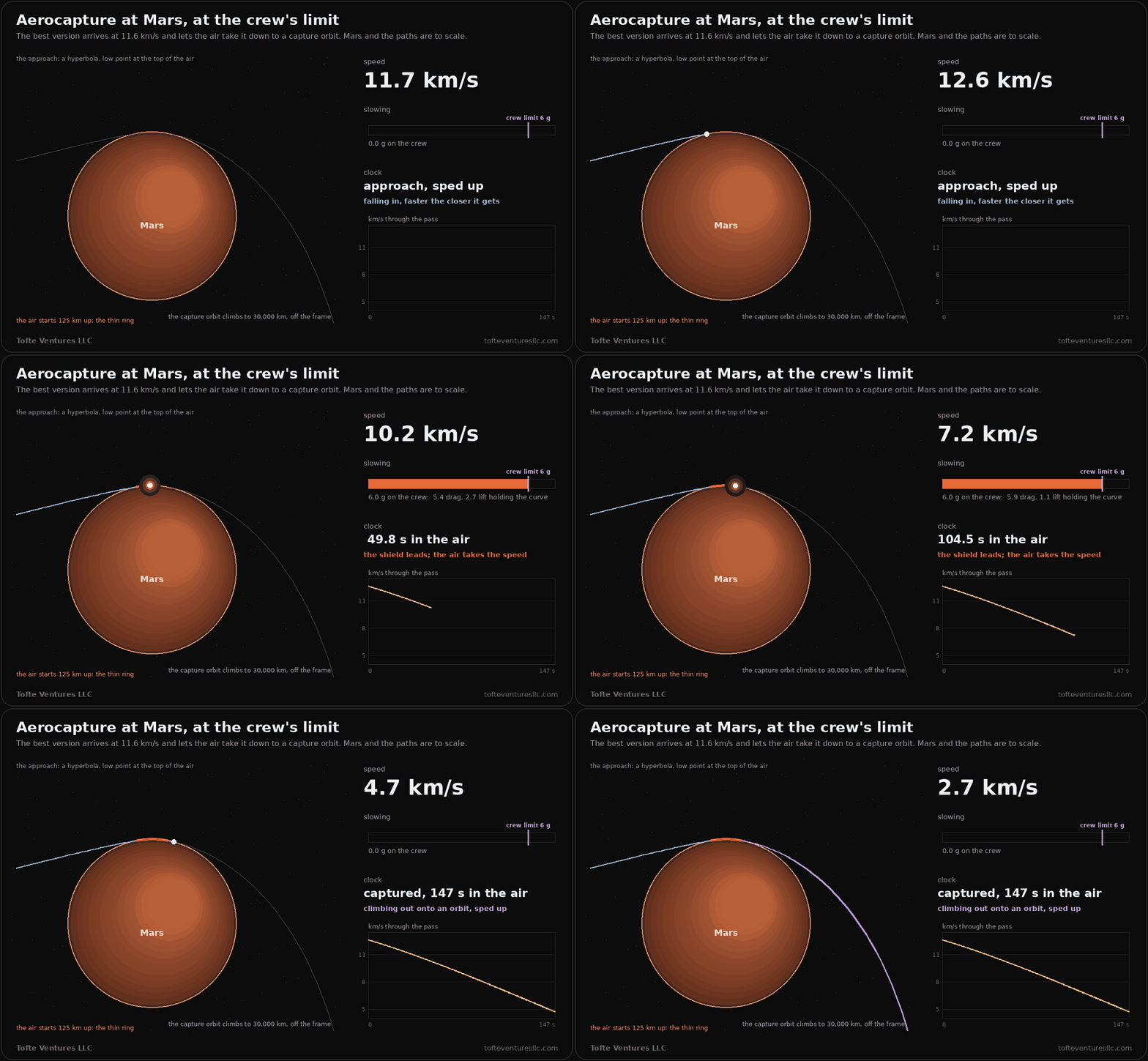
The pass covers 1,304 kilometres, about 6 percent of the way around Mars, in 147 seconds, at 6 g the whole way. It ends at 4.7 kilometres a second, which is exactly the speed that leaves the ship on an orbit reaching 30,000 kilometres up. It is captured.
What it saves
Here is every setting at once: days to Mars against how hard the crew may be slowed, at both ends of every band, with the shield each one needs carried the whole way.
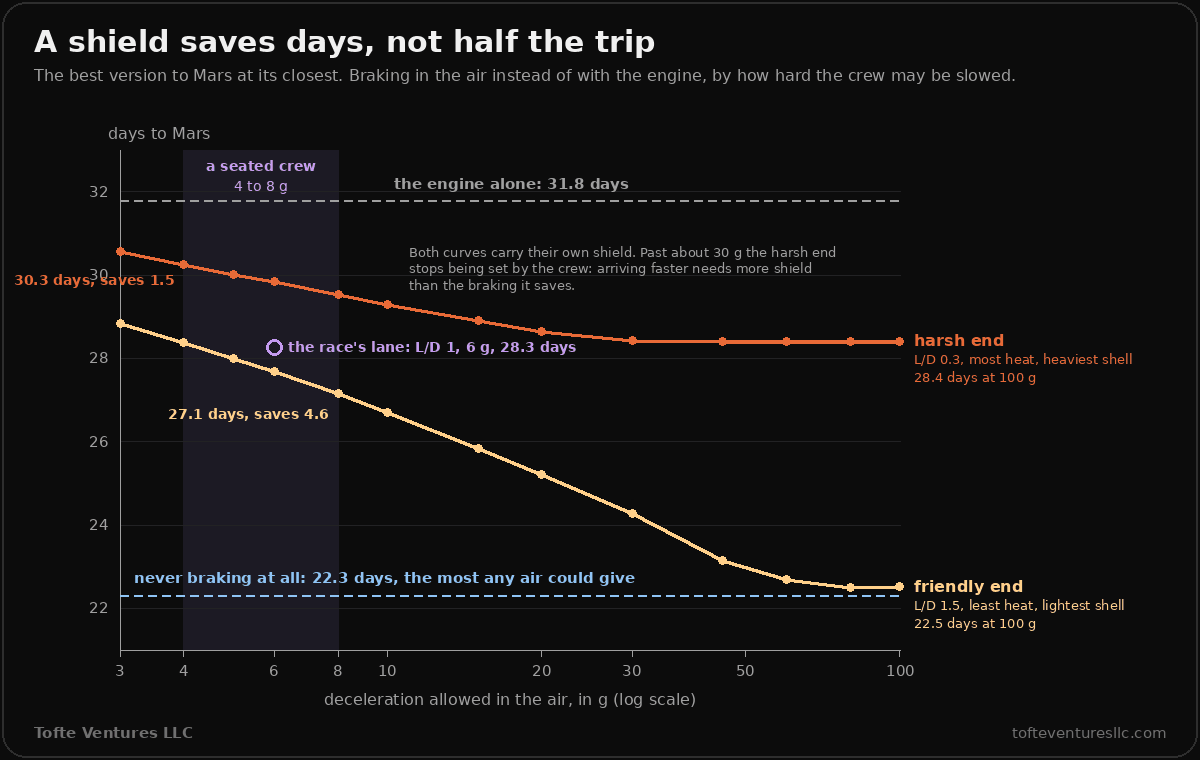
With a crew, the shield saves 1.4 to 4.6 days, 4 to 15 percent of the trip. The race's lane, in the middle, saves 3.5 days: 28.3 against 31.8. A probe that can take 30 g saves up to 7.5 days, and at 100 g the friendly end reaches 22.5 days, nearly the floor. Past about 30 g the harsh end stops improving at all, because a faster arrival there needs a shield heavier than the braking it saves.
The shield
The shield has to cover the widest thing on the ship, which is the hydrogen tanks at 26.2 metres. With a tenth to spare it is 28.8 metres across. Its structure is 13 tonnes at the race's setting, 20 kilograms a square metre. The rest is whatever soaks up the heat.
A percent or two of the energy the air takes off the ship reaches the shield rather than the shock in front of it. That share is a wide band, 0.5 to 5 percent, because at these speeds much of the heating is light from the shock layer, and nothing has flown through it at 12 kilometres a second. The heat has to go somewhere. The usual answer is an ablator, a material that chars and carries the heat away as it burns off, at 20 to 100 megajoules a kilogram.
The ship's own hydrogen does better. Warming liquid hydrogen from 20 kelvin to 2,500 absorbs 35.5 megajoules a kilogram, and heating it until its molecules split absorbs 252. At both ends of the bands the hydrogen is the lighter coolant: 1.6 tonnes against 4.0 at the friendly end, and 16.3 against 29.4 at the harsh end. The race takes it at its worst, warming only, and the shield comes to 34.9 tonnes: 13.0 of structure and 21.9 of hydrogen. That is about 1 percent of the ship at launch.
The shield rides the whole way, including trips where there is no air at the end. On the century run toward Proxima it costs a little: 0.219 light years instead of 0.224, stopped.
What is not priced
The engine names what it could not work out rather than leaving it out:
- the shield's shape and the flow around it, which set the lift to drag that the bands only bracket;
- the nozzle fitting in the shield's wake. The nozzle has a mass and no dimension, so whether it sits safely in the shadow of a 28.8 metre dish is unknown;
- the ship's structure under several g sideways, with tanks 26 metres across that were only ever pushed from behind;
- radiative heating at entry speeds nothing has flown, which is why the heat share is such a wide band;
- the passes that lower the orbit afterwards. The capture orbit reaches 30,000 kilometres up. Bringing it down takes weeks of shallower passes, and those are not counted in the trip.
One more simplification is worth saying. The model flies the pass at the radius where the air begins and lets the air give whatever drag the crew allows. A real pass would dip deeper to find that much air, and every 35 kilometres deeper takes about half a percent off the fastest entry speed.
So is it worth it
For a crew going to Mars, a shield buys about three and a half days out of thirty-two, costs a tonne of ship in a hundred, and adds a dish nobody has designed yet in front of a nozzle nobody has shaped. It is the kind of add-on Bolt Everything On kept finding: real, modest, and nowhere near what it looked like at first. Like the scoop, it works as a brake. Unlike the scoop, it is a small brake, because the brake was already the cheap half of the trip.
The saving is bigger where the crew is not. A probe that can take 30 g saves a week, and one that can take 100 saves nearly everything a planet could ever give. Either way, the ceiling is 30 percent, not half.