Correction, 24 September 2026. The stopping trip in this post dropped the whole tank before the braking burn, so the brake ran on hydrogen held in no tank at all. With the shells that hold the braking hydrogen kept aboard, stopping on the line takes 13.0 years rather than 12.8, peaking at 360 kilometres a second rather than 374, and the straight line with no Sun 12.7 rather than 12.5. Flying down the line does not brake and is unchanged at 8.9 years, now passing 650 AU at 530 kilometres a second. The numbers and figures below are the corrected ones, and every conclusion stands. How it turned up is in The Nearest Star, Flown.
Every trip on this blog so far has gone somewhere that is already there: a planet, a moon, the Sun. This one goes to a place defined only by geometry. It is where the Sun's own gravity turns it into a telescope, and it is the first destination where the fusion engine is not just faster than what we have, but the difference between going and not going.
The Sun bends starlight onto a line
Light passing a mass is bent toward it. For light grazing the Sun the bend is 4GM / c²b, 1.75 arcseconds, the number the 1919 eclipse measured. It is tiny, but it points every grazing ray from a distant star at the same place: the axis behind the Sun, on the far side from the star.
The engine works out where. Rays grazing the Sun cross the axis b²c² / 4GM behind it: 548 AU. It checks that against the exact relativistic orbit of a photon, integrated, and the two agree to six parts in a million; the exact orbit bends a hair more, and the difference is the second-order term general relativity predicts, to within a part in eighty thousand. Rays passing higher bend less and meet further out, so the focus is not a point. Every point on the line past 548 AU is a focus.
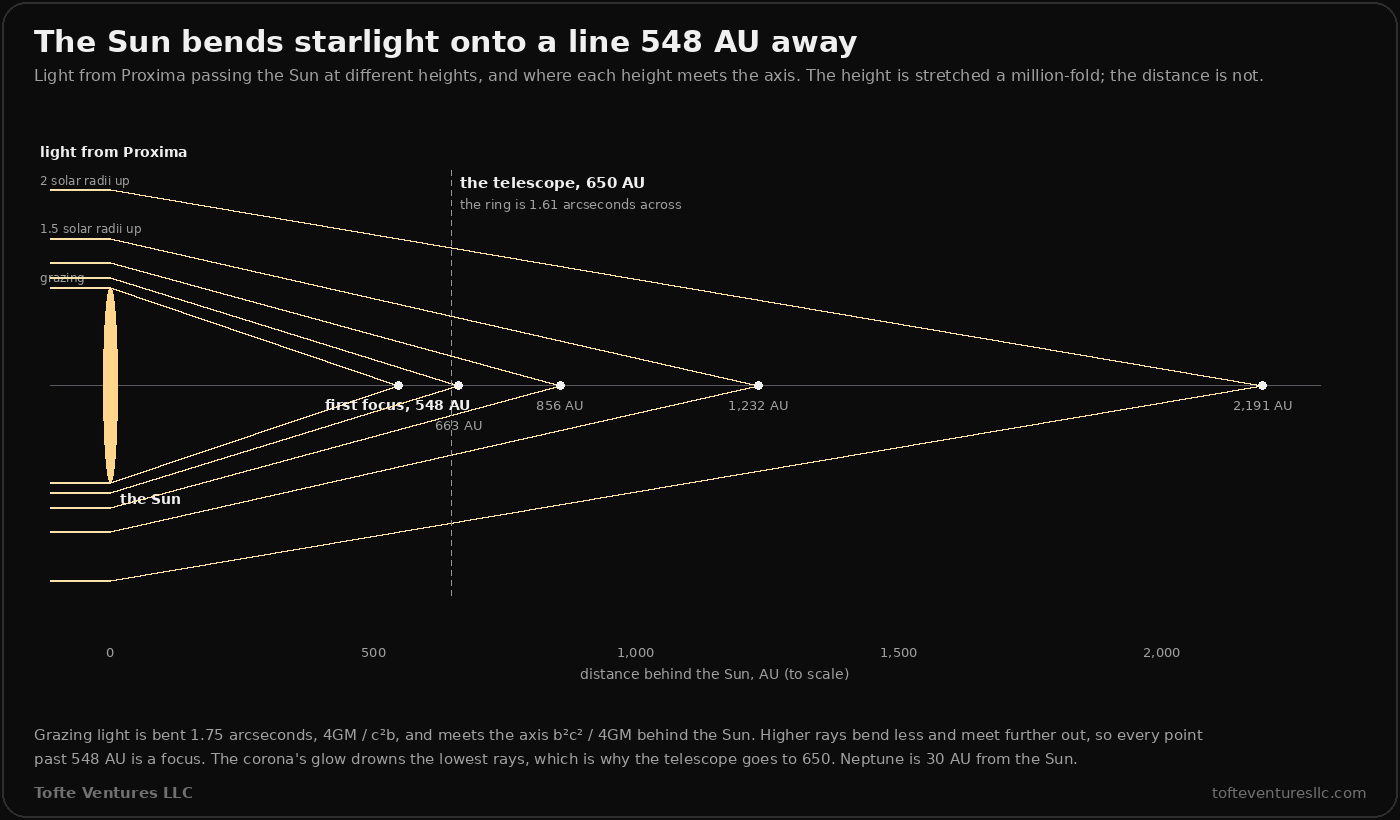
In practice the telescope goes a little further, to about 650 AU. The Sun's corona glows, and the rays that pass lowest have to come through it; the engine carries 650 AU as a chosen value, from memory, with that reason attached.
What the telescope sees
Standing on the line and looking back at the Sun, a telescope would see the star behind it bent into a ring round the Sun, 1.61 arcseconds across at 650 AU. Hide the Sun behind a disc, and a planet round that star appears the same way: its light wrapped round the Sun.
The lens does something stranger than magnify. It makes a real image of the planet in space, scaled by the ratio of the distances. An Earth-sized planet at Proxima Centauri becomes an image 31 kilometres across at 650 AU, and the telescope has to be inside it. Each position in that image sees the ring lit by a different part of the planet, so a picture is built by moving across it, point by point.
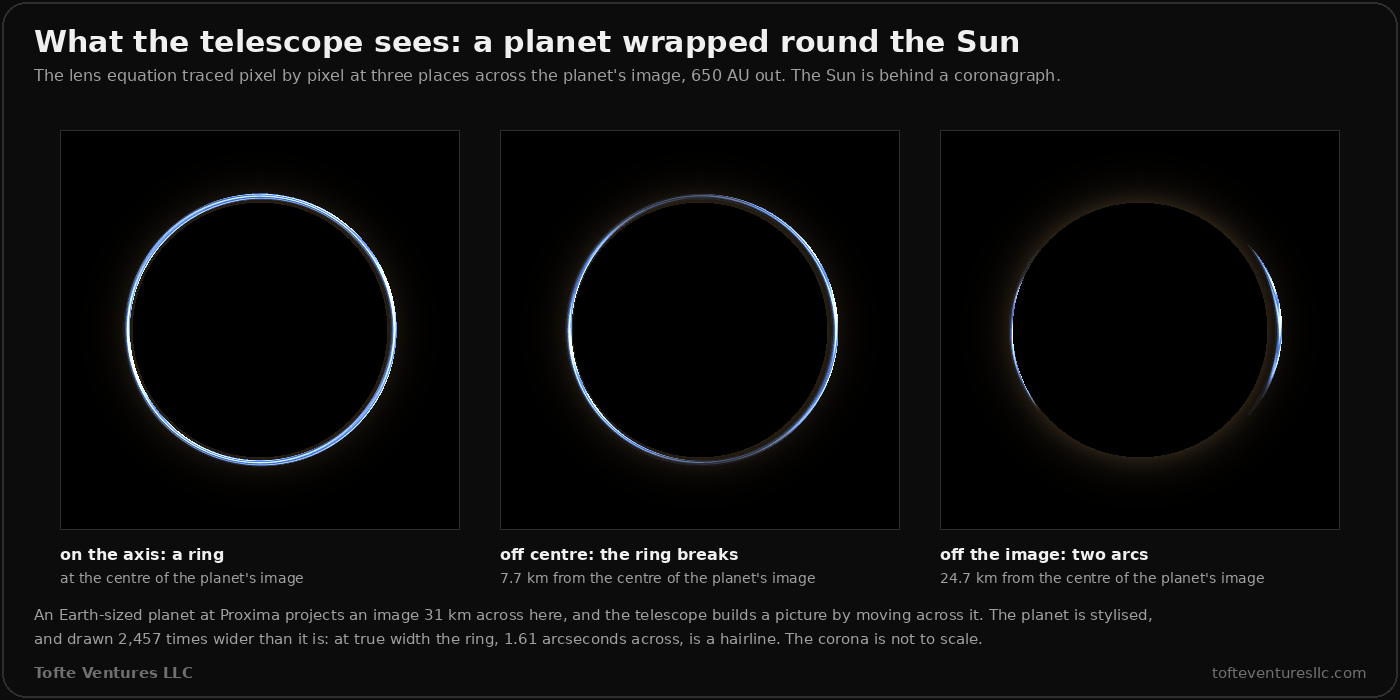
The renders are the lens equation itself: every pixel's ray is sent back to the point of the planet it came from, which is correct because a lens keeps surface brightness. The engine checks that equation against brute force, firing a grid of rays and counting how many land on a small source, and gets the textbook brightening to within a few percent. The ring gathers light from the whole circle round the Sun, and the brightening quoted for it on the axis is about a hundred billion times in the near infrared. That figure is the ideal, transcribed from memory rather than derived here, before the corona and a real telescope take their share.
Why nobody has gone
650 AU is a long way. Voyager 1, the furthest thing ever sent, is about 170 AU out after nearly half a century. And the line is not in the plane of the planets. It runs away from whatever you want to look at, so the lens for Proxima is on the far side of the Sun from Proxima, 45 degrees above the plane the planets move in. Every mission to it has to climb out of that plane as well as out of the Sun's well.
Flying down the line
The engine flies it door to door: the spiral out of low Earth orbit, then the crossing from Earth's real position and speed on a real date, with the Sun pulling the whole way, to a point 650 AU down the line opposite Proxima. Two ways, because they are different missions. Flying through keeps going, down the line, imaging as it goes, since every point past 548 AU is a focus. Stopping arrives at rest on the line and can stay.
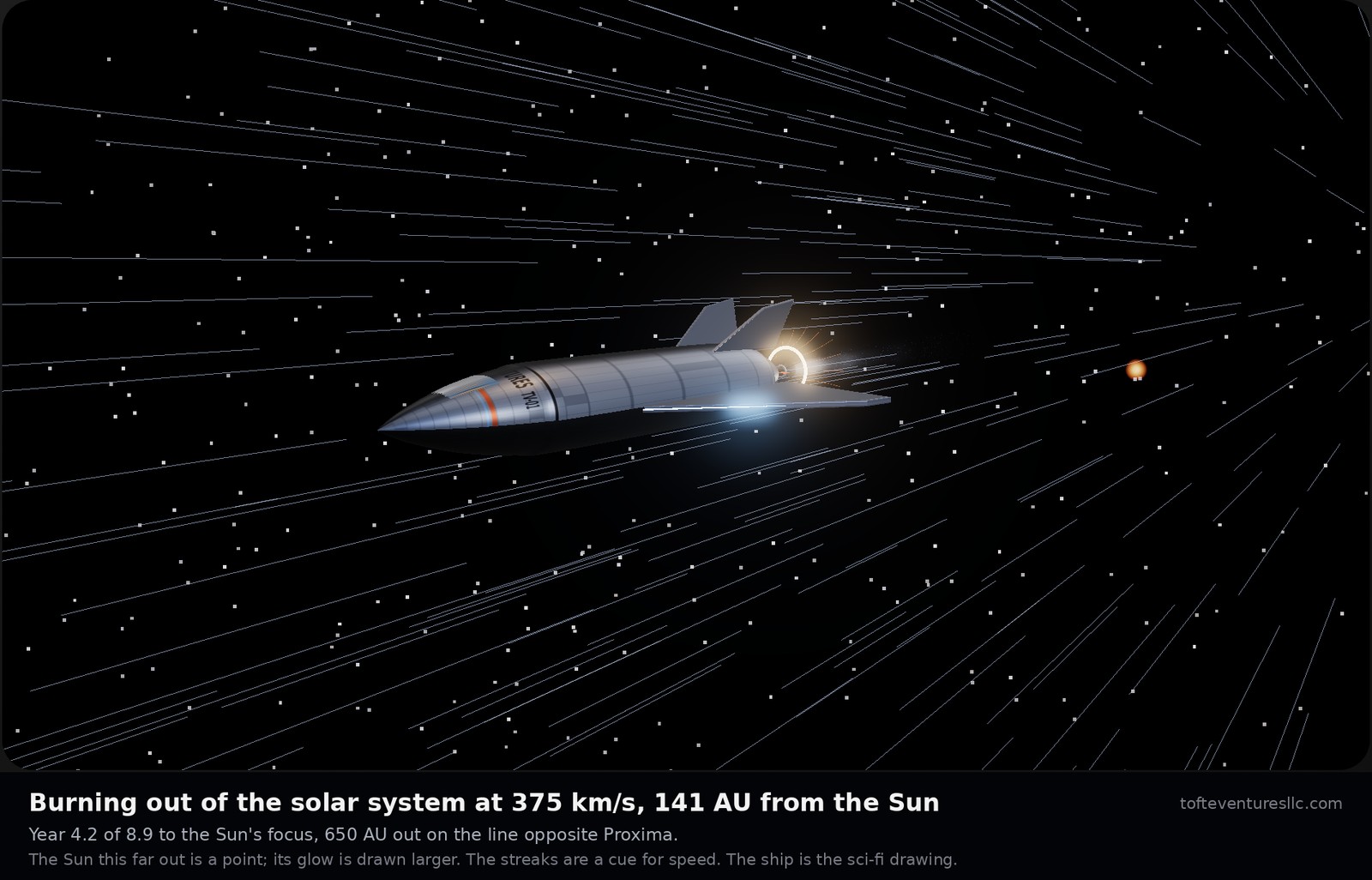
Flying through, the ship passes 650 AU after 8.9 years, at 530 kilometres a second. That is 0.18 percent of the speed of light and about 110 AU a year, faster than any trip flown on real orbits on this blog so far. Stopping, it arrives after 13.0 years, having peaked at 360 kilometres a second.
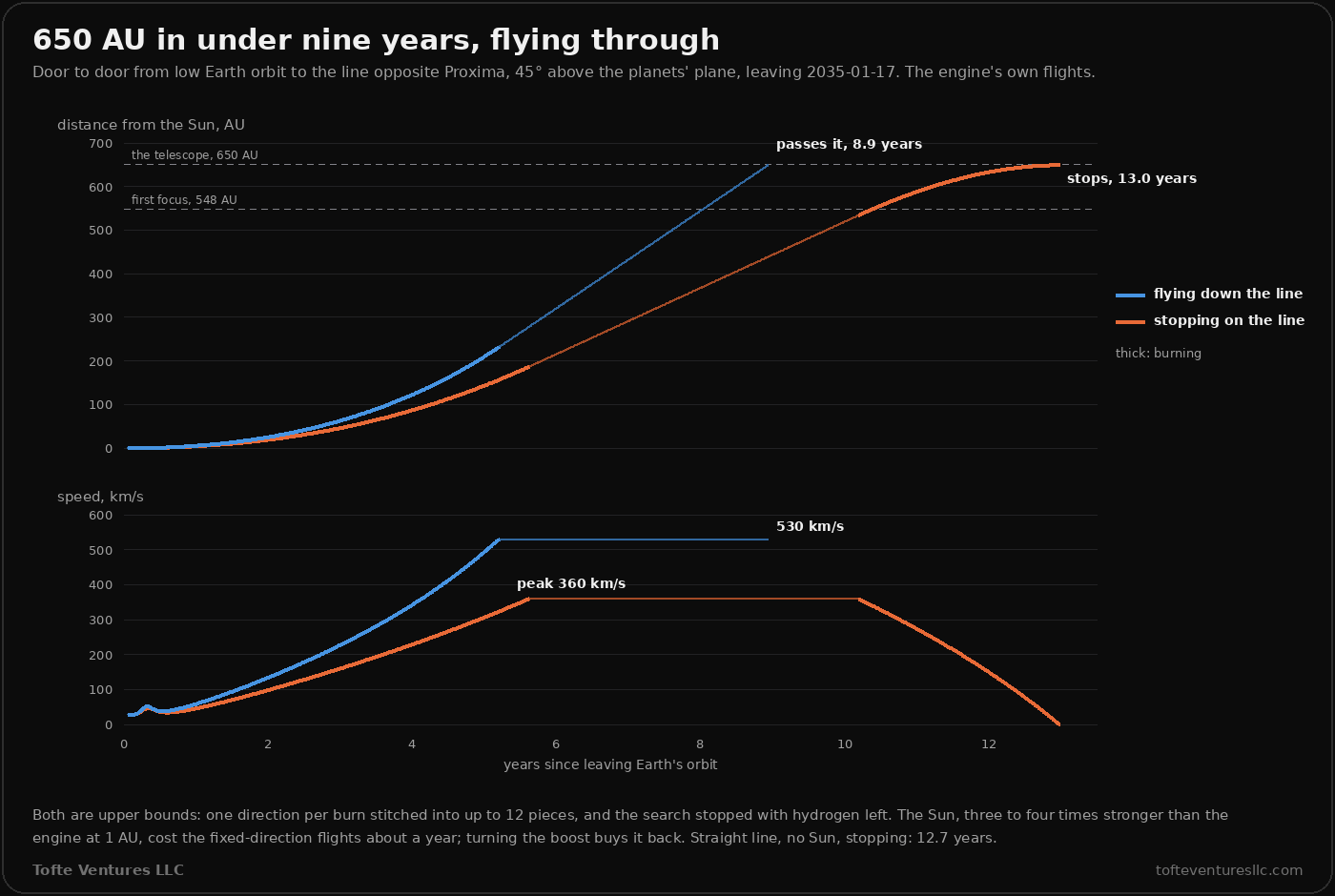
The first obstacle is not the distance. At Earth's distance the Sun pulls on the ship three to four times harder than the engine pushes, the same shape of problem as climbing out of Earth's orbit in Further Out, on a larger scale. The engine's usual steering, one fixed direction per burn, fights that badly: flown that way the trip dips toward the Sun before it climbs away, and takes about a year longer. Letting the boost turn up to a dozen times, with the hydrogen minimised at each step, buys that year back, and the stopping trip comes in at 13.0 years against 12.7 for a straight line with no Sun at all. Both times are upper bounds: the search stopped with hydrogen still in the tank.
Holding the line
The line runs from Proxima through the centre of the Sun, and the Sun does not sit still. The planets swing it round the solar system's centre of mass, Jupiter most of all, and the engine works out from the ephemeris that the Sun wanders up to 1.1 million kilometres across the line, more than a solar radius and a half. The line wanders with it, and a telescope inside a 31-kilometre image has to follow. The speed it takes is small, about 6 metres a second a year, which this engine could supply without noticing. Knowing where you are to a few kilometres, 650 AU and almost four light days from anyone, is a different problem, and nothing here prices it.
An answer that was off by 5,600 kilometres
One of the engine's own numbers was wrong on the way, and it is the kind of wrong this blog keeps finding.
The figures on this page are drawn by a separate script that flies both trips again from the engine's controls, with its own integrator, and checks that they arrive. It said the stopping ship ended 5,600 kilometres from where the engine said it had. The engine's flight was well formed and converged in the sense that mattered to its solver, and the script was right: the engine's default step is sized for trips of weeks, and over twelve years it had not converged. At a tenth of the step the engine's own answer moved to the script's. It changed no trip time, 5,600 kilometres being seconds at these speeds, but it was a confident number that was not true, and only the second route caught it.
What is not priced
The engine names what it has not worked out:
- the corona: its glow swamps the ring close to the Sun, which is why the telescope goes to 650 AU; its brightness and the coronagraph that hides the Sun are not priced;
- turning a ring into a picture: the ring mixes light from the whole planet, so an image is rebuilt from many positions across the 31-kilometre image, and how long that takes is not priced;
- the planet moves: it turns and goes round its star while the picture is built;
- navigation: knowing where the telescope is to far better than the image, 650 AU out;
- the gain: the hundred-billion-fold brightening is the transcribed ideal;
- one target per trip: each star's line is on the far side of the Sun from it;
- the steering: a boost turned a dozen times, not steered continuously, so every time is an upper bound;
- talking home: 650 AU is almost four light days, and the link is not priced.
One per cent of a light year
650 AU is a hundredth of a light year. The best version of the fusion engine gets there in nine years, where anything we have flown would take well over a century, and in doing so it becomes the first ship on this blog that opens a door rather than shortening a trip.
Proxima itself is 413 times further. That is the next question: what this engine does against the distance to the nearest star, and what would have to change for the answer to be a lifetime rather than an age.