Correction, 24 September 2026. Every leg in this post dropped the whole tank before the braking burn, so the brake ran on hydrogen held in no tank at all. With the shells that hold the braking hydrogen kept aboard, the refilled round trip is 80 days rather than 78, carrying the return is 99 rather than 98, a month at Mars makes it 114 rather than 112, and the helium-3 is 8.1 to 8.6 kilograms rather than 8.2 to 8.7. The numbers and figures below are the corrected ones, and every conclusion stands. How it turned up is in The Nearest Star, Flown.
The Whole Voyage got the best version of the fusion engine to Mars on real orbits: 32.3 days, leaving in August 2035. That is a true answer to a question no crew will ask. A crew wants to know when they get home.
So the engine now flies Mars to Earth too, with the same solver, the same Sun and the same arrival at the planet's own speed. And a round trip asks three things a one-way trip never did. Does the ship carry its return hydrogen, or make it at Mars? What does making it cost? And where does the reactor's own fuel come from, when a trip burns kilograms of something that is rare on Earth?
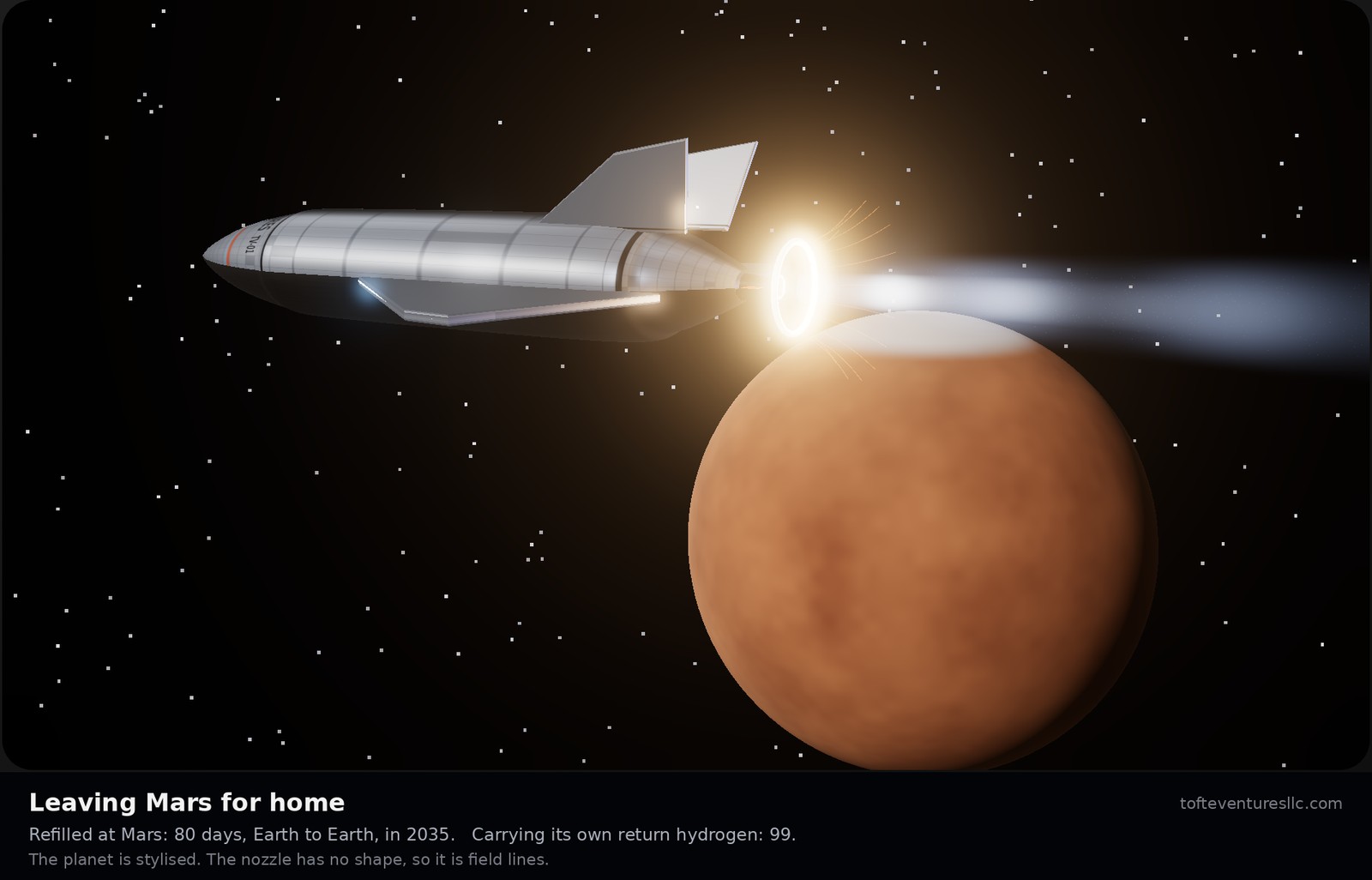
The drawing is the sci-fi one from last time, for fun, and the planet in it is stylised rather than a map of anywhere. The numbers are not for fun.
Two ways home
Two ships leave Earth together on 25 August 2035, the best window before 2045. Each spends a week in orbit at Mars and flies home.
Ship A is refilled at Mars. It flies out on its full 2,000 tonnes of hydrogen, is given 2,000 tonnes more at Mars, and flies home on that. Ship B carries its own return. It leaves with the same 2,000 tonnes, but a share of it, and a tank for that share, rides out to Mars as cargo.
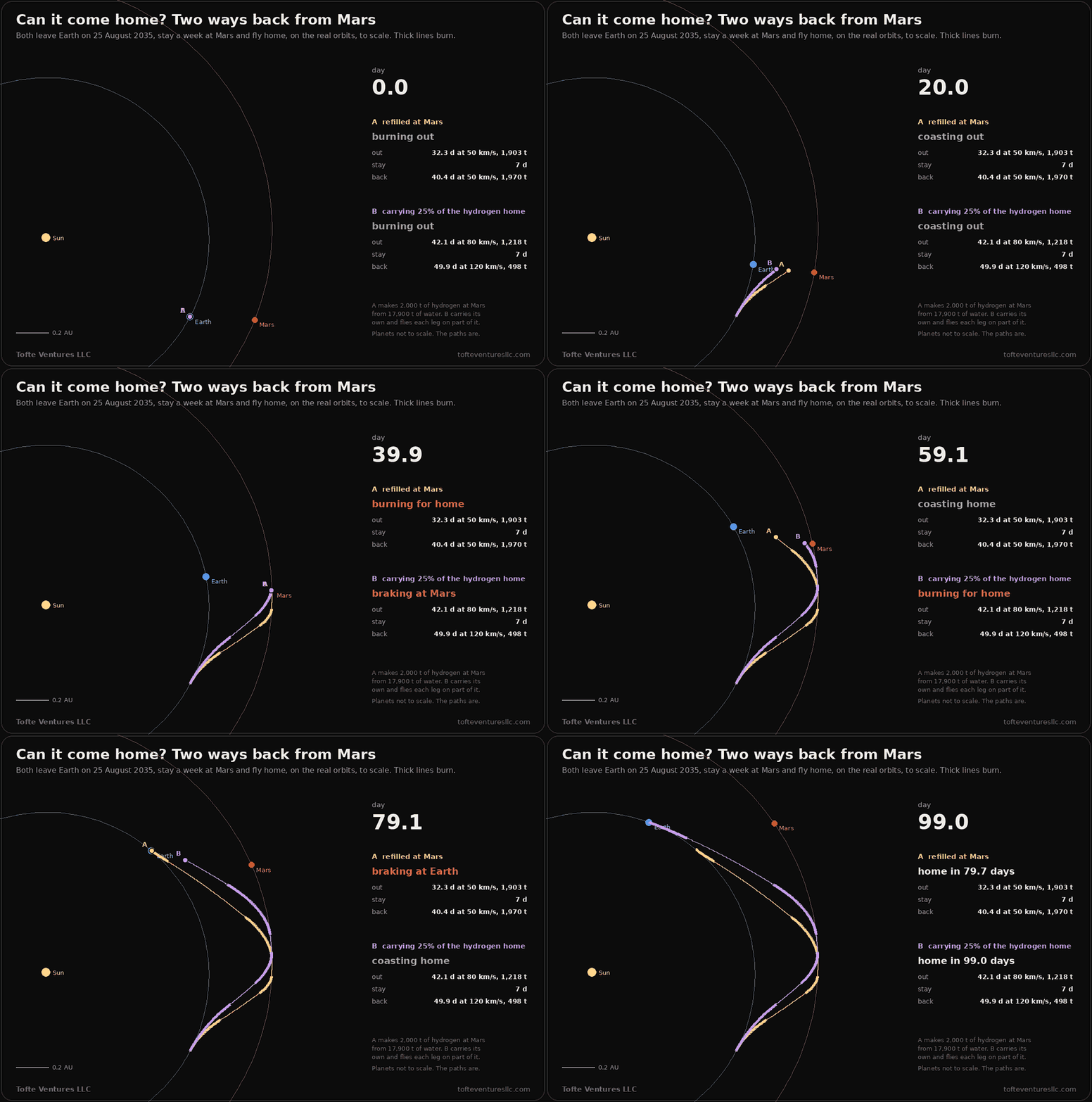
Refilled at Mars, the round trip is 80 days: 32.3 out, a week at Mars, and 40.4 home, landing on 12 November 2035. Carrying its own return, it is 99 days at best, home on 2 December.
The way home is slower than the way out even with a full tank, and the orbits say why. Earth and Mars were closest on 11 September, while the ships were on their way out. By the time they leave Mars, Earth, on the inside track and moving faster, is pulling ahead, and the ship has to chase it and arrive moving at Earth's speed.
Carrying the return is slower at every share
Carrying looks like the self-reliant choice. It costs twice. The way out hauls the return's hydrogen and its tank, 550 tonnes of cargo at the best split, so the outbound leg is slower. And each leg only has part of the tank, so to burn for long enough on it, each has to run its exhaust faster, and a faster exhaust gets less push from the same reactor: 80 and 120 kilometres a second against the refilled ship's 50.
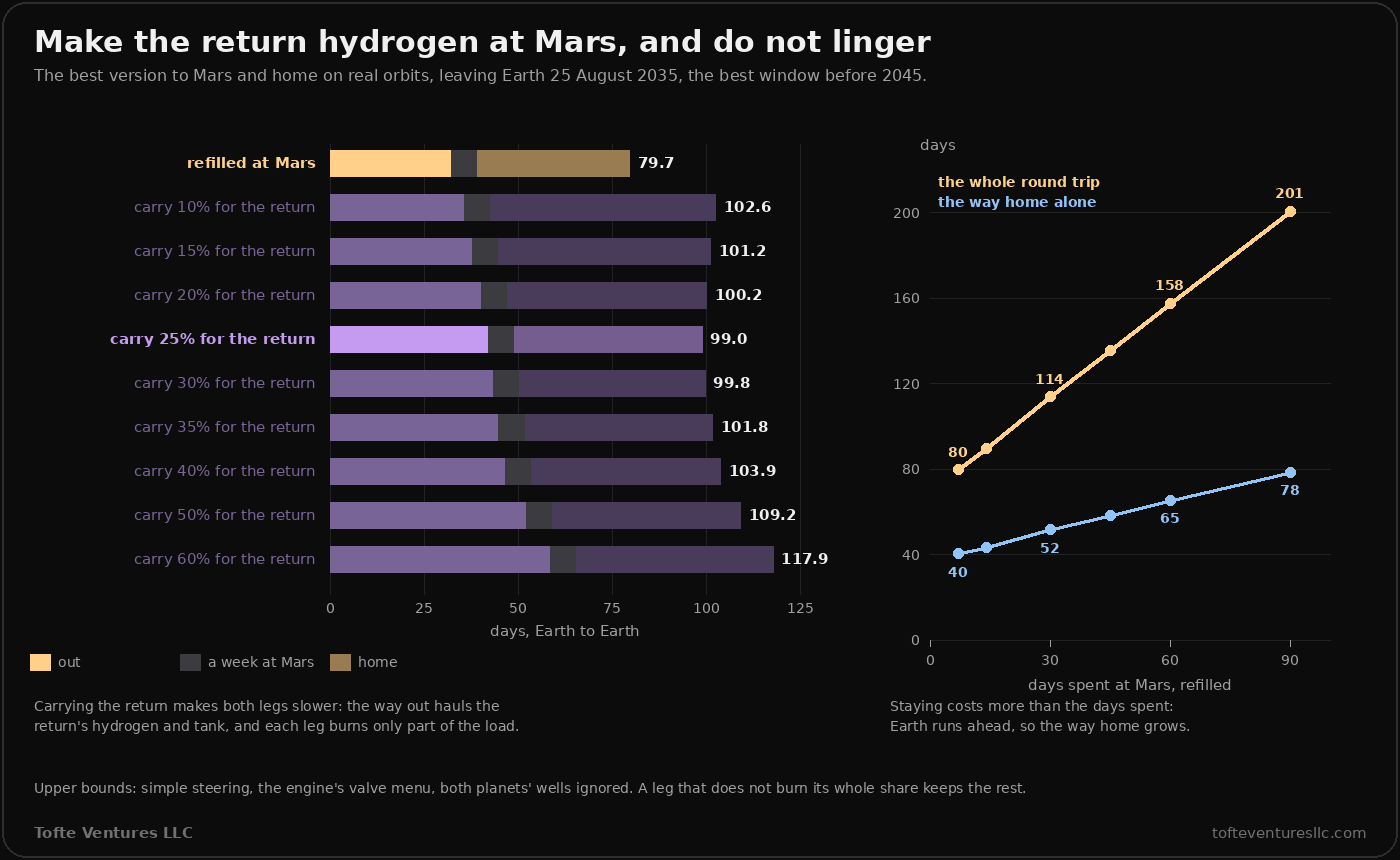
The engine scanned the split. A quarter of the hydrogen for the return is the best, at 99.0 days, and anything from a tenth to three tenths lands between 99 and 103 days. Carry half and it is 109.
One honest limit, and it runs against the carried ship: at 80 kilometres a second the way out burns 1,218 of its 1,500 tonnes, and the engine does not move the 282 it did not burn over to the way home. So 99 is an upper bound, like everything here.
Do not linger
Staying costs more than the days spent. The longer the ship waits at Mars, the further ahead Earth gets. A week's stay makes the round trip 80 days. A month makes it 114: 23 more days at Mars cost 34 more days in total, because the way home grows from 40 days to 52. Stay two months and it is 158 days, three months and it is 201, with 78 of them on the way home.
A real crew would want more than a week on Mars. The honest version of that is a different mission: wait at Mars for the next good window home, the way conventional plans do. That is not flown here.
The refill is 17,900 tonnes of water
Making 2,000 tonnes of hydrogen at Mars means finding water and splitting it. Water is two hydrogens in eighteen by mass, so 2,000 tonnes of hydrogen is 17,900 tonnes of water, worked from the molar masses rather than typed in.
Splitting it takes 39.4 kilowatt hours per kilogram of hydrogen at the ideal and about 55 in practice, and chilling the hydrogen to a liquid takes another 10 to 15. That is 0.36 to 0.50 petajoules. The ship brings its own power station: the reactor makes 1.38 gigawatts, and if 30 to 70 percent of it can be turned into electricity, the refill takes 4 to 14 days. So a week at Mars covers the refill only at the good end. A fortnight covers nearly both, and the round trip is then 90 days.
What is not priced is most of the work: the plant that digs, melts and cleans 18,000 tonnes of ice, and a new tank to hold the hydrogen, because the ship dropped its outbound tank on the way.
The helium-3 bill
The reactor burns deuterium and helium-3. That fuel was chosen in the best version because it is the one that beats its own radiation across the whole range of the physics. This is where the bill for that choice arrives.
The reactor burns about 3.9 milligrams of fuel a second. The round trip has the engine running for 41 of its 80 days, which is 13.6 to 14.4 kilograms of fuel. Helium-3 is 60 percent of that by mass, from the atomic masses, so the trip burns 8.1 to 8.6 kilograms of helium-3. The engine checks the fusion energy two ways, as the reactor's power times the time and as the fuel burned times its energy, and gets 4.89 petajoules both ways.
Helium-3 is rare on Earth. The usual answer is the Moon, where the solar wind has been planting it in the soil for billions of years, at the 1 to 20 parts per billion usually quoted. The engine carries that band from memory, unverified. At those concentrations 8.1 to 8.6 kilograms of helium-3 is 0.4 to 8.6 million tonnes of lunar soil, dug and heated to 600 to 800 kelvin to let the gas out.
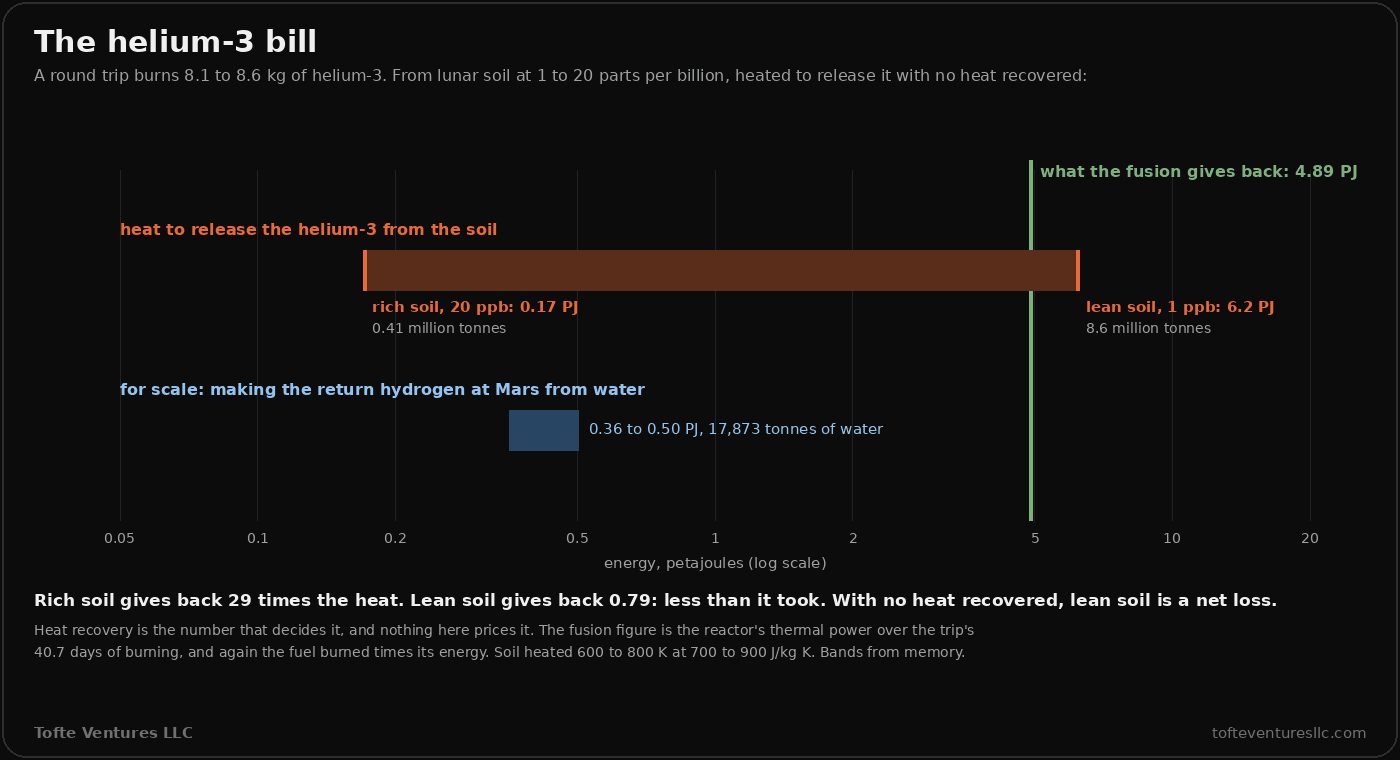
At the rich end, the fusion gives back 29 times the heat it took to get the fuel out of the soil. At the lean end it gives back 0.79: less than it cost. With no heat recovered, lean soil is a net loss before a single tonne has been moved or a single machine built.
I did not expect that. The fuel was chosen for being clean and for beating its own radiation, and both are still true. But a fuel you have to cook out of millions of tonnes of rock is only as good as the cooking. The number that decides it is how much of that heat can be recovered, and nothing here prices it. That is the pattern this blog keeps finding: the fuel's energy per kilogram is a well formed answer, and true, and it is not the answer to whether the fuel pays.
What is not priced
The engine names what it has not worked out:
- a new tank at Mars for the refilled return, since the outbound tank is dropped on the way;
- mining the ice: where it is, how deep, and the plant that digs, melts and cleans 18,000 tonnes of it;
- turning the reactor's power into electricity: the conversion efficiency is a band from memory;
- leftover hydrogen: a leg that does not burn its whole share keeps it, and it is not moved to the other leg;
- the helium-3 plant: moving and heating the soil at the rates those tonnages imply, and whether the heat can be recovered;
- both planets' own gravity at each end, as in the one-way trip, and the aerocapture saving is not added.
So can it come home?
Nothing in the arithmetic stops it. In the best window, the best version gets a crew to Mars and back in 80 days, if Mars can give it 2,000 tonnes of hydrogen in a week, and 99 days if it carries its own. Every one of those numbers is an upper bound. What the round trip adds is two supply chains nobody has built: 18,000 tonnes of ice at Mars, and millions of tonnes of lunar soil for a few kilograms of helium-3, where the whole question comes down to how much heat you can get back.