Correction, 24 September 2026. Every crossing in this post dropped the whole tank before the braking burn, so the brake ran on hydrogen held in no tank at all. With the shells that hold the braking hydrogen kept aboard, door to door is 571.27 days with the pass rather than 559.03, and 571.71 going straight rather than 559.47. The pass still saves under half a day, now eleven hours rather than ten, and turns the ship 6.0 degrees rather than 6.2. The numbers and figures below are the corrected ones, and every conclusion stands. How it turned up is in The Nearest Star, Flown.
Further Out flew the best version of the fusion engine to Neptune in 572 days, door to door, and ended on the obvious next idea: nothing there tried a gravity assist. Voyager 2, the only probe ever to get there, took twelve years with help from three planets on the way, starting with Jupiter. So the engine now flies the trip with a pass of Jupiter in it.
In the one year Jupiter is on the way, the pass saves about eleven hours. This is why.
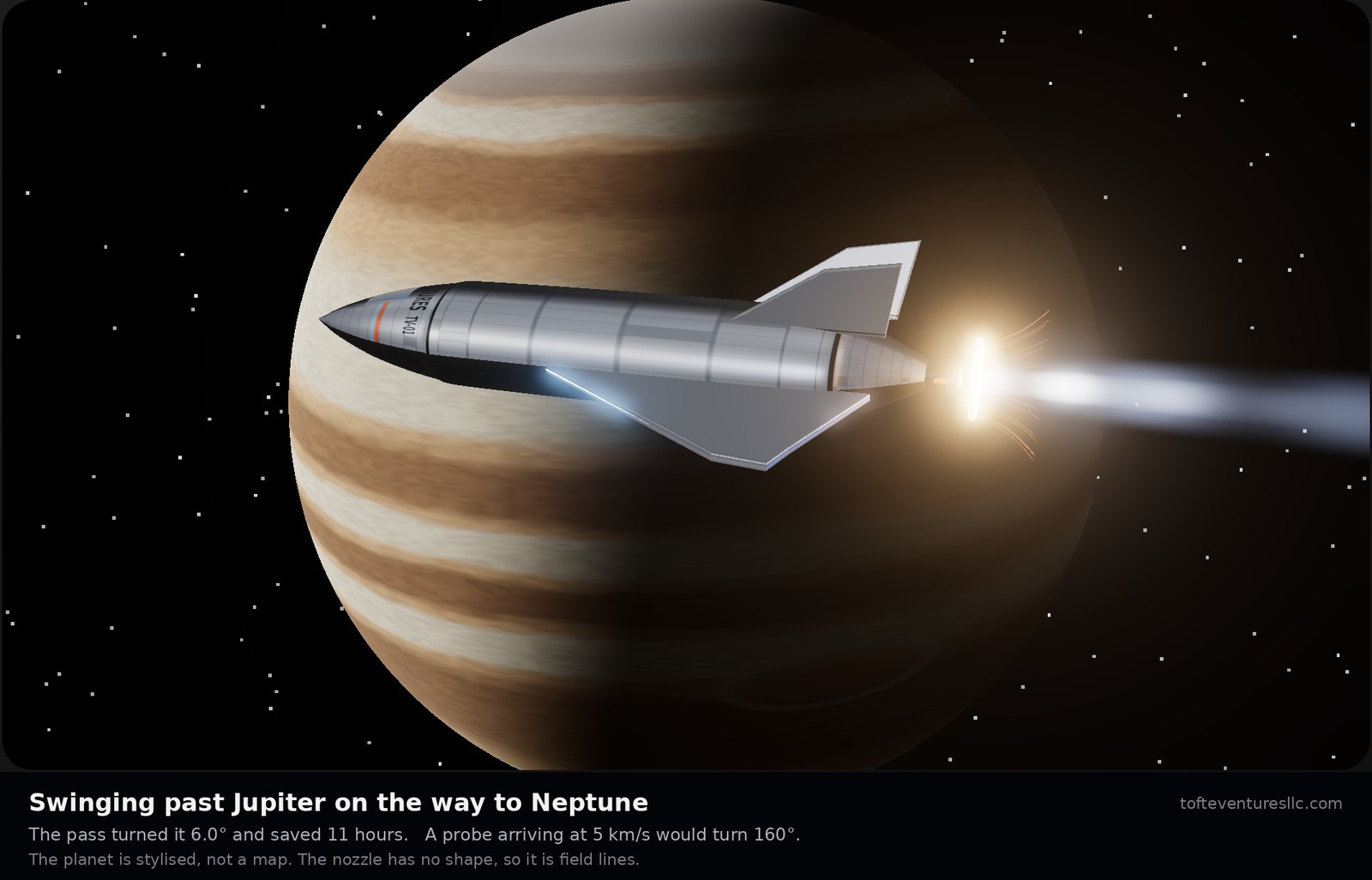
The drawing is the sci-fi one again, and the giant is a shader, not a map of Jupiter.
A planet can only turn you
A gravity assist looks like free speed and is really a turn. Seen from Jupiter, a passing ship falls in, whips round and climbs out again at exactly the speed it arrived at. What changes is the direction. The speed gained is only seen from the Sun, where the turned velocity is added to Jupiter's own 13 kilometres a second round its orbit.
How far a pass can turn a ship has a closed form, 2 asin(1 / (1 + r v² / GM)), where r is the closest approach, v the speed the ship arrives at, and GM is Jupiter's gravity. The engine checks it by flying passes through Jupiter's field with its own integrator, and the two agree to about one part in a hundred thousand from 5 to 100 kilometres a second.
The v² is the whole story.
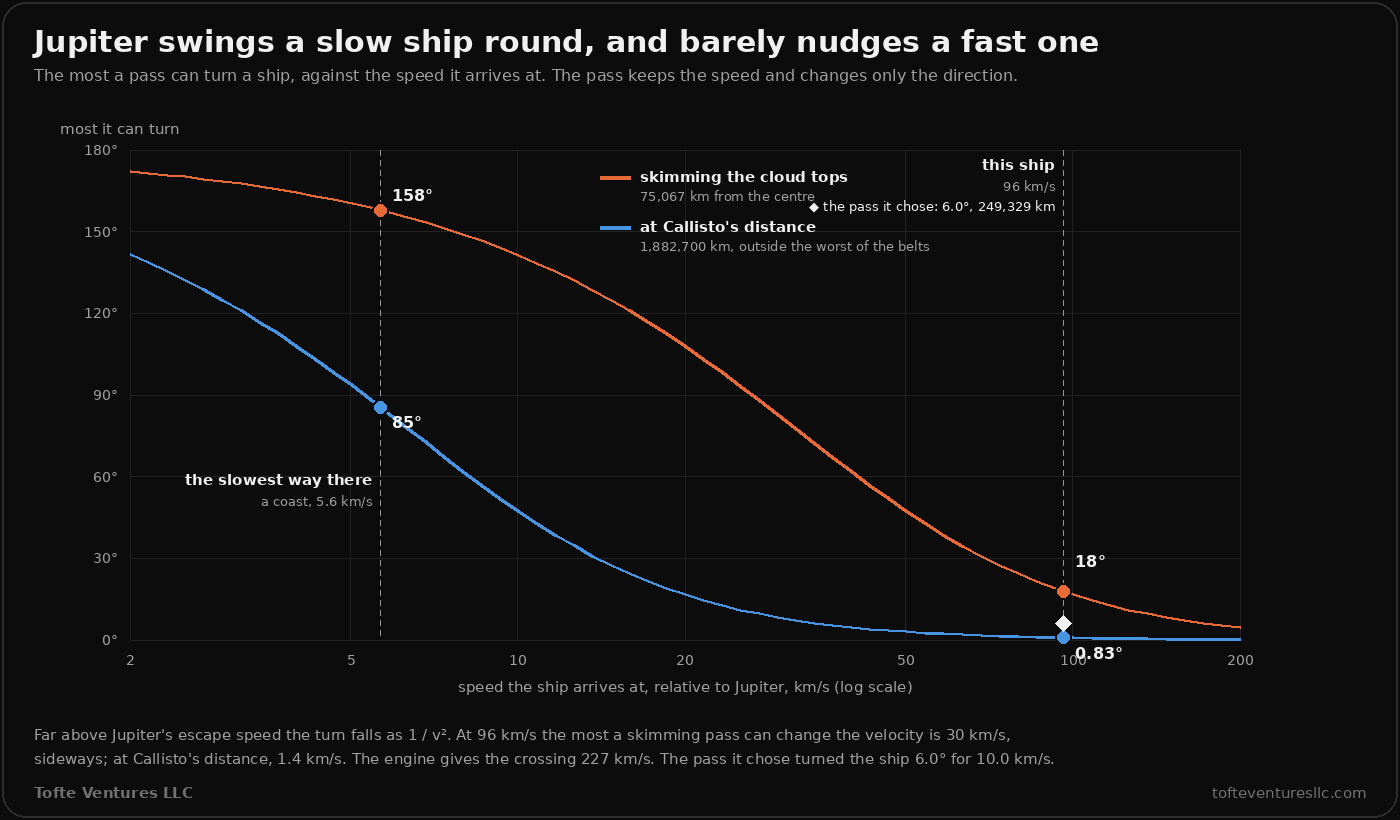
A probe coasting out to Jupiter arrives at about 5.6 kilometres a second, and a pass skimming the cloud tops can turn it 158 degrees, nearly straight back the way it came. That is a velocity change of more than twice its arrival speed, for nothing. This ship arrives at 96 kilometres a second, and the same pass turns it 18 degrees at most. Far above Jupiter's own escape speed the turn falls as one over the speed squared, so a ship seventeen times faster gets about a ninth of the bend.
Eighteen degrees at 96 kilometres a second is still a 30 kilometre a second nudge, sideways, which sounds like a lot until you set it against the engine. Over the crossing the engine gives the ship 227.
Jupiter is on the way once every thirteen years
A pass only helps if Jupiter is near the path already. The two planets line up every thirteen years or so, and inside the years the ephemeris covers that means departures in 2034, and not again until about 2047.
Even in 2034 the fit is loose. The straight trip to Neptune misses Jupiter by 0.31 AU at best, 47 million kilometres, so the pass is a detour: the ship has to aim at Jupiter, be turned by it, and burn its way back onto the line to Neptune. In 2035 the straight trip misses by at least 1.3 AU.
The engine flies both trips the same way, with the same one-direction steering for each burn, and the pass is a patched-conic turn at Jupiter: the approach velocity rotated, its size kept. It brings the pass in gradually, moving the point the first leg must hit from where the straight trip already goes to Jupiter itself, and then walks the trip time down while the hydrogen fits.
Hours, not years
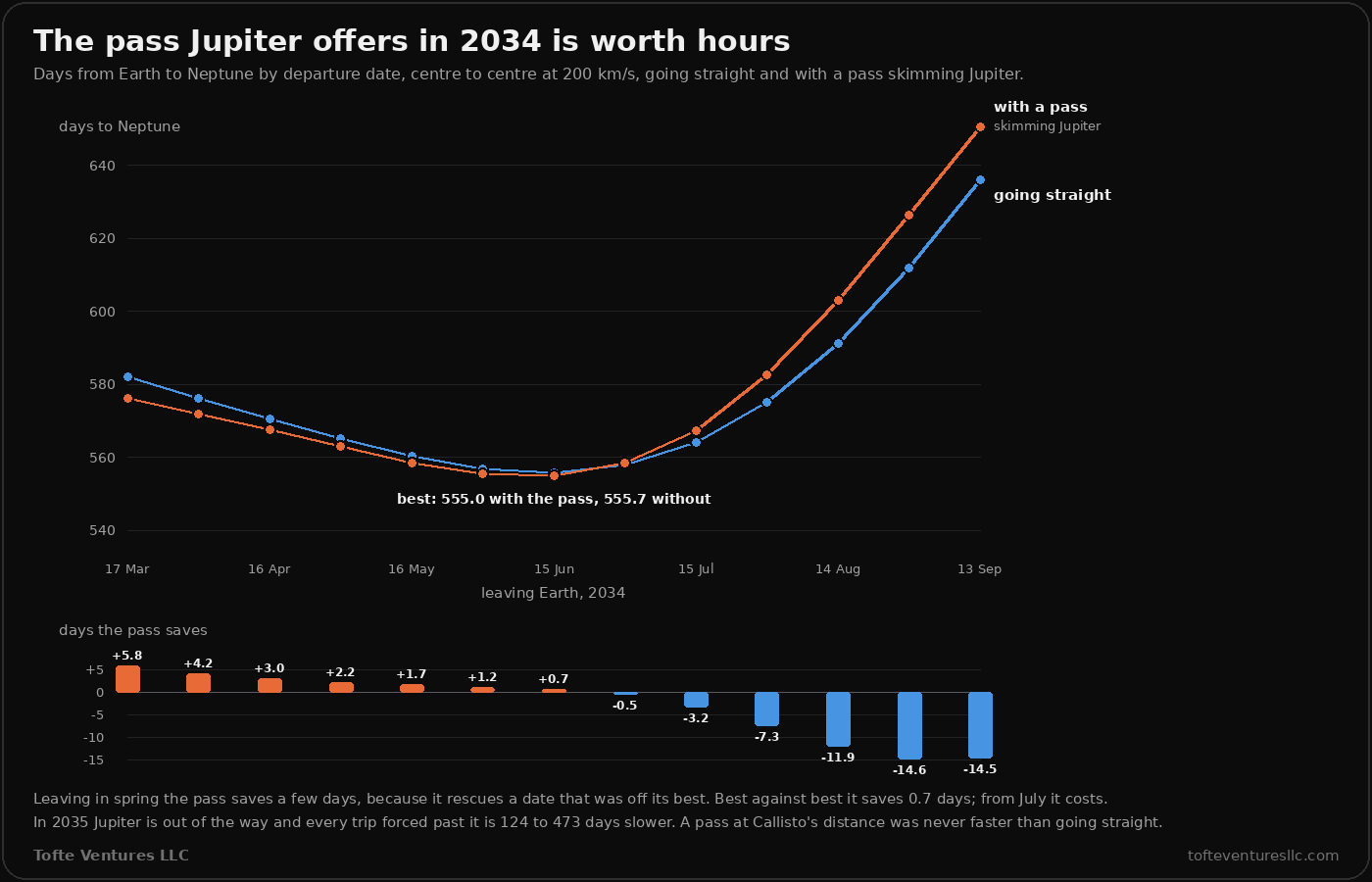
Best day against best day, the pass saves 0.7 days on a 556-day crossing, centre to centre. It helps more in spring, up to 6 days in mid March, because it rescues a departure that was already off its best; it is a way to leave a little early, not a way to arrive a lot sooner. From July it costs time, up to two weeks by September. In 2035, with Jupiter out of the way, every trip forced past it is 124 to 473 days slower.
Door to door, from low Earth orbit to Triton's orbit, leaving on 15 June 2034:
- with the pass: 571.27 days. 6.1 days spiralling out of Earth, 564.0 across, 1.1 spiralling down at Neptune.
- straight there: 571.71 days. The same spirals, 564.5 across.
The pass saves about eleven hours. Against the best straight trip in either year, 571.50 days in June 2035, it saves about five and a half.
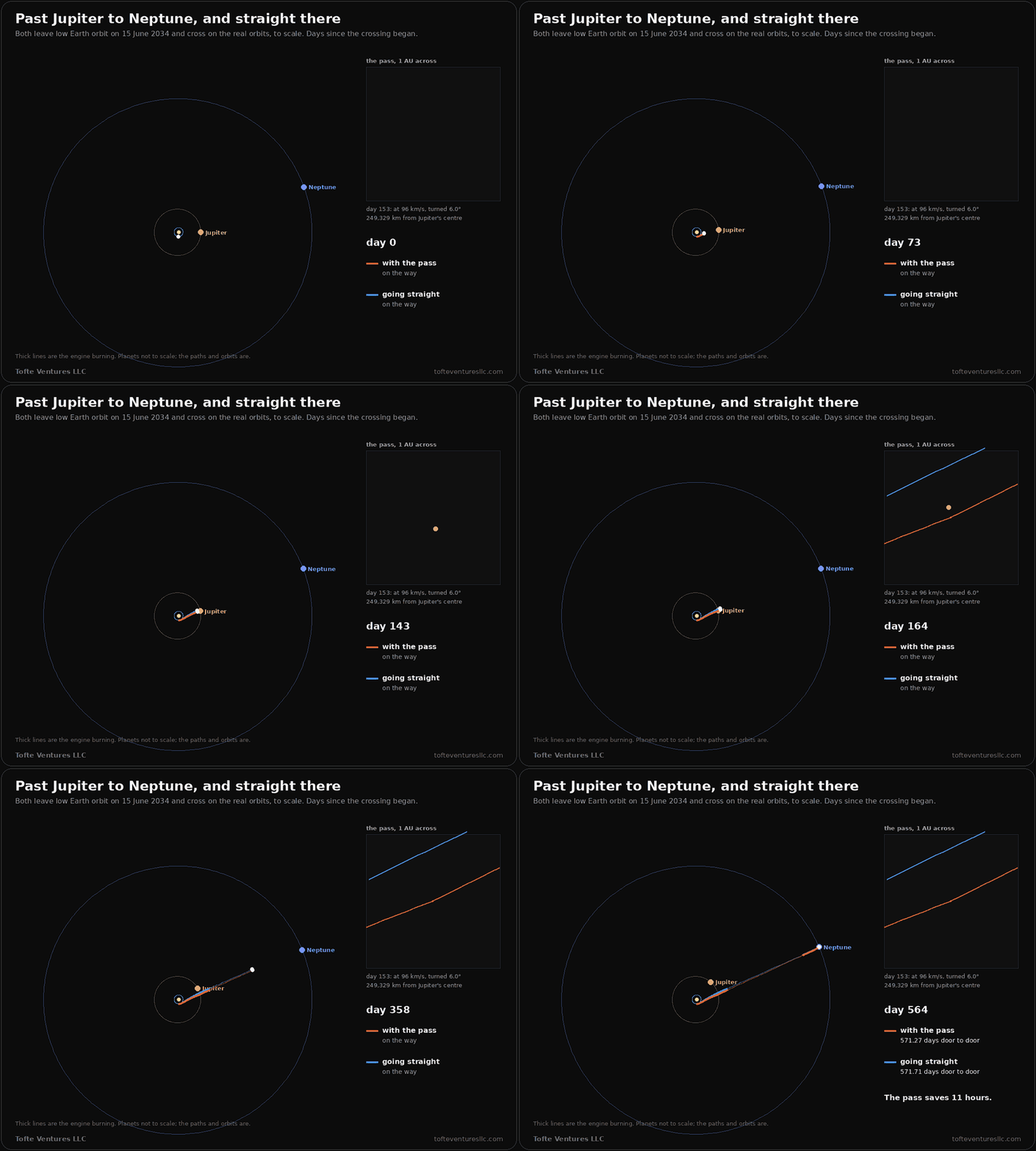
The pass the engine chose is not even the hardest one on offer. It turns the ship 6.0 degrees of the 18 available, 249,300 kilometres from Jupiter's centre, for a 10.0 kilometre a second nudge. A harder turn would need the ship to swing further off its line to reach Jupiter, and the detour costs more than the extra turn gives back.
This is the pattern this blog keeps finding. "A gravity assist shortens the trip" is a well formed answer and a true one, for the ship it was worked out for. For a ship that arrives at Jupiter seventeen times faster, it is about eleven hours.
The pass a crew could fly is worth nothing
The pass the engine chose goes 3.5 Jupiter radii from the centre, deep inside the radiation belts, and spends 3.5 hours inside Europa's orbit, where they are fiercest. Speed cuts both ways here: a slow probe skimming the same way spends twelve to fourteen hours in there. But Further Out stopped its crewed Jupiter trip at Callisto's orbit precisely to stay outside the worst of it, and nothing here prices the dose inside.
At Callisto's distance the most Jupiter can turn this ship is 0.83 of a degree, a nudge of 1.4 kilometres a second against the engine's 227. Every trip the engine found through a pass that far out was months slower than going straight, and on several dates it found none at all. The crew-grade pass is not a small help. It is a detour.
One correction to the last post
Measuring a saving of hours needed the trips walked to a finer resolution than before. The engine used to stop shortening a trip at steps of 0.15 percent, most of a day on a Neptune trip, which was plenty for Mars and not enough to measure hours against. At the finer resolution the best straight Neptune trip is 571.5 days, against Further Out's 571.7. That post calls every time an upper bound and rounds to 572, so it stands, but the difference is real and both trips here are measured the same way.
What is not priced
The engine names what it has not worked out:
- the belts' dose on the pass: the hours inside Europa's orbit are counted, the dose in them is not;
- the pass is patched: the ship's approach is turned in an instant at Jupiter's centre, and the days it spends inside Jupiter's sphere of influence are flown in the Sun's field alone;
- burning at the pass: firing near closest approach, where the ship is fastest, is worth more than firing anywhere else; nothing here tries it;
- the steering: one direction for the whole boost, pass or no pass, so both trips are upper bounds and the comparison is like for like;
- Jupiter's moons: a pass inside their orbits meets their gravity, which is not modelled;
- the other giants: a pass of Saturn or Uranus on the way to Neptune is not tried.
So does Jupiter help?
A slingshot works by turning a slow ship through a big angle, and a planet's pull is only strong enough to do that to something moving not much faster than the planet's own escape speed. The best version of the fusion engine arrives at Jupiter at 96 kilometres a second, well above Jupiter's own escape speed, and the turn it can get has already fallen to a ninth of a coasting probe's. In the one year it is on the way, Jupiter is worth about eleven hours of a 571-day trip. The engine is the reason Neptune is 18 months away instead of 30 years, and at that speed Jupiter can barely touch it.