Correction, 24 September 2026. Every crossing in this post dropped the whole tank before the braking burn, so the brake ran on hydrogen held in no tank at all. With the shells that hold the braking hydrogen kept aboard, door to door is 36.7 days to Mars rather than 36.1, 157 to Jupiter rather than 154, 252 to Saturn rather than 248, 411 to Uranus rather than 404, and 572 to Neptune rather than 560. Saturn's best trip now climbs out of Earth hard and crosses at 200 kilometres a second. The doses move with the days. The numbers and figures below are the corrected ones, and every conclusion stands. How it turned up is in The Nearest Star, Flown.
Every trip on this blog so far started at the centre of the Earth, treated as a point. The Whole Voyage flew the best version of the fusion engine to Mars in 32.3 days, and that number begins with the ship already clear of Earth, moving at Earth's speed round the Sun. A crew does not start there. A crew starts in orbit, 400 kilometres up, going round the planet every hour and a half, and has to get out first.
So this time the engine flies the whole trip, door to door. Then, with that settled, it goes further out, to the giant planets, where a trip of months finally gives it room to burn.
Leaving Earth is a spiral, not a launch
The best version is a power-limited rocket. Its reactor makes 1.38 gigawatts, and the push that power buys depends on how fast the exhaust leaves. At 30 kilometres a second, the hardest setting, the push is 92 kilonewtons, on a ship of 2,919 tonnes. That is 3.2 thousandths of a g. Earth pulls on it nearly 300 times harder. It cannot climb straight up. It can only push along its orbit and let the orbit grow.
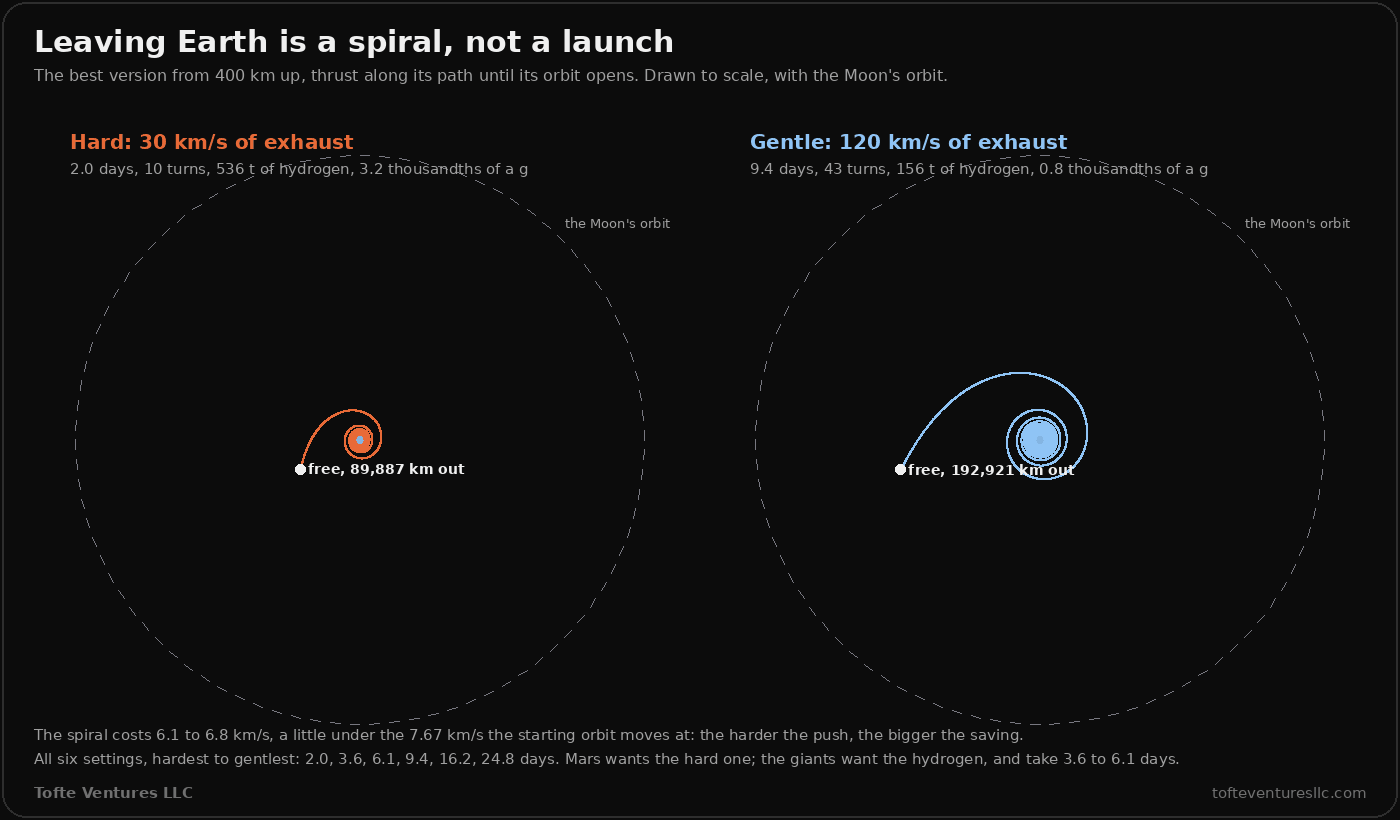
At the hard setting, the ship is free of Earth in 2.0 days, after 10 turns, and 536 tonnes of hydrogen. Its orbit opens 89,887 kilometres out, under a quarter of the way to the Moon. At the gentle setting, 120 kilometres a second, it takes 9.4 days and 43 turns but only 156 tonnes, and it is free 193,000 kilometres out. The six settings the engine tries run from 2.0 days to 24.8.
The engine's own check on this is a classical one. A gentle push spiralling out of a circular orbit should cost close to the speed of that orbit, a little less the harder the push. The orbit at 400 kilometres moves at 7.67 kilometres a second, and the spirals cost 6.1 to 6.8, less for the hard ones, in that order. The figure's script flies the hard spiral again with its own integrator and gets the same days, the same hydrogen and the same ten turns.
That is about twice what a chemical rocket pays. A single kick at the bottom of the well, where the ship is already moving fastest, needs only 3.2 kilometres a second to escape from the same orbit. The fusion engine cannot kick. It spreads its push over the whole climb, and most of it is spent high up, where it does the least. It gets away with this because its exhaust is so much faster than a chemical rocket's that the extra speed costs hydrogen it has, and days it barely notices.
Door to door to Mars
Put the spiral in and the Mars trip changes. In the August 2035 window:
- climbing out of Earth: 2.0 days at the hard setting, 536 tonnes;
- the crossing: 34.1 days at 50 kilometres a second;
- spiralling down to a 400 kilometre orbit at Mars: 0.6 days and 22 tonnes, since the crossing already delivers it moving at Mars' own speed.
Door to door, it is 36.7 days, against the 32.3 from centre to centre. The climb is two days and the spiral down most of a day. The rest comes from the crossing, which now starts 536 tonnes lighter in hydrogen and has to make do with what is left.
Four and a half days is not much. But 32.3 was the number I had been quoting, and it was the time from the centre of one planet to the centre of the other, which no crew will ever fly. That is the pattern this blog keeps finding: a well formed answer, correct for the question it answered, and not quite the question anyone was asking.
The window is months before the planet is closest
The obvious date to leave for a giant planet is when it is closest, at opposition, when Earth passes between it and the Sun. The engine does not take that on trust. It sweeps departures every fortnight, from five months before opposition to three after, and flies the soonest trip from each.
The best day is always months early: 77 days before opposition for Jupiter, 91 for Saturn, 105 for Uranus and 121 for Neptune, to the fortnight the sweep steps in. The oppositions are worked from the same ephemeris the trips are flown on. The reason is the same one that makes the way home from Mars slow: a trip of months aims at where the planet will be, and Earth, moving faster on the inside track, runs ahead of the target meanwhile. Leave at opposition and every trip is a quarter to three tenths slower: 186 days to Jupiter instead of 150, 692 to Neptune instead of 556.
Letting it burn
Mars is a sprint. The best trip there runs the engine at 50 kilometres a second of exhaust and burns for 20.0 of its 32.3 days, because a hard push gets there before a gentle one has built up speed.
The giants are the opposite. A trip of a year wants a burn that lasts that long, and that means turning the exhaust up, trading push for hydrogen. To Jupiter the best crossing runs at 120 kilometres a second. To Saturn, Uranus and Neptune it runs at 200, where the push is only 14 kilonewtons but the 1,060 to 1,770 tonnes of hydrogen for the crossing last. The engine burns for 98 days of the 152 to Jupiter, and for 297 days of the 564 to Neptune: out past the orbit of Jupiter before it stops pushing, and moving at about 121 kilometres a second relative to the Sun, four times Earth's speed, read off the flown path.
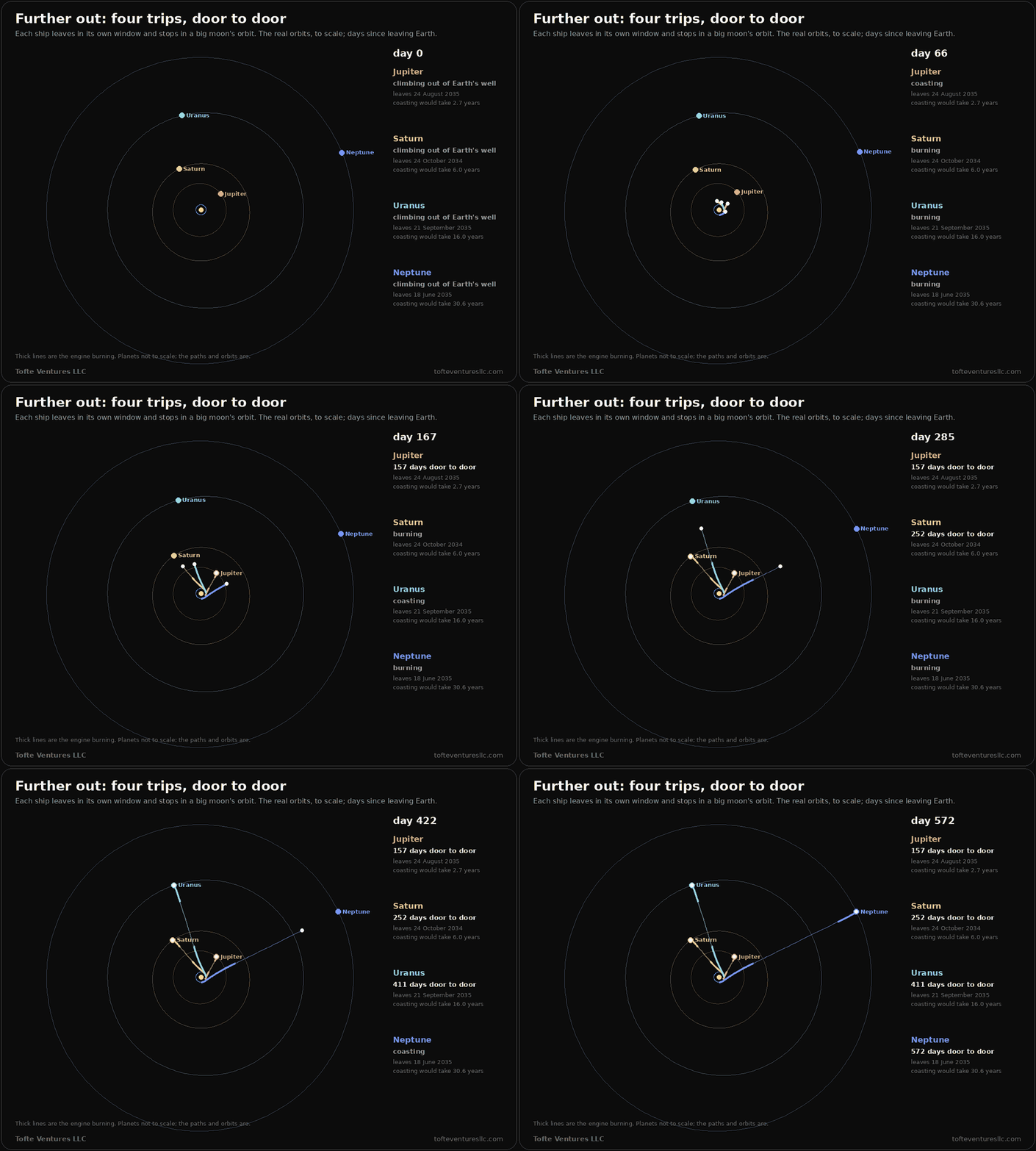
Door to door, low Earth orbit to the orbit of a big moon, each on its best date:
- Jupiter, to Callisto's orbit: 157 days. 3.6 to climb out, 152.3 across, 1.3 down. Leaving 24 August 2035.
- Saturn, to Titan's: 252 days. 2.0, 248.8, 1.4. Leaving 24 October 2034.
- Uranus, to Titania's: 411 days. 3.6, 406.5, 0.9. Leaving 21 September 2035.
- Neptune, to Triton's: 572 days. 6.1, 564.5, 1.1. Leaving 18 June 2035.
The least-energy coast between the orbits, the Hohmann transfer, takes 2.7 years to Jupiter and 30.6 years to Neptune, from Kepler's third law. The engine is more than six times faster to Jupiter and 20 times faster to Neptune. Real probes beat plain coasting with flybys: Voyager 2 reached Neptune in twelve years with help from three planets on the way. Nothing here tries a flyby.
Two things surprised me. The climb out of Earth, which dominated the Mars trip, is a rounding error here, and for three of the four the engine chooses a gentler one than it did for Mars, 50 or 80 kilometres a second instead of 30, to save hydrogen for the long burn. Saturn climbs out hard, at 30, and saves its hydrogen on the crossing instead, at 200. And the spiral down at the far end is the easiest part of the whole trip: about a day, and 5 to 21 tonnes of hydrogen, because the ship arrives already moving at the planet's speed and only has to fall in and shed the difference. Each trip's crossing is flown twice, once in the search and once again from its answer, and lands within a few metres of the planet both times; the figure's script flies the Neptune crossing a third time with its own integrator and lands 12 kilometres from Neptune's centre, well inside the planet.
Fast enough for the planets, not for the crew
In deep space the crew's dose is set by the days. Galactic cosmic rays deliver 1.2 to 2 millisieverts a day behind light shielding, and the career limits set for astronauts are 0.6 to 1 sievert. The engine carries both bands from memory, unverified.
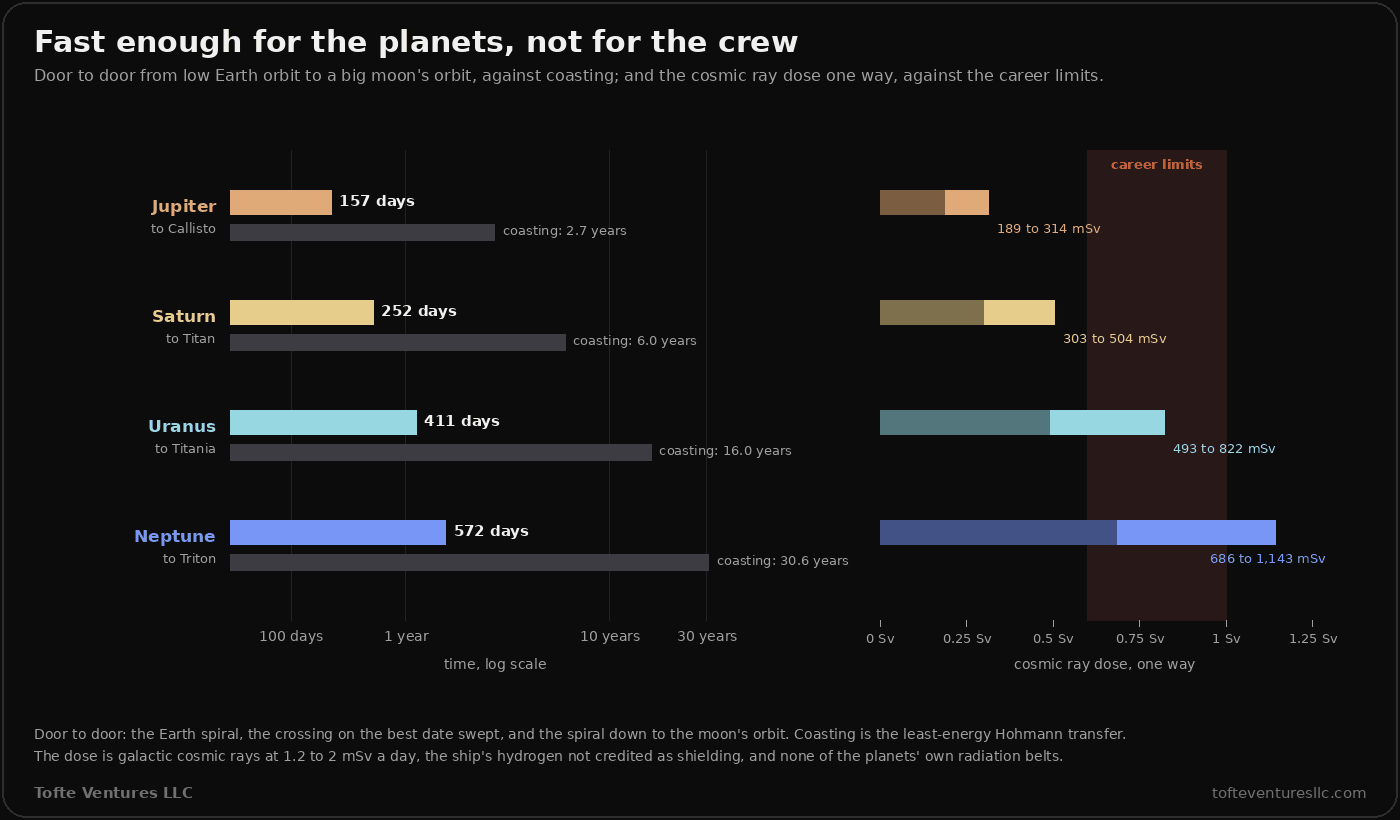
Jupiter costs 189 to 314 millisieverts, one way. Neptune costs 686 to 1,143: a whole career's limit, before anyone has turned round. Saturn stays under the band. Uranus reaches into it at the high end of the dose.
That is the finding I did not expect when we set out to let it burn. The engine takes a 30 year trip down to a year and a half, and the answer is still no for a person, because a year and a half in deep space is the problem. Jupiter and Saturn are within reach, one way. The outer two are for machines, or for a ship that carries far more shielding than this one prices, or for an engine that is faster again.
Two things cut the other way and neither is counted. The ship's own hydrogen is a good shield and is not credited. And Jupiter has the fiercest radiation belts in the solar system, which is why the stop is Callisto's orbit, outside the worst of them, and the dose there is not priced at all.
Letting it burn, drawn
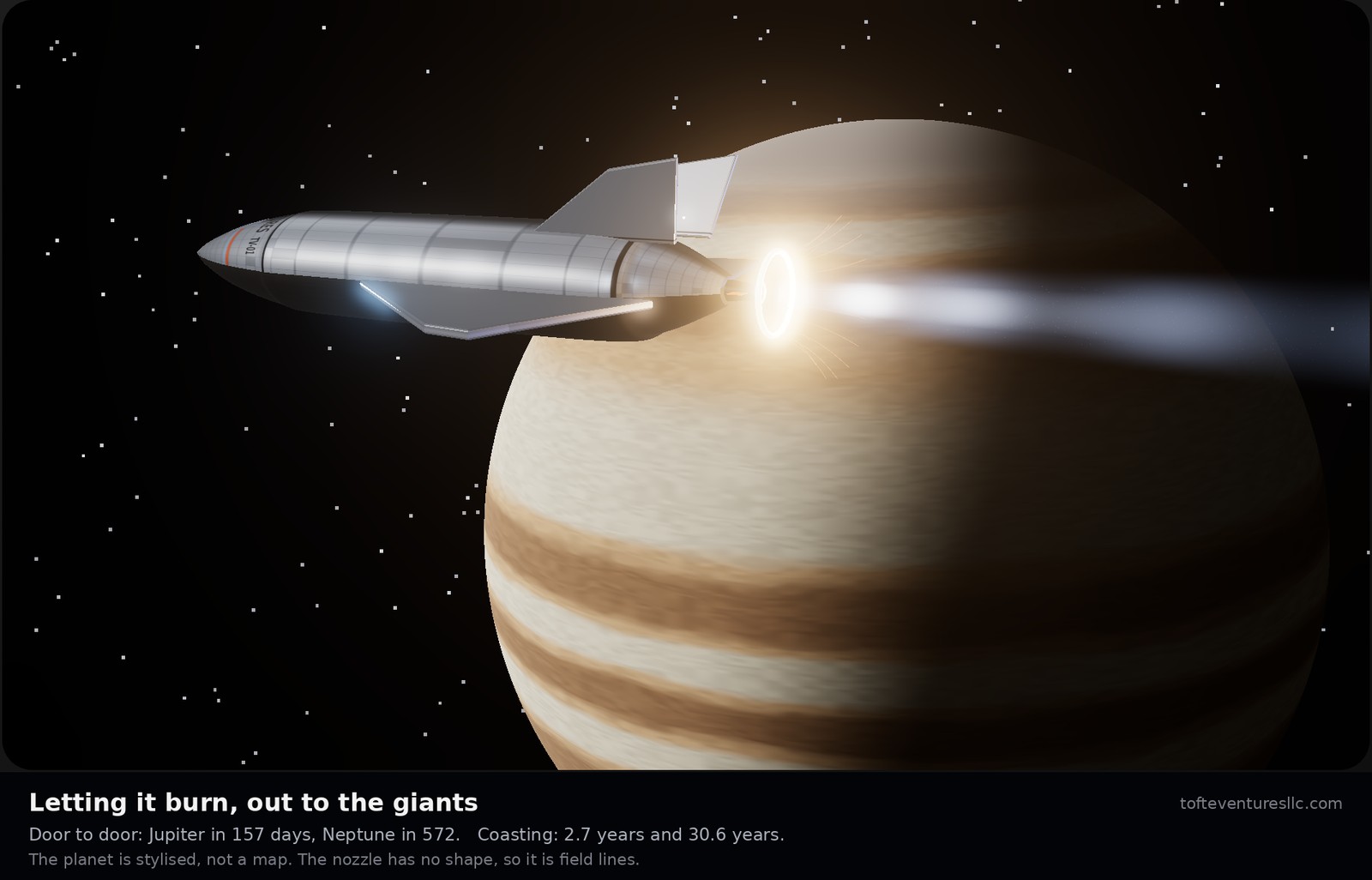
The drawing is the sci-fi one again, for fun. The giant is a shader written for it, stylised bands, and is not a map of Jupiter or anywhere else. The nozzle is still field lines, because the engine gives it a mass and no shape.
What is not priced
The engine names what it has not worked out:
- the Moon: every Earth spiral here stays inside the Moon's orbit, but its pull on the way out is not modelled, nor a flyby that could help;
- the Sun during the spirals: each planet's gravity alone inside its sphere of influence, and the Sun's alone outside it;
- the steering: thrust along the path in the spirals and one direction per burn in the crossings, the simple choices rather than the best, so every time here is an upper bound;
- the planets' shadows: every spiral passes through one each turn, which costs a fusion ship nothing and is not modelled;
- landing: the spiral stops in the moon's orbit round the planet, not on the moon, and the moon's own gravity is not in it;
- the way home: every trip here is one way, and the return window from a giant is its own question;
- flybys: Jupiter on the way to Saturn and beyond could help, and nothing here tries one;
- the dose: cosmic rays by the day only, with the hydrogen not credited as shielding and the planets' belts not priced;
- keeping warm: the reactor needs no sunlight, but everything else aboard does at 30 times Earth's distance, and that is not priced.
So how far can it go?
Nothing in the arithmetic stops the best version reaching any planet in the solar system inside two years. It leaves Earth in a spiral of a few days, burns for months at the gentle end of its range, and stops in orbit round a big moon in about a day. Every time is an upper bound. The limit it runs into first is not the engine. It is the people inside, and a year and a half of sky.