The last post mapped every way of making a black hole, from the Planck mass to supermassive holes, and found a wall for every carrier. Three questions were left at the edges of that map. What is the smallest hole light could make, and would it still be a black hole in any useful sense? Does a hole that spins, or carries charge, loosen any of the walls? And the power, c⁵/2G for every mass, comes from the whole pulse having to arrive at once. What if it doesn't?
The engine behind this blog now prices all three, and checks each answer a second way. None of them turns out to be a way through. They are the same wall seen from three sides.
The smallest hole light can make is two photons
The light that makes a hole has to fit inside it: no photon's wavelength can be longer than the horizon. That sets the least energy each photon can have, and so the most photons a hole's worth of energy can be split into. For a hole of mass M it comes to the square of M in Planck masses, divided by π, where the Planck mass is 22 micrograms. For the drive hole that is 2.3 × 10³³ photons. Near the Planck mass it is a handful.
A single photon cannot make anything. It has no rest frame, so however much energy it carries, you can always see it as a weaker photon by moving alongside it. The fewest photons that can make a hole is two, colliding head on. That puts the lightest hole light can make at √(2π) Planck masses, 55 micrograms, made from two photons of 1.25 Planck energies each. That is about 10¹⁵ times the energy of a collision at the Large Hadron Collider, per photon. A hole of one Planck mass would need a third of a photon, so light cannot make it at all.
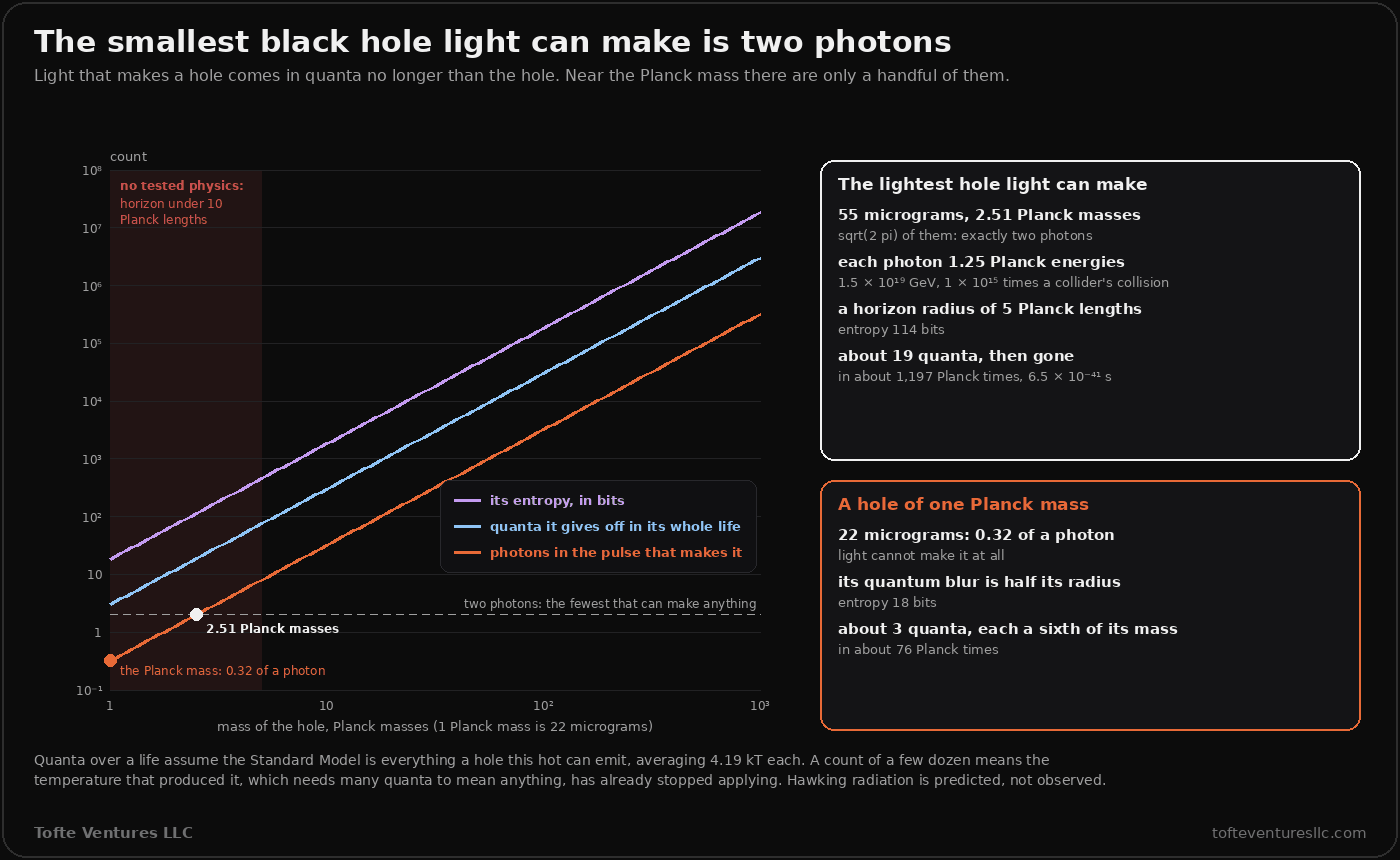
So what would a 55 microgram hole be? Its horizon radius would be five Planck lengths. That is inside the engine's quantum-gravity refusal, which is set at ten, because no tested theory describes spacetime curved that tightly. Its entropy would be 114 bits.
To say how long it lasts I needed something the engine did not yet compute: not how much power a hole radiates, but how many quanta. That is the same calculation as the power, with one factor of frequency taken out. It gives the average energy of each kind of quantum a hole emits, and the answers came out at 2.81, 4.23 and 5.71 times the hole's temperature for scalars, neutrinos and photons. Those land within one percent of the values published by MacGibbon and Webber, which I checked from memory and have marked as such. Averaged over everything a hot hole emits, a quantum carries about 4.2 times its temperature.
Add up the quanta over a hole's whole shrinking life and the two-photon hole gives off about 19 of them, and a Planck-mass hole about 3, each a sixth of its whole mass. The engine will also print a lifetime, 6.5 × 10⁻⁴¹ seconds for the two-photon hole. That number is well formed. The count of 19 beside it is the reason not to believe it. A temperature is a statement about a great many quanta, and a hole that radiates 19 has none to speak of. The calculation reaches the edge of the map and reports that it no longer applies there, which is the most useful thing it can do. Whether evaporation really ends at some last remnant is an open question, and nothing here settles it.
Spin makes every wall harder
A spinning black hole has a smaller horizon than a still one of the same mass, down to half the size at the most spin a hole can have. So the light that makes it has less room and less time. The power the pulse needs rises from half the Planck power to the whole of it, and every photon has to be harder by the same factor. At a spin of 0.9 that is 1.39 times each: 627 GeV photons instead of 450.
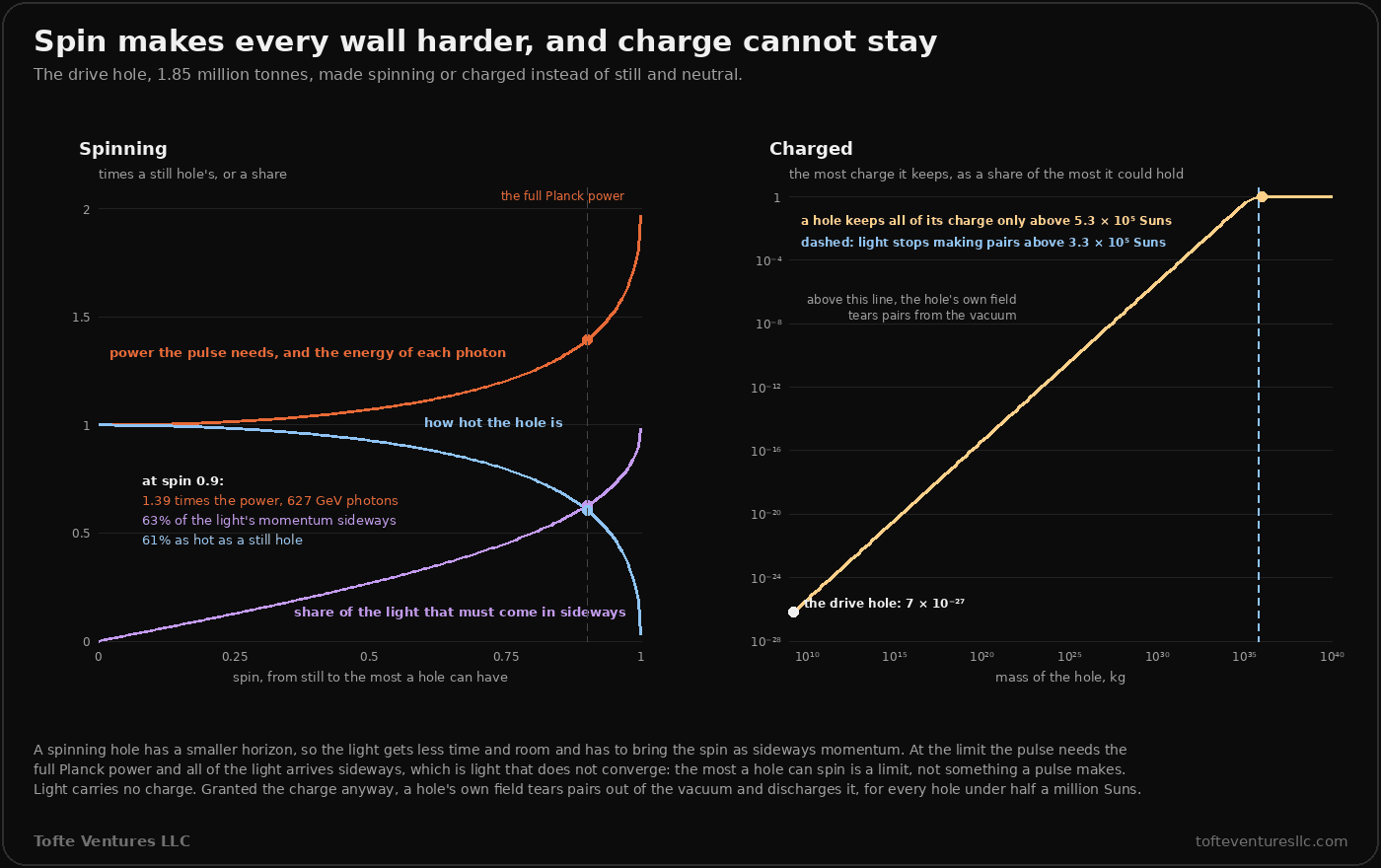
The light also has to bring the spin with it. Light arriving inside a horizon of radius r can carry at most r times its momentum as angular momentum, and only if it all comes in sideways. At a spin of 0.9, 63 percent of the light's momentum has to be sideways. At the maximum it is all sideways, and light that is all sideways circles the point instead of converging on it. That is the builder's view of a rule known as the third law of black hole mechanics: nothing finite makes a hole with the most spin it could have. It is a limit you approach, not a thing you make.
And the finished hole is colder, 61 percent as hot at 0.9 and approaching zero at the limit. For a drive, which wants the hole to shine, that is the wrong way. The engine checks the temperature a second way, by differentiating the hole's entropy at fixed spin, and checks the horizon against the rotating-hole geometry itself. What a spinning hole then emits it does not compute: spinning holes shed their spin faster than their mass, which is Page's 1976 result, carried as a note rather than a number.
Charge cannot stay
Light carries no charge, so a hole made of light is neutral, and the last post found that a charged beam brings 24 million times the charge a hole can hold. But grant the charge anyway and ask whether the hole could keep it. The field at a charged hole's horizon is strong enough to pull electron-positron pairs out of empty space, and the pairs carry the charge away. A hole can keep all the charge it is allowed only above 5.3 × 10⁵ Suns. The drive hole could keep 7 × 10⁻²⁷ of it.
That edge sits next to one from the last post: light stops making pairs of its own at 3.3 × 10⁵ Suns. The two agree to within a factor of two because they are the same physics. Both are a field set by gravity at the horizon, measured against the one field empty space tolerates.
A pulse that does not arrive all at once
The power wall exists because a hole's whole energy has to be inside its horizon at the same moment, and light crosses the horizon in a single light-crossing time. There are two ways to deliver it slowly, and the engine prices both.
Make a small hole first, then feed it. The seed is itself a black hole made of light, so it needs c⁵/2G for its own crossing time, whatever its size: the power wall is still there, just for a smaller hole. After that the feed has to beat the seed's own glow at every mass on the way up, aimed at a target the size of the seed. A two-photon seed glows at 2.5 × 10⁴⁹ watts. Nothing is gained.
Store the light, then let it fall in. This one really does escape the power wall. The drive hole's energy is only 0.44 seconds of the Sun's entire output, so the energy was never the problem; the timing was. Fill a box slowly, for as long as you like, and when it holds enough, it collapses on its own.
The cost moves to the box. Nothing static can sit closer to its own horizon than 9/8 of its radius (that is Buchdahl's limit, which the engine finds as the point where a uniform star's central pressure goes to infinity), so the box has to hold a hole's worth of light in a sphere barely bigger than the hole. For the drive hole its wall has to hold 4.5 × 10⁷⁷ pascals.
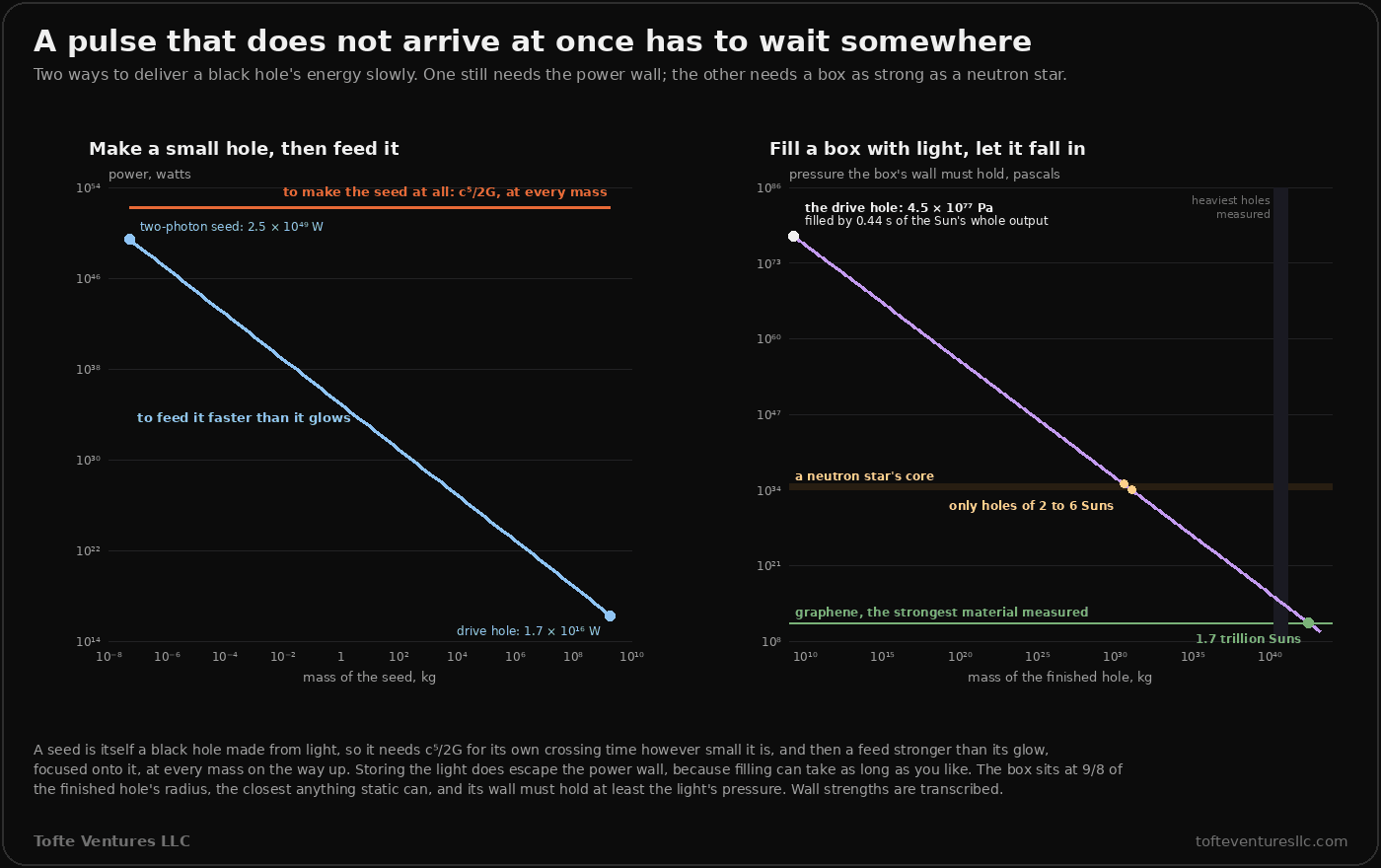
The pressure falls as the hole gets heavier, as one over the mass squared, so there is a mass where some material could take it. The pressure at the centre of a neutron star is enough only for holes of 2 to 6 Suns, which is roughly the mass at which neutron stars stop holding themselves up. Graphene, the strongest material ever measured, is enough only for a hole of 1.7 trillion Suns, heavier than any black hole anyone has found. At that size the light in the box would be radio waves, and a mirror for radio waves is easy. The wall is the problem. Both wall strengths are transcribed, and the pressure is only a floor on the stress a real wall would carry.
What the edges look like
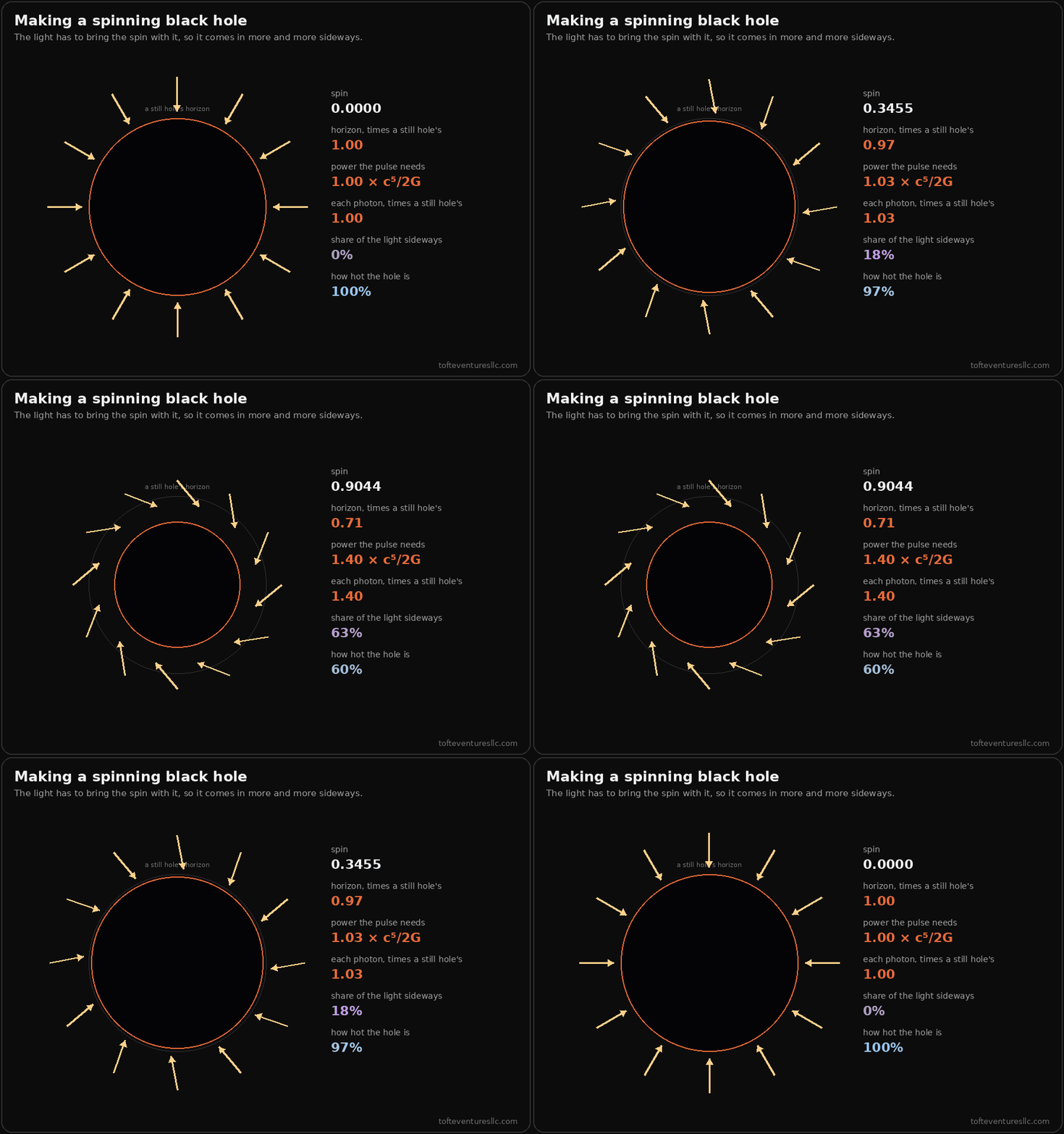
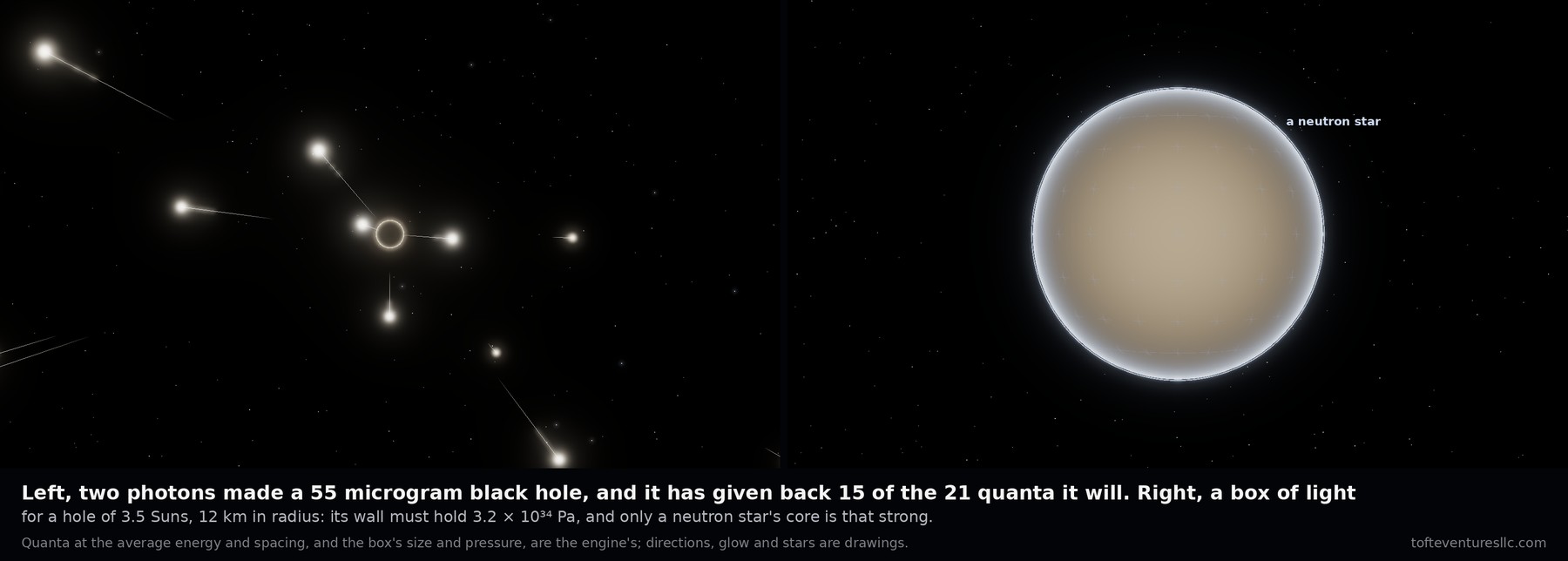
I rendered all three as a short film. In the first shot two photons meet head on and make the 55 microgram hole, which then gives its mass back one quantum at a time. Each quantum carries the average energy for the hole it leaves behind and comes after the average wait, so the hole shrinks in steps, not smoothly. Counted that way, it gives off 21 quanta over 1,285 Planck times, where the smooth formula gives about 19 over 1,197. Near the end each quantum is a real piece of the whole: the twentieth carries 15 percent of what the hole was. Two reasonable ways of counting that disagree by a tenth are what a calculation looks like at the edge of the map.
The second shot spins the hole up and watches the horizon shrink and the light turn sideways. The third is the box, zoomed out from 270 times smaller than a proton to over half a light year while the pressure on its wall falls. It reaches a neutron star's core for holes of 2 to 6 Suns, when the box is 7 to 21 kilometres in radius. At the one mass where a strong enough wall exists, the box is the size of a neutron star. Graphene is strong enough only when the box is 0.61 light years in radius.
Try the edges
Slide the mass from a Planck mass to two trillion Suns and the spin from nothing to almost the maximum. The widget runs the same module as the figures. It thuds on a phone when you cross an edge: two photons, the quantum-gravity limit, the mass above which a hole keeps its charge, or a wall a box of light could lean on.
Where the map ends
Each of the three edges comes back to the same place. Light can only make a hole of at least two photons, and a hole that small is a few dozen quanta, not a thermal object. Spin makes the pulse harder in every way and approaches its limit without reaching it. Charge cannot stay on anything smaller than half a million Suns. And delivering the energy slowly means storing it in a box that only a neutron star is strong enough to be, at the masses where neutron stars are already collapsing into black holes by themselves.
The last post found that stars are the kugelblitzes nature actually makes, made of fermions at about two Suns. This one finds the same thing from the other side. The only box strong enough to hold a black hole's energy until it falls in is the one a collapsing star already is.
Hawking radiation is predicted, not observed, and nobody has made a black hole out of anything.