The last post made a black hole out of light, and the obvious next question was what else it could be made from. My first guess was radiation from radioactive material, because radioactive material is so energy dense. That guess turned out to be wrong in an instructive way. It mixes up two questions that have separate answers.
What pays for the pulse, and what the pulse is made of. The first is the source: uranium, fusion fuel, antimatter, sunlight. The second is the carrier, whatever actually arrives at the point and collapses: light, neutrinos, protons, gravitational waves. The engine now prices both, and every carrier has its own wall.
What pays for it only decides the fuel
Whatever the source, the pulse has to carry the hole's whole rest energy, E = mc². No source can lower that. All a source changes is how much fuel it burns to supply it, and that depends on one number: the share of the fuel's own mass it can turn into energy.
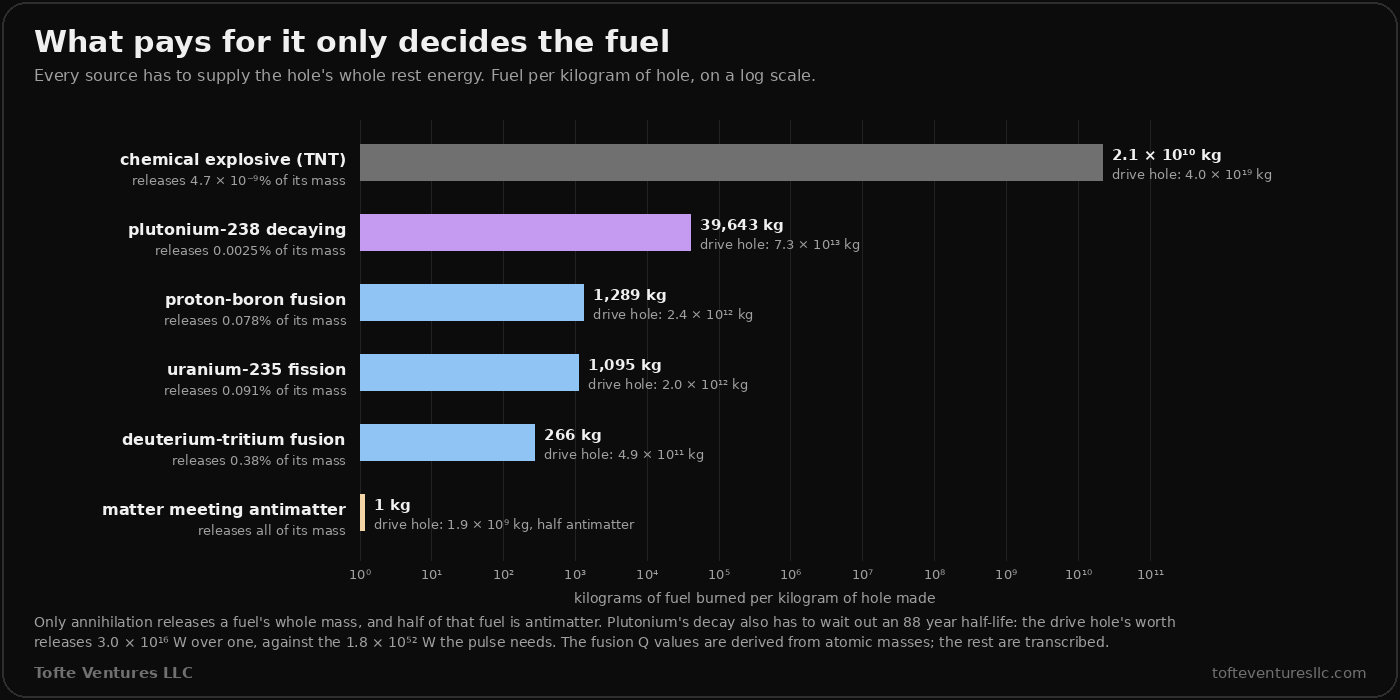
Radioactive material really is energy dense: fission releases about 20 million times what the same mass of TNT does. But a black hole is made of the energy locked inside mass itself, and fission lets out less than a tenth of a percent of it. Every kilogram of hole costs 1,100 kilograms of uranium, about 2 billion tonnes for the 1.85 million tonne drive hole. Radioactive decay is worse again, at 40,000 kilograms per kilogram, and it arrives slowly. Plutonium-238 releases its energy over an 88 year half-life, so a drive hole's worth of it puts out 3 × 10^16 watts, against the 1.8 × 10^52 the pulse needs.
Fusion does better, and the engine works its energy out from the atomic masses rather than typing it in: 17.59 MeV per deuterium-tritium reaction, 266 kilograms of fuel per kilogram of hole. Proton-boron fusion, the clean fuel, turns out to release less of its mass than fission does. Only antimatter burns a mass equal to the hole's, and half of that fuel has to be antimatter.
The same applies to making the pulse with electricity from a fusion plant. That is a source, and it only sets the fuel. The electricity still has to become something that arrives at the point, which is the second question.
What it is made of decides the wall
The engine sorts carriers by one rule of quantum mechanics.
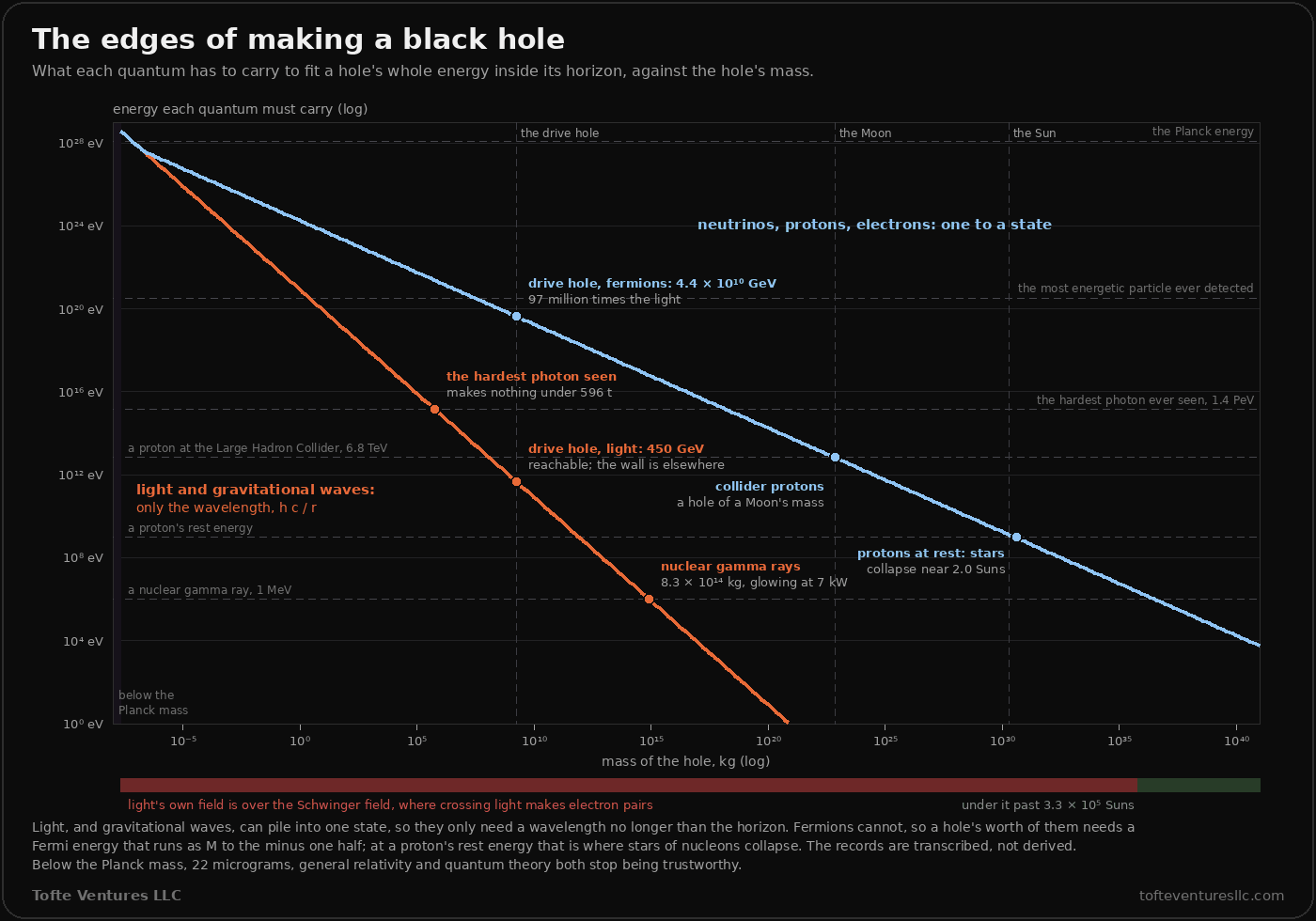
Bosons, which include light and gravitational waves, can crowd into the same state without limit. For them the only requirement is the one from the last post: each quantum's wavelength must be no longer than the hole it is making. Fermions, which include neutrinos, protons and electrons, cannot share a state; that is the Pauli exclusion principle. Packing a hole's worth of them inside a space the size of its horizon means stacking them up to very high energies, and the engine works out exactly how high.
Radioactive radiation is the wrong kind of light
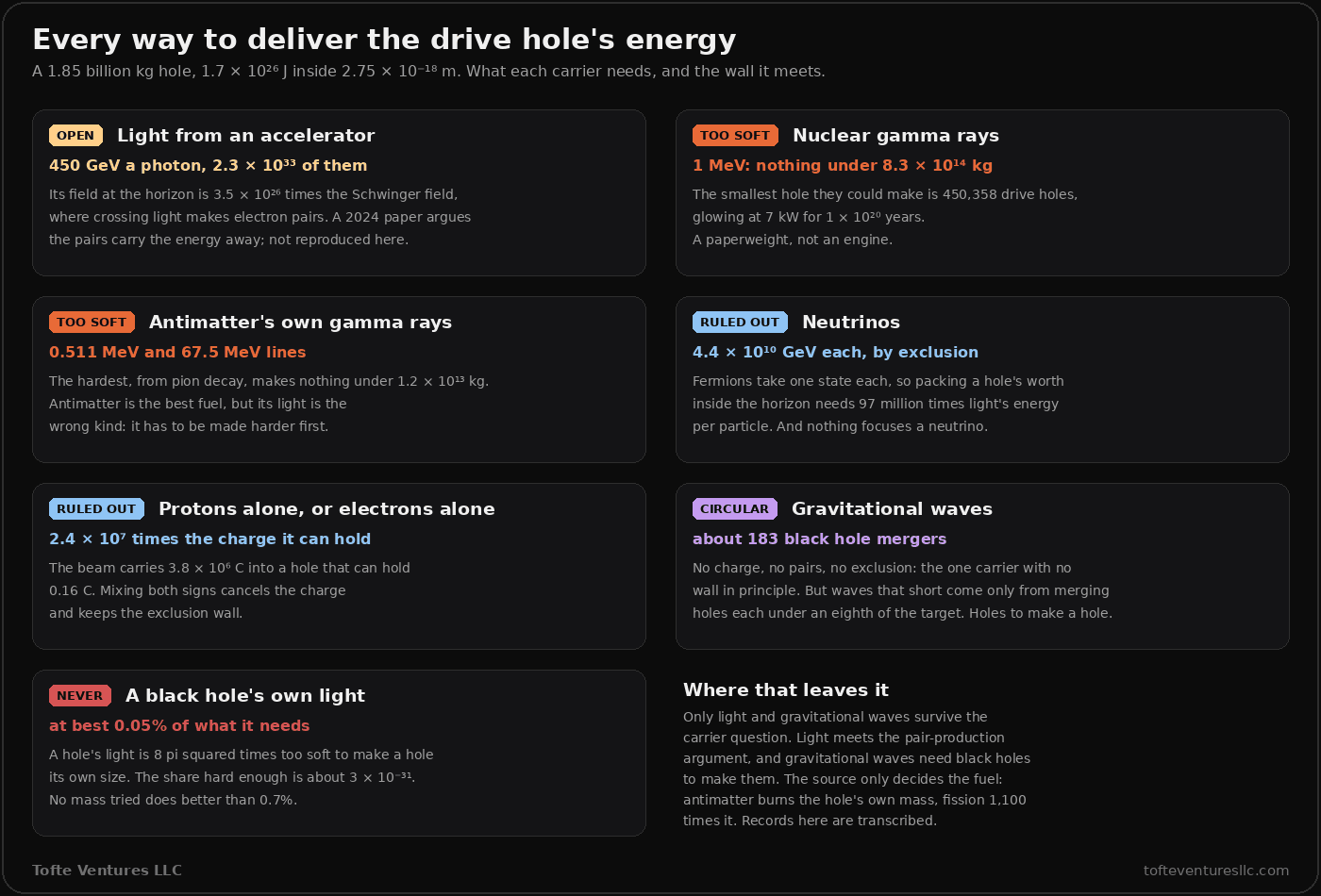
Nuclear gamma rays have fixed energies, around 1 MeV. That is a wavelength of about a trillionth of a metre, 450,000 times too long to fit inside the drive hole. So there is a smallest hole they could ever make: 8 × 10^14 kilograms, 450,000 drive holes' worth. It would glow at 7 kilowatts, about three electric kettles, for 10^20 years. It is a paperweight, not an engine. Antimatter's own gamma rays have the same problem: its hardest line, 67.5 MeV from pion decay, makes nothing lighter than 1.2 × 10^13 kilograms.
This is the 8π² rule from the last post, working in reverse. A hole made from light of energy E glows at about E divided by 79. To build an engine that shines at GeV, you need light of hundreds of GeV, and no radioactive process makes it. Only a particle accelerator does. The hardest photon anyone has ever seen, 1.4 PeV, could make a hole as small as 596 tonnes if you had enough of them. That hole would burn out in under a tenth of a second.
Neutrinos, and why stars collapse where they do
For fermions the requirement is steep. To fit the drive hole's energy inside its horizon, each neutrino would need 4.4 × 10^10 GeV, 97 million times what each photon needs, and there would have to be 2.4 × 10^25 of them. That is a seventh of the energy of the most energetic particle ever detected, per particle. Nothing can focus a neutrino either, since they pass through lenses and mirrors alike.
The requirement falls as the hole gets heavier, as one over the square root of its mass. That gives the engine a check I did not plan. Set the energy to a proton's own rest energy and ask what mass that allows: the answer is 2.0 times the mass of the Sun. That is the scale at which stars made of ordinary matter collapse into black holes. The classic estimate for it, Landau's, comes out at 1.85. The same arithmetic that rules out a small neutrino kugelblitz is the arithmetic that decides where stars stop. In that sense nature does make black holes out of fermions all the time, but only star-sized ones.
Protons from the Large Hadron Collider, at 6.8 TeV each, could only make a hole about as heavy as the Moon.
Protons carry charge the hole cannot hold
A beam of protons on its own brings its charge with it. A black hole can only hold so much charge before its horizon disappears, and for the drive hole that limit is 0.16 coulombs. The beam would bring 3.8 million coulombs, 24 million times the limit. Mixing in electrons cancels the charge, but it does not get round the exclusion problem, because electrons are fermions too.
Light tears pairs out of the vacuum
Light that concentrated has an electric field of its own. For the drive hole it is 3.5 × 10^26 times the Schwinger field, the strength at which crossing light pulls electron-positron pairs out of empty space. That is the mechanism behind the 2024 paper from the last post, which argues that the pairs carry the energy away before a horizon can form.
The field weakens as the hole gets heavier, so there is a mass above which light can make a hole without reaching the Schwinger field. The engine puts it at about a third of a million Suns, with a horizon about 10^9 metres in radius. The paper's fuller calculation puts its edge at 10^8 metres, so the simple field comparison and the careful one agree to within a factor of ten. The lightest hole light can make cleanly would take all of the Sun's output for 5 × 10^18 years.
Gravitational waves need black holes to make them
Gravitational waves are the one carrier with no objection in principle. They carry no charge, make no pairs and are not fermions, and waves concentrated enough do collapse into black holes in the equations. The problem is making them.
They would need 500 times the peak power of GW150914, the first black hole merger LIGO heard, at a frequency about 4 × 10^23 times higher. Waves that short come only from merging black holes, and a merger's waves are about eight times longer than its own horizon. So the waves for the drive hole would take about 183 black hole mergers, each of holes under an eighth of its mass, all timed to within 10^-26 seconds. You need black holes to make a black hole.
A black hole's own light can never make another one
This was the idea I liked best going in: collect one hole's radiation and use it to make the next. The 8π² rule rules it out completely. To make a hole no heavier than itself, a hole's light would need quanta 79 times its own temperature, and the share of its output that hard is about 3 × 10^-31. The engine tries every other size of child hole too. The best any hole's light can do is supply 0.05 percent of the energy it would need, and no mass tried does better than 0.7 percent.
Try every combination
Pick a carrier, a fuel and a mass, from the smallest hole physics can describe to a supermassive one. The widget computes what each quantum has to carry and the wall it meets, using the same module that drew the figures. It thuds on a phone when a wall gives way: at the mass where a fixed-energy gamma ray becomes able to make the hole, or where light's field drops under the Schwinger field.
The edges
The map runs from the Planck mass, 22 micrograms, where a hole would need quanta of π Planck energies each and neither general relativity nor quantum theory can be trusted, to supermassive holes. Three places on it are worth remembering.
The drive hole's light is not the hard part. 450 GeV a photon is within what accelerators already reach. What rules it out is everything else: a power of 1.8 × 10^52 watts, a timing of 10^-26 seconds, and a field that tears pairs from the vacuum.
Stars are fermion kugelblitzes. The blue line crosses a proton's rest energy at about two Suns, which is where collapsing stars really do become black holes.
Light only makes a hole cleanly above a third of a million Suns, and only if you can gather 5 × 10^18 years of the Sun's entire output into a pulse.
So here is where it all comes out. Only two carriers survive: light, which meets an unresolved argument about pair production, and gravitational waves, which only black holes can make. Only one source doesn't multiply the fuel, and it is antimatter. The least impossible kugelblitz is antimatter-powered accelerator light, and it is only clearly allowed for a hole of a third of a million Suns. Radioactive material is very energy dense. The trouble is that it was being compared with chemistry, and a black hole has to be compared with E = mc².
The records on the map (the most energetic particle, the hardest photon, the collider energy, GW150914's peak and the ringing of a merged hole) are transcribed rather than derived, and they are marked that way in the engine. Hawking radiation is predicted, not observed, and nobody has made a black hole out of anything.