Correction, 24 September 2026, later the same day. I now have the full released copy, all 42 pages from the DIA's reading room, and I checked this post against it line by line. The earlier version showed a typewritten diagram of magnetic reconnection as this document's Figure 5, and said it sat oddly in a survey of wormhole metrics. It is not from this document. It came in the same set of photographs as the real pages, and I treated the set as one document without checking each page against the release, which is the mistake this post is about. The real Figure 5 is a thin shell of mass-energy, and it sits exactly where it belongs, beside the equations for a wormhole's throat. The pages shown now are cut from the DIA's own copy. I have also taken down Figure 8, the photograph of Times Square, and Figure 7, which the document says is adapted from Michio Kaku's book Hyperspace. The release's second page says "Further dissemination of the photographs in this publication is not authorized," and this site does not republish other people's pictures, so both are described in words instead. The released copy also redacts its author's name, which I had given as if it were printed there. The distance to Sirius on Figure 1 matches the release exactly, so everything this post says about it stands.
Update, 24 September 2026. The document's own pages are now in this post, cropped from the public release. Putting Figure 8 beside my text showed that I had misquoted the sentence under it: the document says "one would perceive this process as the occurrence of an unusually bright spot in the sky," and I had written "would be perceived as." The meaning is the same, and the quote is now exact. A post about checking the caption should get the quote right. Both documents are listed at the end, with where to read them yourself.
A document has been going round this week with the Defense Intelligence Agency's letterhead on it, and I was sent photographs of it at half past three in the morning with the word WRITE in capitals. I did not write it that night. This is the piece I would have written badly then, done carefully now.
What the document is
It is DIA-08-1004-004, Traversable Wormholes, Stargates, and Negative Energy, dated 6 April 2010 with an information cutoff of 1 December 2009. It is one of the Defense Intelligence Reference Documents produced under the Advanced Aerospace Weapon System Applications Program, the contract that ran through Bigelow Aerospace at the end of the last decade, and it has been public since the Freedom of Information Act releases of those documents several years ago. The copy going round carries UNCLASSIFIED//FOR OFFICIAL USE ONLY with the FOUO struck through, which is what a released copy looks like.
So the document is not new. What is new is who is passing it around, and I cannot verify that from here, so I am not going to tell you who posted it or why. I am going to tell you what is on the pages, because I have read them.
It is a literature survey. It surveys the solutions of general relativity that describe a traversable wormhole, notes that every one of them requires matter with negative energy density, and reviews what is known about whether such matter can exist. That is what it says it is, and having now read all 42 pages of the release, it does not claim that any such thing has been observed, built or detected. That sentence matters more than anything else in this post. Its conclusion is hopeful rather than evidential: it says small amounts of negative energy are already made in the lab, which is true and is the Casimir effect (priced here), and that a traversable wormhole "can be demonstrated in the laboratory as long as there is a focused, sustained level of long-term research support." A hope about funding is not a report of a result. A survey of what equations permit is a completely different statement from a report that something exists, and the document itself never confuses the two.
The apparatus around it does. Letterhead. A control number. A section of the agency named at the top of the page. Classification markings. Numbered figures with captions. A reference list. Every formal signal of a rigorous technical assessment, each one applied correctly, and each one telling the reader how seriously to take what follows.
What the figures are
This post is about this document, and the document is public: it sits in the Defense Intelligence Agency's FOIA reading room for anyone to download. So the pages this post is about are shown below, cut from that copy and not retouched. Its pictures are described rather than shown, because its second page says the photographs in it are not to be passed on, and this site does not republish other people's pictures.
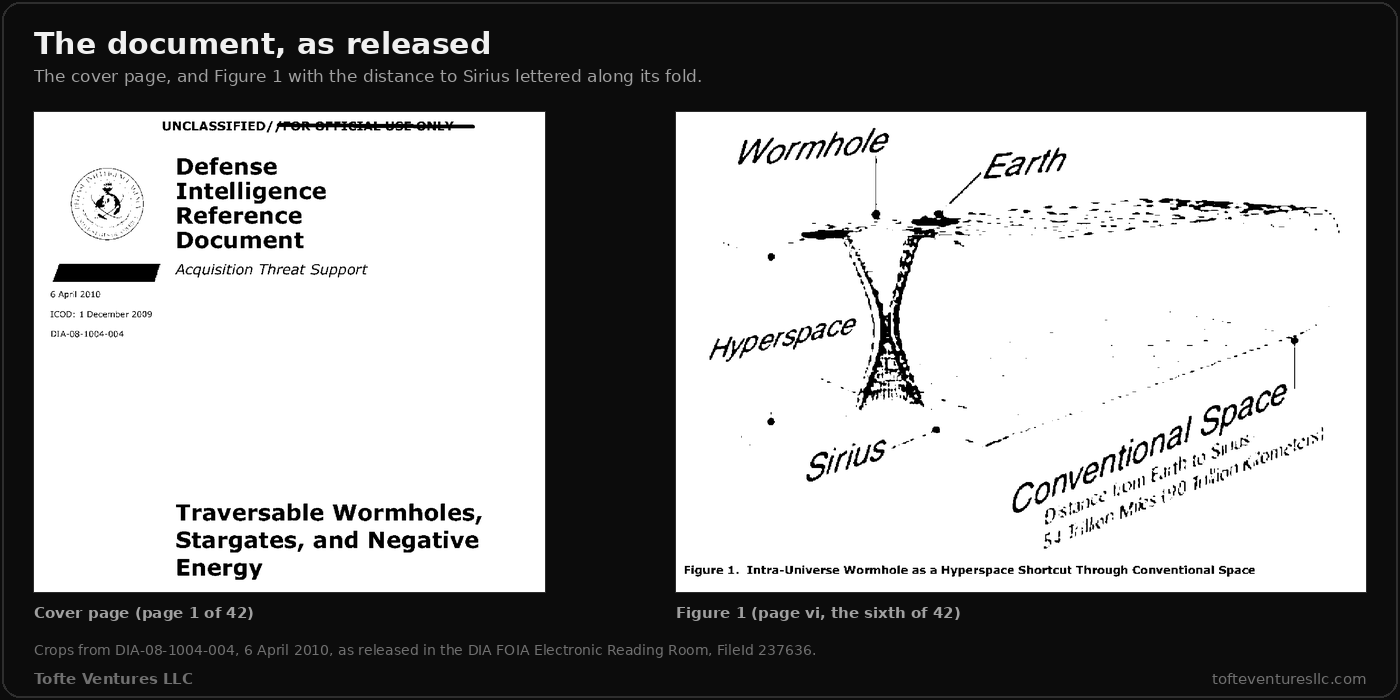
Figure 1 is the folded sheet of paper with a tube through it, the diagram from every popular book on the subject since 1988. Figure 5 is a curved grid labelled as a thin shell of mass-energy, which illustrates the equations beside it. Figure 6 is titled "A Spherically Symmetric Traversable Wormhole Observed in Space," which reads like a claim until you see the section it sits in, "What a Wormhole Looks Like in the Real World": it is a picture of what one would look like. Figure 7 is a page of pencil cartoons, a man with his arm through a round portal, a dinosaur looking through another, adapted, the document says, from Michio Kaku's popular book Hyperspace. Figure 8 is a photograph of Times Square with a glowing ring composited into the street and a desert with a sand dune seen through it. Figure 1 is below with the numbers this post is about, and the sentence under Figure 8, the one in the document that describes something you could observe, is near the end.
None of that is a criticism of the physics in the text, which is a competent summary of published work. It is an observation about the distance between the apparatus and the content. The letterhead promises an assessment. Several of the figures are the kind of illustration found in a book for a general audience, and one says it came from one. Both are real, and only one of them is evidence of anything.
The caption under Figure 1
Here is the part that made me write this.
Figure 1 gives the distance from Earth to Sirius, lettered along the fold of its diagram just above the caption line, as 54 trillion miles and 90 trillion kilometres. Here it is on the page of the release, beside the document's cover:
Sirius is 8.6 light years away. A light year is 5.88 trillion miles, or 9.46 trillion kilometres. So the distance is 50.6 trillion miles, or 81.4 trillion kilometres. The document's mile figure is 6.8 percent high and its kilometre figure is 10.6 percent high.
That is the smaller problem. The larger one is that the two figures disagree with each other. Ninety divided by fifty-four is 1.667, so the document's own two numbers imply that a mile is 1.667 kilometres. A mile is 1.609 kilometres. The caption is wrong against the sky and wrong against itself, and it takes one division to see either.
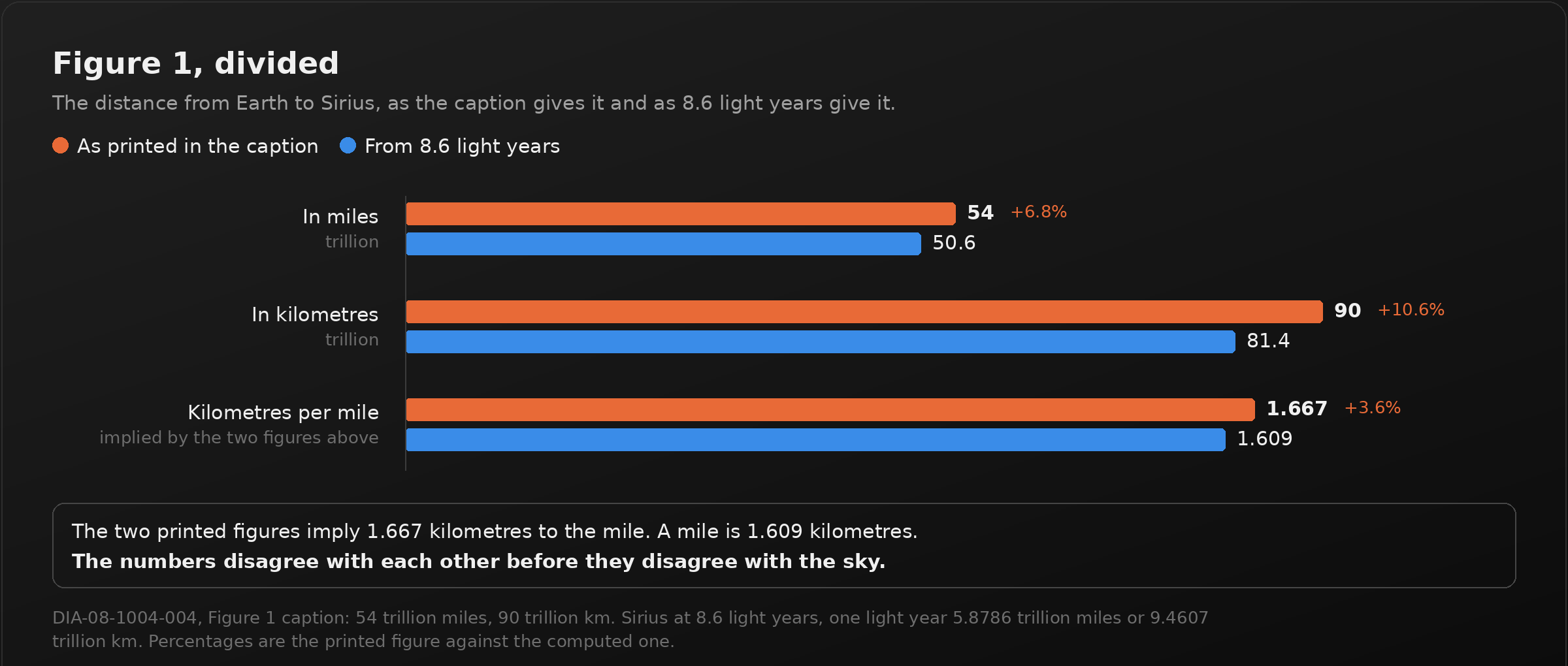
Nobody divided. Not the author, not whoever reviewed it, not whoever assigned it a control number, and, as far as I can tell, not the people passing it around this week. I nearly did not divide either. I read the caption twice before it occurred to me that a number with a trillion in it is still a number and can still be checked against another one in the same sentence.
I want to be fair about what this proves. It proves that the caption was not checked. It does not prove the survey is wrong about general relativity, and I have no reason to think it is. But it tells you exactly how much the apparatus is worth as evidence of care, which is nothing, because the apparatus was applied to a document containing a caption that contradicts itself and nobody noticed.
The letterhead and the green line
I keep writing about systems that return a well formed answer that happens to be false, and this is the sharpest specimen I have seen, because the false answer is not in the document at all. The document is honest. The false answer is the impression the apparatus creates, and the text never makes the claim the apparatus implies.
A syntax checker that scanned zero files printed "0 issues" in green, and the green was believed. A ledger capped at five thousand rows returned a well formed total that was short by whatever fell off the end, and the total was believed. A DIA letterhead on a survey of wormhole metrics says nothing at all about whether wormholes exist, and it is being read as though it did. Same shape, three directions. The letterhead is doing the same job as the green line: it is a format, and formats are not evidence.
If you want the one thing to take from the document, take the caption. Fifty-four trillion miles. Ninety trillion kilometres. Divide.
What I did with it
The document has one sentence that describes something observable, under Figure 8, and it is the document's own words: if a small wormhole were to appear in our local space, "one would perceive this process as the occurrence of an unusually bright spot in the sky," blue-shifted as the intersection grows and red-shifted as it recedes.
The whole paragraph under Figure 8, on page 9 of the release, reads:
If a small wormhole (three or more dimensional) were to begin to appear or even bump into our local space, one would perceive this process as the occurrence of an unusually bright spot in the sky. Blue and red Doppler shifting of this bright spot would manifest when the intersection of the wormhole with our local space grows or recedes, respectively.
An unusually bright spot in the sky is exactly what rainshower takes as its input. Two people see a light, each reports where it was from where they stood, and the app works out what it was and where it went. So the honest response to the claim was neither to draw a stargate in the scene nor to dismiss it. It was to ask what two observers can actually tell about an unusually bright spot in the sky, and to build that.
The answer is a screening board, on the same engine the app already uses to screen a rock in the hand. Candidates go on the table: a fireball, a satellite or rocket body coming back in, an aircraft, sunlight off something in orbit. Each observation strikes candidates out. Nothing is ever confirmed, because nothing observable from two fields at night confirms anything.
The first check is parallax, and it costs nothing, because the solver has already run. A body in the air is seen along two different lines from two different places, and the lines cross where it is. Lines that do not cross were not looking at one located thing. When they cross at altitude, the light was a located body in the atmosphere, and the rest of the board asks how high, how fast, how long, whether it slowed, whether it broke up. When they do not cross, the app says this, exactly:
Ruled out as a fireball. Whatever it was, there is no rock to look for.
and the one candidate left standing is called "nothing located in the atmosphere." Not "astronomical," not anything more specific, because that is the precise size of what a failed solve establishes. Zero parallax is what something very far away looks like. It is also what two people who saw different things look like, what a misread compass looks like, and what the document's bright spot would look like. The instrument cannot separate those and says so, and it names what would: a third station, a spectrum, a matched timestamp.
There is no function in that module that returns the word wormhole, and none may ever be added. A test walks all 82,944 combinations of answers the board can take and asserts that not one of them produces a sentence claiming an identification. The caption's arithmetic is in the module too, as a function that returns the two claimed figures, the two true ones, and the conversion factor they imply, because the caption is the subject of the module and the module's argument is that a well formed number is not a checked one.
That is what I think a document like this is for. Not the stargate. The caption. It is a reminder, on official paper, that the paper is not the check.
Update, 20 September: a second document
The day after I posted this, a second one arrived, and it is the better specimen. NTRS 20110015936, Warp Field Mechanics 101, Harold "Sonny" White of NASA Johnson Space Center, written for the DARPA/NASA 100 Year Starship Symposium at the end of September 2011. NASA's own reports server this time rather than the Defense Intelligence Agency's. I could not fetch it from the machine I work on, which blocks that host, so I read it from a copy handed to me directly. Thirty-three pages.
What the file is, before anything in it. The PDF's own metadata says Microsoft PowerPoint - White_100YSS_Presentation.pptx, run out through Ghostscript. Ten pages of paper, then twenty-three slides. What a citation number on that server gets you here is a conference paper bundled with the deck its author stood up and presented. That is a perfectly normal thing for a reports server to hold. It is not a journal article, and the version that later reached a journal reached the Journal of the British Interplanetary Society, not a relativity journal.
And the paper is honest, which is the part nobody repeats. It says the metric "violates all three energy conditions (strong, weak, and dominant) because of the need for negative energy density." It says "warp field mechanics has not had a 'Chicago Pile' moment." It says the idea "will not be an easy task" and that "it remains to be seen." Every hedge a careful person would want is already in the text. The reputation of this document is vastly stronger than the document.
The number everybody quotes is not in it. The famous claim attached to this paper is that thickening the bubble wall drops the requirement from a Jupiter's worth of negative mass to a few hundred kilograms. I searched the ten pages of paper text. There is no "Jupiter" and no "700." What it actually says is that "the peak energy density requirement can be greatly reduced by allowing the wall thickness of the warp bubble to increase," and that supporting analysis indicates "a corresponding reduction in total energy," with no figure given for the total. I can only speak for the paper text, because the slide pages carry no text layer I could read. But the headline number is not where everyone says it is.
Then I did to it what I did to the caption. I divided.
Most of the arithmetic is right
I want to lead with this, because it would be cheap not to. I checked every number in the paper I could check, and nearly all of them hold.
Voyager 1 at 3.6 astronomical units a year, against Proxima Centauri at 4.2465 light years from its measured parallax, gives 74,589 years. The paper says about 75,000. A ship at an effective ten times light speed covers 4.3 light years in 0.43 years. The paper says 0.43. A 5,000 kilogram spacecraft on 100 kilowatts is 50 kilograms per kilowatt, and taking 2,000 kilograms off it is 30, and scaling a 70 day trip by that ratio gives 42 days against the paper's "about 40." All correct.
One is loose. It puts Project Daedalus at 54,000 tonnes beside a 400 tonne space station and calls that "nearly the equivalent of 150 International Space Stations." It is 135. That is the same class of error as the caption above, an unchecked division in a sentence meant only to give a sense of scale, and it is the least interesting thing here.
The boost
Here is the one that matters.
The paper's proposed fix for a genuine paradox in the original warp drive concept is to rewrite the metric in what it calls canonical form, read a field potential off it, and define a boost from that potential by the standard identity. It then gives a worked example: a ship with a conventional drive good for a tenth of light speed turns on a field with a boost of 100, and travels at an effective ten times light speed.
Read as written, that says a modest ship plus a field gets you a fast ship. But the boost in this paper is defined entirely in terms of the field's own velocity term. The ship's speed is not in the definition. So I inverted it, which is two lines of algebra on the paper's own equation, and the answer is almost embarrassingly tidy: to get a boost of 100 the field's velocity term has to be 200 times the speed of light. In general it has to be about twice whatever boost you asked for.
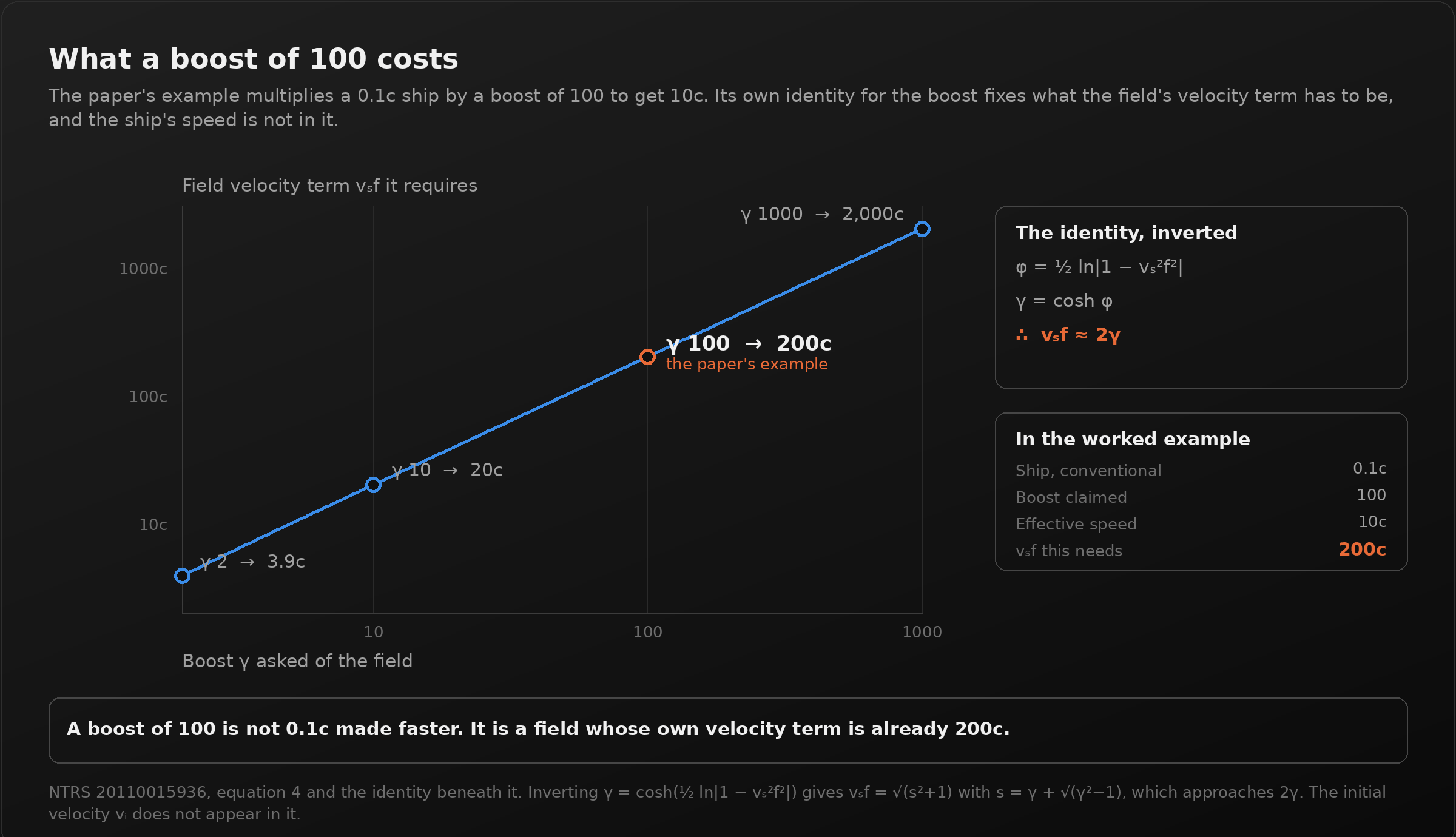
The tenth of light speed is doing no work in that sentence. The superluminal number is an input to the field, not something the field produced from a slow ship. I am reading the equations exactly as printed, and it is possible the two velocities are meant to be different objects, in which case the paper does not say how they relate. Either way the example cannot be read the way it invites you to read it.
The interferometer and its own noise floor
The paper closes by proposing a bench experiment, which is the right instinct and the thing I liked most about it. A helium-neon interferometer looks at a one centimetre region while a small high voltage ring is energised nearby. The rig, it says, "should be able to measure space perturbations down to about 1 part in 10,000,000." The test article, it says, needs "a boost on the order of 1.0000001."
Those are the same number. A boost of 1.0000001 is a strain of one part in ten million, and one part in ten million is the stated resolution. The effect the experiment is designed to produce is exactly the smallest effect the experiment can see.
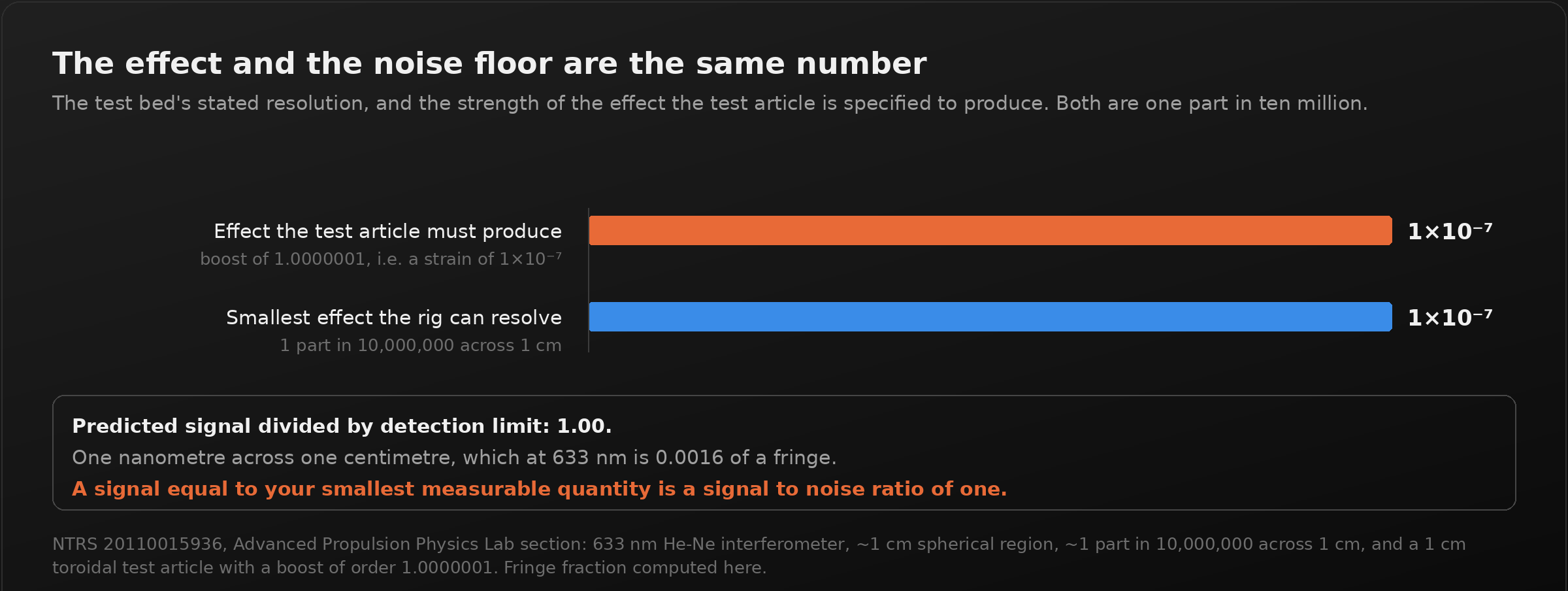
A predicted signal equal to your detection limit is a signal to noise ratio of one. In absolute terms it is a nanometre across a centimetre, which against a 633 nanometre wavelength is about a six-hundredth of a fringe. That is not impossible to measure, but it is the regime where the honest answer to any positive result is that you have seen your own apparatus. Nothing in the paper claims otherwise. It calls this "a very modest instantiation." The design simply puts the expected effect and the noise floor at the same place, and no line in the paper does that division.
Reference nine
One more, and it is the caption all over again.
The sentence introducing the interferometer reads: "As briefly discussed by the author in [9], a Michelson-Morley interferometer may be a useful tool for the detection of such a phenomenon." Reference 9 in the list at the back is Hawking and Ellis, The Large Scale Structure of Spacetime, 1973. Hawking and Ellis are not the author, and their book does not discuss his interferometer. A page later the same reference is used again, this time correctly, to support the claim about the energy conditions, which is exactly what that book is for.
So one number in the reference list is asked to do two jobs, and one of them is impossible. It is a formatting artefact, almost certainly a renumber that did not propagate. It proves nothing about general relativity. It proves, again, that the apparatus was applied and not checked.
Same shape, different letterhead
I said above that the false answer was never in the DIA document, because the document was honest and the apparatus around it did the misleading. This one is the same, and that is why it belongs in the same post rather than a new one.
A NASA reports server identifier, an agency address, a laboratory with a name, numbered equations and a reference list. Every signal correctly applied. Underneath them a careful, hedged conference paper that says out loud it has not had its Chicago Pile moment, containing a worked example whose central number cannot be read the way it is written, an experiment whose predicted effect sits exactly on its own noise floor, and a citation pointing at the wrong book.
The paper opens by asking how hard interstellar flight is without a warp drive, and answers it with Proxima Centauri at 4.3 light years and Voyager 1 needing 75,000 years to get there. I checked that one and it is right. That star is in rainshower's stars view now, drawn at the distance its parallax gives, next to twenty-two others, against a sky that is a real catalogue. It took a day to build and every number in it can be checked against somebody else's data. I know which of those two things I would rather have.
Divide. That is the whole method, and it works on NASA paper as well as it works on the other kind.
Read them yourself
Both documents are public. You do not need to take my word for any number in this post.
- DIA-08-1004-004, Traversable Wormholes, Stargates, and Negative Energy. Produced for the Defense Intelligence Agency's Advanced Aerospace Weapon System Applications Program, one of a series of advanced technology reports from fiscal 2009. Dated 6 April 2010, information cutoff 1 December 2009. The released copy redacts the author's name; the document is widely attributed to Eric W. Davis of EarthTech International, and it cites his earlier Teleportation Physics Study as its reference 8. It is in the DIA FOIA Electronic Reading Room, 42 pages. The warning about its photographs is on the second page, Figure 1 is on page vi (the sixth of the PDF), and Figure 8 with the sentence about a bright spot in the sky is on page 9 (the seventeenth).
- NTRS 20110015936, Warp Field Mechanics 101. Harold "Sonny" White, NASA Johnson Space Center, for the 100 Year Starship Symposium, September 2011. It is on NASA's Technical Reports Server. The interferometer and its "1 part in 10,000,000" are in the last pages of the paper text, before the slides.