In What OpenAI Actually Did to Navier-Stokes the useful finding was not about the proof. It was that a real fluid gives out before the mathematics does: squeeze a vortex in water and the water boils long before the equations blow up.
That sentence applies to the solver behind every craft post on this blog. It assumes the fluid is one incompressible phase. It already refused to give a drag once the flow peeled off the surface. It never noticed the water boiling. Now it does, and it refuses there too.
The speed where the water boils
Water flowing round a shape speeds up over the curved parts, and faster flow means lower pressure. The lowest pressure on the surface falls with the square of the speed. When it drops to water's vapour pressure, about 2.3 kPa at 20 °C or two percent of an atmosphere, the water boils right there on the surface. That is cavitation, and it is why ship propellers come out of service pitted.
The test is simple once you have the lowest pressure, and the lowest pressure is exactly what this kind of solver is best at. On the two shapes where the answer is known exactly, it lands within 0.8 percent on a circle and 0.4 percent on a thin ellipse.
What it says:
- A 12 percent thick section near the surface boils at 22 m/s, 43 knots. That is about where real hydrofoil boats are known to run into cavitation, which is a loose check but the right kind of number.
- A 6 percent section holds out to 31 m/s. A 24 percent one boils at 15.
- Warm water boils sooner, because it is closer to boiling already: 20.1 m/s at 60 °C against 22.1 at 5 °C. Depth helps, because every metre adds a tenth of an atmosphere pushing back: 26.9 m/s at five metres down.
Air has its own version. Instead of boiling, the fastest point on the surface reaches the speed of sound and a shock wave forms there. The solver now finds that too, with three standard compressibility corrections returned side by side so their disagreement is the error bar. NACA 0012 goes critical at Mach 0.730, where published tables give about 0.72 to 0.74, and a circular cylinder at 0.395, where the textbook says about 0.40.
Then the check that mattered most to me. Every water result published on this blog was run at ten metres a second, and every section from 6 to 24 percent thick is still single phase there. Nothing needs retracting. Above about twenty metres a second, the solver now refuses to give a drag and says the water has boiled.
Asked to boil last
In Told to Hold an Area the shape search was told to keep the enclosed area and cut the drag. It found a section with 29 percent less drag. So I gave the same search, from the same start, under the same constraints, a different question: keep the area, and boil as late as possible.
Before asking anything new, the old numbers had to come back exactly, and they do: the published start still prices at 0.005310 and the published least-drag shape at 0.003764, six digits each.
Then the new search. It moved the speed where the water boils from 22.3 to 28.6 m/s at zero incidence, 28 percent more. It did it by moving the thickest point back from 31 percent of the chord to 47, which spreads the low pressure over more of the surface instead of concentrating it near the nose. That is the direction NACA's laminar-flow sections went in the 1940s, found here by a search that was never told about them.
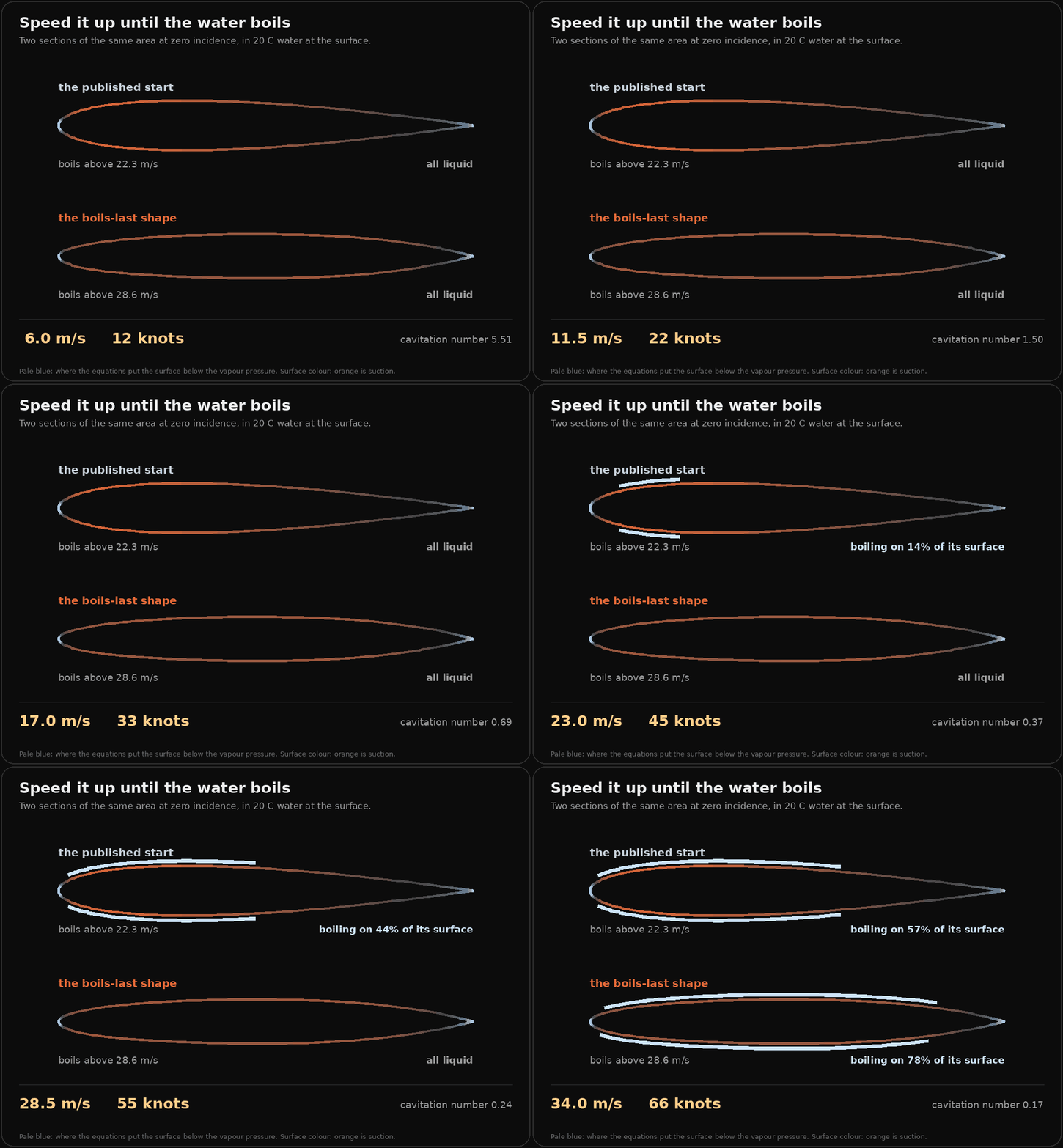
The result checks out. The search converges rather than running out of budget. The lowest pressure moves 1.2 percent when the shape is solved at twice the resolution, against 0.9 percent for the shape it started from, so the search found a shape and not a quirk of the grid. And the numbers come back the same three times: from the engine, from a separate numpy implementation that draws the figures, and from a third one that runs in your browser below.
The trap, two degrees wide
Here is what the search was not asked about. It optimised at zero incidence, meeting the water dead on. A hydrofoil or a propeller blade almost never does: waves, turns and gusts tilt it a few degrees either way all the time.
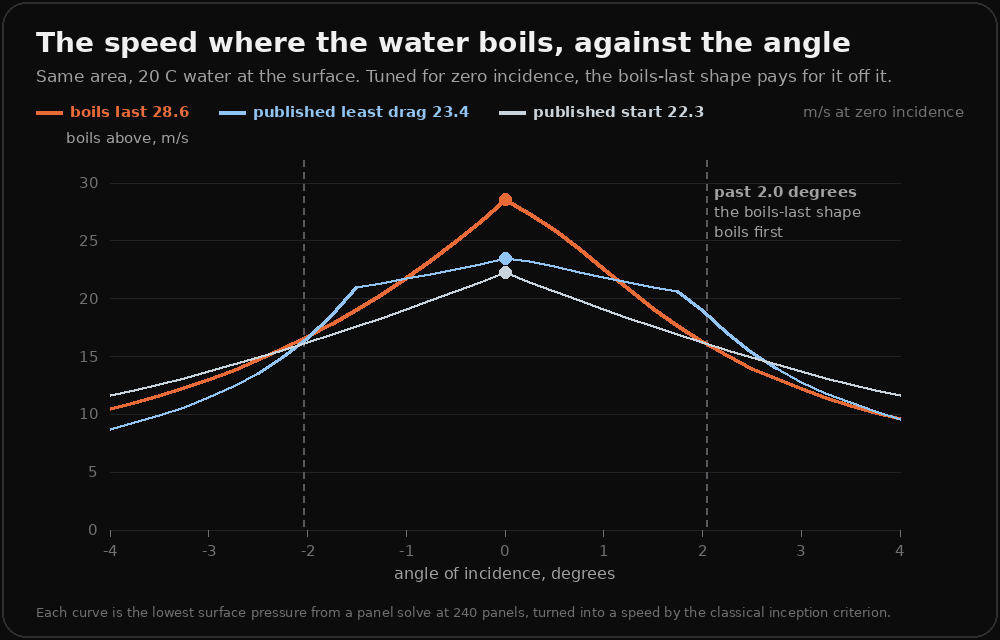
Past 2.0 degrees either way, the boils-last shape boils before the shape it started from. At four degrees it boils at 9.6 m/s against 11.6. The low pressure it flattened comes back as a sharp spike at the nose the moment the flow meets it at an angle. Designers call the range of angles where a section stays liquid its cavitation bucket, and this search made the bucket taller and narrower.
This is the same shape as What the Optimiser Was Not Told: tuned for the one point it was asked about, worse right beside it. For anything that meets changing angles, the width of the bucket is the design number, not its height. Try it yourself: pick the boils-last shape, set the speed to 20, and tilt it.
The drag number I am not going to quote
There is one more thing the search turned up, and I am going to tell you about it without claiming it.
The model says the boils-last shape also has less drag than the published least-drag shape: 0.00353 against 0.00376, which beats the 29 percent the drag search published. Restart the drag search from the boils-last shape and it finds a section with 46 percent less drag than the start.
I do not believe the 46 percent, for the reason I Said It Works in Water. It Does Not. gave: an optimiser goes looking for the place where the model is most wrong in its favour. Both of these shapes keep the flow smooth over most of their surface. The part of the model that decides where smooth flow turns turbulent assumes a perfectly clean surface and perfectly calm oncoming water, so it is at its most flattering on exactly the shapes a search will find.
What I do believe is narrower. The published search's 29 percent is the bottom of the basin it started in, not the bottom of the problem. Given more evaluations it converges to the same 29.1 percent, and a different starting point finds a deeper basin. That is what "a local search" means, and now there is a number on it.
What it means for building things
Every shape now comes with two speed limits alongside its drag:
- In water, the speed where it boils. Under about 20 m/s, 40 knots, near the surface, ordinary sections stay liquid. Above that the design problem is cavitation, deeper is better, and a warm lake is worse than a cold sea.
- In air, the speed where a shock forms. Around Mach 0.7 for ordinary sections, lower for thick ones.
Past either line, the solver still has a drag coefficient. It is well formed and in the right units, and it describes water that has already boiled or air that has already shocked. That is the recurring subject of this archive, and it was sitting in my own solver. It no longer answers there.