The saw arrived this morning. I opened it in the car, which is where the photographs were taken, and I am writing this before the first cut rather than after, for the same reason I opened the tumbler at six hours instead of seven days: the interesting part is the part before it goes wrong.
It very nearly went wrong in the first five minutes.
What is in the box
A 750 W bench motor with a speed dial from 1,000 to 10,000 rpm. A flexible shaft with a handpiece, a polishing wheel on the other end of the arbor, a small cutting table that bolts on, a bag of sanding discs, two blocks of polishing compound, and a blade.
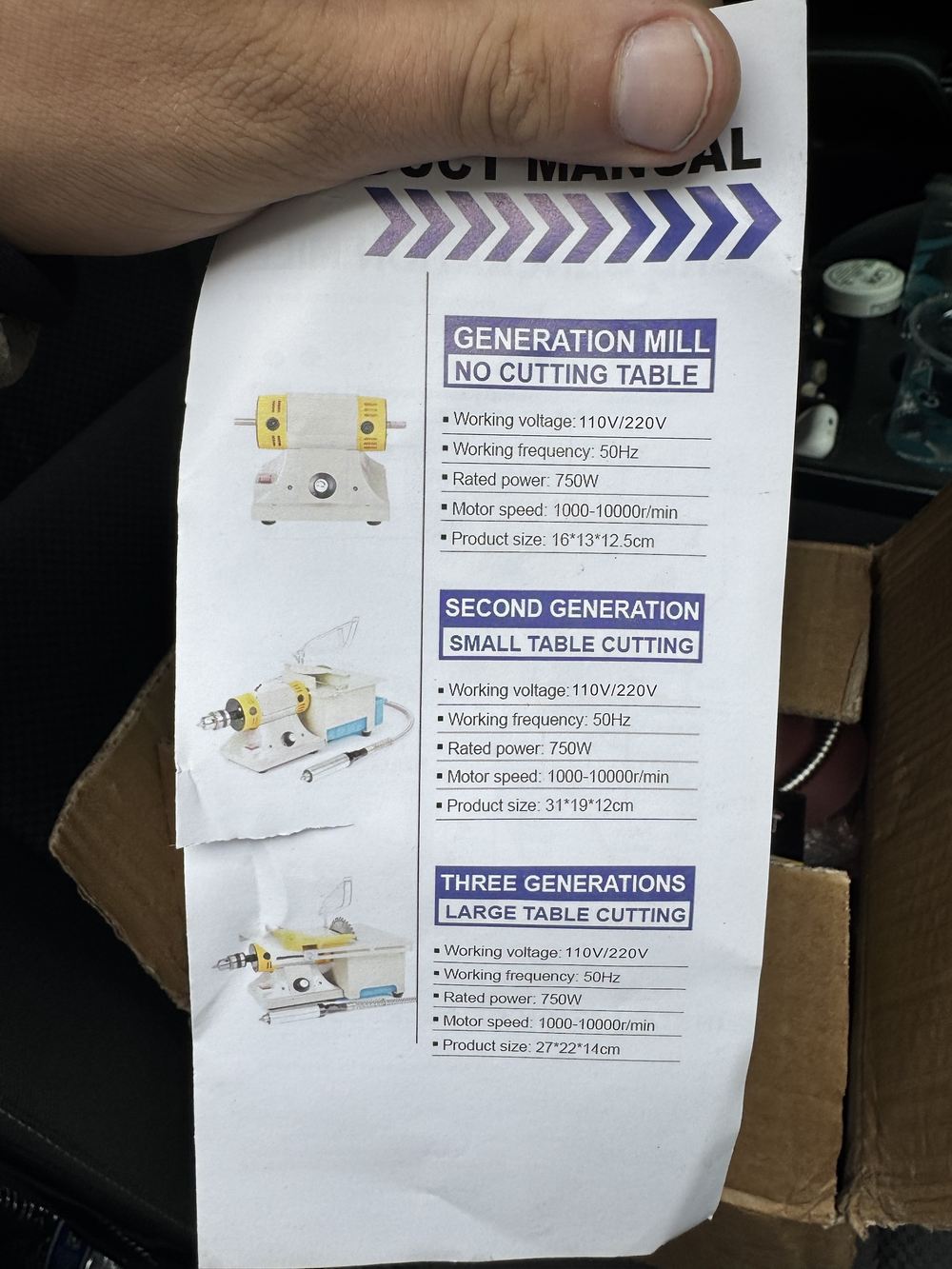
The sheet lists three generations of the thing and this is the third, the one with the larger table. Everything on it is correct. The motor is the motor, the table is the table, the flex shaft works, and the photographs on the sheet are the object in the box. I want to be clear about that before the next section, because the next section is not a complaint about a bad product.
The blade says woodworking on it
It is a 150 mm carbide-tipped blade with about thirty teeth, and the packet reads "Fine Woodworking Carbide Saw Blade" in letters large enough to read from the driver's seat.
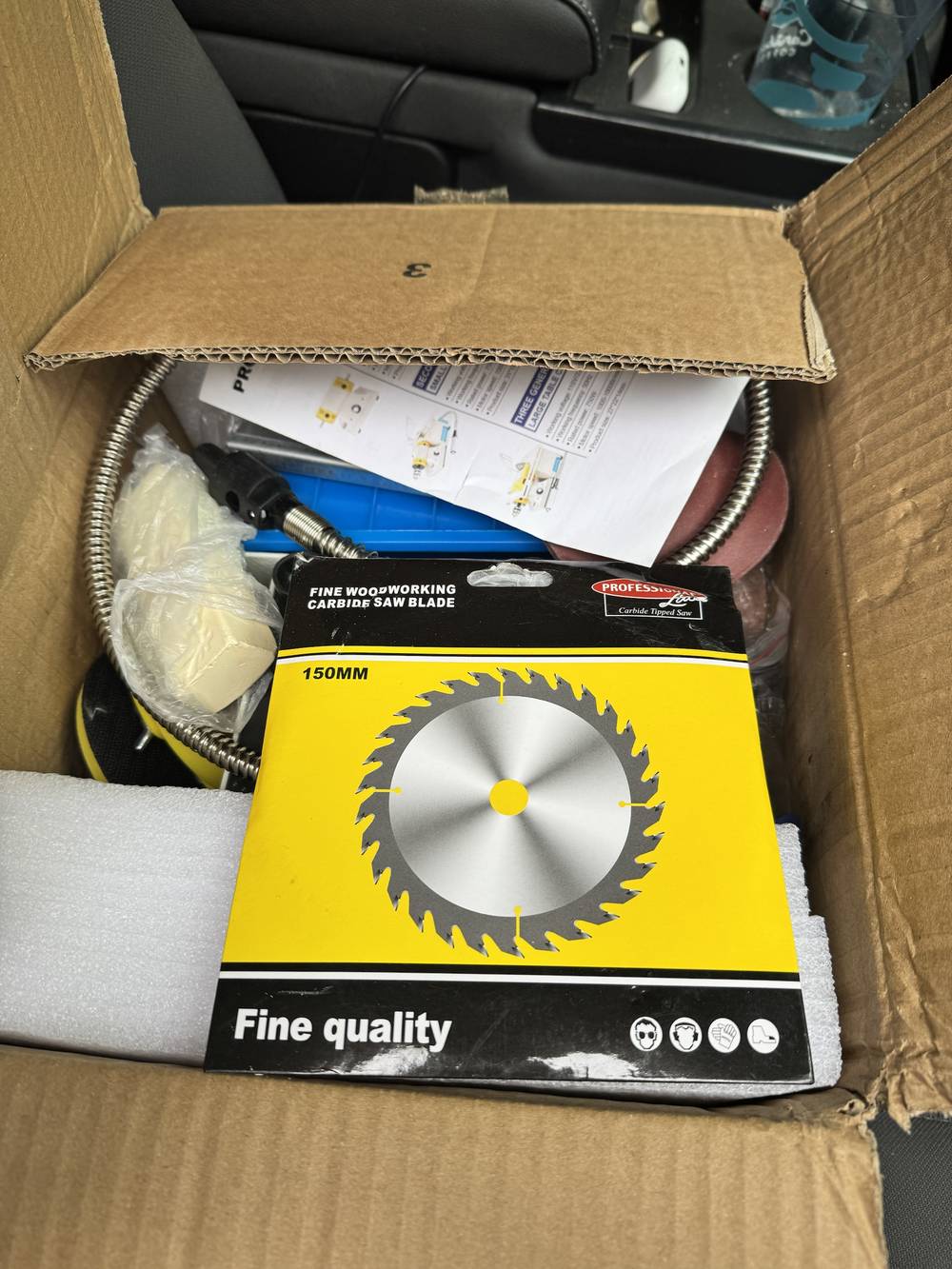
That is a wood blade. It is a perfectly good wood blade. It will go through pine and plywood and a bit of aluminium and it will not go through a stone, and the reason is worth understanding because it is not the reason most people assume.
Tungsten carbide is harder than quartz. That is not the problem. If hardness were all that mattered, a carbide tooth would cut agate the way it cuts oak. The problem is what a tooth does. A tooth cuts by biting: it takes a chip out of the material and the material has to yield to let it. Wood yields. Quartz does not yield to anything. It is brittle, so a tooth driven into it does not take a clean chip, it starts a fracture that goes where the stone decides, and the tooth's brazed edge goes with it. A few seconds of that and the blade has fewer teeth than it started with, and the stone has a crack through it that no amount of polishing will remove.
A lapidary blade has no teeth. It grinds rather than bites, with diamond grit bonded into a continuous rim, and it runs wet so the water carries the heat and the ground stone away. The two blades look similar from across a room. They are not the same tool, and the packet knew it.
How close this came
I had a stone in my other hand when I read the packet. The tumbler batch is a day into stage one again after the coating fiasco and I had been looking forward to seeing a sawn face next to a tumbled one for a week. The table bolts on in a minute. The blade goes on in another. Nothing about the assembly would have told me anything was wrong.
The listing said lapidary saw. The box says lapidary saw. The motor is the right motor and the table is the right table. Every formal signal was correct, and the one component that decides whether the thing cuts stone was a component for something else, in the box, with its purpose printed on the front in a language I read.
I keep writing about this shape, and here it is again with a blade in it. A well formed kit is not a kit for your job. The formatting was right. The letterhead was right. The one thing that mattered was labelled, correctly, as the wrong thing, and it was still nearly the first thing I used, because the box it came in had already told me what it was for.
Two smaller things, for the record
The sheet says 50 Hz. North American mains is 60 Hz. For a motor with a speed dial running from 1,000 to 10,000 rpm, which is almost certainly a brushed universal motor, the frequency does not matter, because a universal motor does not care what frequency it is fed. An induction motor would run about a fifth fast. I have not opened it to check, and I will before I trust the top of that dial.
There has to be water. A lapidary saw runs wet for two reasons, and only one of them is about the blade. The other is that agate and chalcedony are quartz, and grinding quartz dry puts fine crystalline silica into the air, which is the kind of dust the lungs do not give back. So the first cut waits for water as well as a diamond blade.
Correction: there is a tank, and there is a jade set
The version of this post that went up this morning said, in the paragraph above, that there was no water on this unit: "nothing on this unit drips, pumps or holds coolant." That sentence is gone from the paragraph and recorded here instead, because I then unfolded the second sheet, which I had not read, and it says otherwise twice.
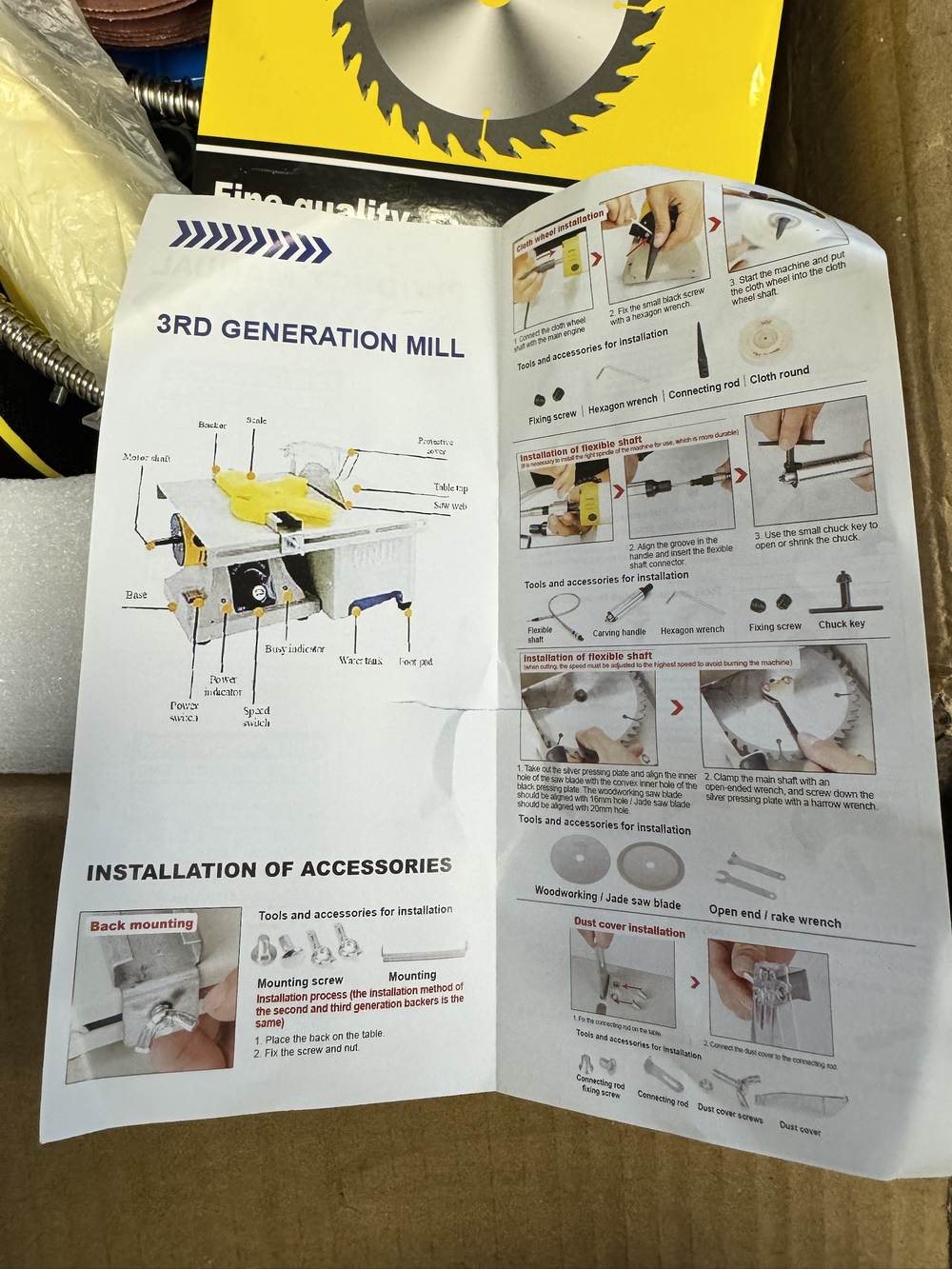
There is a water tank. The diagram labels one, at the base under the table. It is the blue tray I photographed in the box without recognising it, in the same picture where I was reading a blade packet carefully enough to write eight hundred words about it. So the machine can run wet, and the sentence saying it could not was wrong, and I am leaving the correction in rather than quietly editing the sentence out, because the post is about reading what is in front of you and I had not.
And the blade mount is made for both. The parts row says "Woodworking / Jade saw blade," and the instructions say the woodworking blade sits on the 16 mm hole and the jade blade on the 20 mm. Jade, in this catalogue's language, is stone, and a jade blade is a diamond blade. A note on the accessory sheet says the grinding disc "is not included in the woodworking and jade sets." So this kit ships as three sets, woodworking, jade and grinding, on one machine, and the one that arrived is the woodworking set.
That is a better story than the one I told this morning, and a harder one. The machine was never mislabelled. The listing sold me a variant, and the variant was the wrong one for stone, and the only place that fact was written down was on a blade packet and a folded sheet inside the box. The tool was right. The set was wrong. The 20 mm arbor is now the one number I need to order the right blade, and it was in the box the whole time.
One more line from that sheet, which I am recording rather than resolving. It says: "when cutting, the speed must be adjusted to the highest speed to avoid burning the machine." At the top of the dial a 150 mm blade has a rim speed of about 78 metres a second, which is well above what a lapidary trim saw normally runs, and the instruction is plainly about keeping the motor's own fan turning rather than about the stone. So there is a real tension between what the machine wants and what a diamond blade in wet quartz wants, and I do not know yet where it settles. That is a question for the first cut, not for a paragraph written before it.
What happens next
A thin sintered diamond blade, 150 mm, 20 mm arbor, is ordered. The tank gets filled. The first cut is a stone from the tumbler batch, and the photograph is the sawn face next to the tumbled face, both dry, because wet rock looks polished and I am not doing that to a reader.
Cutting is its own post. This one is the box.
The thing I would tell someone opening the same box tonight is not "check the blade," though do that. It is that the listing is not the tool, and neither is the first sheet. The listing is a description written by somebody who wanted to sell it, the first sheet is the description they printed, and the tool is whatever is actually in the box, including the second sheet folded under the packing foam that says which set you bought. I read the packet and missed the sheet. Read both.