I started tumbling stones this week. I am not good at it yet, and this is not a guide. It is notes from the first batch, written while I still remember what surprised me.
Almost all of these I picked up by hand. A few came in the box with the tumbler. I am deliberately not going to tell you what any of them are, because I do not know yet: we are verifying composition with instruments shortly, and a confident mineral name with nothing behind it is exactly the sort of thing this blog exists to complain about. So they are stones. Two of them weigh between 155 and 168 grams.
Six to eight hours, which is wrong
Every tumbling guide I have read gives times in days. Seven days of coarse grit, seven of medium, and so on, a month or more to finish a batch.
I am running six to eight hours per barrel and then stopping.
For finished stones that would be a mistake. For what I am actually doing it is the whole point, and there are two reasons.
The first is the material. The stones I picked were already smooth, because water had spent a long time doing the coarse stage for free. A guide assuming angular rough is solving a shaping problem I do not have. My first stage is not knocking corners off anything, it is working on the surface, and that is a shorter job.
The second reason matters more. A sealed barrel running for a week hands you a result and no account of how it got there. You put rough in, you come back in seven days, and something has happened. If it went well you do not know why, and if it went badly you have seven days of undifferentiated tumbling to blame.
Opening it at six hours is how the process stops being a black box. You see what one stage does, on this material, at this stage, because you interrupted it while the change was still small enough to attribute. It costs efficiency and buys understanding, which is the trade I want right now. The tumbler is assisting. It is not doing the work.
The gap between stages is a step, not a pause
This is the part I would tell someone starting out, and it is the part the photographs above are really about.
Between stages, I pick the stones out, scrub them with a wire brush, wash them, and dry them. Then, before the next grit goes anywhere near them, they go back in the barrel and run with no grit at all.
The reason is that grit does not politely leave when a stage ends. It lodges in pits, in cracks, in the texture of the stone, and in the barrel itself. Carry a few grains of the coarse stuff into a finer stage and they keep cutting at the coarse scale while everything else works at the fine one.
What makes that worth a paragraph is the shape of the failure. The batch does not stop. Nothing jams, nothing sounds wrong, no stage reports an error. The stones come out at the end looking finished, and they are scratched, and the scratches were put there days earlier by a contaminant you could have brushed off in a minute. You find out at the end or not at all.
It is the same failure I keep writing about in software: the process completes, the output is well formed, and it is wrong for a reason that was invisible at the time it was introduced. The defence is the same too. You do not detect it afterwards, you make it impossible earlier, and you treat the boundary between stages as a thing you actively do rather than a gap between the things you do.
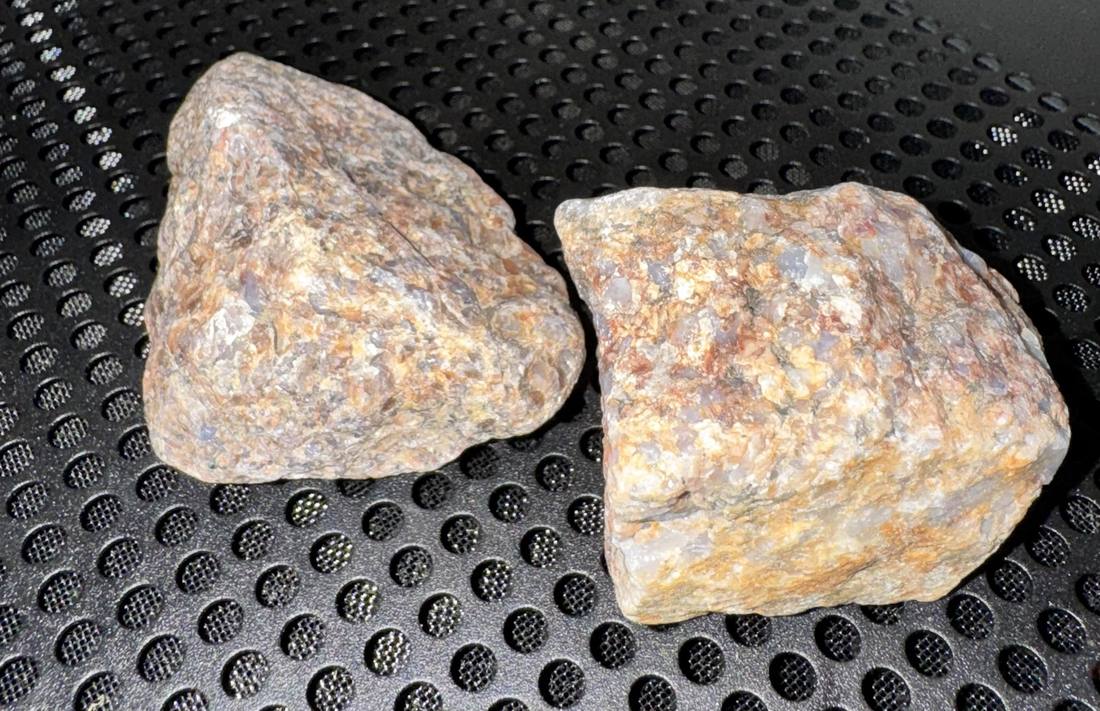
Those two are clean, dry and ready for the next stage. They have had one run with grit and the brushing that follows it.
Correction: the defence failed the first time I used it
I wrote the section above before running it. Then I ran it, and it did the opposite of what it is for.
The stones went into the barrel for the no-grit cleaning run and came out coated. Not scratched, not damaged. Every piece uniformly dulled, matte, grey, wearing a thin film of the exact grit the run existed to remove.
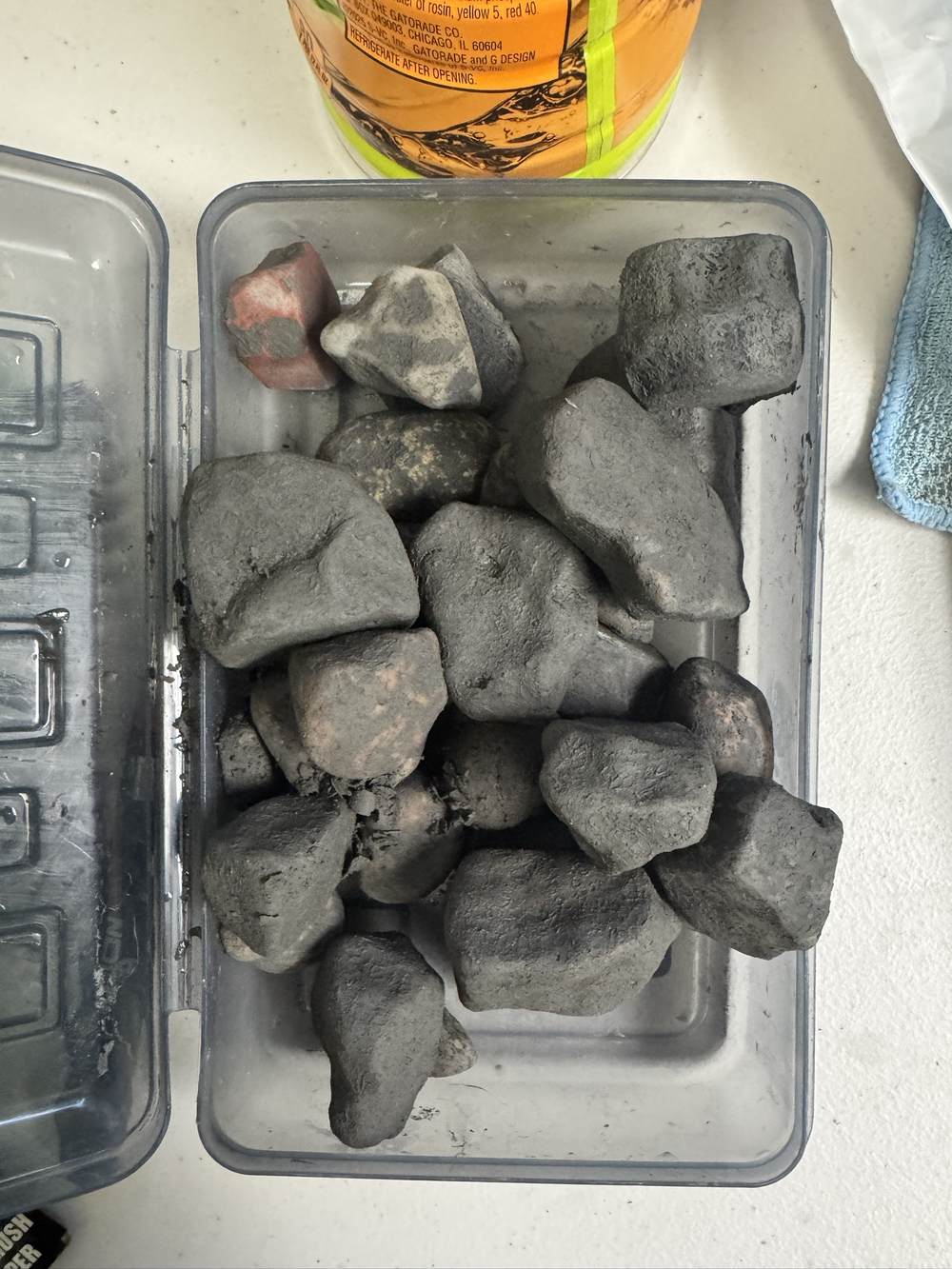
They were not dry enough. I had brushed and washed and dried them and believed that was done, and enough moisture remained in the surface and in the pits that the leftover grit dust in the barrel stuck to it instead of falling away. With no water in the barrel there is nothing to carry the grit off and nothing to cushion anything, so several hours of tumbling pressed a damp film of abrasive evenly into every surface.
The step that exists to prevent invisible contamination had quietly caused it. The tumbler ran for hours. Nothing jammed, nothing sounded wrong, nothing reported an error. Running it did more harm than not running it at all, and the only reason I know is that the stones came out visibly grey.
That last part is luck rather than method. A lighter coating on darker stone would have looked like nothing, and I would have gone into the next grit stage carrying the previous one, which is the exact failure the run was supposed to prevent.
So the rule needs the precondition it was missing, and the precondition is the whole thing:
Bone dry, not towel dry. "Dried" is not a state you glance at, it is a threshold you have to actually reach, and moisture hiding in pits and cracks is invisible on a surface that looks and feels dry to a hand.
They are back in stage one now, soaking in hot water and soap before another scrub, and this time they get hand dried properly before anything spins. I would rather report that than leave the tidy version standing.
The photographs are dry on purpose
Small thing, and I want it on the record because it took me about four seconds to work out and it invalidates an enormous amount of what people post.
Wet rock looks polished. A film of water fills in the surface, does what a finish would do to the way light leaves the stone, and makes a piece straight out of coarse grit look like the end of the process. Every stone in a bucket looks extraordinary. Every one of them dries dull.
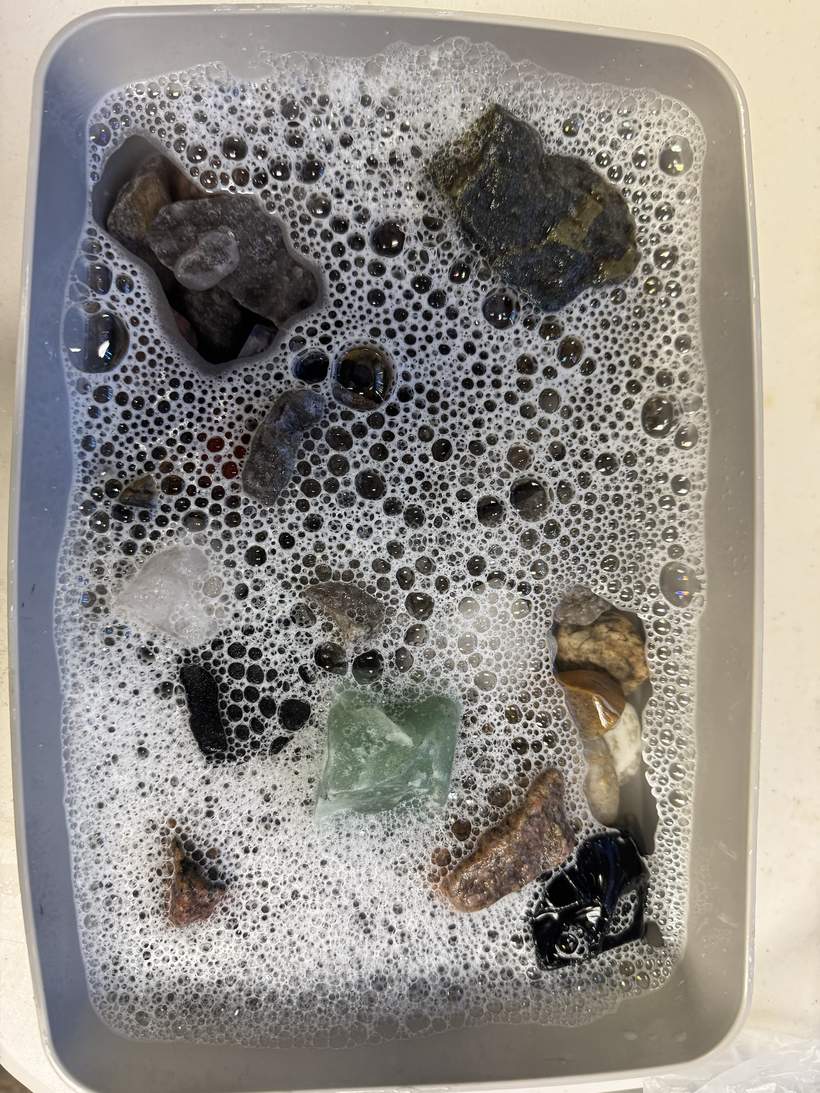
So the pictures here are of dry stones, cleaned, untouched, exactly as they came out. The wet one is wet because it is a photograph of washing, which is the step it is illustrating.
If you are looking at somebody's before and after and the after is glistening, you are looking at water.
Found there is not from there
I should say where these came from, because it turns out to be the most interesting thing about them and I got the story wrong at first.
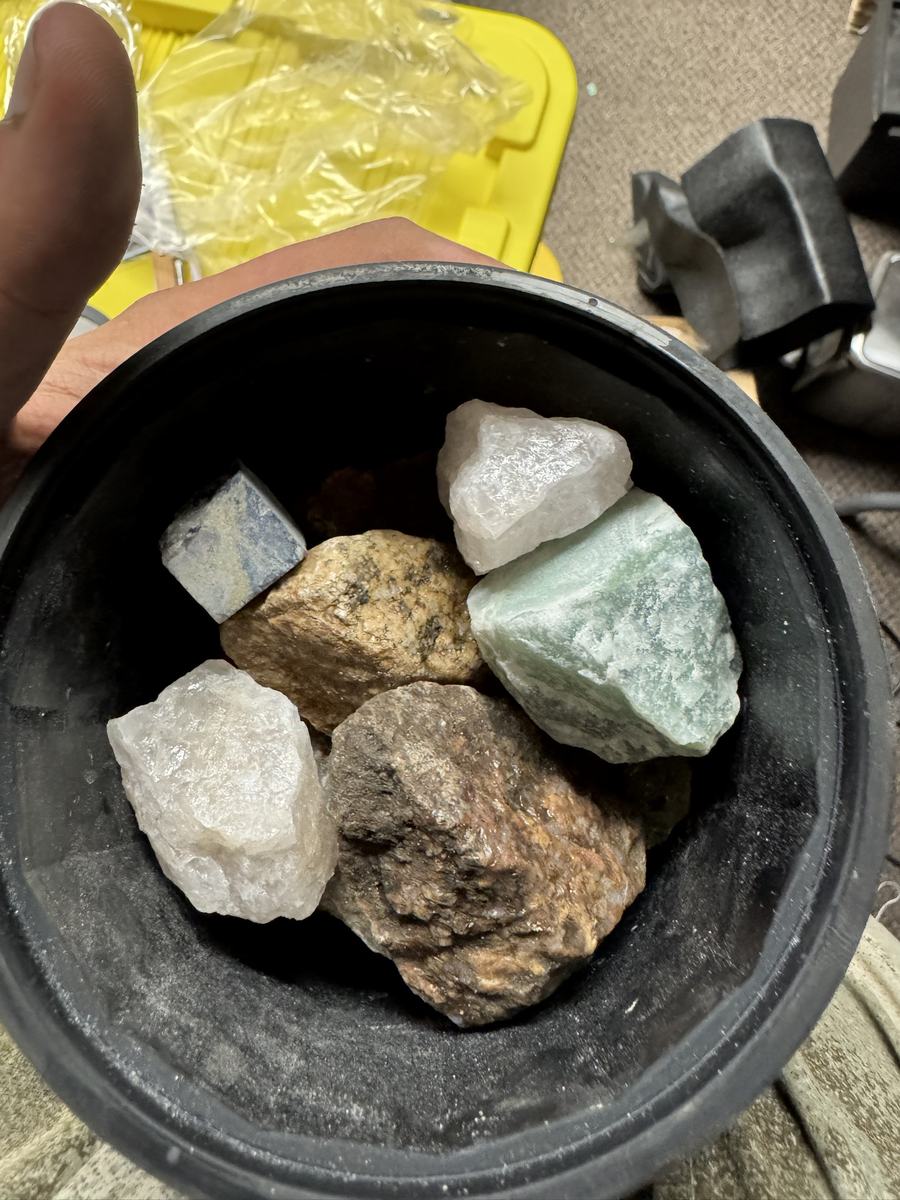
Most of them I picked off the edge of a railroad track and a bike trail in St. Paul. My first assumption was that they had come down the river, which would make them anything at all from anywhere upstream.
That is a claim about transport, and it is separate from the find, and it has its own evidence. There are at least three ways a rock gets to that trail edge, and the rock itself cannot tell you which:
- Glacial till, or the gravel worked out of it
- River gravel, from the Mississippi's own upstream catchment
- Imported ballast or landscaping stone. Railways lay down crushed rock chosen for drainage and interlocking, quarried somewhere else and hauled in. In some regions and eras that included furnace slag, which is worth knowing before you put one in a tumbler: slag is glassy, often full of bubbles, and does not behave like rock.
The part I had backwards is the one that matters. I have written at length about the Duluth Complex, which sits up in the northeast of the state. It drains to Lake Superior, not to the Mississippi. The Laurentian Divide runs between them. Water leaving that country goes east into the lake and eventually to the Atlantic, so "it came down the river" is the wrong mechanism for anything from up there arriving in St. Paul.
What actually moves that rock south is ice. The Superior lobe of the Laurentide sheet flowed southwest out of the Superior basin across this part of the state and left its load as till, and the gravel derived from that till is everywhere down here.
Which is the explanation for something every Minnesotan already half knows. The Lake Superior agate is a glacial erratic. It formed in the rift basalts, the same eleven-hundred-million-year-old event that put the Duluth Complex where it is, and it turns up in gravel hundreds of kilometres from the lake because ice carried it. The state gemstone is a rock that is not from where you find it.
So I can say where I picked these up and I cannot say where they are from, and those are different sentences. The one I nearly wrote sounded more knowledgeable and was less true.
What I do not know yet
Quite a lot.
I do not know what these stones are, and I am not guessing in public. I have four grades of grit and I am partway through them. I do not yet know how this particular material behaves at the finer end, whether the softer pieces in the barrel will survive a run with the harder ones, or how much of what I am doing by hand would have been better left to the machine.
The saw arrives tomorrow, and cutting is a completely different problem from finishing. That is its own post, once I have made enough mistakes to have something worth reporting.
The reason I am writing any of this down at the six hour mark rather than at the end is the same reason I am opening the barrel at the six hour mark. The interesting part of a process is visible while it is still going wrong. Wait until you have a tray of beautiful finished stones and the only honest thing you can say about them is that it worked.
You cannot automate a process you do not understand. That is the rule underneath all of this, and it is why the hand work is the point rather than an inconvenience on the way to a better setup. Every step I am doing manually is a step I would eventually like a machine to do, and I will not know what to ask the machine for until I have done it badly myself a few times. A week of sealed barrel would have handed me finished stones and taught me nothing I could write down. The batch that came out coated taught me a precondition I would never have thought to put in a procedure, because until it failed I did not know it was a precondition at all.