This started with a video game.
There is a mod with a famously deep ore processing chain. You crush the ore, wash it, run it through a separator, and put the result through electrolysis, and each step drops byproducts. I assumed the byproducts were invented to make the tech tree feel dense.
They are not invented. You do not mine platinum. You mine copper, and during electrorefining a sludge collects at the bottom of the cell, and that sludge is where the precious metals end up. They are recovered afterward as a separate product. A deposit can list six metals in its resource statement while exactly one of them pays for the mine.
I thought that was delightful, so I kept reading. Then I found out the largest undeveloped example of this on the continent is about four hours north of my house, and that there is an active fight about it, and that I had already repeated a number about it that turned out to be garbage.
I got it wrong twice, which is the useful part
The first number I repeated was that Minnesota holds 75 percent of the country's platinum group metal reserves. I got it from an AI summary. I went looking for the source and could not find one. Dropped it.
Then I corrected someone else's figure and got the correction wrong. A brief I was reading quoted the Duluth Complex at 0.66 percent copper and 0.20 percent nickel. I checked it against the published numbers for a specific deposit called NorthMet, saw it did not match, found it sat close to a different deposit called Maturi, and concluded the two had been mixed up.
Wrong. That figure is real and it is neither of those deposits. It is a theoretical resource of 4.4 billion tons averaging 0.66 percent copper and 0.20 percent nickel for the entire Duluth Complex, credited to the Minnesota Geological Survey and the University of Minnesota, Miller and others, 2002.
I saw a number that did not match the thing I was looking at and assumed it was misattributed, when the real answer was that it described something much bigger than a deposit. I checked the digits and guessed at the noun.
That is the whole subject of this post, and I did it myself, twice, while writing about it.
Resource, reserve, and the third word nobody mentions
These are not synonyms. They are tiers, and the difference is the entire argument.
A resource is rock that contains the metal. It is a geological statement. It says the stuff is in the ground.
A reserve is the part of a resource that has been demonstrated to be economically mineable under current conditions. It is an economic and legal statement. Prices, costs, engineering, permits.
A theoretical resource, which is the category that 4.4 billion ton figure actually sits in, is weaker still. It is an estimate of what is probably down there based on geological reasoning, not a measured inventory.
Three tiers, and the popular version of any of these numbers almost always arrives wearing the strongest one. When someone says Minnesota has vast mineral reserves, ask whether the source said reserves, because a resource that cannot currently be permitted or mined economically is not a reserve, and swapping the word turns a geology fact into a policy argument without anybody having to make the argument.
What is actually published
Here is what I could find, with the source attached to each line so you can check it rather than trust me.
The whole complex: 4.4 billion tons, averaging 0.66 percent copper and 0.20 percent nickel, plus a platinum-group enriched zone of 37 million tons. Miller and others, 2002.
There is also a widely repeated figure of "nearly 8 billion tons." I could not reconcile it with the 4.4. They are probably measuring different things, different cutoff grades or ore versus all mineralized rock. I am telling you the gap exists instead of picking the bigger one.
Individual deposits, which is where the real numbers live:
| Deposit | Category | Tons | Copper | Nickel | Platinum | Palladium |
|---|---|---|---|---|---|---|
| NorthMet | Measured | 340 Mt | 0.497% | 0.115% | 36 ppb | 101 ppb |
| NorthMet | Indicated, above 0.2% Cu | 400.9 M short tons | 0.328% | 0.089% | 79 ppb | 287 ppb |
| Maturi | Proven and probable | 478 Mt | 0.59% | 0.19% | 154 ppb | 349 ppb |
| Nokomis | Indicated | 449 Mt | 0.624% | 0.199% | 0.600 g/t combined |
What those numbers feel like
Percent and parts per billion are abstractions. Here is the arithmetic, and you can check every line of it on a phone.
A tonne of rock is roughly the size of a kitchen island. Solid stone.
Copper at 0.497 percent means that tonne of rock contains about 5 kilograms of copper. Call it eleven pounds. One boulder, eleven pounds of metal. That is the good part, and it is why anyone bothers.
Palladium at 101 parts per billion means that same tonne contains 0.101 grams of palladium. A paperclip weighs about a gram. So you would need roughly ten tons of rock to get one paperclip's worth of palladium.
Platinum at 36 parts per billion means about 0.036 grams per tonne, which works out to roughly 28 tons of rock per gram.
This is not an argument against mining it. Byproduct recovery at that scale is real industrial practice and the metal genuinely comes out. It is an argument against the mental picture most people have, which involves platinum being up there in some retrievable sense. It is up there the way sugar is in a lake you dissolved a spoonful into. Real, measurable, and inseparable from everything else without processing a mountain.
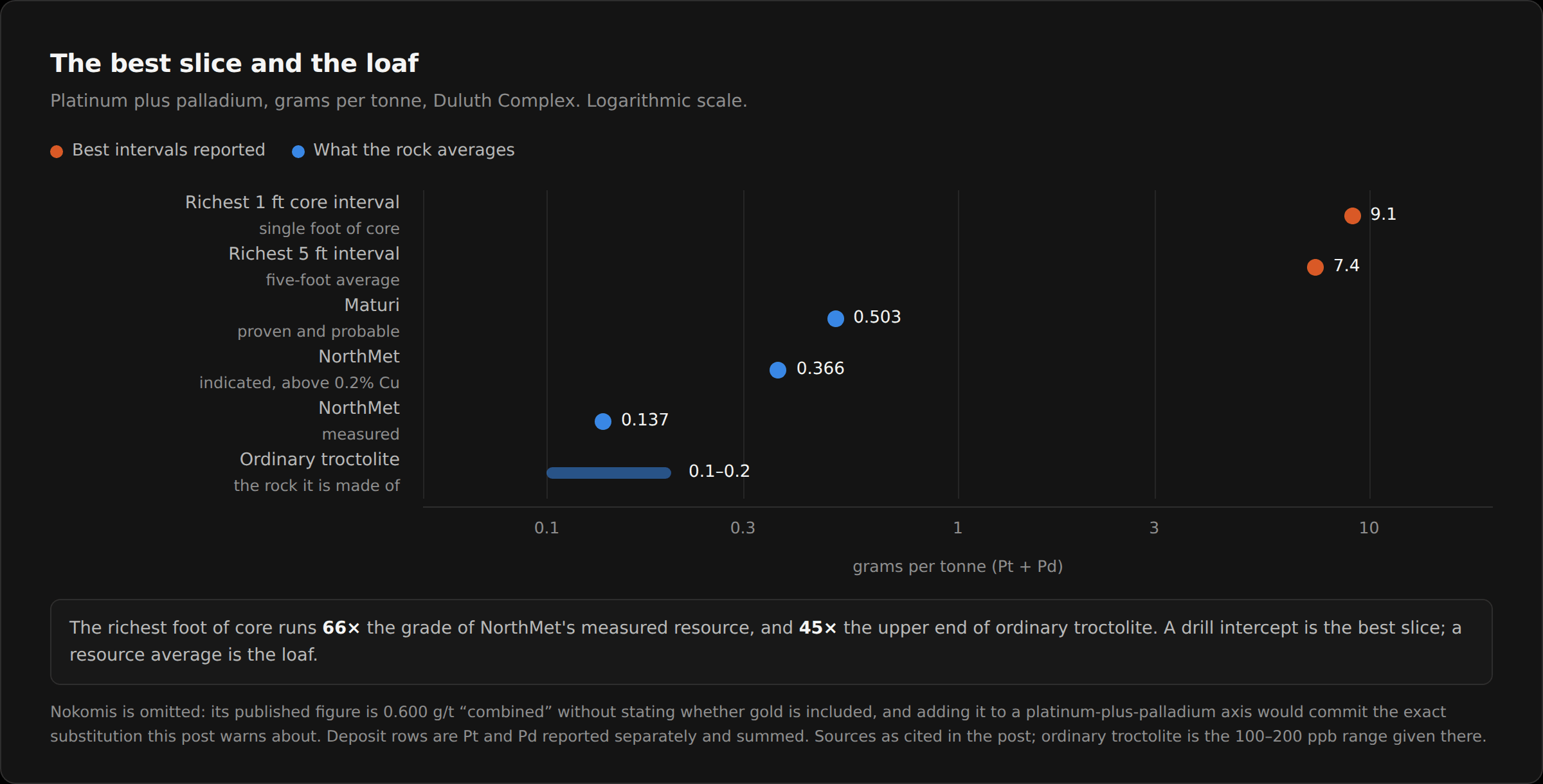
The highest values in the literature are a lot better. Individual foot-long core intervals have hit 9.1 grams per tonne of platinum plus palladium, and the richest five-foot interval averaged 7.4. But ordinary troctolitic rock in the complex runs 100 to 200 parts per billion, which is 0.1 to 0.2 grams per tonne.
That is a factor of forty or more between the showcase interval and the rock the deposit is actually made of. Deposit averages sit near the low end. They have to. That is what an average is.
Two traps to watch for
TPM does not mean what it looks like. You will see resources quoted in grams per tonne of "TPM," or Total Precious Metals. That is platinum plus palladium plus gold, added together. Gold is not a platinum group metal. So a headline that turns TPM into "precious metals" and then into "platinum" has quietly laundered gold into platinum in two steps. When you see one number covering three metals, split it before you compare it to anything.
A drill intercept is not a deposit. Press releases report things like 116.5 feet at 1.043 percent copper, or 40 feet at 2.268 grams per tonne TPM. Those are real, honestly measured numbers. They are also, by definition, the best thing found in that hole, which is why they are in the press release. Maturi's actual reserve average is 0.59 percent copper. An intercept at 1.043 percent does not contradict it. One is the best slice, the other is the loaf.
The metals that are not in the numbers
I went looking specifically for rhodium and iridium, because "platinum group metals" as a phrase implies all six of them: platinum, palladium, rhodium, ruthenium, iridium, osmium.
Every Duluth Complex resource statement I could find reports platinum, palladium and gold. None of them reports rhodium, iridium, ruthenium or osmium at all.
That absence is an answer. It does not prove those metals are not present in trace amounts. It does mean that no published resource figure carries them, and so nobody has claimed they are economically recoverable here.
While I am at it: platinum group metals are not rare earths. Rare earths are a different set of elements entirely, the lanthanides plus scandium and yttrium, in different rocks with different processing. Press coverage mixes them constantly. If an article uses the terms interchangeably, that tells you something about the article.
What is actually happening right now
This stopped being abstract for me when I understood the calendar.
The Boundary Waters is not scenery to people who live here. That matters for how I read all of this, and I would rather say so than pretend to a neutrality I do not have.
- A 20-year federal mineral withdrawal covering roughly 225,378 acres of the Boundary Waters watershed, put in place in 2023, was overturned through the Congressional Review Act and signed into law in April 2026.
- Governor Walz signed an executive order in August 2026 moving to block nonferrous mining near the Boundary Waters in response.
- Minnesota DNR cancelled a Twin Metals state mineral lease, effective November 10, 2026. Twin Metals, a subsidiary of the Chilean company Antofagasta, says it still holds a mix of state, private and mineral rights.
- Separately, NewRange (the PolyMet and Teck joint venture behind NorthMet) says it holds 21 of the 24 permits it needs to begin operating. Its 2019 Section 404 permit was revoked in June 2023. It filed a new application on July 29, 2026.
- The Army Corps of Engineers comment period on that application was extended to September 27, 2026.
If you live here and you have an opinion in either direction, that last line is the one that has a deadline on it.
Where I land
I want both things, which is uncomfortable and I think fairly common.
I think the metals matter. Byproduct platinum and palladium out of a copper operation is real industrial chemistry and I find it genuinely fascinating. And I think the Boundary Waters is not replaceable, and that "we can always undo it later" has never once been true about water.
What I am confident about is narrower and I will defend it: the numbers in this argument are being used carelessly, and the carelessness runs in the direction of making the prize sound bigger and more available than any published figure supports. Resource gets said as reserve. Theoretical resource gets said as resource. TPM gets said as platinum. A drill intercept gets said as a deposit. Not one of those is a lie. Every one of them shifts the picture the same way.
You do not have to resolve the mining question to insist the numbers be stated with their actual nouns attached. That is the part I would want from either side.
On sources, honestly
I could not open a single primary document while writing this. The network I was researching from blocks USGS, the Minnesota DNR, the University of Minnesota archive, the Army Corps, and the technical reports themselves. I confirmed that three different ways.
Every figure above came from a search index summarizing those sources. The results were consistent and each one is traceable to a named origin, which is why they are here at all. But a summary is not the document, and I would rather tell you that than imply a level of verification I did not reach.
The single most valuable thing anyone reading this can do is open the Twin Metals NI 43-101 technical report, which is a primary document that states its own categories, cutoff grades and definitions. I could not. You probably can.
If you check any of this and find I have something wrong, tell me and I will correct it in public, the way I corrected myself twice above.
Sources
- Miller and others, Mineral potential of the Duluth Complex and related intrusions
- USGS, Occurrence Model for Magmatic Sulfide-Rich Nickel, SIR 2010-5070-I
- USGS, Platinum-group elements, Professional Paper 1802N
- USGS, Platinum-Group Elements in Layered Intrusions Associated with the Midcontinent Rift
- Platinum Group Elements and Platinum Group Minerals in the Duluth Complex, University of Minnesota Digital Conservancy
- Twin Metals Minnesota Project, NI 43-101 Pre-feasibility Technical Report
- Nokomis deposit resource summary
- USGS Mineral Resources Data System, Birch Lake
- Save the Boundary Waters, memos on critical minerals claims
- Reporting on the 2026 Congressional Review Act reversal, the August 2026 executive order, and the DNR lease cancellation
Gunnar
Founder, Tofte Ventures LLC