Build a rocket, put it on the pad, and try to get it into orbit. It runs right here, on a phone or a desk.
How to fly
The first orbit takes a few tries. This works:
- Pick Two-stage and press To the pad, then Full.
- When you are moving at about 60 metres a second, hold Tilt left or Tilt right for a moment, about 20 to 30 degrees, then press Hold prograde. Either way reaches orbit. The rocket now follows its own path and leans over as it climbs. Try 4x time here.
- When the highest point reads about 65 km, press Cut. If the first stage runs dry before that, press Stage.
- Coast up. When you are close to the highest point, press Hold horizon and Full.
- Watch the lowest point. When it climbs above 50 km, the top of the air, press Cut. You are in orbit.
On a keyboard: A and D tilt, W and S throttle, Z full, X cut, Space stages, P holds prograde, R holds retrograde, H holds the horizon, M opens the map.
The planet is small on purpose
Pebble is made up. It is 400 km from its centre to its surface, with the same gravity at the surface as Earth and air that thins out ten times faster with height. Reaching orbit round the real Earth takes roughly nine kilometres a second (a figure from memory) and several minutes of burning, which makes for a slow game. Kerbal Space Program, the game this is a very small nod to, also puts you on a small planet. Here, a circular orbit at 65 km means going sideways at 1,837 metres a second.
The parts are made up too. Three engines (Hammer, a big lifter; Needle, a vacuum engine that is weak in thick air; and Spark, a small one), three tank sizes and a capsule, with plausible masses and thrusts rather than any real engine's figures.
Everything else is real physics. Gravity falls off with the square of distance. The air thins exponentially and drags on the rocket in proportion to its density and the square of the speed. An engine burns fuel at the same rate at any height but pushes harder in a vacuum, because thick air gets in the way of its exhaust. A rocket too heavy for its engines sits on the pad burning fuel until it is light enough to lift. Nothing in the code is told the rocket equation, and burned out in empty space the rockets land on it to nine decimal places anyway.
Four rockets to start from
- Hopper: two small engines and a small tank. It flies, and falls back. 1,453 m/s on the tin.
- Pencil: one big engine and three tanks, one stage. 3,006 m/s. It reaches orbit if you fly it well, with almost nothing to spare.
- Two-stage: a lifter, then a vacuum engine for the top. 3,287 m/s. The easy way up.
- Big Hammer: three big engines on a large tank, then another. 4,703 m/s. Far more than orbit needs.
Or change the engines, the tanks and the stages yourself. The builder shows each stage's delta-v and whether it can lift itself off the ground.
Where the delta-v goes
"On the tin" is the rocket equation: how much speed the rocket could gain in empty space with no gravity. That is the number every rocket gets quoted by, and it overstates what getting to orbit leaves you with by a long way.
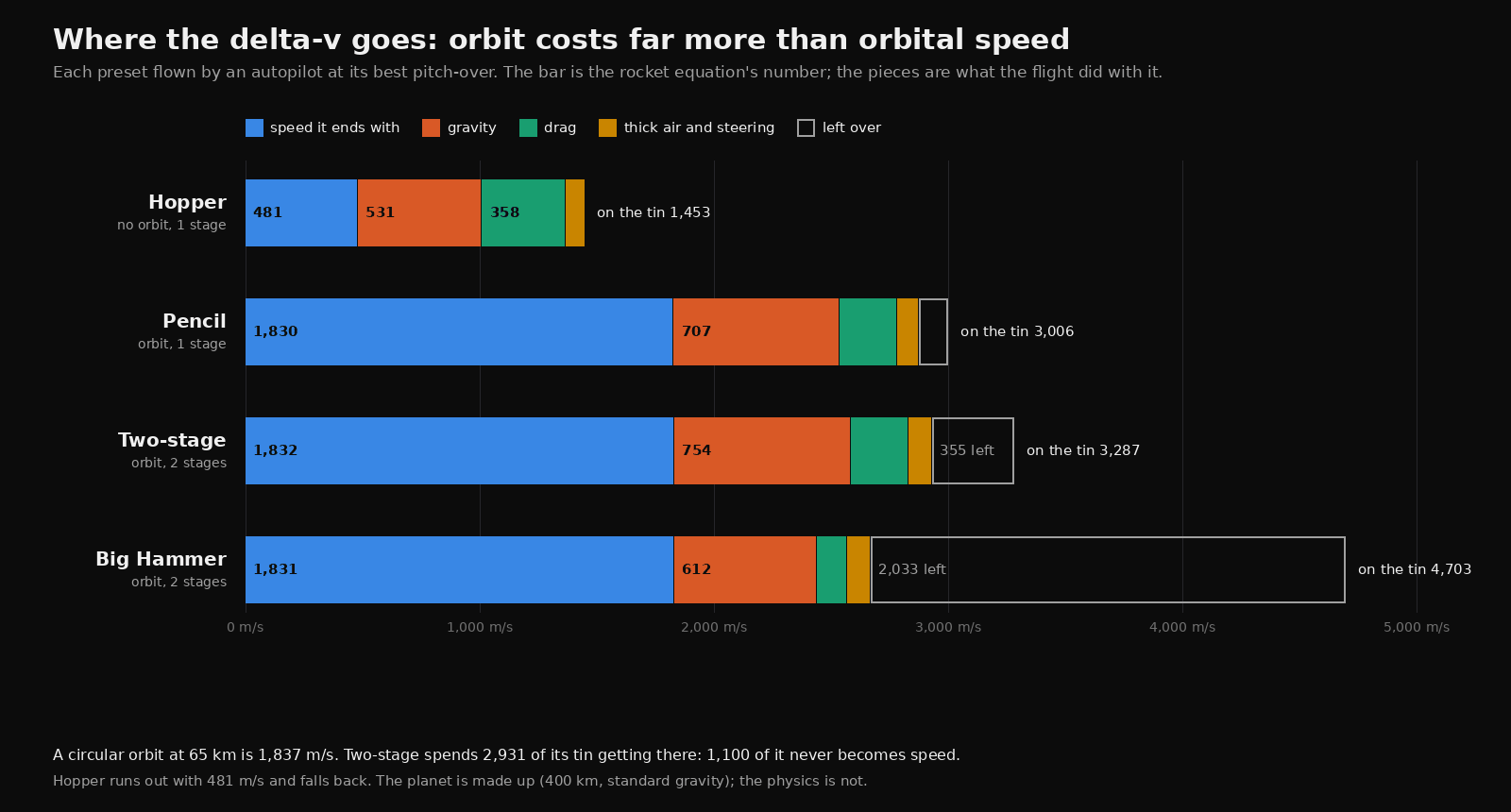 Each preset flown by an autopilot at its best pitch-over, the autopilot trying every angle from 1 to 45 degrees. Drawn from the engine's own flights.
The autopilot flies the Two-stage into orbit at 1,832 metres a second, and spends 2,931 of its tin doing it. 1,100 metres a second never becomes speed:
- Gravity takes 754. Every second spent climbing, gravity pulls speed back off the rocket. Climb slowly and you pay for longer.
- Drag takes 248, while the air is still thick enough to push back.
- Thick air takes about 90 from the engines. They burn the same fuel for less push until they are clear of it.
- Steering takes 6, the cost of pointing a little off the direction of travel.
Big Hammer, on its best flight, loses less to gravity (612) and to drag (127). Hopper loses nearly as much to gravity and drag as it ever turns into speed, and falls back. That is the whole game in one chart: going up is easy; going sideways fast enough, before gravity takes it back, is the hard part.
The check
Every toy on this site carries the number that says whether to believe it. This one is a ledger. Every metre per second the engines give is booked, inside the same calculation step as the motion, as speed gained or as gravity, drag or steering. The books have to balance against the engines' total, and the readout in the game prints by how much they miss: around a ten-billionth of a metre per second on a flight to orbit.
Three more hold the engine to account in its tests. Burned out in empty space, three designs land on the rocket equation to nine decimal places. A rocket left coasting in orbit keeps its energy and angular momentum to a part in ten trillion over a full lap. And the orbit read off a single moment, the highest and lowest points the game shows you, matches the orbit actually flown to within a metre, including going straight up, where the textbook formula divides zero by zero. My first version of that readout did exactly that, and every test flight ended on the pad. Those three are flown with Pebble alone. In the game, Pebble is not alone (see below), and far out the highest and lowest points drift, because something else is pulling.
Why the tin lies
This blog keeps finding answers that are well formed and false. The rocket equation is exactly right about a rocket in empty space. Quoted as "what this rocket can do", it is wrong by a thousand metres per second on the way to orbit, and the gap is not in the formula. It is gravity, air and time: the things the formula was never asked about. It is the same shape as the pulley that multiplies your pull by its strand count until friction puts a ceiling on it, and the game rope that is right when it is allowed to finish.
Something else is out there
Pebble has company. There are hidden bodies in the game that the map will not show until you get close, and the counter under the controls says how many you have found. They pull on you from the first second, whether you have found them or not. Their gravity goes into the same ledger as Pebble's, so the books still close. Near one, the readouts, the view and a new Hold retrograde button switch to it, so you can stay or go down. They go round Pebble the way a rocket that tilted left does, so that is the way to leave if you mean to catch one. Of the four rockets, only Big Hammer has the fuel to spare once it is in orbit, or build your own.
The engine checks them the way it checks everything. The same coast is flown two ways: in Pebble's frame, where the rocket also feels the tug each body puts on Pebble, and in a frame where everything moves and nothing needs correcting. The two agree to within a centimetre over an hour and forty minutes, on a coast the body's pull moves by 29 km. An ordinary orbit at 65 km stays out of the air for ten laps with all of them pulling.
What is and is not modelled
It is flat: two dimensions, and the bodies go round on circles. The planet does not spin, so there is no free speed from launching east, and the air does not move. The rocket turns as fast as you ask, with no wings, fins or torque; its drag area never changes. Nothing heats up. There are no parachutes, so coming back down ends one way. The planet, its air and every part are made up; the laws are not. The game's physics and its tests live in our own engine, powered by rainshower, and the site's build check flies the four rockets on every build and holds the numbers in this post to them.
It is also in the physics playground, next to Orbit Golf.