The second old experiment on our own engine, powered by rainshower. The first was Foucault's pendulum. This one is older by about two thousand years.
Pick how many tackles, how many strands, and how good the sheaves are, and see whether one person moves the ship.
What Plutarch says
In his life of Marcellus, Plutarch has Archimedes write to King Hiero that with any given force it was possible to move any given weight. Hiero asks to see it. The demonstration, in the Loeb translation:
Archimedes fixed upon a three-masted merchantman of the royal fleet, which had been dragged ashore by the great labours of many men, and after putting on board many passengers and the customary freight, he seated himself at a distance from her, and without any great effort, but quietly setting in motion with his hand a system of compound pulleys, drew her towards him smoothly and evenly, as though she were gliding through the water.
That is chapter 14. I read it through search results rather than the page itself; the copy I tried to open is blocked from the machine this was built on. Plutarch gives no weight for the ship, no ground, and no account of the pulleys. Everything the engine needs beyond that is a guess, and the post says which.
On paper, he is right
A block and tackle is two blocks of pulleys with a rope rove back and forth between them. With n strands of rope between the blocks, pulling the free end with some force puts n times that force on the load. Put a second tackle on the free end of the first, and the multiplications multiply. Five tackles of four strands each give 4 × 4 × 4 × 4 × 4, which is 1,024 times.
So with perfect pulleys, any force can move any weight: add tackles until it does. The engine agrees. It walks the rope round every pulley wheel, called a sheave, sums what each strand pulls, and with perfect sheaves lands on exactly n for one tackle and exactly 1,024 for five.
The sheaves
Real sheaves are not perfect. Each time the rope goes round one, bending it and turning the axle costs some of its tension. Call the share it keeps eta. A sheave at 0.95 passes on 95 percent of what it receives.
In a tackle the rope goes round one sheave after another, so the first strand carries 95 percent of your pull, the next 90, the next 86, and so on. Each extra strand adds less than the last. One block and tackle has a ceiling: eta divided by one minus eta, however many strands you give it. At 0.95 that is 19 times. At 0.9 it is 9.
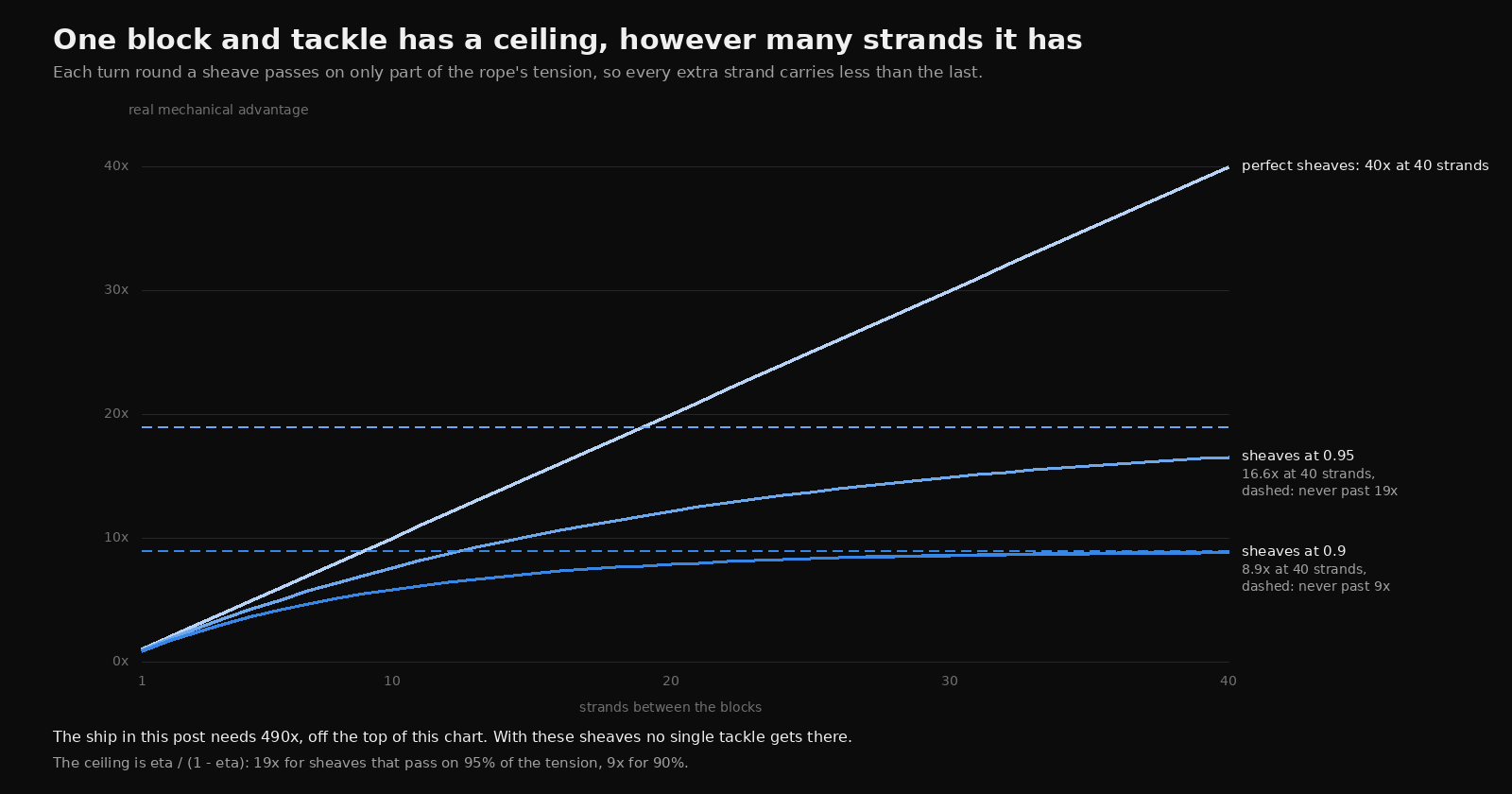 One tackle, three kinds of sheave. The dashed lines are the ceilings no number of strands can pass.
I do not know what an ancient sheave passed on, and I have not found a figure for one I would trust. The toy lets you choose.
The ship
To have something to pull, the engine needs a ship, a ground and a person, and Plutarch supplies none of them. So these are this post's guesses, stated once:
- A loaded three-master of 100 tonnes.
- Resting on greased timbers, resisting with a tenth of its weight once it moves.
- One person pulling 200 newtons at a standstill, less the faster the hand moves, and nothing at 1.5 metres a second.
Moving that ship takes about 98,000 newtons, 490 times what the person can pull. With sheaves at 0.95, no single tackle can reach that, since it tops out at 19. Stacking tackles can. Each stage multiplies what it receives, and 19 is not a limit on a product.
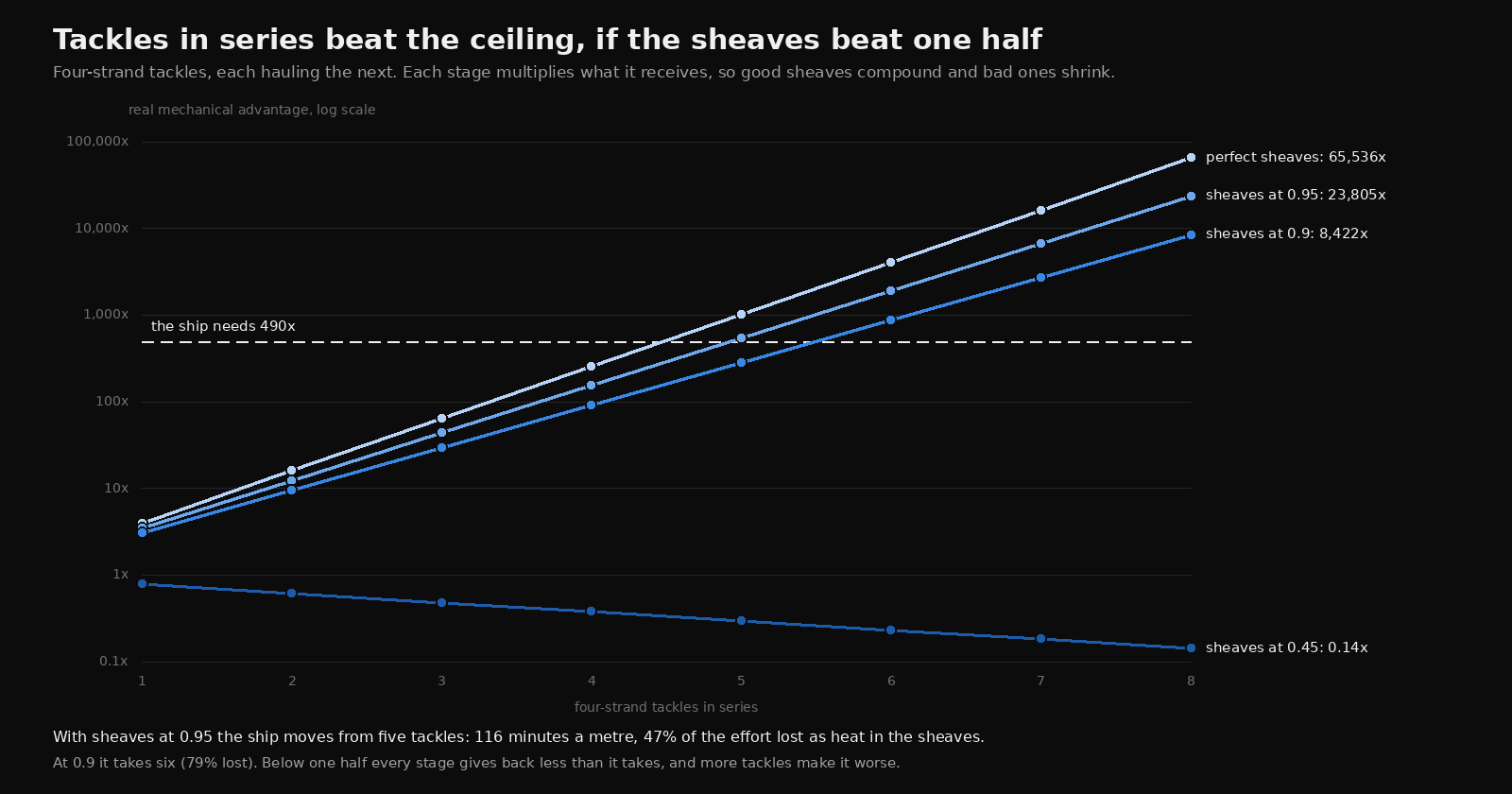 Tackles in series. Good sheaves compound past what the ship needs; bad ones only shrink.
With sheaves at 0.95, five four-strand tackles give 544 times, and the ship moves. On these guesses she settles at 0.14 millimetres a second: about two hours per metre, and half a metre an hour. The hand hauls 1,024 metres of rope for every metre of ship, and 47 percent of the work goes into heating the sheaves. At 0.9, five tackles give only 284 times and she stays put. Six give 879 times, and 79 percent of the effort goes into the sheaves.
Smoothly and evenly, yes. Gliding, not on these guesses: a lighter ship or a slicker slipway goes faster, and the toy shows how much.
Below one half, nothing works
There is a line under all of this. A single tackle's ceiling, eta over one minus eta, is less than 1 whenever eta is below one half. Below that, no tackle multiplies anything: whatever you pull, the load gets less, and every stage you add makes it worse. The engine checks this with sheaves at 0.49 across tackles of 1 to 200 strands, and the best of them gives 0.96 times.
Between one half and perfect, compounding always gets there in the end. It takes more stages, more rope and more heat. For a two-strand tackle the break-even point is an efficiency of 0.618, the golden ratio's reciprocal, which the tests check to twelve decimal places.
So Archimedes' claim holds on paper, and in practice holds only while the sheaves are better than one half. On this post's guesses, given decent sheaves, a patient person and enough rope, one hand can move a ship.
The same failure, again
This blog keeps finding answers that are well formed and false. "Strands times pull" is a formula that is exactly right about a machine that does not exist. It is wrong about real pulleys in a way that looks like a small correction, and then turns out to be a ceiling. It is the same shape as the game rope: a method that is right when nothing is lost along the way, and quietly something else when things are.
The check in the toy is energy. What the hand puts in has to come out as work against the ground, heat in the sheaves, and motion of the ship. The engine books all three every step, and they balance to about one part in ten trillion. If the sheave arithmetic were wrong, that is where it would show.
What is and is not modelled
The rope is weightless and does not stretch, and the blocks weigh nothing. Every sheave keeps the same share of the tension, whether it is the first or the last in the tackle. The ground resists with the same force from the moment the ship moves, with no extra effort to break her free. The person follows the simplest straight-line pull against speed, which is an assumption, not a measurement. The rope never runs out. In a real rig the tackle nearest the hand closes up after a short haul and has to be re-rigged, which the engine does not do. Each hauling run is stepped with the exact solution of its motion, so the step size never makes the ship stall. An earlier version stepped it the ordinary way, and the energy ledger caught it losing 5 percent. The pulley module and its tests live in our own engine, and the site's build check holds the numbers in this post to it.
The other toys, including this one, are in the physics playground.