I have started doing old experiments again on our own engine, powered by rainshower. The rule is simple: build the setup from the physics alone, run it, and hold what comes out to what was reported. This is the first one.
Pick a place below, let the pendulum go, and watch the swing turn. Then give it the tiny ellipse.
What Foucault showed
In 1851 Léon Foucault hung a heavy ball on a long wire in the Panthéon in Paris and let it swing. Over the hours, the line it swung along turned, clockwise seen from above, with nothing pushing it. The pendulum keeps swinging the same way in space, and the floor turns underneath it.
The figures I have for it are from memory and not checked against a primary source: a 67 metre wire, and Paris at about 48.85 degrees north. Those are what the toy uses. The size of the swing is my choice, 3 metres each way.
The rule that comes with it: the swing turns at the Earth's spin times the sine of the latitude. The Earth turns once every 23 hours 56 minutes against the stars (also from memory), which is 15.04 degrees an hour. At the pole the swing gets all of it. On the equator it gets none. In Paris it gets sin(48.85°) of it: 11.3 degrees an hour, one full turn every 31.8 hours.
Rebuilt with nothing telling it to turn
The engine's pendulum is a bob on a wire in three dimensions. It knows about gravity, about the ground turning under it (the Coriolis push, and the tiny difference in centrifugal pull between the top of the wire and the bob), and that the wire does not stretch. There is no line anywhere that says the swing should turn. At the far end of every swing it notes which way the bob is pointing, and a straight line through those readings is the rate.
It lands on the rule everywhere.
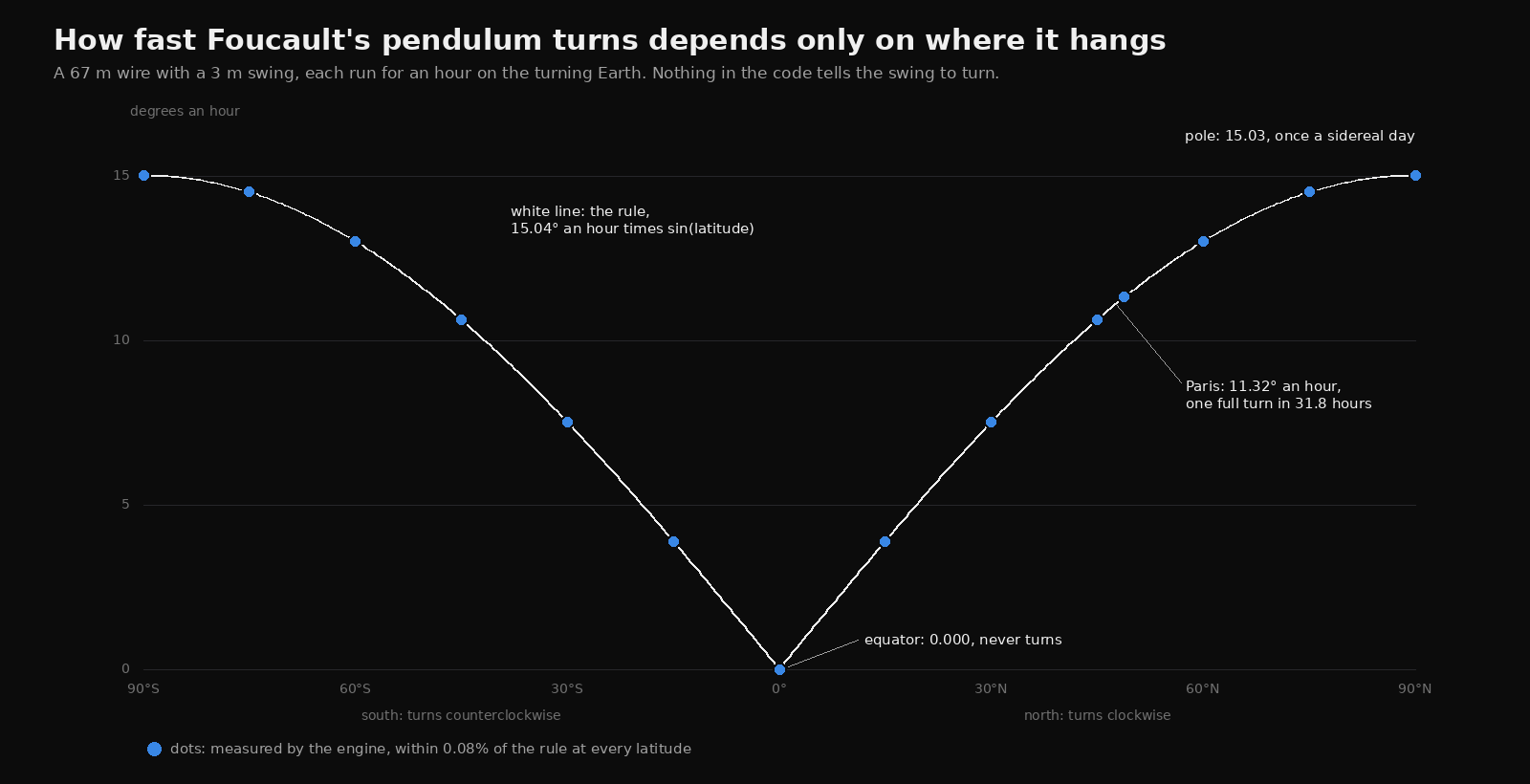 A 67 metre pendulum, run for an hour at each latitude. The dots are the engine's measurements; the line is the rule.
At Paris it measures 11.32 degrees an hour against the rule's 11.33. On the equator it does not turn at all. At the pole it turns once every 23 hours 56 minutes. It goes clockwise in the north and counterclockwise in the south, and nothing told it which.
The half millimetre
Here is the catch. A real swing is never a perfect straight line. Push it very slightly sideways as you let go and the bob traces a thin ellipse instead. A pendulum swinging in a thin ellipse turns its swing all by itself, in the direction the bob goes round, even on a planet that does not spin.
The rate for that is usually credited to George Airy: three eighths, times the two half-widths of the ellipse, times the swing's frequency, over the wire's length squared. I have that formula from memory, so the engine measured it instead of trusting it. With the Earth switched off entirely, a 1 metre pendulum with a 10 cm swing and a 1 mm ellipse turns at 1.175 ten-thousandths of a radian a second, against the formula's 1.174. The 67 metre one agrees to within 0.02 percent.
So how wide does the ellipse have to be to turn the swing as fast as the Earth does in Paris?
- A 1 metre desk pendulum with a 10 cm swing: 0.47 millimetres.
- The Panthéon's 67 metre wire with a 3 metre swing: 57 centimetres.
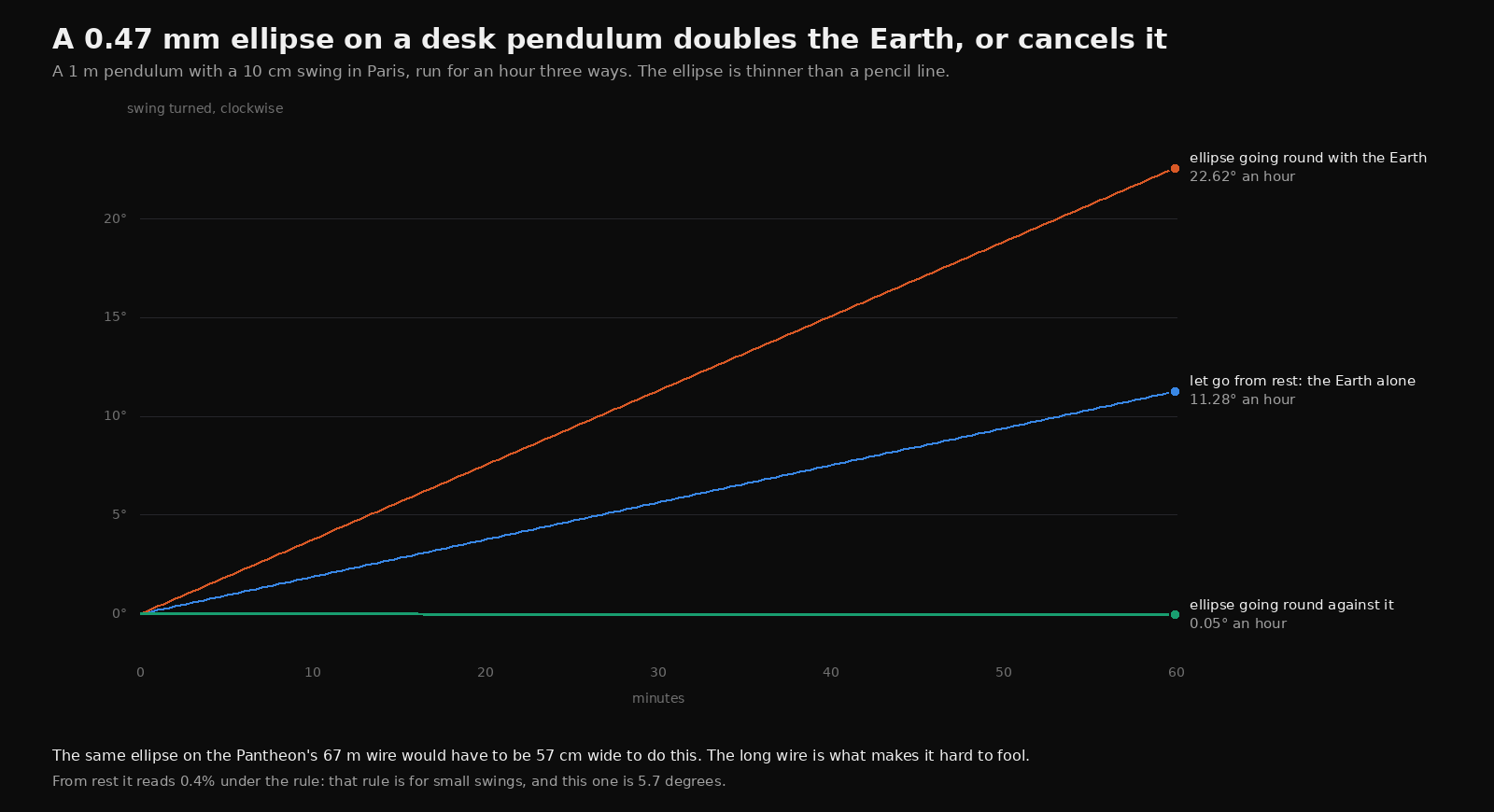 The same desk pendulum in Paris three ways. The ellipse is thinner than a pencil line.
Let it go from rest and it turns at the Earth's rate. Give it an ellipse half a millimetre wide going round the same way and it turns at twice the rate. Send the same ellipse round the other way and it barely moves: 0.05 degrees an hour, as if the Earth had stopped. All three runs look equally convincing. Nothing in the swing says which one you are watching.
Try it in the toy. Pick the equator, where the Earth does not turn the swing at all, give the pendulum the tiny ellipse, and it turns 11.3 degrees an hour anyway.
Why the long wire helps
The long wire does two things. It swings slowly, and it makes the ellipse needed to fool it enormous. From the formula, at the same swing angle, the width that fakes the Earth grows as the wire's length to the power of one and a half. On 67 metres it is a 57 centimetre sideways wobble that anyone watching would see. On a desk the same deception fits inside a pencil line.
One honest wrinkle. Let go from rest, the desk pendulum turns 0.4 percent slower than the rule, while the 67 metre one is within 0.08 percent. The rule is exact only for small swings, and a 10 cm swing on a 1 metre wire is 5.7 degrees, more than twice the Panthéon's 2.6. I am reporting what the engine measures rather than rounding it into agreement.
The same failure, again
This blog keeps finding the same thing: an answer that is well formed and false. A pendulum reports "the Earth turned this much" and has no way to say whether the Earth did it or the ellipse did. The number it gives is real. What it gets credited to is the part that can be wrong, the same shape as a code checker that scanned nothing and reported zero issues.
The fix is not a better-looking pendulum. It is measuring the thing that can fake the result, here the width of the ellipse, and putting that number next to the answer. That is what the "ellipse alone" line in the toy is for.
What is and is not modelled
The bob hangs on a wire that cannot stretch, with no air and no friction, so it never slows down; a real one loses energy and needs restarting. The pivot is perfectly even in every direction, and a real pivot that swings more easily one way than another can turn the swing too, which is not modelled here. Gravity is uniform, and the Earth turns once every 86,164.09 seconds, a figure from memory. The figures use 800 steps a swing and the toy 200; the two agree to 0.1 percent. The pendulum module and its tests live in our own engine, and the site's build check holds the numbers in this post to it.
The rest of the toys, including Orbit Golf, are in the physics playground, where this pendulum is now the eighth.