Physics in 3D is a page in the Tofte Simulators arcade, and it is all about things that spin. Each experiment runs on its own engine, drawn in 3D, and each engine has tests that check it against what the physics says. The numbers below come from running those engines and their tests.
A spinning top
The top is a disc of 100 grams and 3 centimetres radius, its centre 4 centimetres above the tip, with the tip held at one point on the table. That is Lagrange's top, the textbook case he solved in 1788.
Stand it upright and spin it at 25 turns a second, and it stays up. Started leaning 1.15 degrees, it never leans more than 1.76 degrees in the 10 seconds the test watches. Spin it at 15 turns a second, and it falls over in 0.47 seconds.
The line between the two is Maxwell's limit: an upright top stays up only if its spin ω satisfies ω > 2√(m g l I1) / I3, where I1 and I3 are how hard it is to turn across its axis and along it. For this top that is 19.0 turns a second. The tests start it upright at 1.2 and 0.8 times the limit and check that it stands and falls.
Why it does not fall
Lean the top over and gravity pulls its centre of mass down, which tries to tip it further. On a top that is not spinning, that is what happens. On a spinning top the same pull changes the direction the spin points instead, sideways, so the top's axis swings round the vertical rather than toppling. That swing is called precession.
At 30 turns a second, leaning 20 degrees, this top swings round once every 1.22 seconds. The simple formula most books give for a fast top, m g l / (I3 ω), says once every 1.36 seconds. The simple formula is more than 10% off here, because it ignores a term that matters when the top leans this far. The engine is held to the full steady-precession equation, not the shortcut, and the test checks the top stays at its tilt to a millionth of a radian while it swings round.
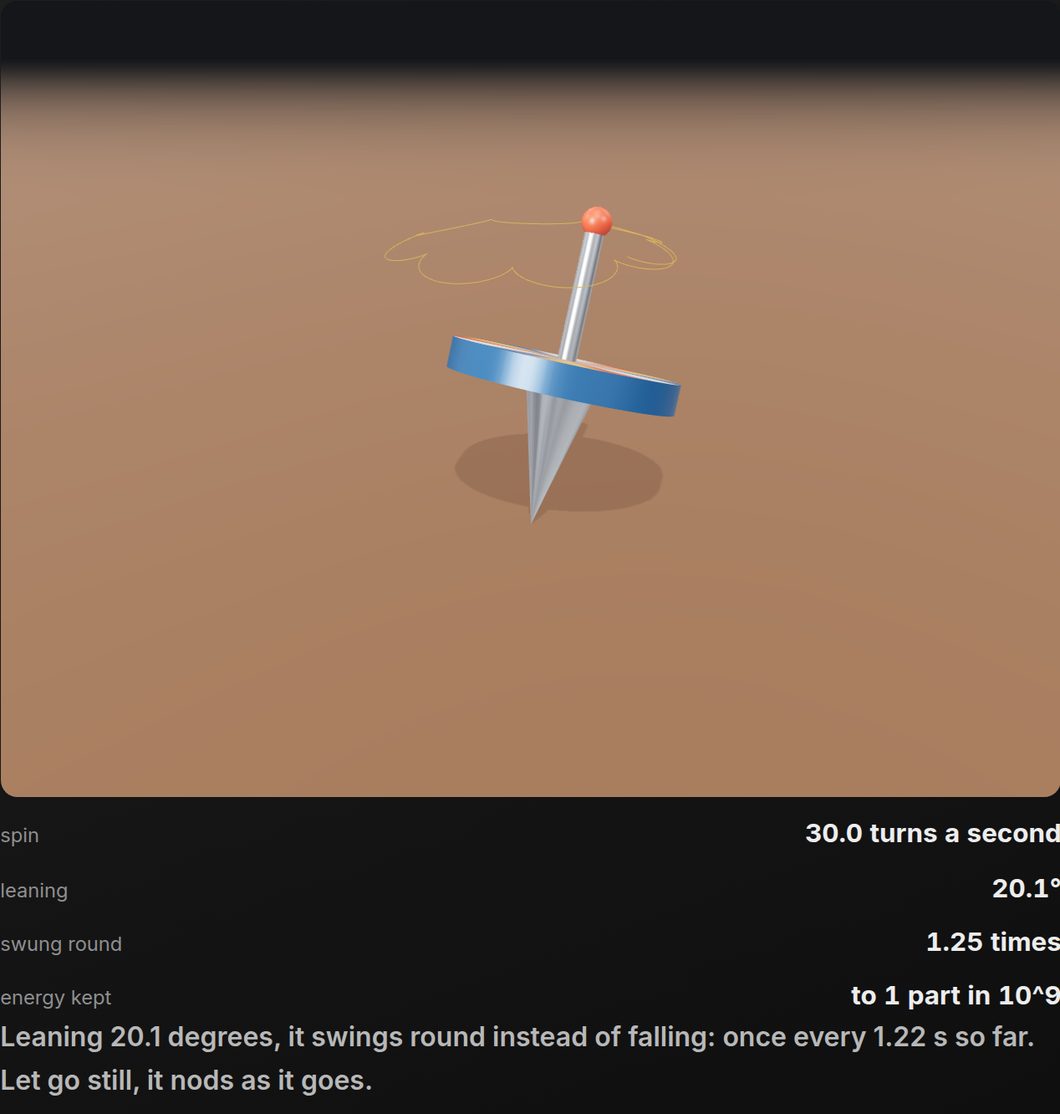
Let it go leaning but not already swinging, and it does something stranger. It dips, starts to swing, and nods up and down as it goes round. The yellow line on the page is the path of the top of the spindle, and it draws a row of little cusps. That nodding is called nutation. From Lagrange's equations, the nodding rate is about 37 radians a second for this top, almost six nods a second. The tests check the simulated top against that formula to half a percent.
Through all of this, three things never change: the top's energy, its spin about the vertical, and its spin about its own axis. The tests check each of them over 5 seconds of tumbling.
A ball on a record
Roll a glass marble across a record spinning at 33 1/3 turns a minute. You might expect it to be flung off the edge. It goes round in a circle, at 2/7 of the record's speed, and comes back to where it started.
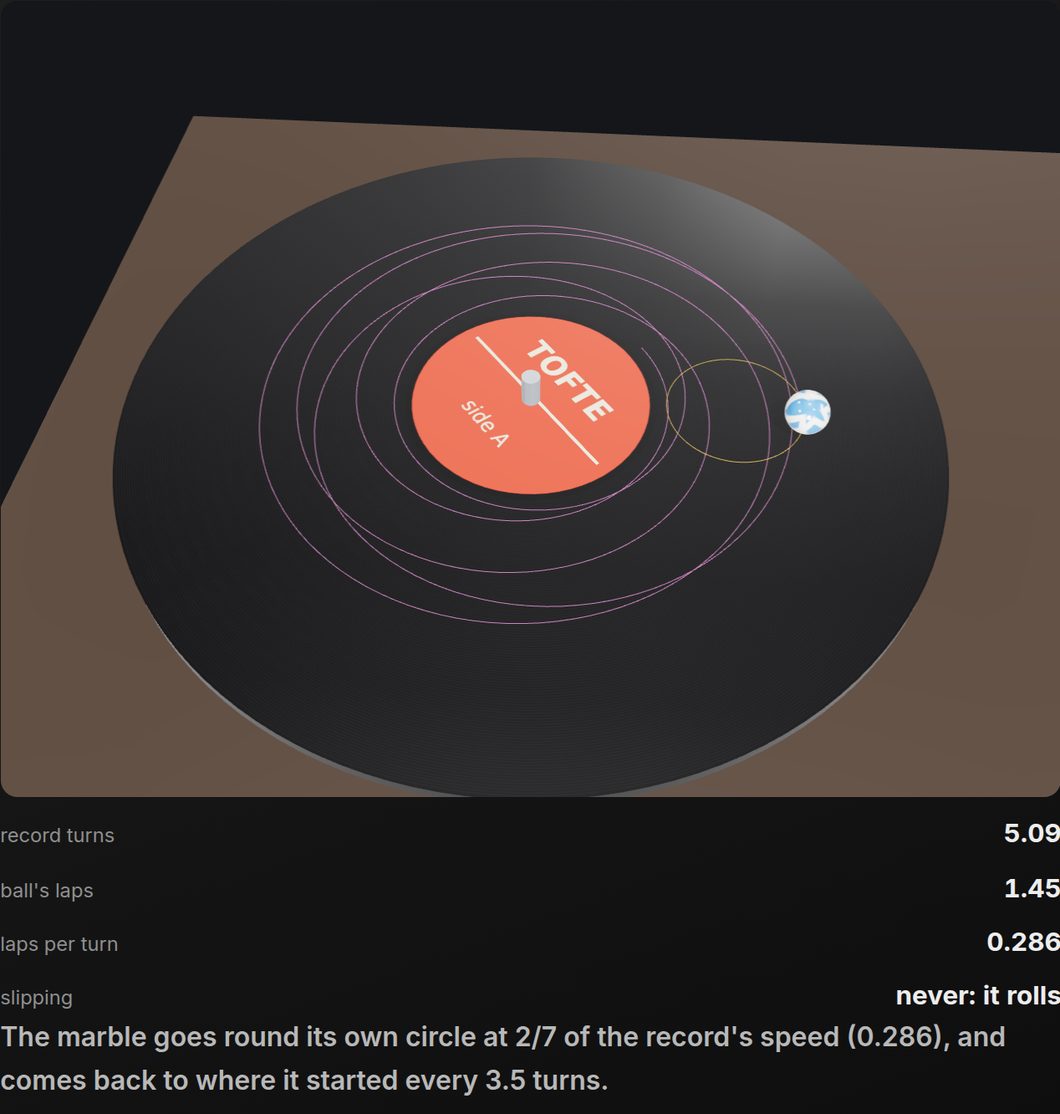
The only thing touching the marble is the record, at one point. Friction at that point does whatever it takes to stop the marble sliding. It turns the marble's spin, and it pushes the marble along. Work that through and the push always comes out at right angles to the marble's motion, the way a string pulls a ball on a circle. Its strength is a fraction K / (1 + K) of the record's turning rate, where K says how the ball's mass is spread out: 2/5 for a solid ball and 2/3 for a hollow one.
| Ball | Laps per record turn | One lap, every |
|---|---|---|
| Marble (solid) | 2/7 | 3.5 turns of the record |
| Ping-pong ball (hollow) | 2/5 | 2.5 turns of the record |
At 33 1/3 turns a minute the marble's lap takes 6.3 seconds. The tests run one lap of each ball and check it is back where it started to within a billionth of a metre, and that the point of the ball touching the record never slides.
Put the ball down so it is still in the room, not still on the record. Then it stays exactly where it is, spinning in place, while the record turns underneath it. The yellow line on the page is the ball's path across the room; the pink one is the path it draws on the record, and that one is a pattern of loops.
A real ball loses a little to rolling resistance and drifts, so a real one spirals rather than closing the circle. The engine has no rolling resistance, and the page says so.
A spring that trades bounce for twist
The Wilberforce pendulum is a weight hanging on a spring. Pull it down and let go, and it bounces. Then, over a few seconds, the bounce dies away and the weight starts twisting instead. Then the twist dies away and it bounces again.
A spring twists a little as it stretches, and stretches a little as it twists. That coupling is small, but when the bounce and the twist take the same time, it hands all the energy from one to the other and back.
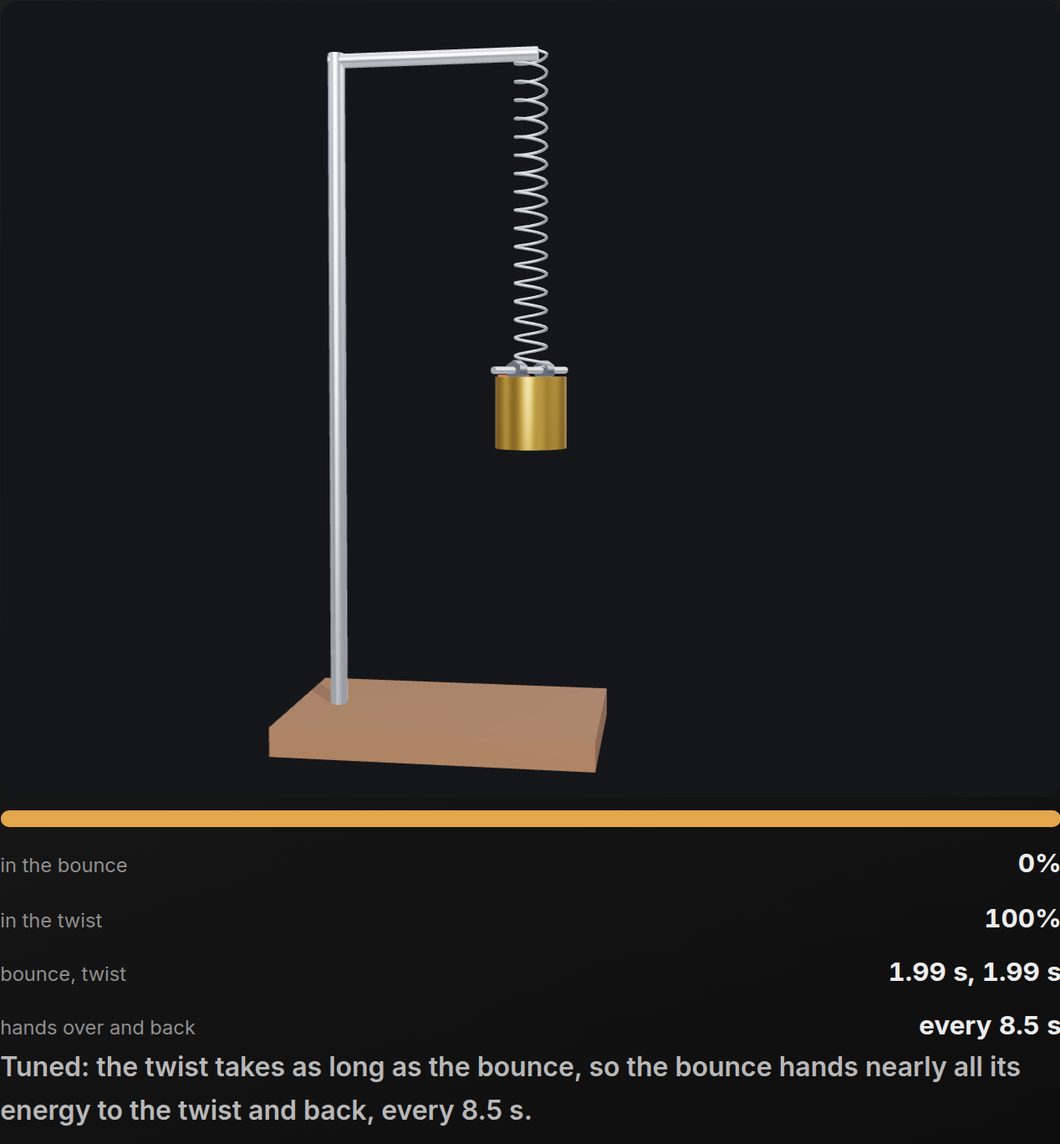
The model is the one used for this pendulum in the physics literature (Berg and Marshall, American Journal of Physics, 1991): two oscillators, bounce and twist, joined by a small coupling term. The numbers are ours. The weight is 500 grams and bounces once every 1.99 seconds. Two nuts on a rod across the top set how slowly it twists: move them out and the twist slows down. With the nuts 1.53 centimetres out, the twist and the bounce take the same time.
Tuned like that and pulled down, the simulated pendulum:
- has 0.02% of its energy left in the bounce at 4.39 seconds, with the rest in the twist;
- has 98.7% back in the bounce after 8.55 seconds, the beat its two normal modes give.
Not quite 100%, and that is real rather than numerical error. The two modes it is made of run at rates more than a fifth apart, so they never line up again exactly.
Move the nuts out to 3.06 centimetres and the twist runs slow. Now at most 55.8% of the energy ever reaches the twist, which the tests check against what the normal modes predict. Real Wilberforce pendulums come with those nuts for exactly this: you move them until the hand-over is complete.
What is real and what is ours
All three run on the physics, integrated step by step, with tests that fail if the engine drifts from it. The tip of the top is held at one point and nothing rubs anywhere. A real top's tip slides and rubs, which slowly stands it up and runs its spin down. A real ball on a record drifts, and a real Wilberforce pendulum slowly dies away. Every size, mass and spring here is our choice, stated on the page.
Play Physics in 3D. The fourth experiment on that page, a T-handle that flips itself over in space, has its own post.