In 1985 the cosmonaut Vladimir Dzhanibekov was aboard the Salyut 7 space station, on the mission to bring it back to life. Supplies were held down with wing nuts. He flicked one off its bolt, it flew off spinning, and after a short way it suddenly turned itself over, 180 degrees, and carried on spinning the other way round. Then it did it again.
Nothing touched it. Nothing pushed it. It is called the Dzhanibekov effect, and it is also known as the tennis racket theorem and the intermediate axis theorem. The mathematics behind it is Euler's equations for a spinning body, which date from the 18th century. It just took weightlessness and a wing nut to make it obvious.
The arcade's Physics in 3D page now has it as the Racket flip: a T-handle and a wing nut, floating in space, spun three ways.
Three axes, three answers
Any solid object has three special axes, at right angles to each other, called its principal axes. Spinning about each one takes a different effort: the moment of inertia about that axis. For a tennis racket they are:
- along the handle: easiest to spin, least inertia;
- through the face, like a wheel: hardest, most inertia;
- across the face, in the plane of the strings: in between.
Spin anything about the axis with the least inertia or the most, and it keeps spinning about that axis. A small wobble just stays small. Spin it about the middle axis, and the smallest wobble grows until the object turns over, then shrinks, then grows again. It flips over and over, at regular intervals, forever.
The T-handle on the page is two bars, 220 grams in all. Its moments of inertia, in kilogram square metres, are:
| Spun | Moment of inertia | What it does |
|---|---|---|
| Along the handle | 2.25 × 10⁻⁴ (least) | Spins steadily |
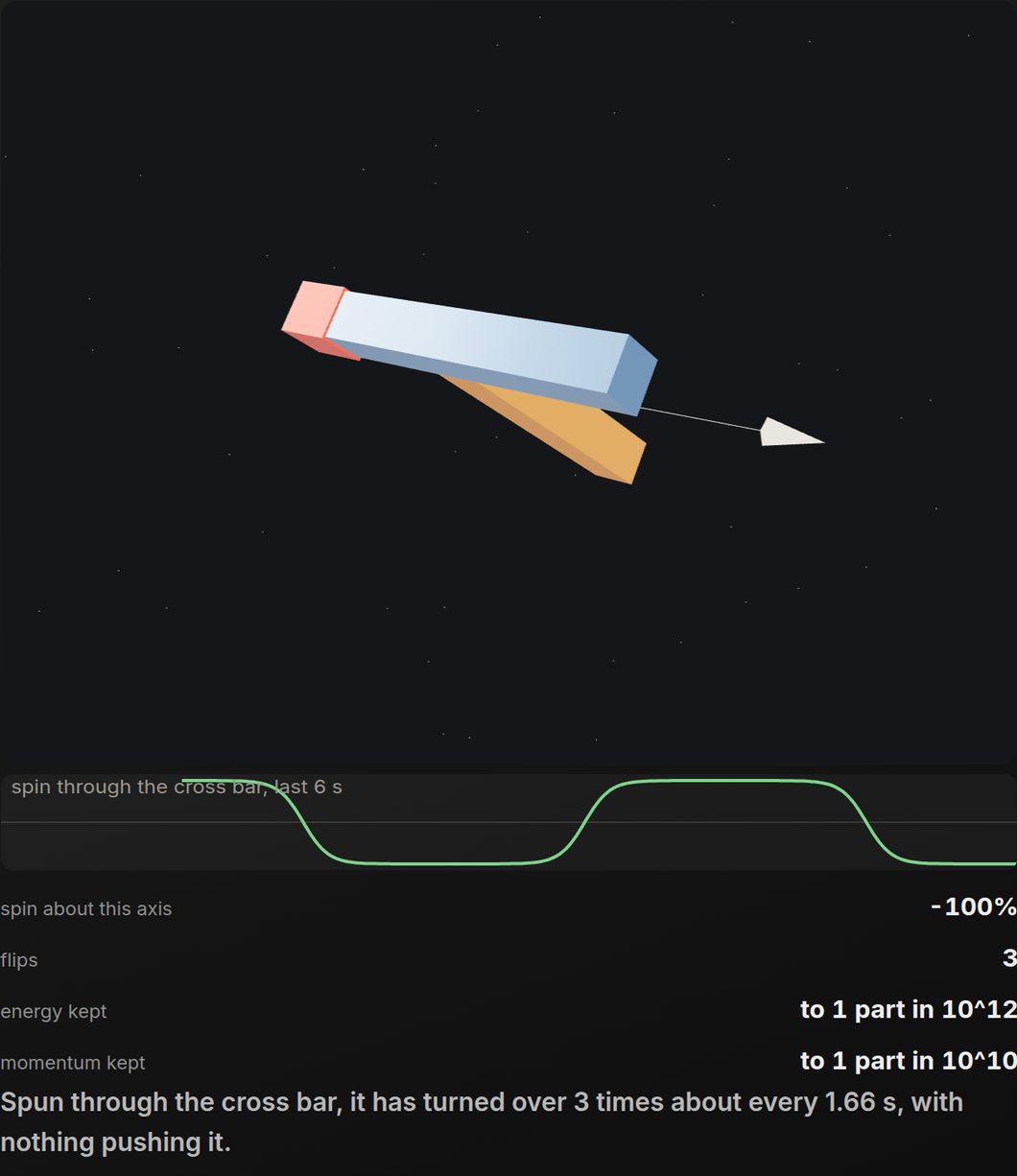
| Through the cross bar | 4.22 × 10⁻⁴ (middle) | Flips |
| Flat, face on | 6.32 × 10⁻⁴ (most) | Spins steadily |
Spun at 2 turns a second about the cross bar, with a nudge of 1% onto the other two axes, it turns over every 1.66 seconds: 12 flips in 20 seconds. Spun about the other two axes, it never flips at all.
Why the middle one
Euler's equations say how a spinning body's spin changes when nothing acts on it. Linearise them about steady spin on one axis, and a small wobble either oscillates or grows. About the least and most axes it oscillates: the wobble stays small. About the middle axis it grows exponentially, at a rate
λ = ω √((I_mid − I_least)(I_most − I_mid) / (I_least × I_most))
For the T-handle at 2 turns a second that is 6.79 per second. The test starts the T-handle with a nudge of one ten-millionth and measures how fast the wobble grows. The measured rate matches that formula to within 1%.
When the wobble gets big, the linear picture breaks down, and the full equations take over. They have no friction to lose energy to, and the total spin (the angular momentum) has to keep its size and point the same way in space throughout. Held to both, the spin can only move along one path, and for the middle axis that path runs all the way round to the opposite orientation and back. The white arrow on the page is that angular momentum, and it never moves while the handle tumbles round it. The tests check the energy and the angular momentum hold to a billionth through every flip.
The wing nut
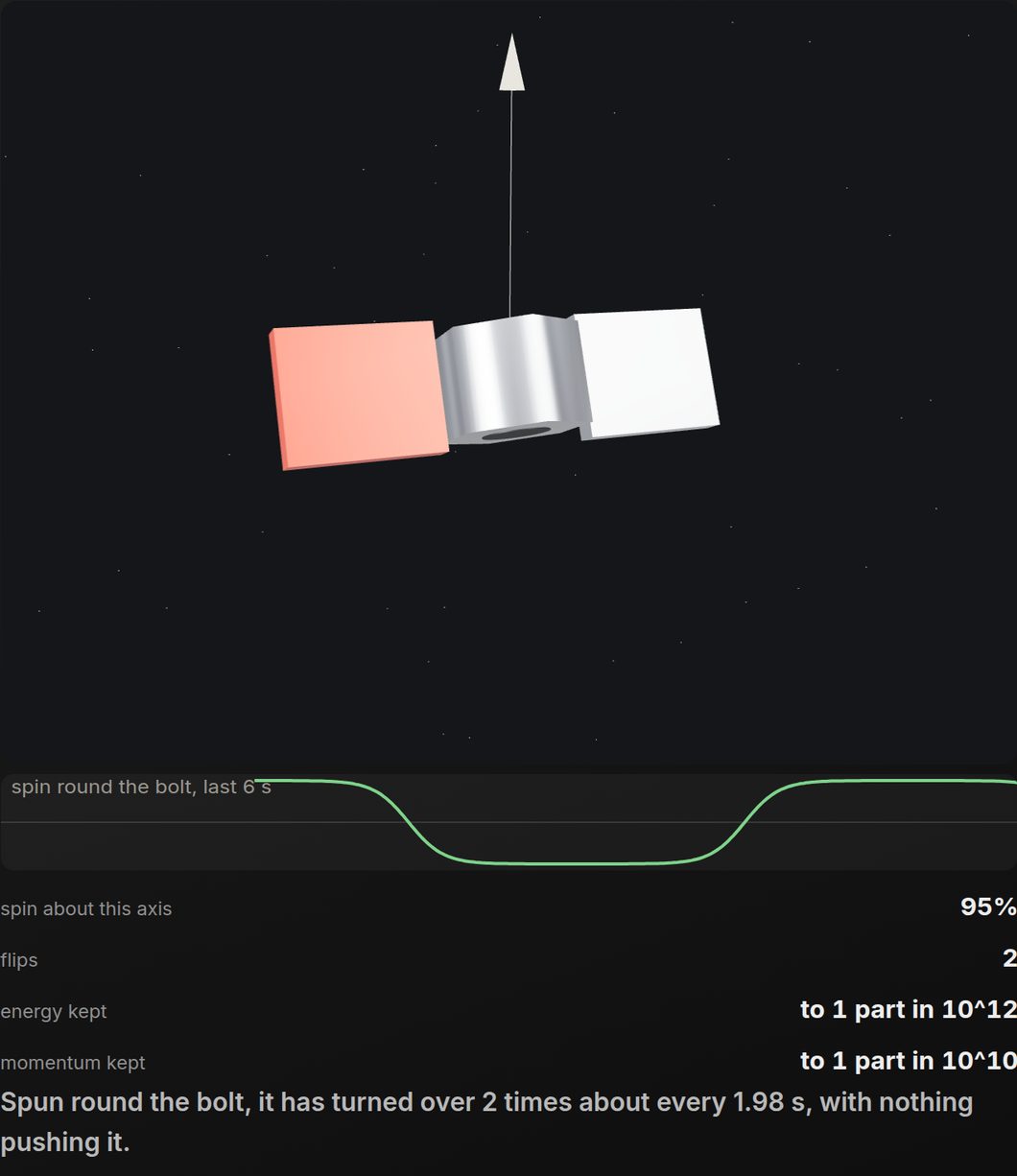
The wing nut on the page is a hub round the bolt and two flat wings, 10 grams in all, drawn five times its size so you can see it. Worked out, its axes come out:
| Spun | Moment of inertia | What it does |
|---|---|---|
| Along the wings | 1.21 × 10⁻⁷ (least) | Spins steadily |
| Round the bolt | 7.33 × 10⁻⁷ (middle) | Flips |
| Face on to the wings | 7.43 × 10⁻⁷ (most) | Spins steadily |
The bolt's axis is the middle one. So when Dzhanibekov spun the nut off the bolt, he spun it about exactly the axis that flips. Spun round the bolt at 3 turns a second, the simulated nut turns over every 1.98 seconds: 10 flips in 20 seconds. Spun along its wings or face on to them, it never flips. A test holds both.
The real one's numbers are not ours to know: its shape, its mass, how fast he flicked it. Ours is a plausible wing nut, and it does what his did, for the reason his did.
Could the Earth do it?
It is tempting to ask whether a planet could suddenly flip like the wing nut. The answer is no, and it is a good example of an answer that sounds right and is not. The Earth is slightly wider at the equator than pole to pole, which makes its spin axis the axis of most inertia, not the middle one. That is one of the two stable axes. The Dzhanibekov effect needs three different moments of inertia and a spin about the middle one, and the Earth's spin is about the largest.
What is real and what is ours
The physics is real: Euler's equations, integrated step by step, with tests for the conserved energy and angular momentum, for the growth rate and for which axes flip. The shapes and masses are ours, and so is the 1% nudge every spin starts with. A real throw is never perfect, and the nudge is what the middle axis amplifies. With no nudge at all the simulated handle would spin about its middle axis forever; in the real world there is always a nudge.
Spin the T-handle and the wing nut, under Racket flip.