I drove west into a rainbow at sunrise this week, in Minnetonka. It stood straight ahead over the road, bright enough to look solid, with a fainter second one off to its left. In the side mirror the sun was coming up behind me in gold.
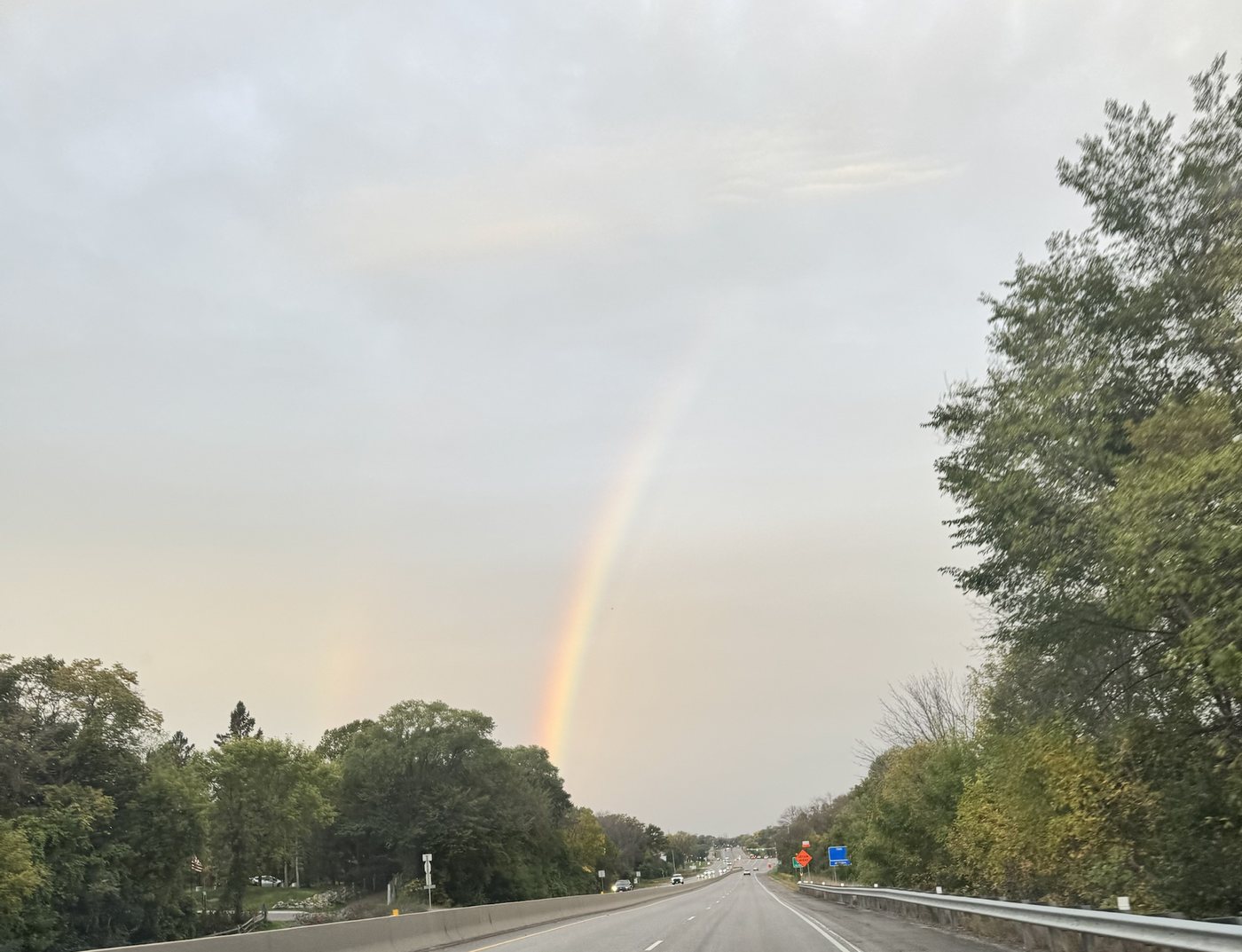 The bow ahead, and the faint second bow to its left. Cropped from a phone photo, nothing else changed.
That mirror is the whole explanation. A rainbow is always exactly opposite the sun. It is not an object at a place. It is a direction: every raindrop that sits 42.4 degrees away from the point directly opposite the sun sends red light to your eye. The drops that do that form a cone with its tip in your eye and its axis running from the sun, through your head, into the ground ahead. What you see is where that cone passes through rain.
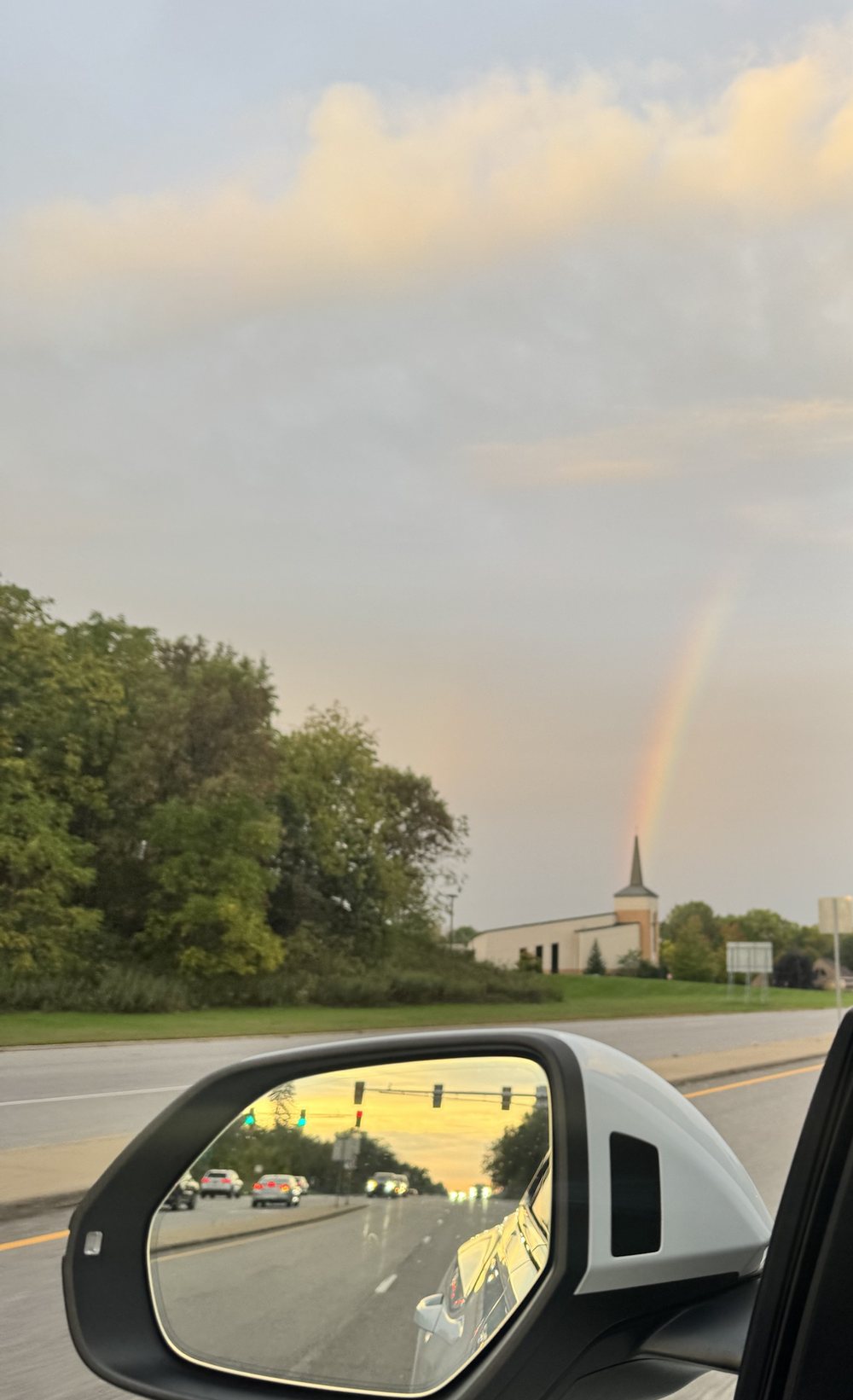 The same morning. Heading west, the bow is ahead and the sunrise is in the mirror, behind.
The road curved between those two photos, so the bow lands in a different part of each frame. It did not move. The car turned underneath it: a rainbow is fixed to the sun, not to the road. As the ground dropped away and the tree line fell, more of the same leg came into view.
That is why nobody reaches the end of one. Drive toward it and the cone comes with you, because its tip is you. It is a well formed picture of something standing in a field, and there is no field and no something. This blog keeps coming back to answers like that, and this one has been in the sky the whole time.
Why 42 degrees
Descartes worked this out in 1637 by following light through a single drop of water. It is simple enough to do again with nothing but Snell's law and a reflection, so I did.
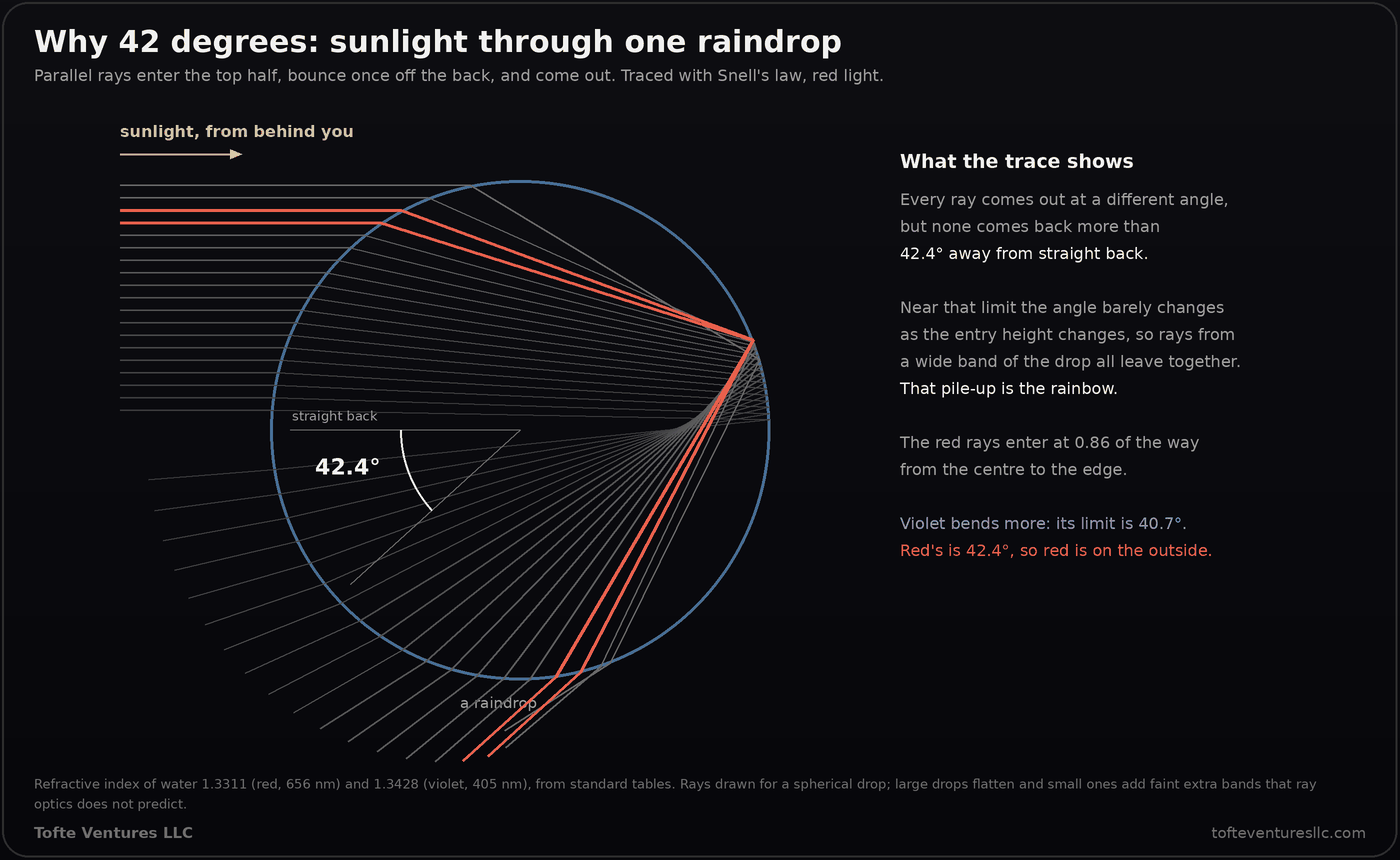
Sunlight goes into a drop, bends, bounces once off the back, and comes out heading roughly back toward the sun. Where it comes out depends on how far from the centre it went in. A ray through the middle comes straight back. Rays further out come back at wider and wider angles, until at 0.86 of the way to the edge they stop getting wider and start coming back in. The widest any of them gets is 42.4 degrees from straight back, for red light.
At that turning point the exit angle hardly changes as the entry point moves, so light that went in across a whole band of the drop leaves in nearly the same direction. The light piles up there. That pile-up is the bright edge you see.
Violet light bends a little more in water, so its limit is 40.7 degrees instead of 42.4. That is why red is always on the outside of a rainbow and violet on the inside. The whole bow is 1.7 degrees wide, about three times the width of the sun, which blurs it by another half degree.
What the sky actually does
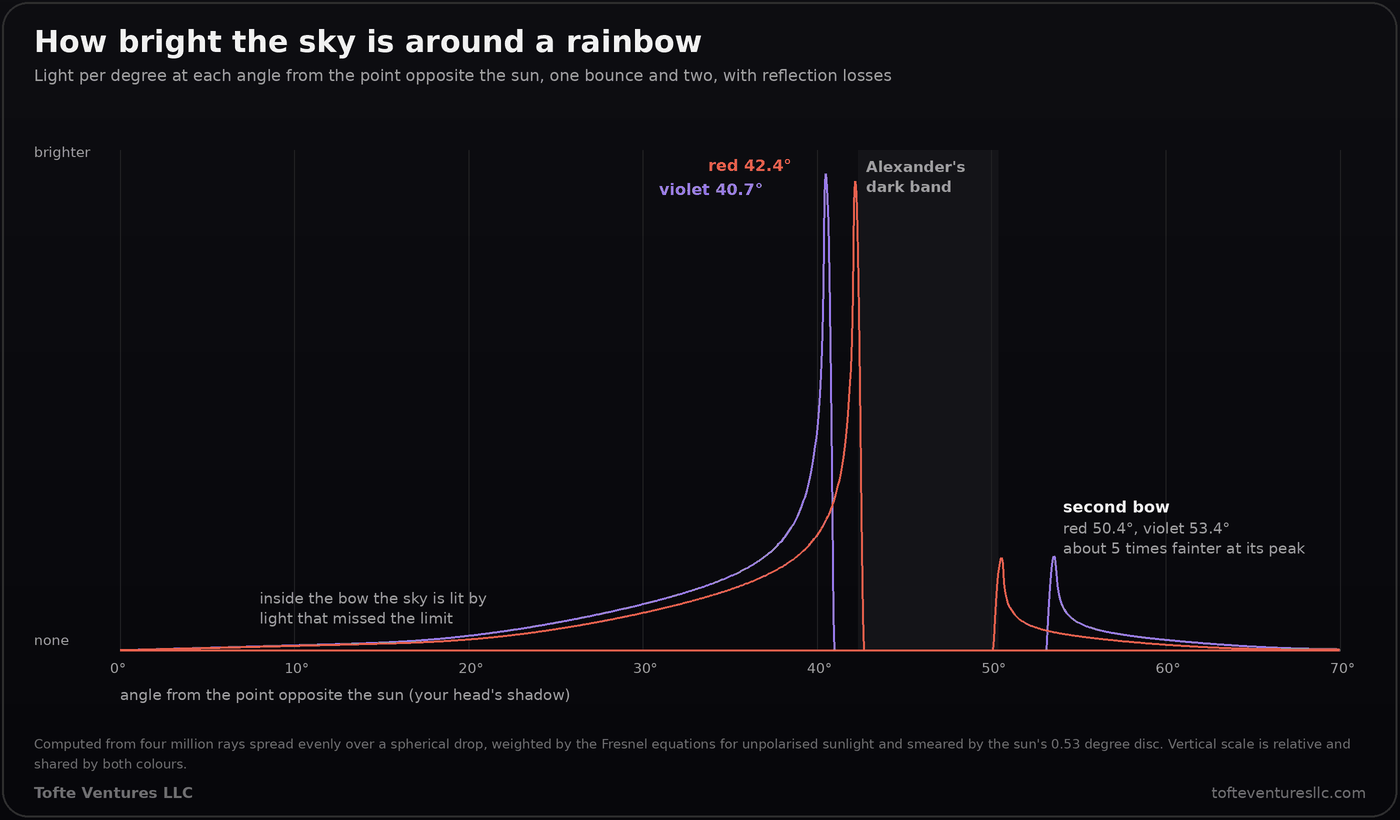
Trace a few million rays instead of twenty and you can plot how bright the sky is at every angle from the point opposite the sun.
Here is the chart in a real sky, from a drive up north.
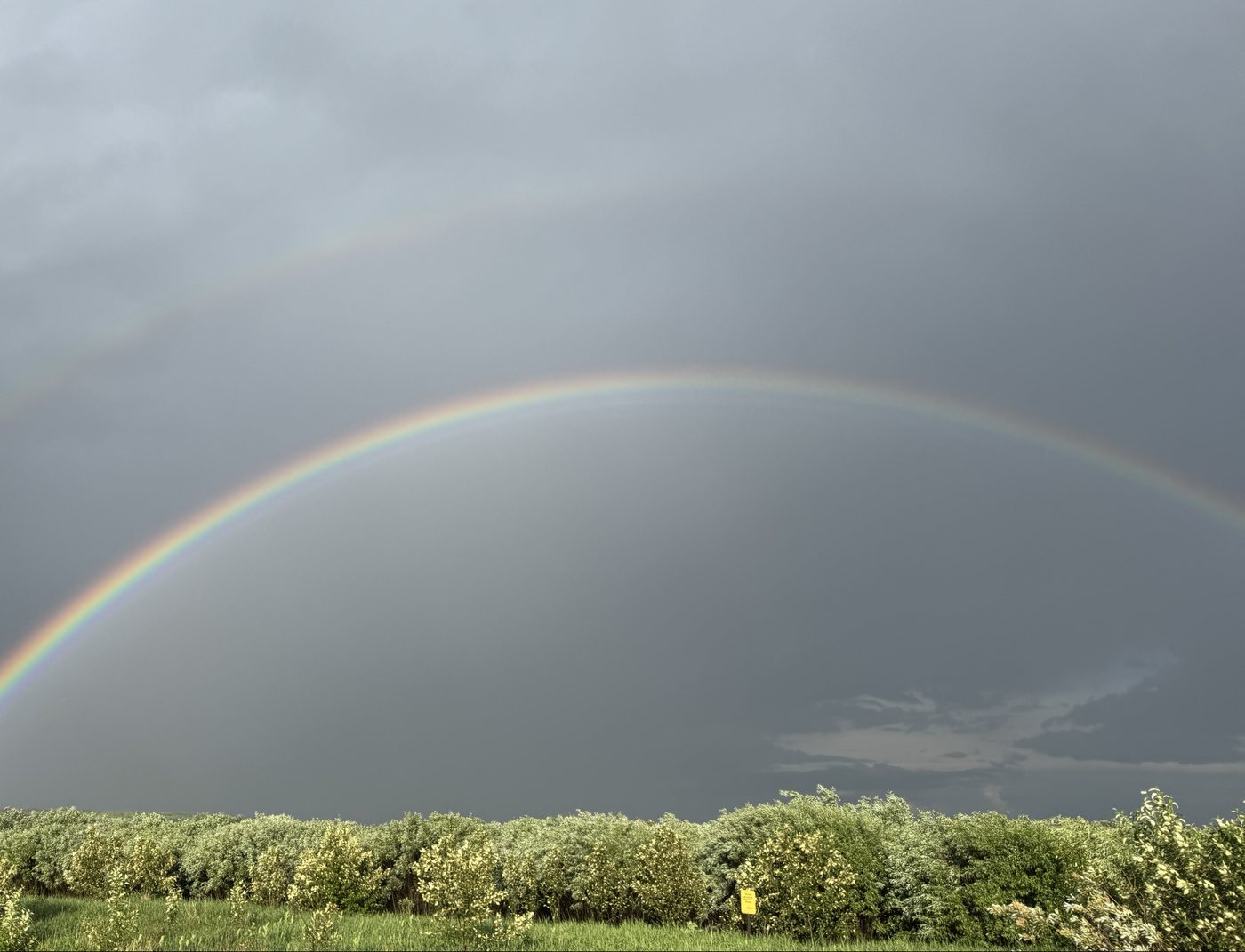 Lighter sky inside the main bow, a dark strip between the two, and the faint second bow above. Cropped from a phone photo, nothing else changed.
Three things in that chart are worth looking for.
The sky inside the bow is brighter than outside it. All the once-reflected light that did not make it to the 42 degree limit lands somewhere inside it. The double rainbow above shows it plainly: the sky under the lower arch is lighter than the sky above it.
The second bow is light that bounced twice. Two reflections send it out at 50.4 degrees for red and 53.4 for violet, so the colours come out in the opposite order, red on the inside. Each bounce loses most of the light, and it peaks about five times fainter than the first bow. That is the pale band to the left of the main bow in my first two photos, and the faint arch above the bright one in the double.
Between the two there is a dark band. Once-reflected light never goes wider than 42.4 degrees, and twice-reflected light never comes in closer than 50.4. Nothing reflected inside a drop lands between them, so that strip of sky is darker than the sky on either side. It is called Alexander's band, after Alexander of Aphrodisias, who described it around the year 200.
Why you get an arc, and sometimes nothing
Turn the drop diagram into the whole sky and the geometry is the cone.
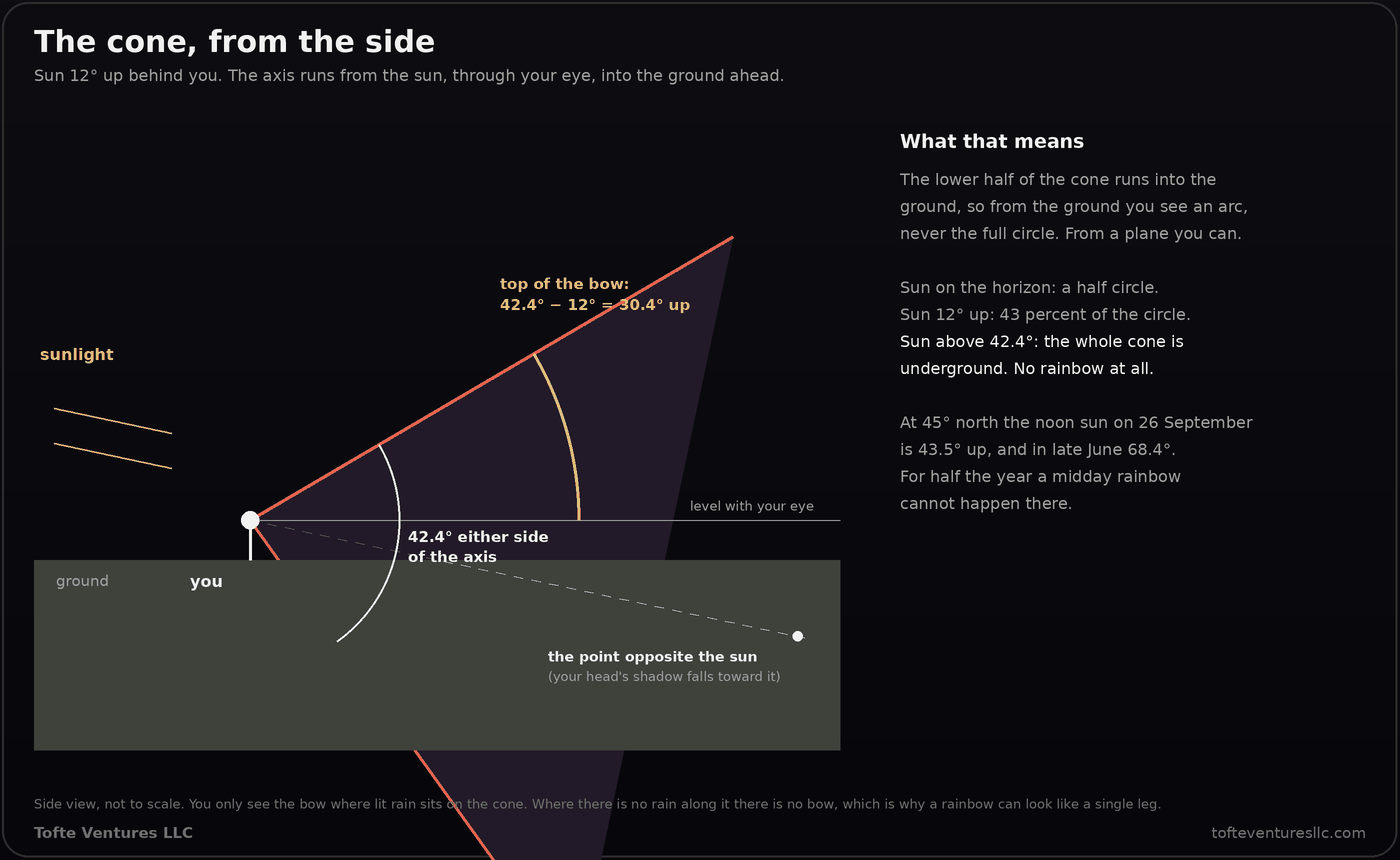
The axis points into the ground, so the lower half of the cone is underground and you see an arc. With the sun right on the horizon the arc is a half circle. As the sun climbs, the arc sinks: the top of the bow sits at 42.4 degrees minus the sun's height. From an aircraft, with nothing underneath, you can see the whole circle.
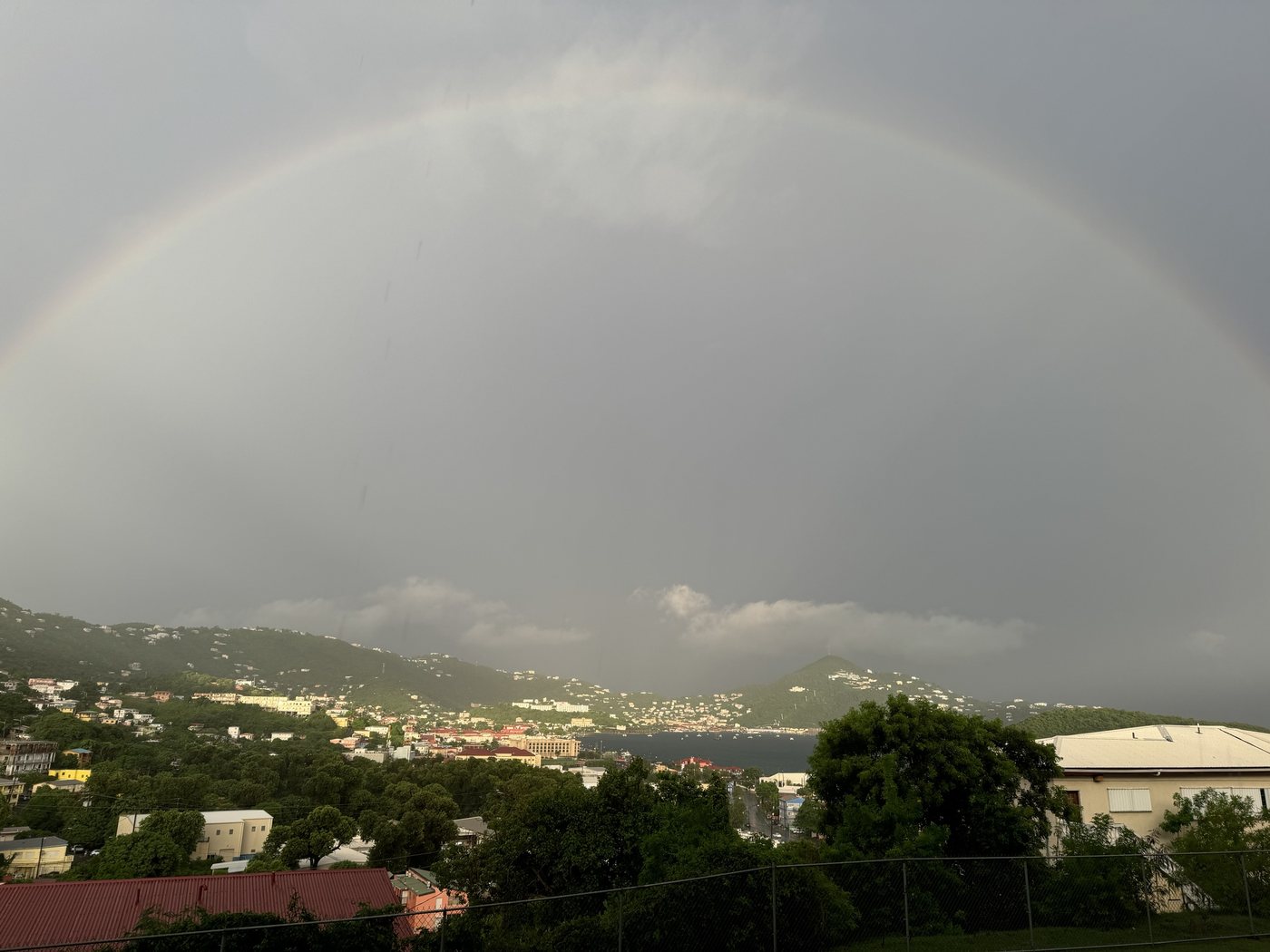 St Thomas, with the sun low behind me: the arch fills the sky and comes close to a full half circle.
You can see where the axis points, too. Your shadow falls along it, away from the sun, toward the point opposite the sun below the horizon. That point is the centre of the circle.
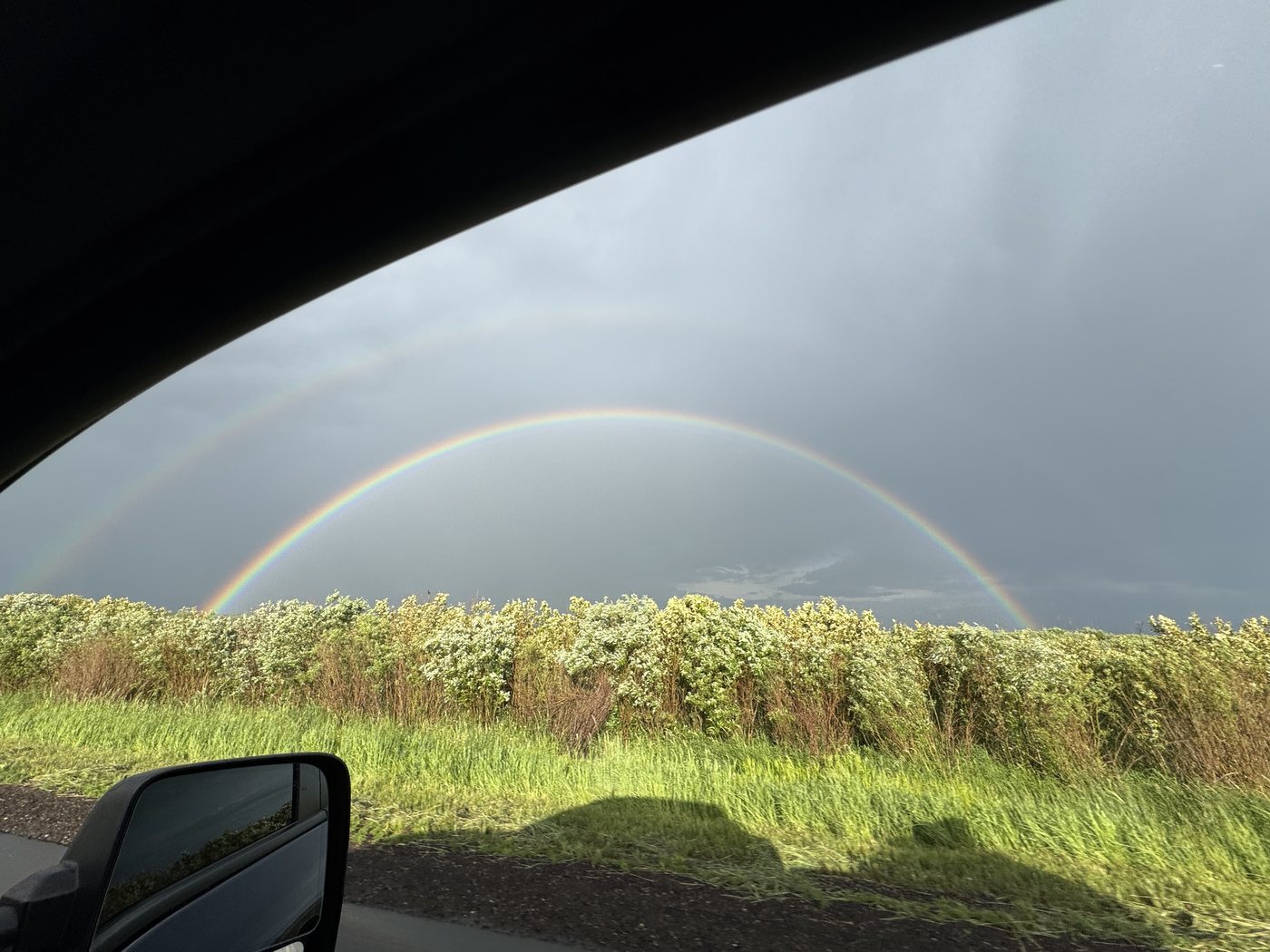 The car's shadow on the grass sits under the middle of the arch. The camera is inside that shadow, so the centre of the bow is straight down the line of it.
Once the sun is higher than 42.4 degrees, the whole cone is below the horizon and there is no rainbow anywhere, however hard it is raining. At 45 degrees north the noon sun on 26 September is 43.5 degrees up, a degree too high. In late June it is 68.4. For half the year, around the middle of the day, a rainbow cannot happen there. They are a morning and evening thing, which is why this one came with a sunrise in the mirror.
And the arc is only where there is lit rain along the cone. Where the shower ends, the bow ends. Both of mine looked like a single leg coming down out of the cloud because only part of the cone had lit rain on it.
Nobody sees the same one
The drops lighting up your rainbow are the ones at 42.4 degrees from your eye. The person in the next lane has their own cone, a few feet over, made of different drops. You are not looking at the same rainbow and you never were.
So the old joke is right: the treasure at the end of the rainbow was with you all along. The end of the rainbow is your eye.
What is and is not modelled
Everything here comes from Snell's law, the law of reflection and the Fresnel equations, for a perfectly round drop. The two refractive indices of water, 1.3311 for red and 1.3428 for violet, are from standard tables and are the only transcribed numbers in the optics. The sun's height comes from the Astronomical Almanac's low-precision formula, checked against solving Kepler's equation directly.
Real drops are not quite round. Big ones flatten as they fall, which weakens the top of the arch. Small ones add faint extra bands just inside the violet edge, which only wave optics explains and this ray tracing does not. Each angle in the figures was computed two ways, as a formula and as a ray traced through the drop, and they agree to within 0.000001 of a degree.
For light bent into a ring on a much bigger scale, see the Sun as a telescope: same idea, a ring that only exists for an observer standing on the axis.