Blackjack is one of the few casino games where the arithmetic can be done exactly. Our own engine, powered by rainshower, plays it on an infinite deck, every card 1 in 13 so that each draw is independent, by exact arithmetic. Every answer below is also held to rounds dealt card by card, and the best-move edge to a counting trainer written separately. The rules are a common table's: the dealer stands on soft 17, a blackjack pays 3 to 2, you may double on any two cards and after a split, you may split once and surrender late, and the dealer checks for a blackjack.
The same game, mirrored
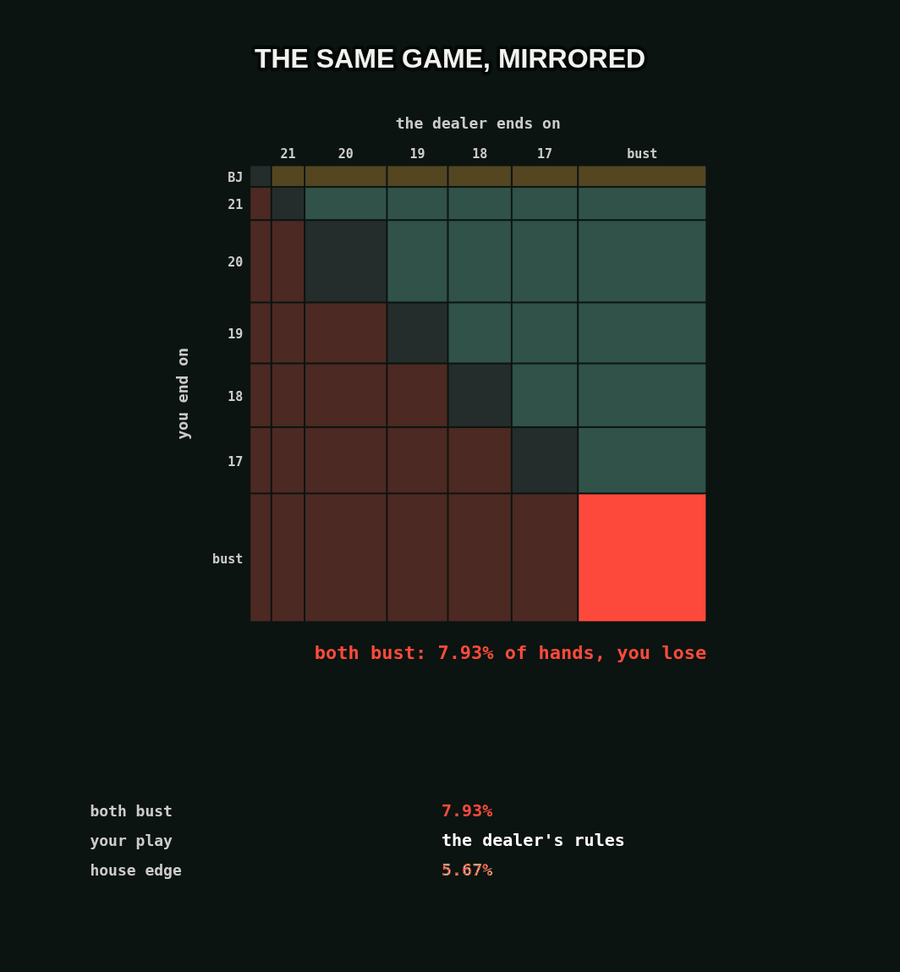
Play your hand exactly as the dealer must, hitting to 16 and standing on 17, and the two of you draw from the same deck by the same rule. The game is then a mirror image of itself except where the rules differ, and they differ twice.
You act first, so when you both bust you have already lost. That happens on 7.93% of hands: the dealer busts 28.16% of the time, and both busting is that figure squared. In return, your blackjack pays 3 to 2, which gives 2.25% back. Played the dealer's way, you lose 5.67% of every bet. That loss is exactly "both bust, less half a blackjack": the identity and the game counted outcome by outcome agree to 1.4e-17. And 2,000,000 rounds dealt card by card land 0.25 standard errors from it.
What good play wins back
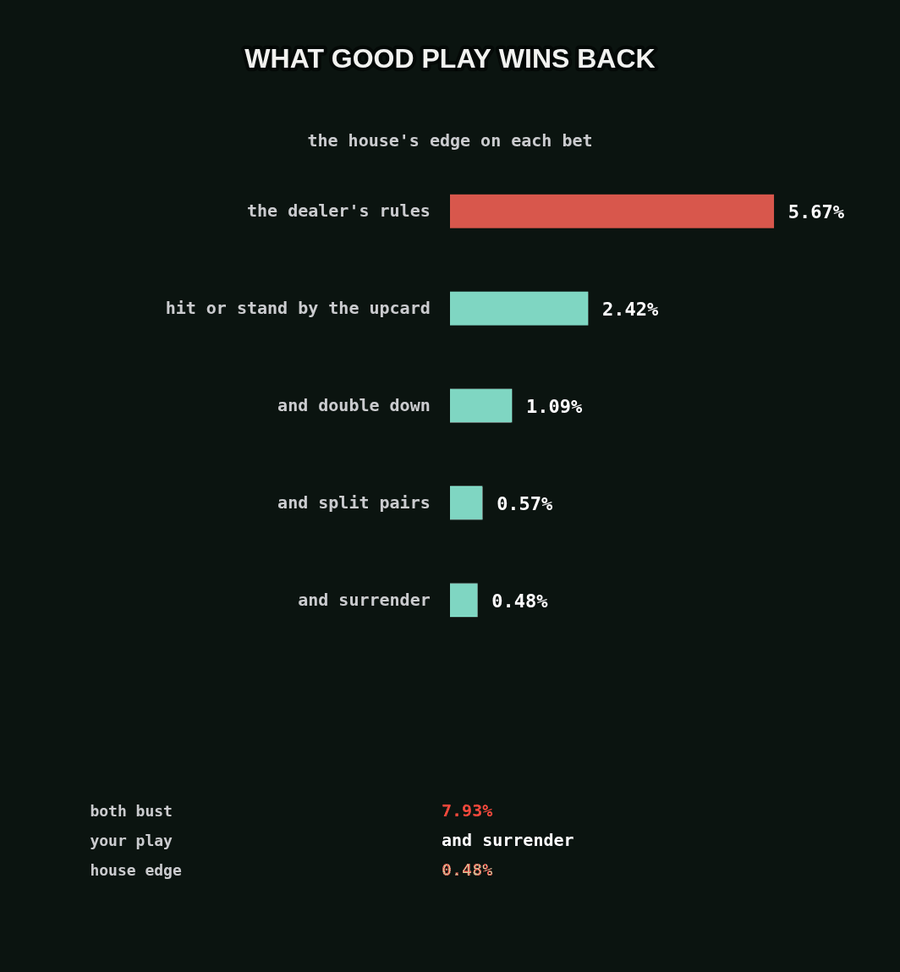
Playing well wins most of it back:
- hitting or standing by the dealer's upcard takes the loss to 2.42%;
- adding doubling down takes it to 1.09%;
- adding splitting pairs takes it to 0.57%;
- adding late surrender takes it to 0.48%.
The best move every time loses 0.4849% of each bet, and the separately written trainer gets the same four places. A table that pays 6 to 5 for a blackjack instead of 3 to 2 costs 1.3529% more. That is three tenths of a bet on every blackjack the dealer does not match, and it takes the edge to 1.84%.
You lose more rounds than you win
Played perfectly, you win 42.35% of rounds, lose 49.08% and push 8.57%, yet you lose only 0.48% of what you bet. The ledger closes exactly. Wins minus losses at one bet each come to -6.73 points. A blackjack's extra half bet gives back 2.25, surrender's half bet back gives 2.23, and doubled and split bets give 1.76.
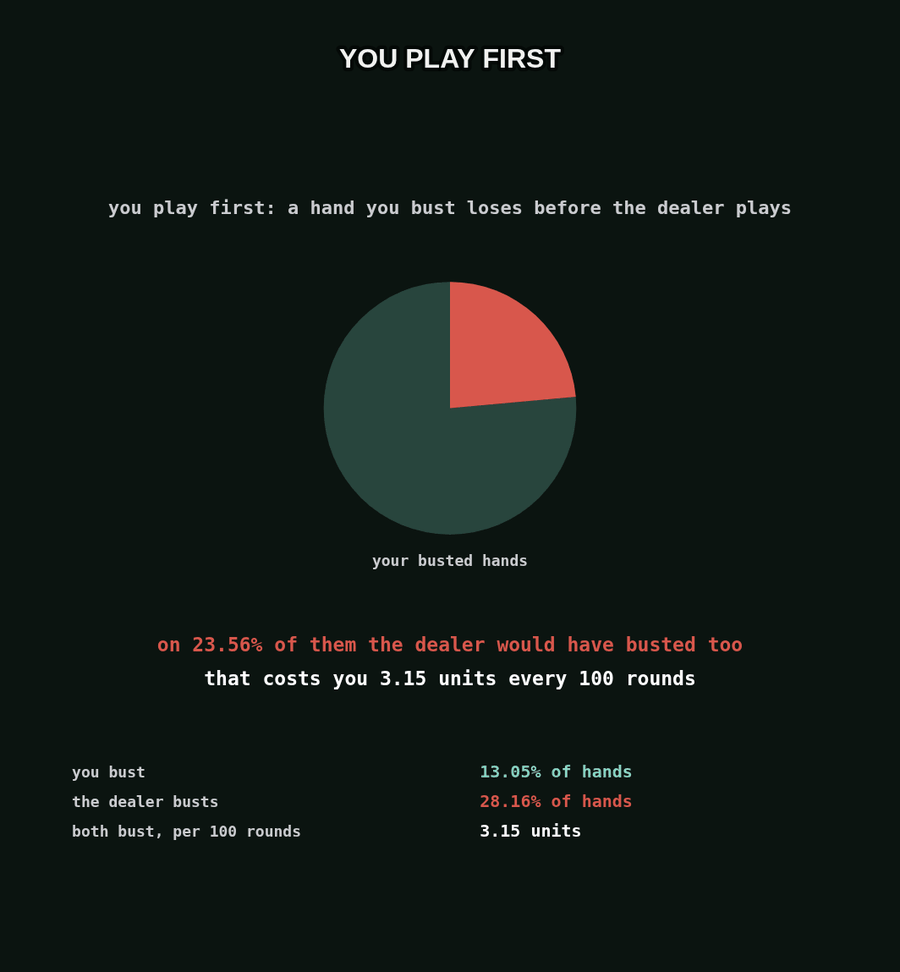
You also bust far less often than the dealer: 13.05% of your hands against the dealer's 28.16%, because you may stand on a weak total and the dealer may not. But a hand you bust loses before the dealer plays. On 23.56% of your busted hands the dealer would have busted too, which costs 3.15 units every 100 rounds. If those were pushes, the same moves would win 2.67%.
What a count is worth
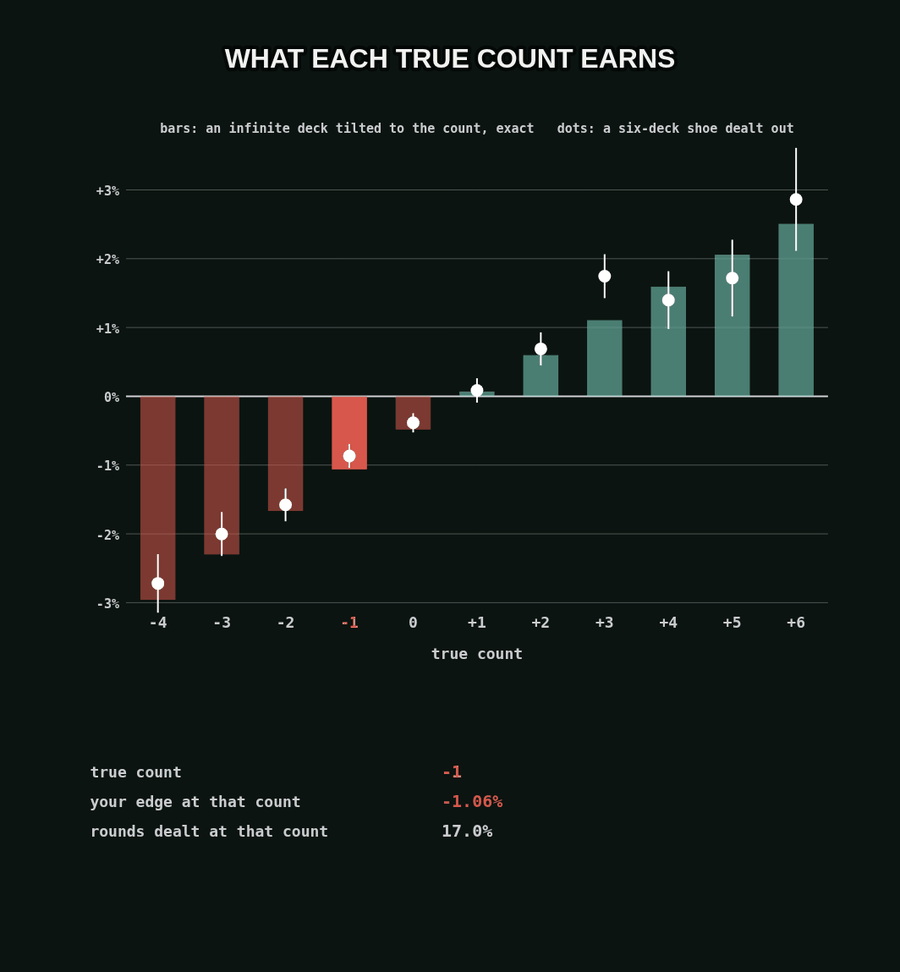
The cards that have gone change what is left. The usual count, Hi-Lo, adds one for each 2 to 6 dealt and takes one away for each ten or ace; the true count is that running total divided by the decks still to come. On a deck tilted to each true count, basic strategy returns:
- -2.96% at -4;
- -1.06% at -1;
- -0.48% at 0;
- +0.07% at +1;
- +1.59% at +4.
That is about half a percent a point. Dealt off a real six-deck shoe cut 75% of the way in, 600,000 rounds put the slope at 0.549% a point, against the tilted deck's 0.569%. And in 10,000,000 rounds from that shoe, 35.9% are dealt at a true count of +1 or more.
What counting earns
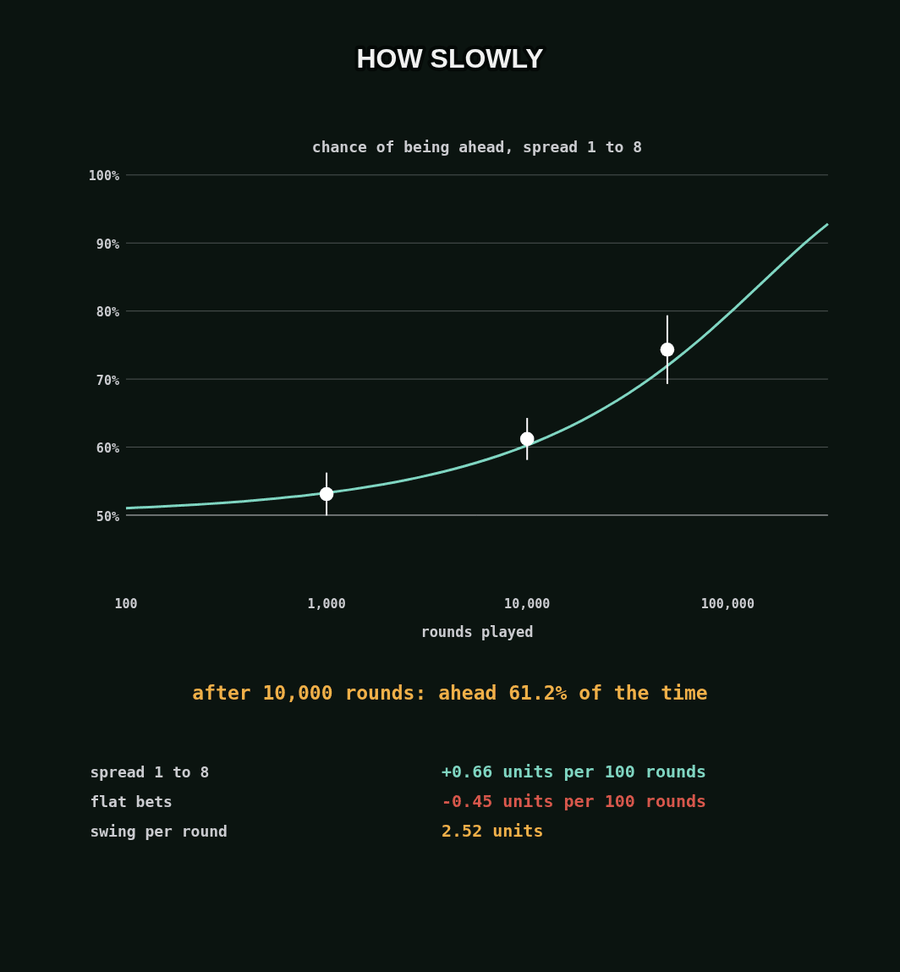
So bet more when the count is good. Bet one unit at +1 or below, then 2, 4, 6 and 8 units at +2, +3, +4 and +5 or more. Over 10,000,000 rounds that spread wins 0.66 units every 100 rounds, against a loss of 0.45 betting one unit flat. But a round swings 2.52 units either way, so it takes 147,910 rounds for the expected win to reach one standard deviation. After 10,000 rounds a counter on that spread is ahead 61.2% of the time; the normal curve says 60.3%.
Insurance
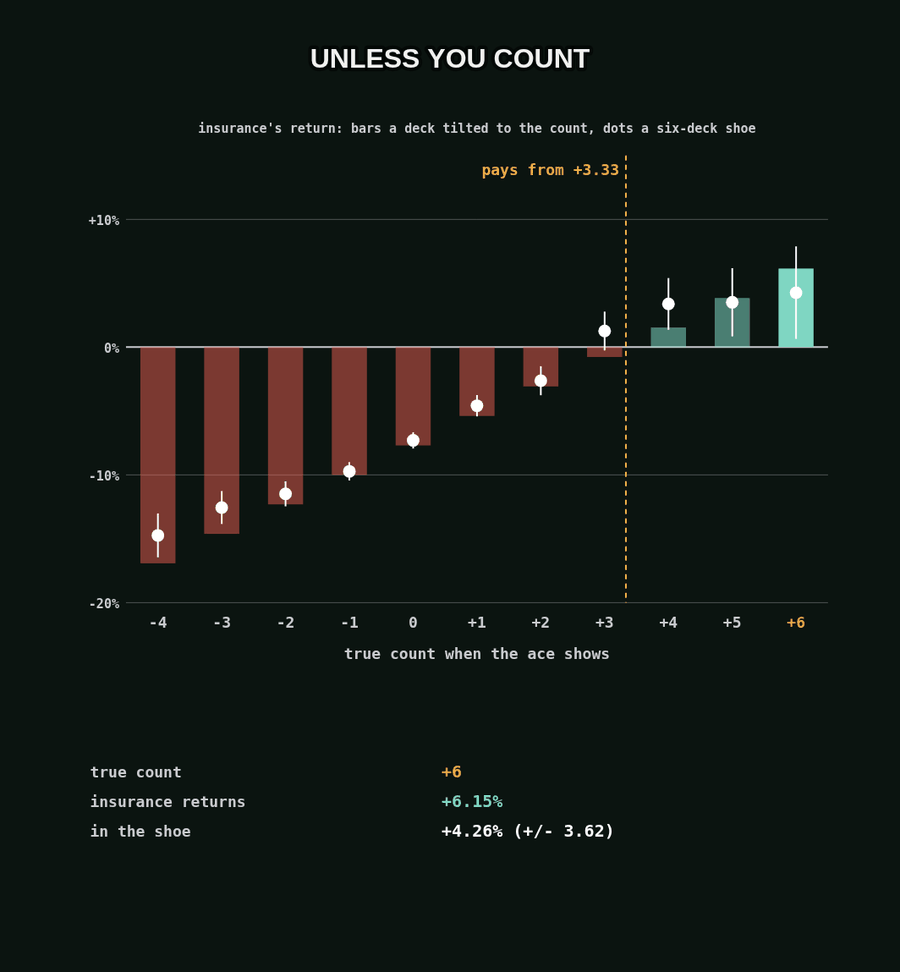
When the dealer shows an ace you can insure: half your bet, paid 2 to 1 if the card face down is a ten. Off a full deck a ten comes 30.77% of the time, 4 in 13, so insurance returns 3 × 4/13 - 1 = -1/13, a loss of 7.69%. On a deck tilted to the count it breaks even at +3.33. Taking even money on your own blackjack is the same bet taken whole: one bet for certain, against 1.0385 bets on average if you decline.
Are you due after a losing streak?
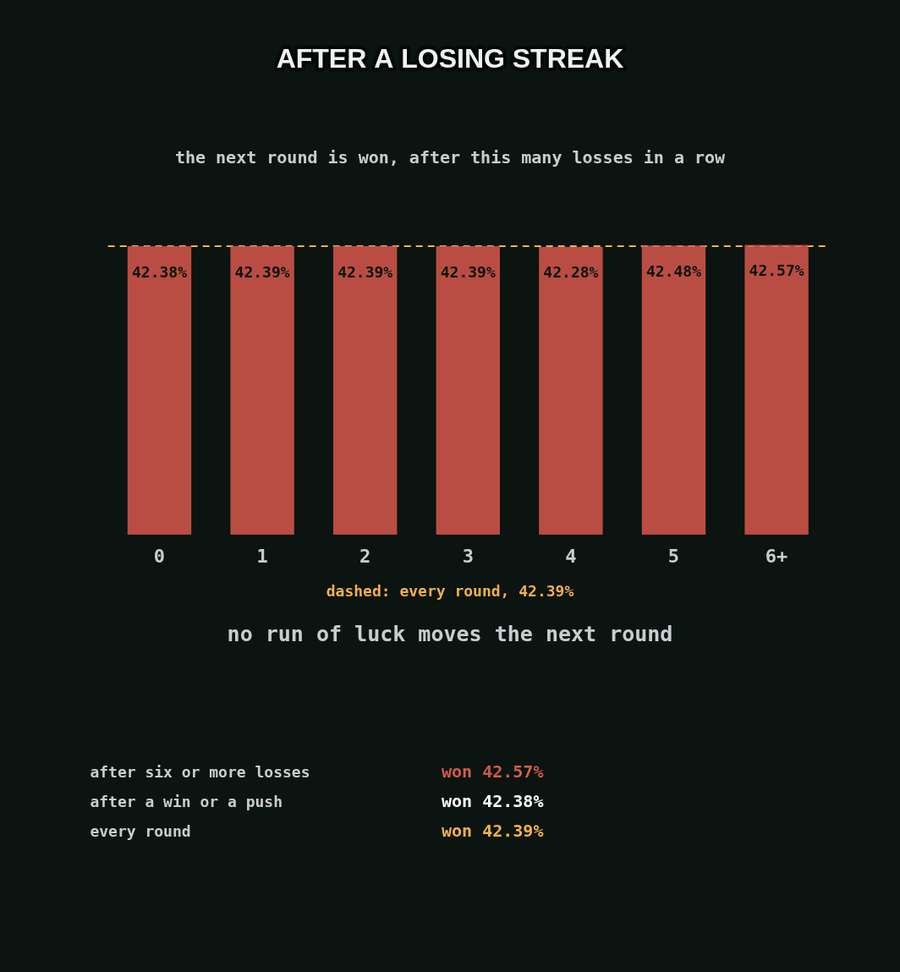
No. In 10,000,000 rounds from a six-deck shoe, the next round is won 42.38% of the time after a win or a push, 42.57% after six or more losses and 42.16% after six or more wins. Over all rounds it is 42.39%, and every bucket is within 1.62 standard errors of that.
The costliest mistakes
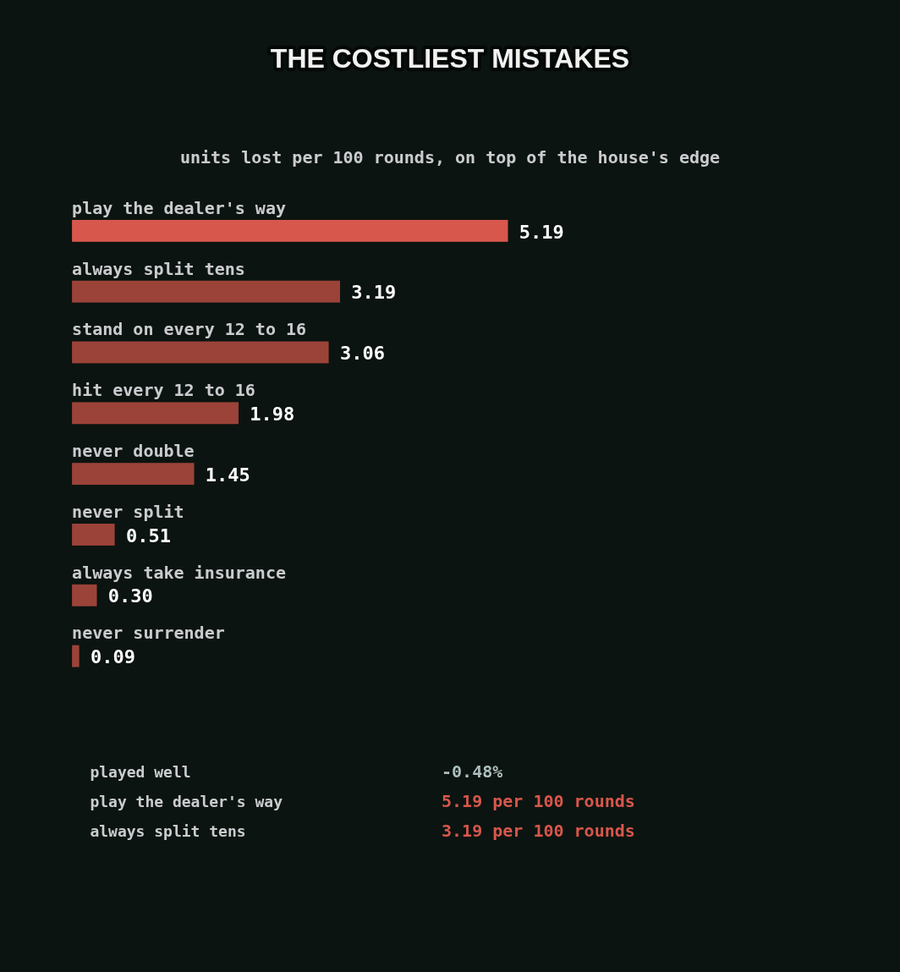
Here is what each common mistake costs in units every 100 rounds, on top of the house's 0.48:
- playing the dealer's way, 5.19;
- always splitting tens, 3.19;
- standing on every 12 to 16, 3.06;
- hitting every 12 to 16, 1.98;
- never doubling, 1.45;
- never splitting, 0.51;
- always taking insurance, 0.30;
- never surrendering, 0.09.
Dealing rounds with the two biggest single mistakes forced lands within 0.08 standard errors of those costs. Standing on a pair of tens beats splitting them against every upcard.
None of this is a way to make money. Bring 100 units, bet one a round and play perfectly, and you are out of money within 10,000 rounds 52.50% of the time. The counter above earns two thirds of a unit every hundred rounds and swings two and a half units a round.
What is ours
- The tables, cards and charts are drawings. Every number on them is the engine's.
- Chosen: the table's rules, the 1 to 8 spread, and the six-deck shoe cut 75% of the way in.
- The exact figures use an infinite deck. A deck tilted to a count is a model of a shoe at that count, not a shoe, and the post says which figures come from a dealt shoe.
- Left out: resplitting, other players' hands, bet limits, and anything a casino does about a counter.