Physics Experiments is a page in the Tofte Simulators arcade. It has three classic experiments, each with an answer most people get wrong the first time. Each runs on its own small engine, and each engine has tests that hold it to the physics, so every number below comes from running them.
The fastest slide
Three beads start at rest at the same point and slide, with no friction, down three wires to the same finish 2 metres lower and π metres along. One wire is straight, one is a circular arc, and one is a cycloid: the curve a point on a rolling wheel traces.
The straight wire is the shortest path. It is also the slowest.
| Wire | Time to the finish |
|---|---|
| Cycloid | 1.003 s |
| Circular arc | 1.028 s |
| Straight line | 1.189 s |
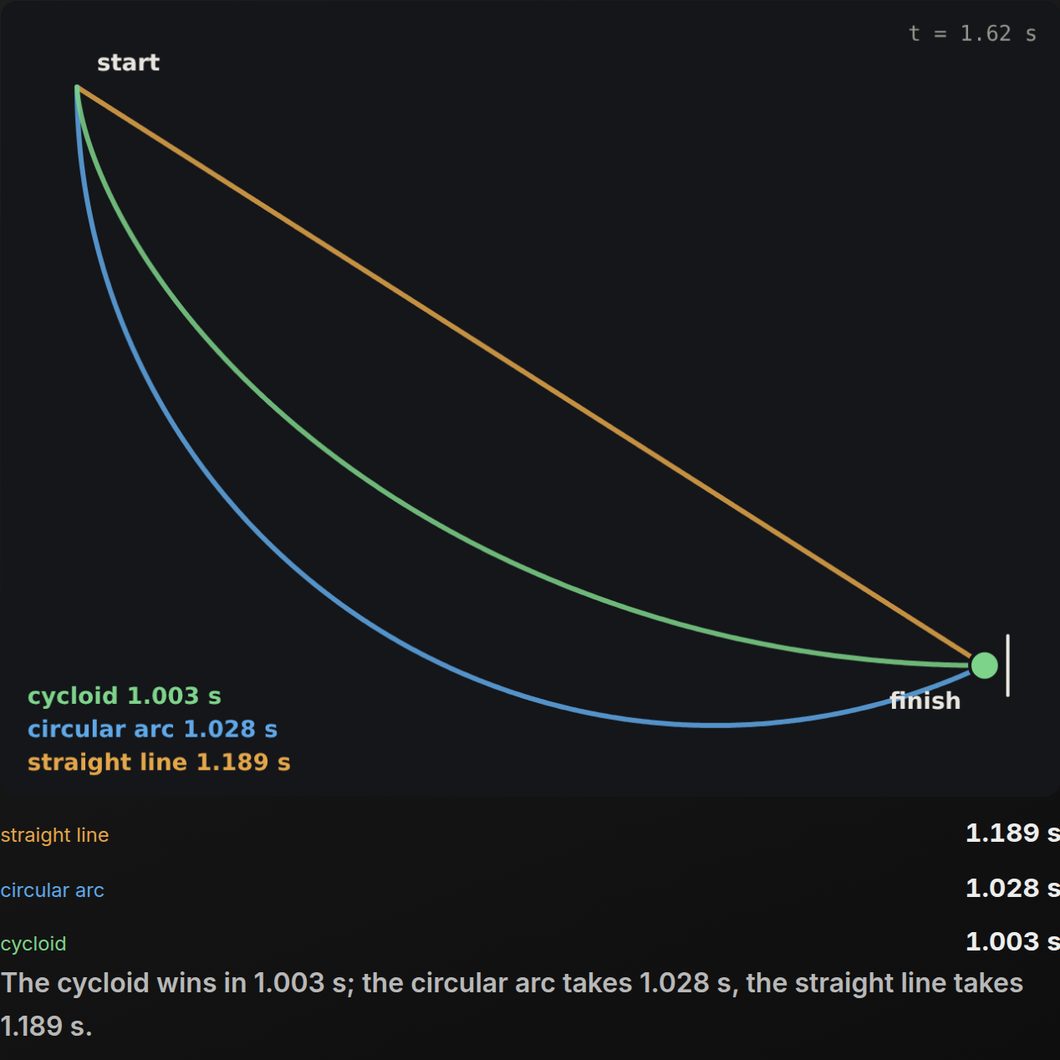
The curved wires win because they drop steeply at the start. A bead's speed at any point depends only on how far it has fallen, so a wire that falls early gets the bead moving fast early, and a fast bead covers the extra length in less time than a slow one covers the straight line.
Johann Bernoulli set this as a challenge in 1696: find the curve of fastest descent. The answer is the cycloid. Galileo had already shown, in 1638, that an arc beats the straight line, and it does, by 0.16 s here. It is just not the fastest.
The tests hold the engine to the closed forms, not just to the ranking. The straight wire's time is L / √(g h / 2), with L its length and h its drop, which is 1.189 s. The cycloid's is π√(R/g), which is 1.003 s for a wheel of radius 1 metre. The engine steps every wire the same way, a little at a time, and lands on both.
Draw your own
You can drag on the picture to draw a wire of your own, and race it. Mine dropped hard, swung low and came up to the finish. It took 1.066 s, faster than the arc and slower than the cycloid.
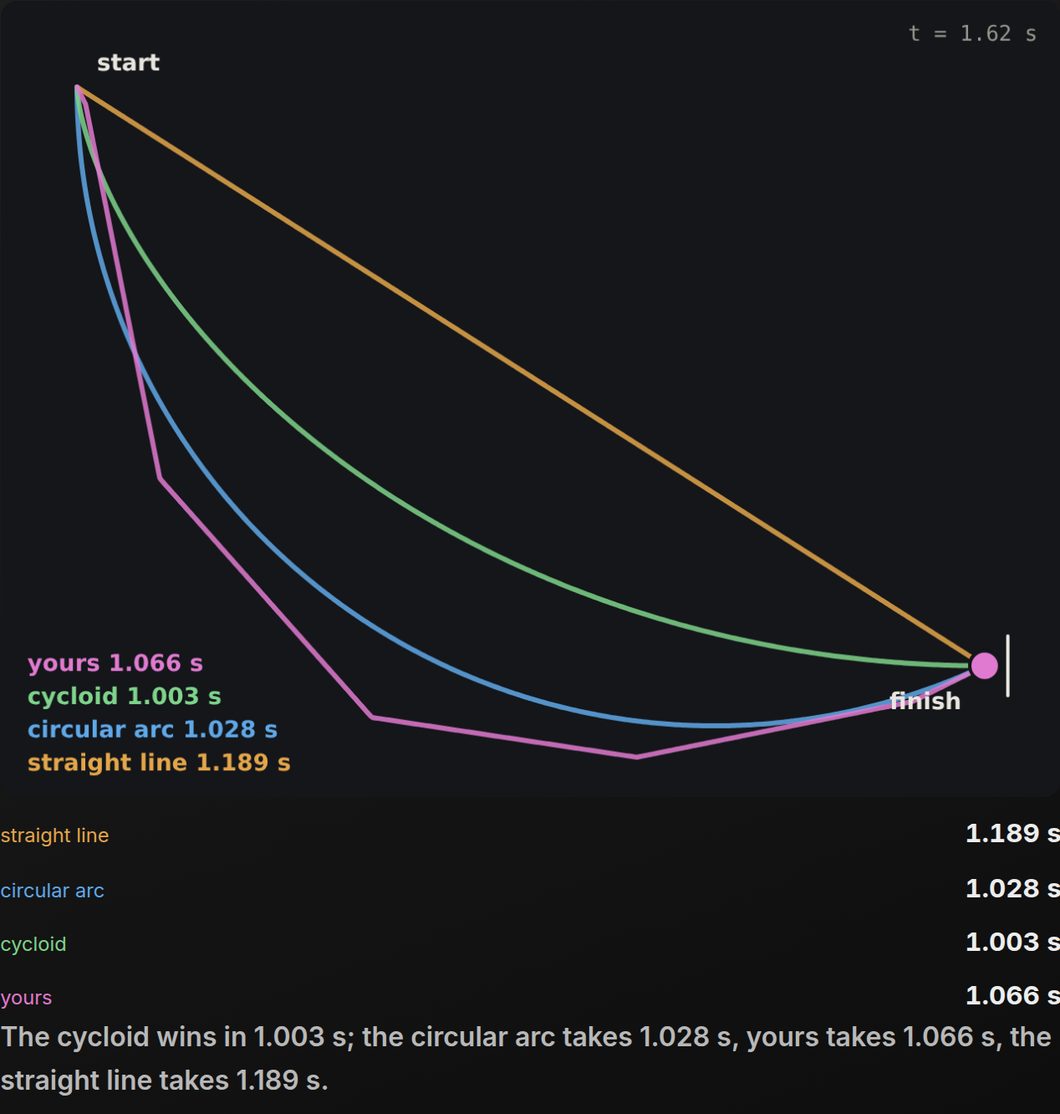
To check that no wire beats the cycloid, the tests bend it 40 different ways, small bends and large, and race each one. All 40 are slower. The closest is slower by 6 microseconds; the worst takes 1.061 s. A wire that climbs back up as high as the start never finishes at all: the bead stops there and slides back, and the page says so.
The bowl that keeps time
Take the same cycloid and turn it into a bowl. Let three beads go from 2 metres, 1.5 metres and half a metre above the bottom. The highest bead has the farthest to go, and the lowest has the least.
They all reach the bottom at the same moment: 1.003 s, every one of them.
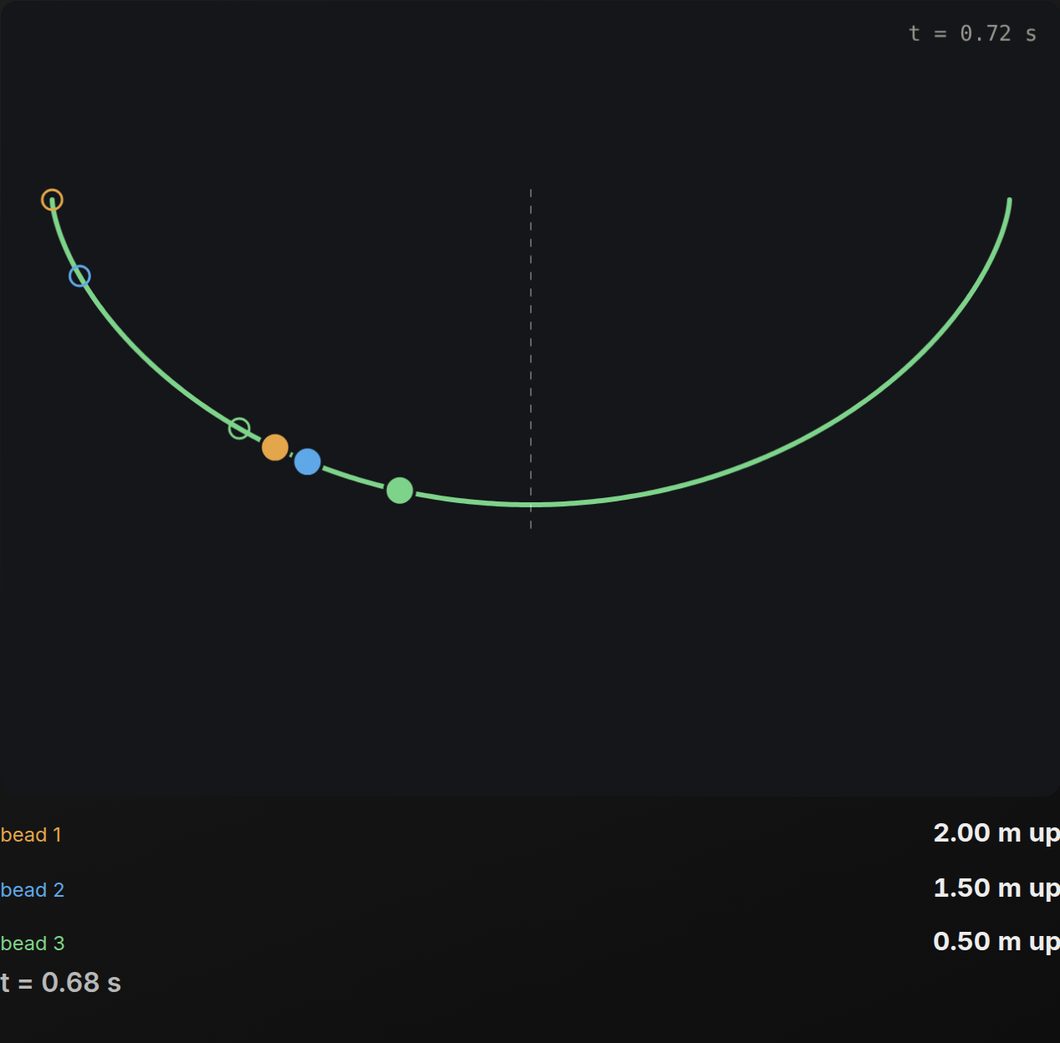
Christiaan Huygens found this in 1659. The curve is called the tautochrone, from the Greek for "same time". On a cycloid, the pull along the bowl grows in step with the distance from the bottom, so a bead swings exactly like a pendulum whose period does not depend on how far it swings. The bead that starts high starts on steeper ground and goes faster. Huygens used it to design a pendulum clock that kept time whatever the swing.
The tests check the same 1.003 s from every start, both by stepping each bead down its wire and from the closed form for the swing. You can tap the bowl to add beads anywhere, and they still arrive together.
The slinky that waits
Hang a slinky from your hand and let go of the top. The top falls. The bottom does not move. It hangs in mid-air, perfectly still, until the collapsing coils from above reach it.
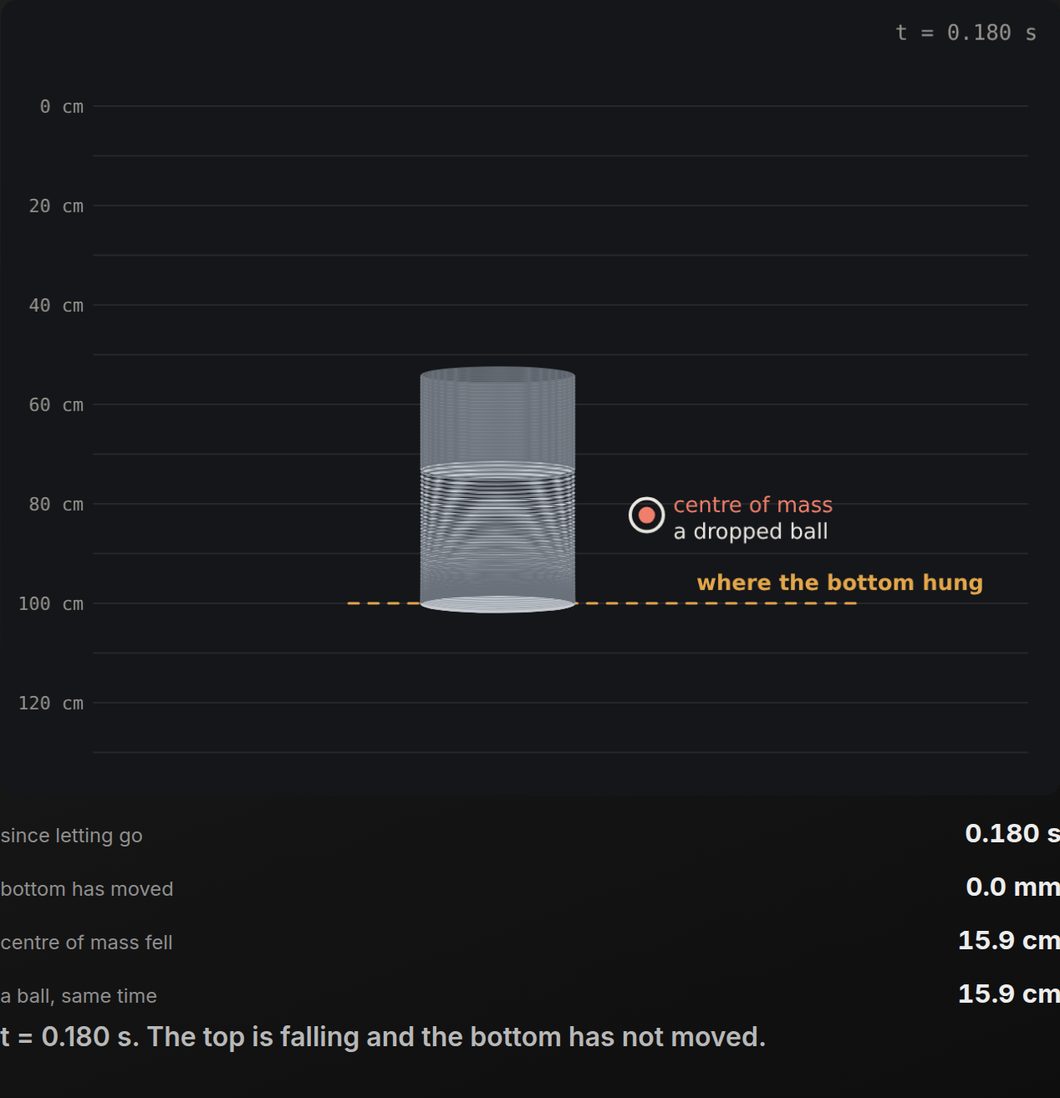
The reason is that the bottom has no way of knowing yet that anything has changed. While it hangs still, each part of the spring is stretched by exactly the weight of everything below it. Letting go of the top changes the forces at the top, and that news travels down the spring as the coils collide. Until it arrives, the forces on the bottom are the same as before, so the bottom stays put.
The engine treats the slinky as an ideal spring of 250 grams that hangs 1 metre long, made of 120 small masses joined by springs that only pull. For an ideal slinky the collapse reaches the bottom at √(M / 3k), where M is its mass and k its stiffness end to end. Here that is 0.2607 s. In the simulation the bottom first moves a tenth of a millimetre at 0.2618 s.
Meanwhile the slinky as a whole falls exactly like a dropped ball, because everything else going on is the slinky pulling on itself. Its centre of mass drops by:
| Time after letting go | Slinky's centre of mass | A dropped ball, g t² / 2 |
|---|---|---|
| 0.1 s | 4.907 cm | 4.905 cm |
| 0.2 s | 19.625 cm | 19.620 cm |
| 0.3 s | 44.152 cm | 44.145 cm |
So the top falls faster than a dropped ball, and the bottom slower (not at all, at first). The page draws a ball dropped beside the centre of mass, and the two stay together all the way down. The slinky test holds that to a tenth of a percent.
At real speed the whole thing takes a quarter of a second, which is why it looks like a trick. The page runs it 10 or 40 times slower, and at 40 times you can watch the collapse run down the coils.
What is real and what is ours
All three run on physics I can check, with tests that fail if the engine drifts from it. The sizes are ours: a wheel of radius 1 metre for the wires and the bowl, a 250 gram slinky that hangs 1 metre long. There is no friction, and the slinky is ideal: a real one's coils have thickness and it collapses into a stack rather than to nothing. The page draws the stuck coils a pixel apart so you can see them.
The straight line is the obvious answer, and it is a well formed one: it is the shortest path, and it is easy to defend. It is still the slowest of the three. That makes this an old, gentle cousin of the thing this blog keeps returning to, an answer that looks complete and happens to be wrong.