Here are seven questions about flying, each made as a 15.5-second reel and each answered by our own engine, powered by rainshower. Every answer is checked a second way. The air throughout is the US Standard Atmosphere with no wind.
Why a wing lifts
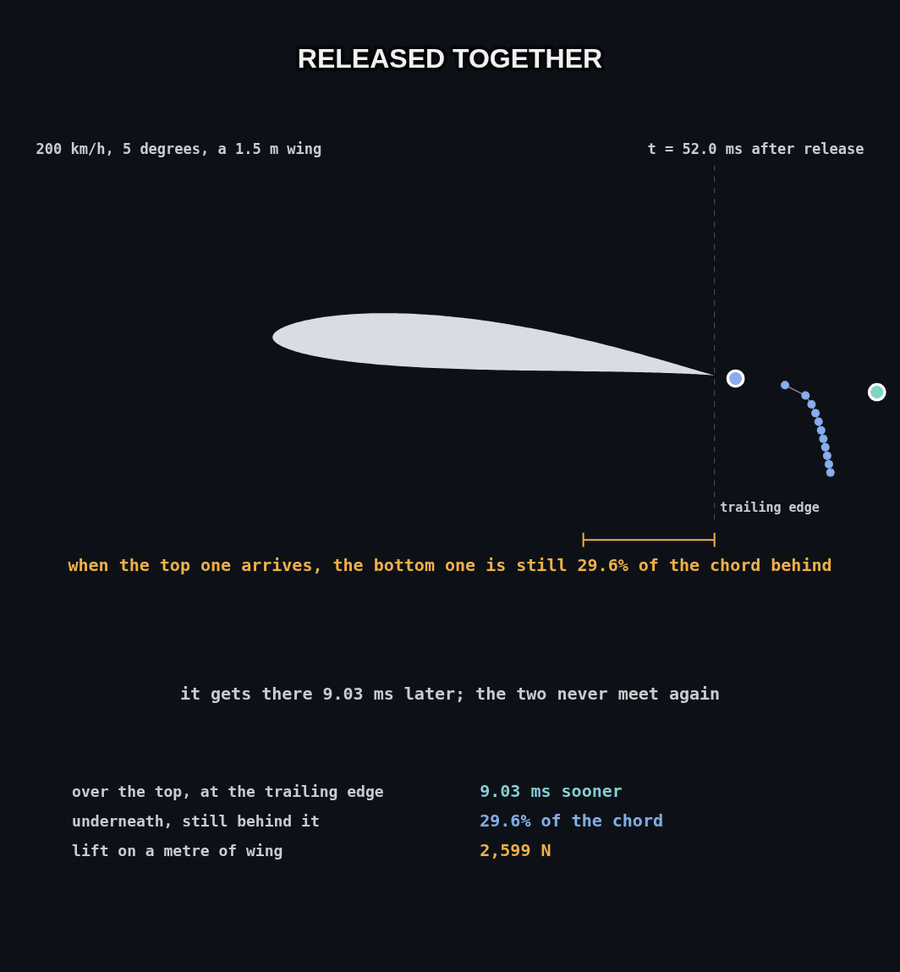
The wing is a Karman-Trefftz airfoil, 11.98% thick and 2.26% cambered, with a trailing edge 10 degrees wide. The flow round it has no viscosity and is worked out exactly by a conformal map, with the circulation that lets the air leave the sharp trailing edge smoothly. A 1.5 m wing at 200 km/h and 5 degrees in sea-level air lifts 2,599.47 N for every metre of span, a lift coefficient of 0.9167. Adding up the pressure all round the wing by Bernoulli gives the same figure within 1e-5 N, and no drag at all, as d'Alembert said it must. A panel method that is given only the wing's outline finds the circulation within 4.2e-5 at 400 panels.
A common explanation says the air over the top has further to go, so it speeds up to meet the air underneath at the trailing edge. Release two puffs together, either side of the point where the air splits at the nose. The top one passes the trailing edge 9.03 ms first, while the one underneath is still 29.56% of the chord behind, and they never meet again. Two puffs 1 cm either side of that point, followed through the panel method's flow instead, arrive 9.0731 ms apart, against 9.0743 in the exact flow.
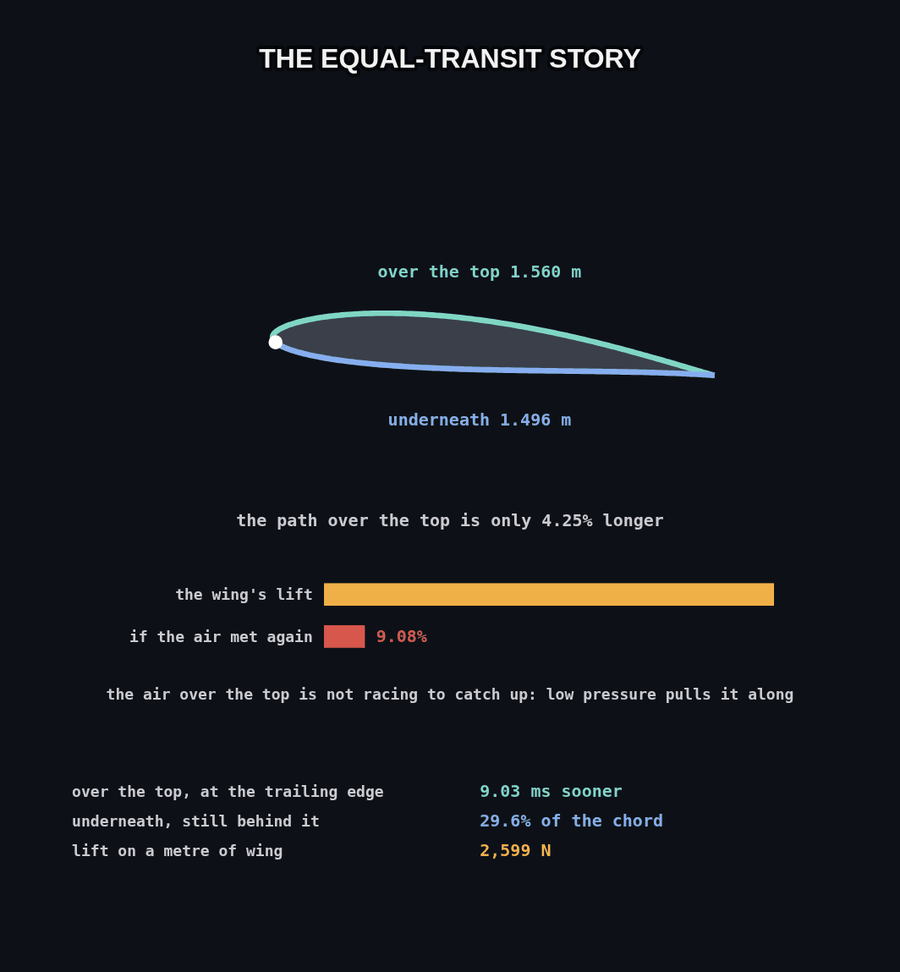
The path over the top is 1.55963 m and the path underneath 1.49607 m, only 4.25% longer. If the air did meet again, the lift coefficient would be 0.0832: 9.08% of the real lift. The story is a well formed answer that happens to be false. The low pressure over the top pulls that air along faster than any meeting would require.
A boom that never lands
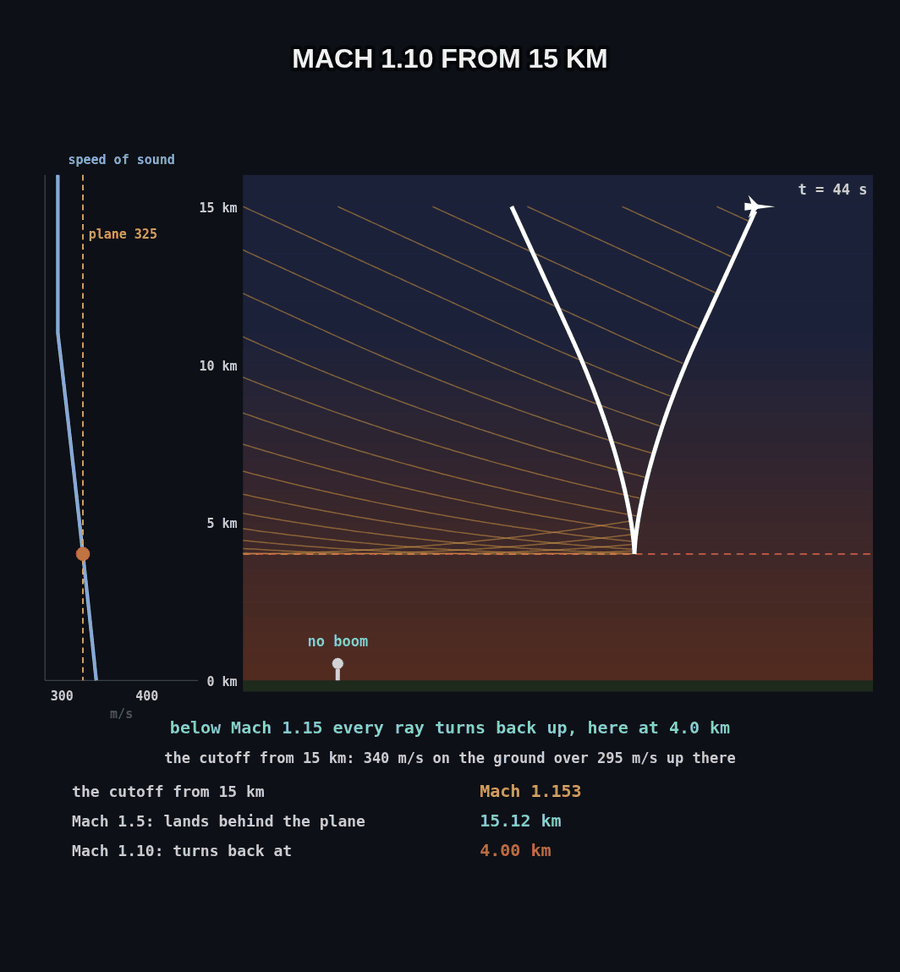
A plane faster than sound piles its sound into a cone, 41.81 degrees either side of its path at Mach 1.5 (the angle whose sine is one over the Mach number). Sound travels faster in warmer air. In the standard atmosphere it does 340.294 m/s at the ground and 295.070 m/s between 11 and 20 km. So sound heading down from a plane at 15 km bends back up before it reaches the ground, unless the plane is faster than 340.294 / 295.070 = Mach 1.1533.
At Mach 1.1 the sound turns back 4.0 km up, and at Mach 1.15 only 251 m up. At Mach 1.5 it lands 15.02 km on after 68.11 s, with the boom's front meeting the ground 15.12 km behind the plane. Those come from the ray's path in closed form, layer by layer. The second route steps each ray down a metre at a time by RK4, and it turns or lands within 4.9e-3 m of height and 1.5e-2 m along the ground of the same places.
A plane on a treadmill
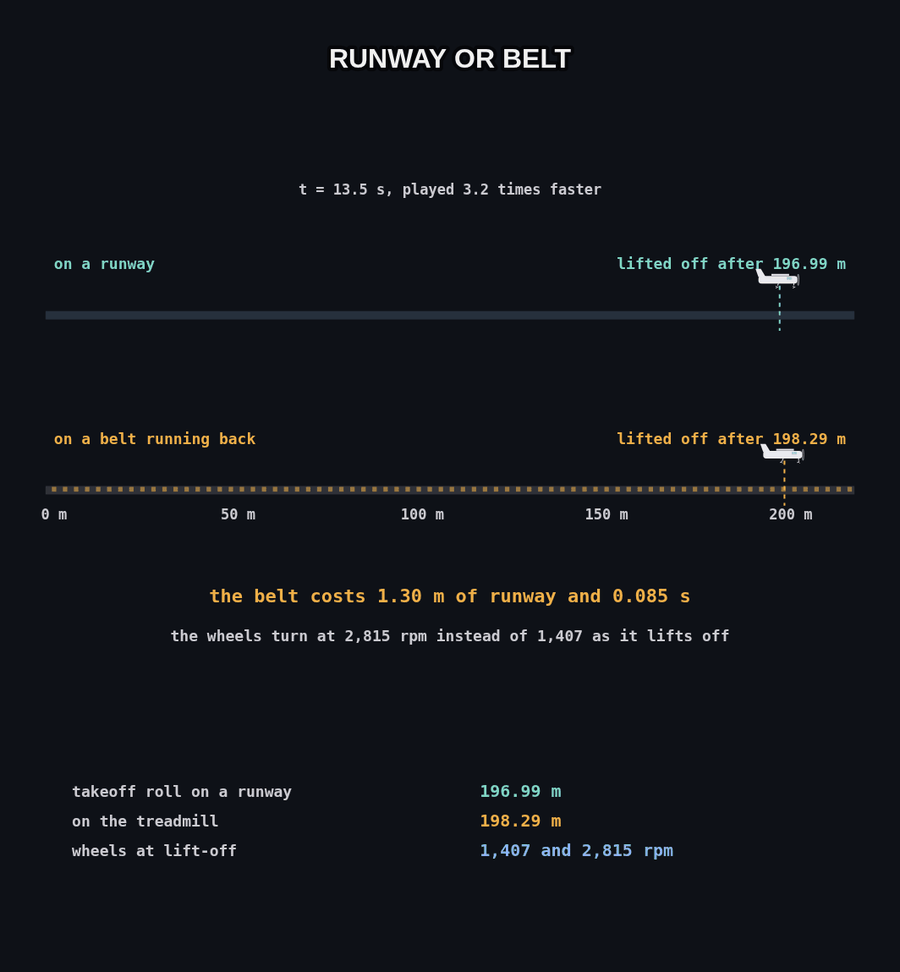
A propeller pushes on the air, not on the ground. Put a light plane on a belt that runs backward exactly as fast as the plane rolls forward, and the belt can only make the wheels spin faster. The plane here is chosen: 1,000 kg, with 3,000 N of thrust that falls off with speed, lifting off at 28 m/s. Its rolling resistance, 0.02, is typed from memory.
On a runway it lifts off after 196.99 m in 12.87 s. On the belt it lifts off after 198.29 m in 12.96 s, its wheels turning at 2,815 rpm instead of 1,407. Spinning them up takes 36.79 N at the start instead of 18.52 N, against 3,000 N of thrust. It takes off: the wheels' spin acts like 13.3 kg of extra mass on the belt against 6.6 kg on the runway, and the roll stretches by just the ratio of the two masses, 1.0066. The roll comes out of the forces by partial fractions, and stepping it in time by RK4 agrees within 3.0e-7 m and 5.1e-9 s.
How much runway a jumbo jet needs
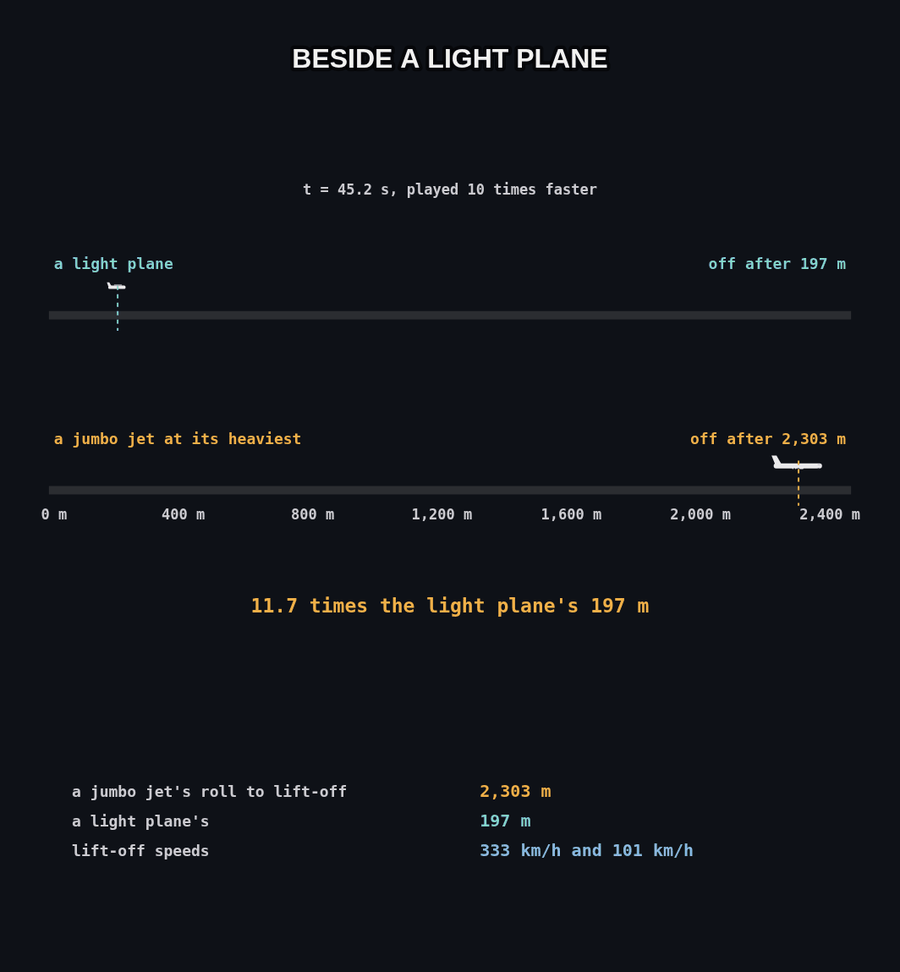
Take the same roll for a jumbo jet at its heaviest: 396,900 kg, four engines of 282 kN and 525 m² of wing, lifting off at 92.6 m/s, all typed from memory. It lifts off after 2,303.2 m in 45.17 s, 11.69 times the light plane's 197.0 m, and the roll stepped in time agrees within 3.7e-7 m. Its thrust for its weight is about the same, 0.290 against 0.306. What differs is how much each square metre of wing carries: 756.0 kg against 62.5, 12.10 times as much. So it has to reach 3.307 times the speed, and the square of that is 10.94.
A hot day, high up
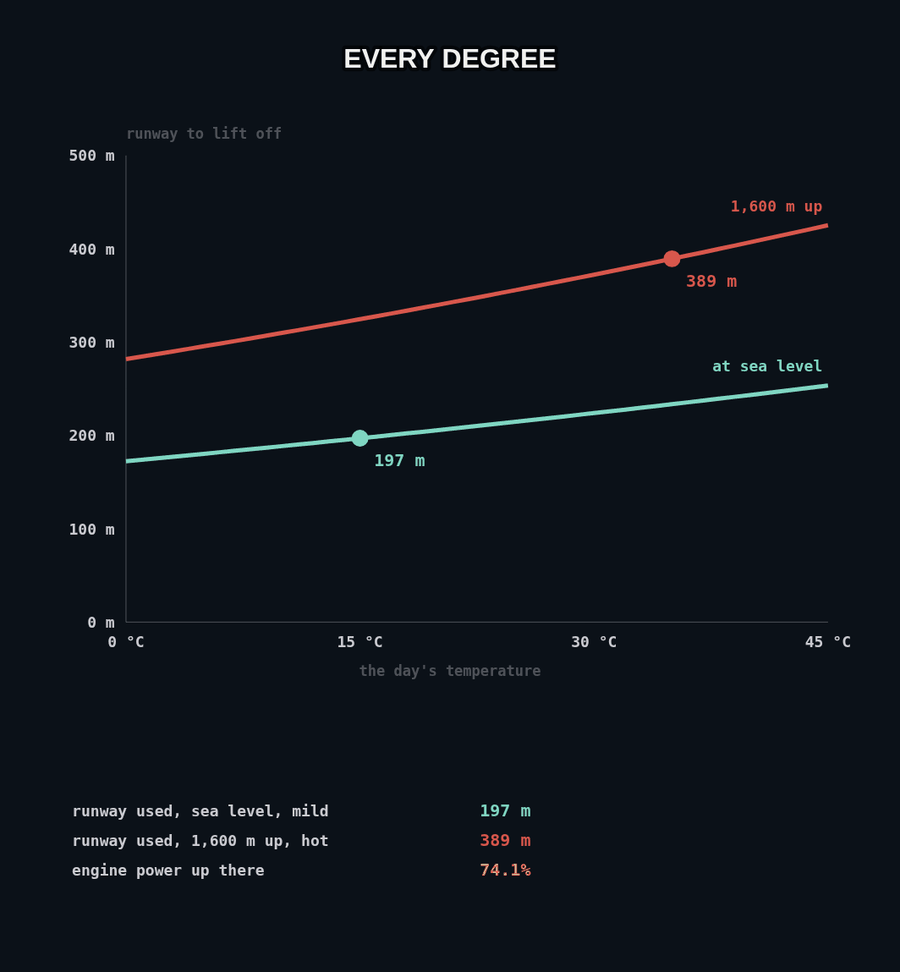
Take the light plane to a runway 1,600 m up on a 35 C day. The air there is 0.9442 kg/m³, as thin as the standard atmosphere 2,630 m up. The plane lifts off at the same airspeed on its dial, so it has to reach 31.89 m/s through the air instead of 28.00. Its engine gives only 74.1% of its power, by the Gagg-Ferrar rule for piston engines, which is typed from memory. It needs 389.35 m of runway against 196.99 m at sea level on a 15 C day: 1.98 times as far. Each half alone, 35 C at sea level or 15 C up high, needs 233.5 m or 324.6 m. Up there, each degree from 15 to 35 C adds 3.2 m on average, and around 35 C it adds 3.5 m.
No engines
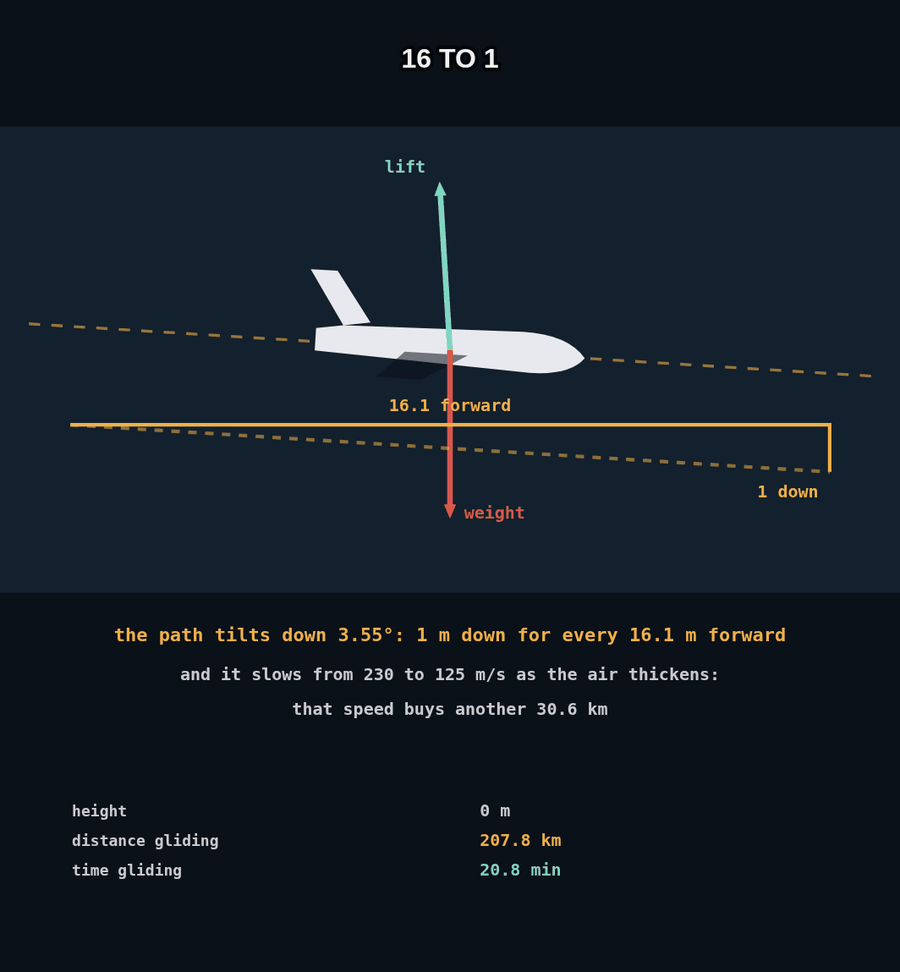
A jumbo jet at cruise weight, 300,000 kg on 525 m² of wing (from memory), with a chosen drag polar, glides best at a lift-to-drag ratio of 16.11. Its path then tilts down 3.55 degrees, 16.1 m forward for every metre down. With every engine out at 11,000 m, and held at that glide all the way down, it covers 207.84 km in closed form and 207.78 km stepped through the standard atmosphere, in 20.79 minutes. The height alone buys 177.24 km. The speed it sheds as the air thickens, from 230.2 down to 125.5 m/s, buys another 30.60. From 1,000 m it would glide only 17.4 km.
Over the top
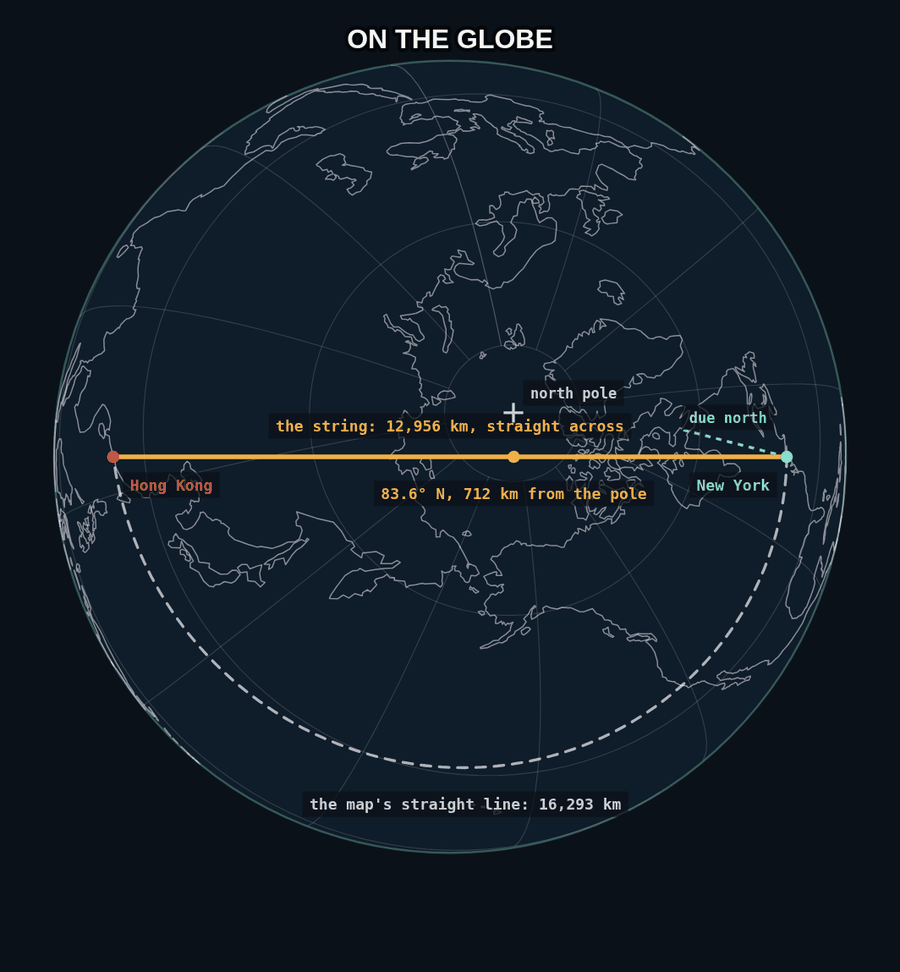
On a round Earth (radius 6,371 km, the cities' positions typed from memory), the shortest way from New York to Hong Kong is a great circle 12,955.6 km long. It sets off on a bearing of 351.5 degrees, almost due north, although Hong Kong lies 18.39 degrees further south, and it passes 83.60 degrees north, 712 km from the pole.
The straight line on a Mercator map holds one compass heading, 262.79 degrees, the whole way, and it is 16,293.1 km: 3,337.5 km, or 20.48%, longer. The map makes the short way look long because it stretches the north. A circle 1,500 km across is drawn 4.00 times as wide at 75 degrees north as at the equator, and stretched by the same amount north to south, which is what keeps every heading true.
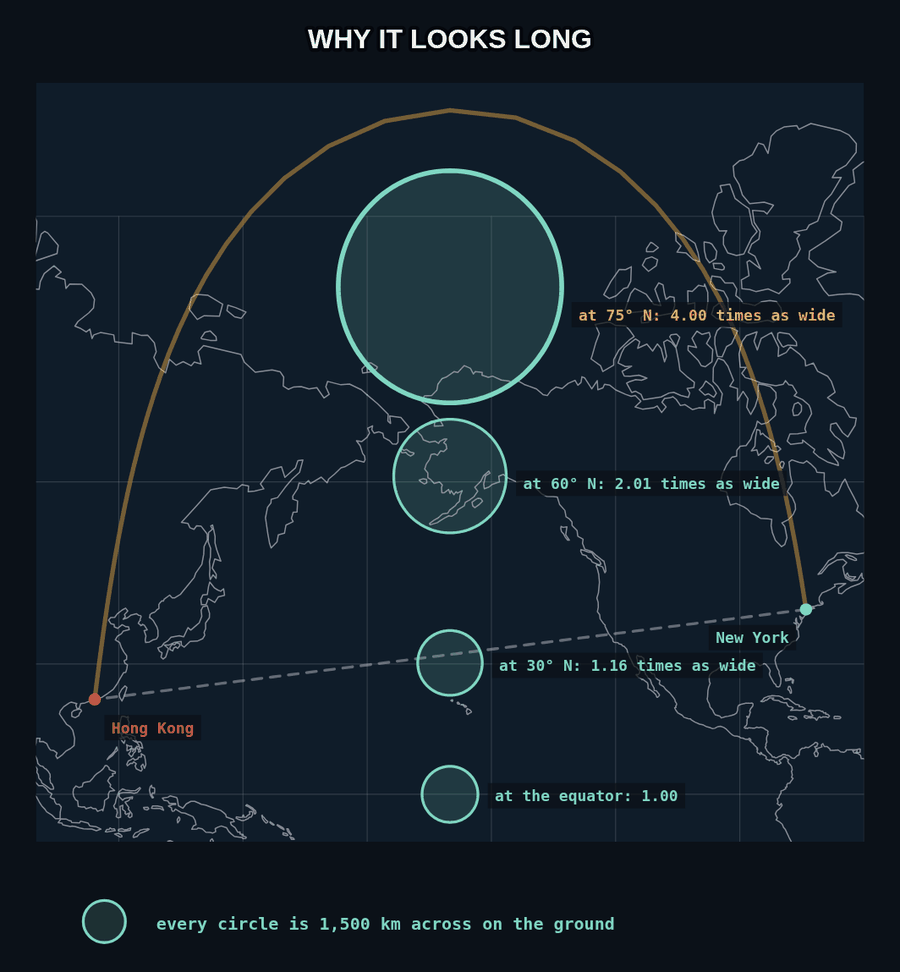
The second route lays a string of 64 segments along the map's straight line and pulls it tight, sweep after sweep. Every sweep makes it shorter, and after 20,000 sweeps it measures the great circle's 12,955.574 km within 9.3e-9 m. Setting off from New York on 351.542 degrees and holding straight ahead, stepped by RK4, ends 2.0e-7 m from Hong Kong.
What is ours
- The planes, the sky, the runways, the globe and the map are drawings. Every number on them is a readout from the engine.
- From memory and not checked: the jumbo jet's masses, thrust and wing area; the light plane's rolling resistance; the Gagg-Ferrar power rule; and the cities' positions.
- Chosen: the wing's shape, speed and angle; the light plane; the jet's drag polar; and the heights, temperatures and speeds.
- Left out: viscosity on the wing, so it has no drag and cannot stall; wind and weather in the boom's path; flaps and the jumbo jet's thrust changing with speed; and the Earth's flattening for the great circle.